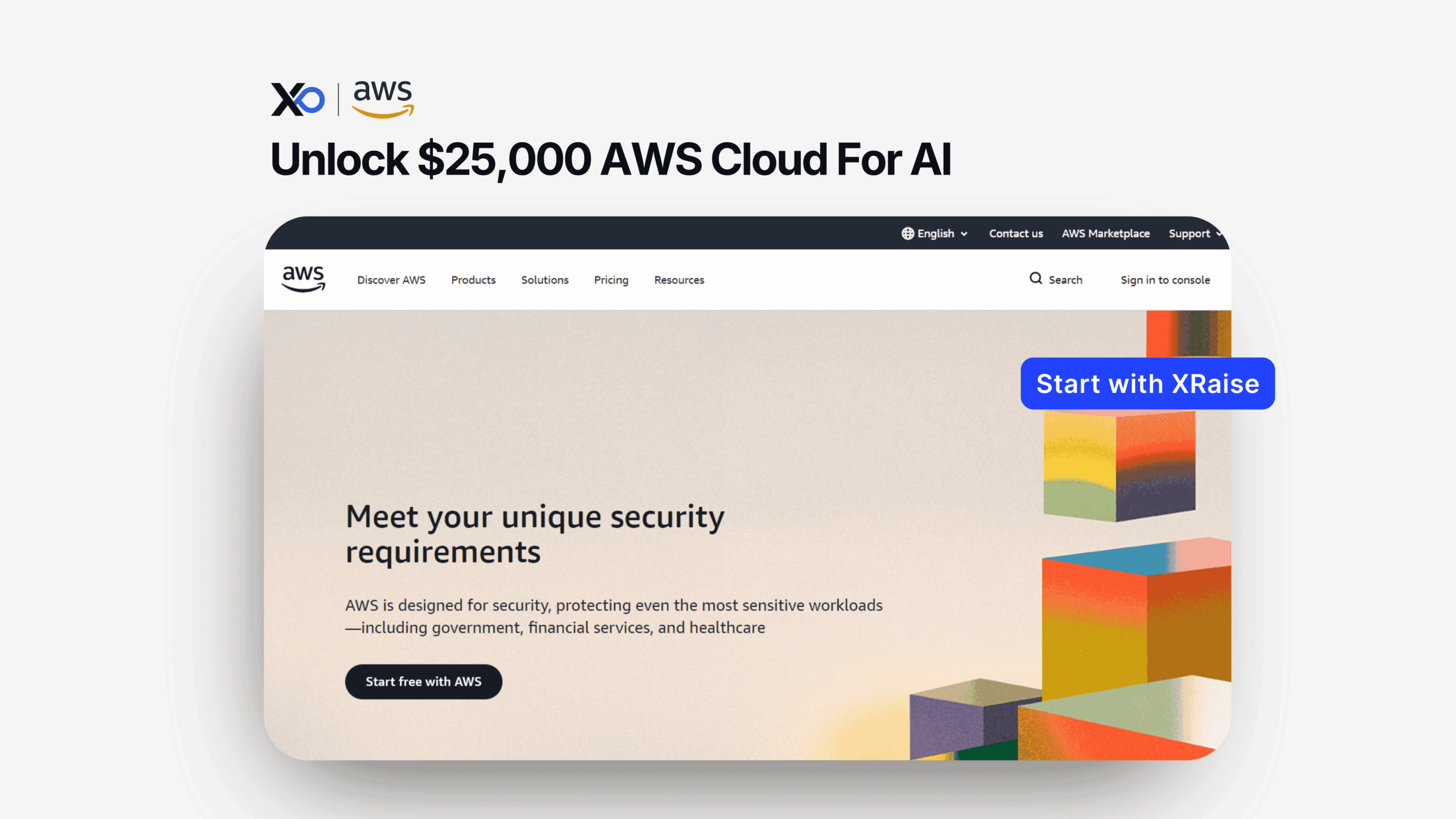
AWS Credits for Startups can cover up to $25,000 in cloud spend, helping early-stage teams build, train, and deploy AI workloads on AWS without burning runway. Through XRaise, eligible founders can apply for credits that support GPU compute, storage, networking, and core AWS services, so you can ship faster while keeping infrastructure costs under control.
That’s why AWS Credits for Startups (up to $25,000) is such a practical perk. It gives eligible early-stage teams a way to build, train, and deploy AI systems while reducing operational costs during product development, exactly when runway matters most.
If you want the simplest path to claim the perk, the goal isn’t to hunt for scattered pages or outdated eligibility threads. The fastest route is to apply through XRaise:



Claim your AWS Credits for Startups on XRaise.
If you’re comparing multiple AWS pathways or trying to understand how AWS credits work across programs, this related guide is also worth reading: AWS Activate Credits for Startups.
What AWS Credits for Startups helps you build on AWS
AWS is a scalable cloud platform that supports the building blocks most startups rely on:
- Compute (including GPU instances for training and inference)
- Storage and databases for AI datasets and product telemetry
- Networking and global deployment for customer-facing applications
- AI and ML tooling that supports experimentation, training pipelines, and production systems
For AI teams, the real value is flexibility. You can prototype quickly, then scale the same infrastructure into production once you find traction, without buying hardware up front.
This is also why cloud credits matter: they lower the cost barrier for heavy experimentation and shorten the “time-to-real-system” for early teams.
What AWS startup credits unlock on XRaise
Through XRaise, eligible startups can access:
- Up to $25,000 in AWS credits
- Credits usable for compute, GPUs, inference, and core AWS services
- Support for model training and large-scale experimentation
- Ability to deploy and manage ML pipelines on AWS
- Cloud tools for storage, databases, networking, and deployment
- A way to run compute-heavy workloads without upfront hardware costs
In plain terms: this perk helps you push more experiments into production, and do it with lower cash burn.
How to claim AWS Credits for Startups on XRaise
A clean application is usually more important than a long one. Here’s a founder-friendly approach:
1) Apply through the XRaise listing
Start with the official XRaise apply link:
Claim your AWS Credits for Startups on XRaise.
2) Describe the workload, not the hype
Since this perk is aimed at AI development and compute-heavy use cases, your application should clearly answer:
- What are you building? (AI-powered SaaS, inference API, internal ML system, etc.)
- What workloads will you run? (training, fine-tuning, batch processing, inference endpoints)
- Why do you need AWS? (scale, GPUs, data pipelines, global deployment)
- What stage are you in? (prototype, MVP, first customers, scaling)
3) Plan your first 30–90 days of usage
Credits are most valuable when you attach them to a milestone:
- Train and evaluate a first “real” model iteration
- Deploy a production inference endpoint
- Build out data pipelines and MLOps workflows
- Launch to customers with reliability and uptime
If you’re not sure which cloud credits path fits your stage best, use this guide as a decision framework: Which cloud credit program is right for your startup.
How Much Is the AWS cloud credits Worth in Practice?
The headline is clear: up to $25,000 in AWS credits.

Startup Perks AI Assistant
Have questions about credits? Let's chat instantly.
But the more useful question for founders is: “What can $25,000 actually fund for our workload?”
Because credit value depends on architecture and usage, you’ll get the most practical ROI by mapping credits to these spend buckets:
GPU compute (training + inference)
This is where AI teams feel the burn first. The perk explicitly supports GPU-heavy workloads, and your credits can be applied to AWS GPU compute instances for training and inference.
Data + pipelines
Most AI products aren’t just models, they’re data systems. Credits can help cover:
- Storage for training data and artifacts
- Batch processing workflows
- Pipeline orchestration components
- Supporting databases and queues
Production deployment
Once you go live, “compute” becomes “reliability.” Credits can offset early production costs while you:
- Validate usage patterns
- Improve latency and uptime
- Iterate on MLOps and monitoring
If you want a deeper primer on how startups typically approach AWS at early stage (and what teams underestimate), this guide is helpful: AWS for startups: what you need to know.

Eligibility + Tips to Maximize the Perk
From the perk details provided, early-stage startups working on AI or compute-intensive applications are strong candidates.
To maximize your odds and your eventual ROI:
Make your use case specific
Instead of “we’re building AI,” write something like:
- “We’re training and fine-tuning a model for X use case and deploying GPU-backed inference endpoints.”
Emphasize iteration speed
Credits are about runway, yes but also about velocity:
- Faster prototyping
- More experiments per month
- Less friction shipping to production
Show responsible cost management
Even a short mention of cost controls helps:
- Budget alerts
- Spend monitoring
- Staged rollouts from dev → prod
Best use cases for AWS credits for AI startups
This perk is a strong fit if your roadmap includes any of the following:
- AI model training and fine-tuning
- GPU-powered inference and generative AI workloads
- Data processing and ML pipeline orchestration
- High-performance compute applications
- Startups building AI-powered SaaS products
The common thread: you need compute and infrastructure to move quickly, and you’d rather spend cash on team + customers than on early cloud bills.
Alternatives to Consider
If AWS isn’t your only option (or you’re evaluating cloud vendors), it’s smart to compare adjacent credits programs.
Two useful starting points:
- Google Cloud promo code for startups for teams considering GCP for AI infrastructure
- Which cloud credit program is right for your startup to choose based on stage, workload, and fit
Even if you expect to land on AWS, comparing alternatives helps you pressure-test your architecture assumptions and cost model.
FAQ
Can the credits be used for GPU instances?
Yes. The credits can be applied to AWS GPU compute instances for model training and inference.
Are the credits available for most AWS services?
Yes. The credits support compute, storage, networking, and many core AWS AI and ML services.
Can early-stage startups apply?
Yes. Early-stage teams working on AI or compute-intensive applications are strong candidates for AWS credits.
Final Thoughts
In AI startups, infrastructure costs can become a hidden tax on iteration. AWS Credits for Startups (up to $25,000) reduces that tax, so you can train, deploy, and experiment without paying full price while you’re still finding product-market fit.
If you’re building anything compute-heavy, this is the kind of perk that directly converts into runway and speed.
Claim your AWS Credits for Startups on XRaise today.
And if you need full vendor-level details, you can always check the official AWS startup credits page.
Want to keep optimizing your stack beyond cloud? Browse more offers in Startup Credits / Perks and build a full “credits strategy” across infra, data, and go-to-market tools.