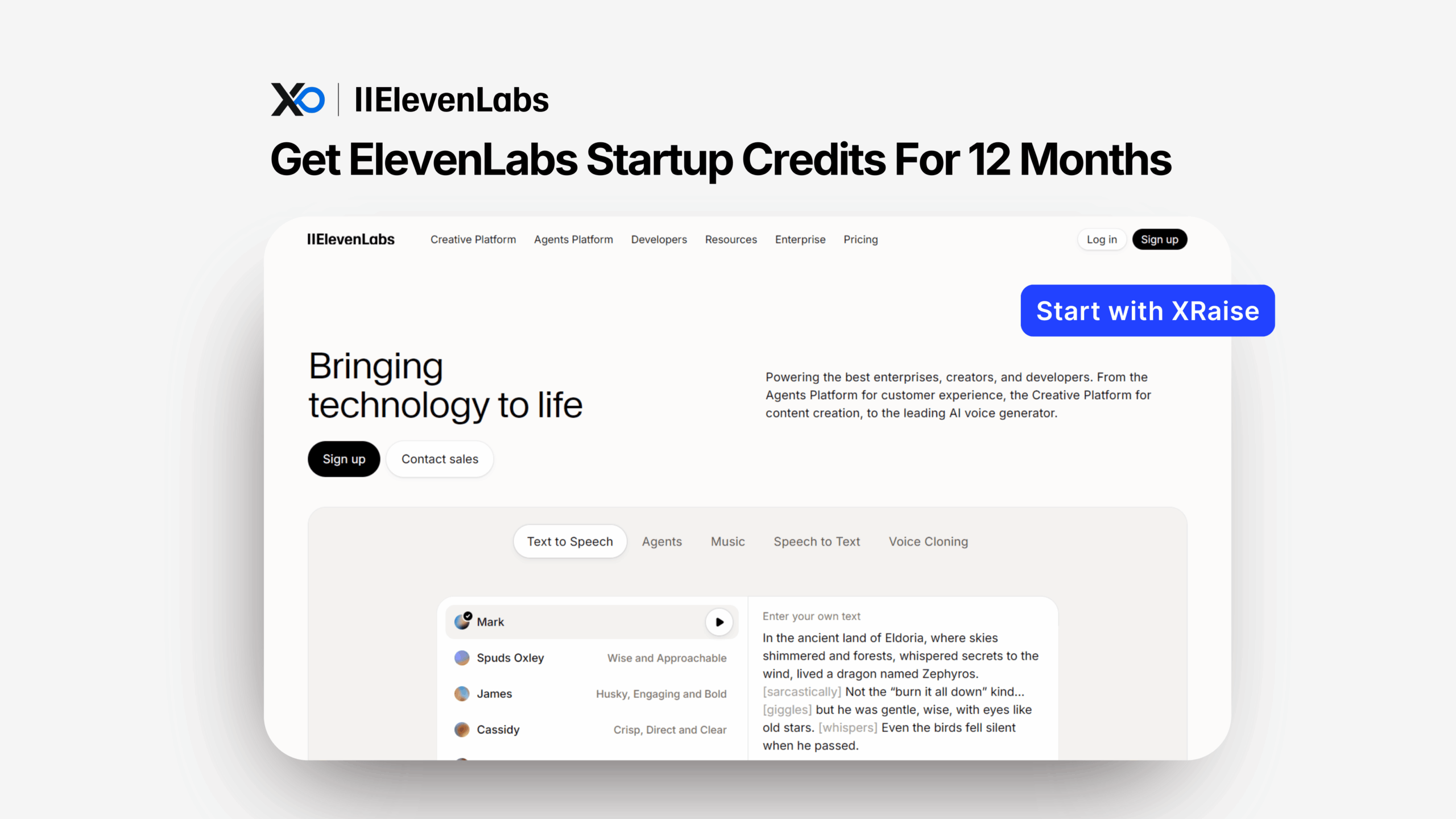
ElevenLabs credits for startups gives eligible startups 12 months free access with 33,000,000 characters. Use it to ship and validate real voice workflows before TL;DR
This guide explains how ElevenLabs credits for startups work, so you can ship real voice features fast without committing budget too early or getting stuck with the wrong audio stack.
- 12 months of voice runway: 33,000,000 characters included, so you can validate voice UX before paying for production usage.
- Real-time-friendly builds: low-latency model options make agent flows feasible, with the practical tradeoff of testing quality vs speed per use case.
- Scale-level headroom: higher concurrency limits and improved support help you avoid bottlenecks when usage spikes.
- Use XRaise to claim the perk and keep your perks stack organized, then check the official ElevenLabs page only for details/terms.
What are ElevenLabs credits for startups and why they matter
ElevenLabs credits for startups (via the Startup Grants program) give eligible early-stage teams 12 months of free access plus 33,000,000 characters to build with ElevenLabs’ AI audio platform. For founders, the real value isn’t “free stuff”, it’s the ability to test voice as a product feature (not a demo) without burning budget while you’re still figuring out what users actually want.



Voice features are deceptively expensive in iteration cycles: you’ll rewrite scripts, adjust prompts, change voices, A/B test pacing, localize content, and rebuild agent flows. The grant-sized character allotment helps you run those cycles in a realistic environment, especially if voice is tied to customer support, sales, accessibility, or multilingual expansion.
If you’re building a broader “non-dilutive runway” stack, it can help to treat these kinds of perks like capital substitutes. For a practical overview of how teams stack credits across vendors, see which cloud credit program is right for your startup.
What the ElevenLabs credits for startups perk includes
Here’s what the Startup Grants perk provides (based on the input you shared):
- 12 months free access via the Startup Grants program
- 33,000,000 characters included, valid for 12 months
- Scale-level benefits, including higher concurrency limits and improved support
- Access to core platform capabilities used to build voice agents and AI audio experiences
What’s excluded or varies (plan/region dependent)
Some details are not always spelled out publicly at a feature-by-feature level (for example: whether a specific advanced tool, model, or workflow is included for every grant recipient). If you need certainty for a particular capability, treat it as Not publicly confirmed until you verify it in the official vendor terms or inside the grant account once approved.
For the most current terms and program details, refer to the official ElevenLabs Startup Grants page.
How ElevenLabs credits for startups work in practice
The best way to use ElevenLabs credits is to anchor them to a shipping milestone. “We’ll explore voice” is too vague and usually turns into months of tinkering. Instead, pick one production workflow, ship it, measure impact, then expand.
Below are practical scenarios where ElevenLabs credits for startups unlock real product progress.
1) Customer support or sales voice agents (web, mobile, or phone)
If you’re building an agent that users actually talk to, iteration speed matters as much as model quality. Your workflow typically looks like:
- Define one narrow job (e.g., “reschedule appointment,” “order status,” “basic troubleshooting”)
- Write a script + fallback logic
- Test with real users
- Instrument outcomes (containment rate, time-to-resolution, CSAT)
- Improve prompts and transitions weekly
A common pitfall is trying to solve every support case from day one. Start narrow, prove it works, then broaden.
If your stack also needs speech-to-text (transcription) alongside voice generation, many teams pair TTS with a separate STT provider. As an adjacent cluster reference, see Deepgram Startup Credits for how founders often structure speech components.
2) In-product narration, voice UI, and accessibility
Narration and voice UI can drive activation, especially for onboarding, guided workflows, and accessibility support. This is also where character usage can ramp fast because you’re generating audio repeatedly across sessions.
A practical approach:
- Start with 2–3 high-impact screens (onboarding steps, key “aha” moments)
- Keep voice segments short and skippable
- Measure whether voice changes activation/retention
- Expand only after you have a positive signal
3) Localization and dubbing workflows
If you plan to expand into new languages, AI audio can reduce the cost and time needed to localize. The key is to validate demand before scaling output.
Use the grant period to:
- Choose 1–2 priority markets
- Localize your highest-converting assets first
- Track conversion by locale
- Decide whether multilingual audio is a growth lever or a “nice-to-have”
4) API-first product integration for developers
If you’re integrating audio via API/SDK, the goal is to build a stable “audio layer” early so you aren’t constantly rewriting integration code while product requirements change.
A clean implementation pattern:
- Wrap the TTS call in a single internal service
- Log latency, text length, failures, and retries
- Add feature flags so product can roll out voice gradually
- Define a quality ladder (fast model for interactive loops, higher-quality model for polished narration)
Eligibility for ElevenLabs credits for startups and how to maximize them
Based on the input you provided, eligibility requirements include:
- You must be a startup/small company with fewer than 25 employees
- Use a valid business email
- Have a monetized product use case
- Enterprise customers are not eligible
- Applications are considered on a rolling basis (no stated deadline)
How to maximize your 12-month grant window
1) Start the clock when you can ship.
If you activate too early, before you have a usable surface in-product, you waste months of “free time” without learning from real usage.
2) Choose one voice KPI.
Examples:
- Voice agent: containment rate, average handle time, handoff rate
- Narration: activation lift, onboarding completion, retention impact
- Localization: conversion by locale, time-to-ship, support load reduction
3) Pressure-test concurrency early.
The perk includes higher concurrency limits, but you still want to run load tests before a launch spike.
4) Avoid tool sprawl.
A common failure mode is combining multiple voice tools before you understand which part of the stack is the bottleneck. Start with a simple architecture, prove it, then add components.
If you’re managing multiple credits at once (cloud + AI + dev tools), map expiration dates and usage targets. For a straightforward example of how founders think about credits timelines, see AWS Activate credits.

Startup Perks AI Assistant
Have questions about credits? Let's chat instantly.
Plans & pricing context for ElevenLabs credits for startups
The grant provides 12 months and 33,000,000 characters as stated in the perk details. Anything beyond that (exact plan equivalence, feature gating, add-on pricing, or model availability across tiers) can change over time and may not be fully specified in a single public summary.
If you need a reference point for how the vendor presents tiers outside the grant, check the official ElevenLabs pricing page, and confirm the Startup Grants terms on the official program page.
Who should use ElevenLabs credits for startups?
You’re a strong fit if:
- You’re building voice into the product, not just creating a one-off marketing asset
- You need to test real-time or near-real-time voice experiences (agents, interactive voice UI)
- You expect to iterate heavily (scripts, prompts, localization, voice style)
- Your roadmap includes multilingual or scalable content production
You may be a weaker fit if:
- Your “use case” is purely experimental with no path to a monetized product workflow
- You only need occasional voice output and don’t expect iteration cycles
Alternatives to ElevenLabs credits for startups
Your “best alternative” depends on what you’re building:
- Speech-to-text first: If your core need is transcription (analytics, summaries, QA), you may prioritize an STT provider and add TTS later.
- Conversation intelligence layer: If you’re focused on sales/support coaching rather than generating voice output, consider tooling that sits on top of calls. For an adjacent perk-style example, see Spiky.ai Startup Perk.
- Other voice generation platforms: Options like Play.ht or Resemble AI may be relevant depending on voice licensing, languages, or SDK requirements (varies by vendor and plan).
The practical rule: pick the tool that matches your primary constraint (latency, quality, languages, licensing, or developer ergonomics), then validate with a real workflow, not a toy demo.
FAQ: ElevenLabs credits for startups
What are the eligibility requirements for ElevenLabs credits for startups?
Applicants must have a monetized product use case, use a valid business email, be a startup/small company with fewer than 25 employees, and enterprise customers are not eligible.
Is there a deadline to apply?
No fixed deadline is listed in the input; applications are considered on a rolling basis.
What happens after the 12 months?
After the grant period, the account converts to a Free plan unless the company chooses otherwise (confirm the latest behavior on the official vendor page when you’re nearing renewal).
Do the ElevenLabs credits for startups cover all features?
Not publicly confirmed at a feature-by-feature level. Verify in the official terms and within your approved grant account if a specific capability is critical.
Final thoughts
ElevenLabs credits for startups are most valuable when you treat them as a focused build window: pick one production voice workflow, ship it, measure impact, and expand only after you’ve proven a real business outcome.