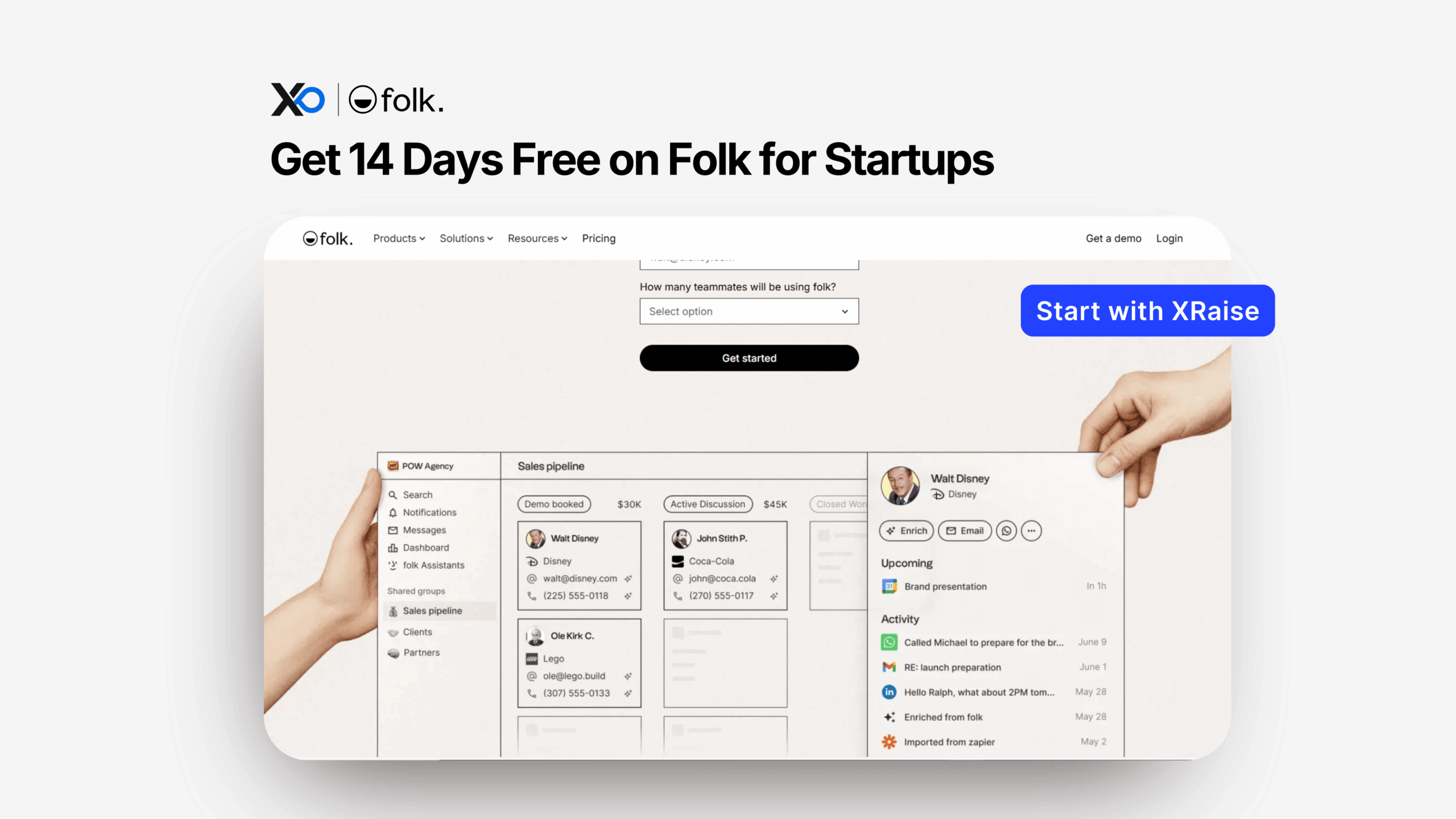
folk CRM is a lightweight, relationship-first CRM designed to help startups capture leads, enrich contacts, and stay on top of follow-ups, without the “implementation project” that usually comes with CRMs.
TL;DR
This article provides a short overview of folk CRM for startups and the folk for Startups 14-day trial perk.


- Key benefits: fast lead capture, AI-assisted enrichment, simple pipelines, and lightweight outreach automation
- Who it’s designed for: founders and lean GTM teams managing leads, partnerships, and follow-ups
- Best fit startups: founder-led sales, agencies, and teams that live in email + WhatsApp + LinkedIn
- Ideal timing: when spreadsheets/inbox follow-ups start slipping, but a heavyweight CRM feels premature
There’s also a folk for Startups perk through XRaise: a 14-day free trial intended to let early-stage teams test the full product in real workflows before committing to a paid plan.
If you want the practical steps first, use this step-by-step application guide/checklist: How to get the folk CRM free trial on XRaise.
What Is folk for startups?
At its core, folk for startups is a lightweight CRM that organizes relationships without a heavy setup. In plain English: it helps you keep a clean record of who someone is, where the conversation stands, and what to do next, while making it easy to capture contacts from the places founders actually operate (social profiles, inbox threads, meetings).
What it replaces (or cleans up) for startups:
- a “CRM spreadsheet” that nobody trusts
- scattered notes across Gmail, calendars, LinkedIn, and WhatsApp
- manual copy/paste enrichment and follow-up reminders
Where it sits in a startup stack:
- before a heavyweight CRM (if you’re still founder-led)
- alongside email + calendar for interaction history
- connected to lead sources (social, web, inbox) via capture and integrations
What folk Helps Startups Do
Startups don’t lose deals because they lack a “CRM feature.” They lose deals because follow-ups slip and context disappears. folk’s value is that it turns messy relationship work into a repeatable system:
- Capture leads quickly from socials and the web using folkX, so prospects don’t vanish between tabs.
- Enrich contacts so you can move from “name + LinkedIn” to “someone you can actually reach,” without manual research.
- Automate follow-ups with sequences so your pipeline is driven by process, not memory.
- Log key interactions (including WhatsApp, if you use it heavily) so the team has context.
Key Features of folk for startups
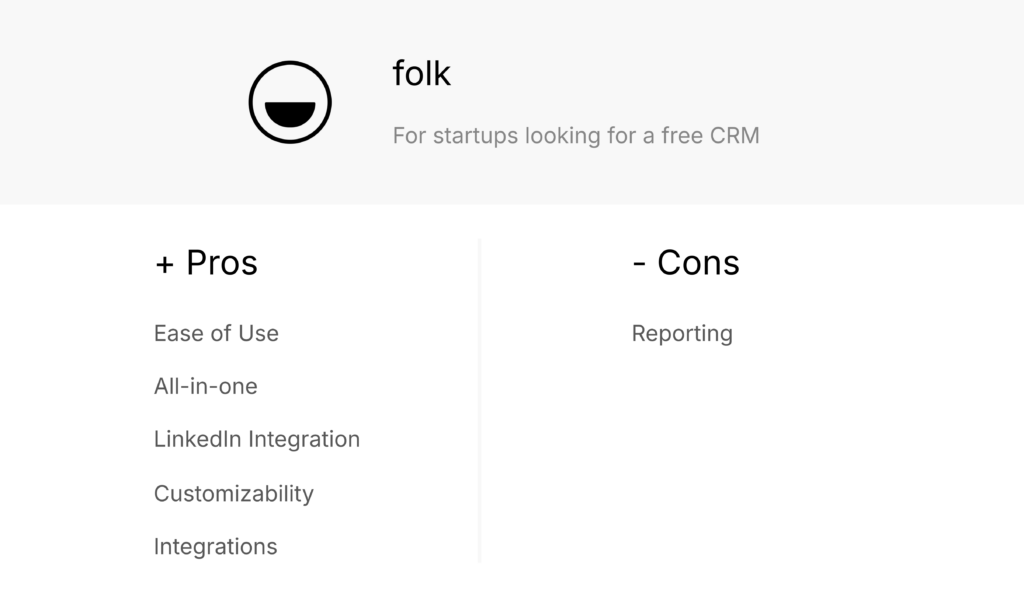
Here are the features that typically matter most to early-stage teams:
- folkX Chrome extension (capture) – add contacts from socials and anywhere on the web to reduce copy/paste work.
- Contact enrichment – find missing details (like emails/URLs) and improve data quality.
- Sequences + messaging – send personalized messages and automated sequences to individuals or groups.
- Interaction tracking – keep a running history of touchpoints so you don’t lose context across channels.
- Integrations – folk positions integrations with email and tools like LinkedIn/WhatsApp, plus automation layers (e.g., Zapier/Make) for broader connectivity.
WhatsApp workflows in folk for startups
If your “real pipeline” happens in WhatsApp, customer development, inbound leads, partner intros, your CRM often becomes incomplete by default. folk’s WhatsApp integration is designed to pull that context into your relationship workflow.
According to folk’s WhatsApp changelog, the integration is meant to help you capture contacts from WhatsApp/WhatsApp Business, update your CRM without leaving the app, and auto-sync conversations so your team stays in the loop.
Their help docs also describe WhatsApp sync behavior like importing contacts and syncing direct conversation threads (including timestamps), plus options to keep interactions private or share them in the workspace.
folk for startups offer: 14-day free trial
The folk for Startups perk is straightforward: a 14-day free trial that’s meant to be “full-featured” so you can test folk in real conditions, not a neutered demo. XRaise’s guide frames it as a way to run your actual workflow, lead capture, enrichment, outreach, and collaboration, before you pay.
What’s included
- 14 days to test folk as a real CRM in your GTM rhythm (not just a sandbox).
- No credit card required during the trial, per folk’s official pricing FAQ.
What’s excluded / what to assume is variable
- This perk is a trial, not credits or a fixed discount value. (So the “value” depends on how well you test.)
- Feature access can be plan-dependent. If you see differences in what’s enabled, treat folk’s pricing/plan docs as the source of truth.
For the practical flow (and what you may need ready), use this walkthrough: How to get the folk CRM free trial on XRaise.
Pricing & Plans Context
folk publicly lists multiple plans (e.g., Standard/Premium/Custom) on its pricing page and confirms the trial mechanics there.
Two trial details that matter operationally:
- The free trial lasts 2 weeks and doesn’t require a credit card.
- If you don’t upgrade after the trial, account access is blocked (with an option to request an extension for another week, per folk’s FAQ).
For the most current plan details and terms, refer to the official folk pricing/terms page.
folk for startups eligibility + common disqualifiers
This perk is a trial-style offer, so eligibility tends to be simpler than “startup credits” programs, but you should still approach it like a real evaluation.
You’re likely a fit if:
- you can run a real two-week test (import leads, run follow-ups, review outcomes)
- you’re still founder-led or a small team where speed matters more than process purity
You might not be a fit if:
- you need a long evaluation window (2 weeks won’t be enough)
- your process requires heavy customization before you can even begin
- you already have mature HubSpot/Salesforce ops and only need a tiny edge feature
What It’s Worth in Practice (Scenarios)
Scenario 1: Founder-led outbound (LinkedIn → email → follow-up)
Use the trial to prove whether folkX + enrichment cuts setup friction, and whether sequences help you maintain a consistent cadence. If you can’t sustain follow-up in folk, it’s a signal you need a simpler system, or a clearer outreach process.
Scenario 2: Partnerships + intros (relationship-heavy)
Partnership deals often fail from context loss. folk’s relationship-oriented contact profiles and interaction tracking can help keep “why this matters” attached to each thread.
Scenario 3: WhatsApp-heavy inbound (fast-moving conversations)
The trial is the time to validate whether WhatsApp sync gives you enough shared visibility to prevent “lost chats,” and whether privacy/sharing settings match how your team works.
Limitations, Tradeoffs, and “Gotchas”
- Time-boxed evaluation: folk states that if you don’t upgrade after the 2-week trial, access is blocked (data not immediately deleted, and an extension may be requested). Don’t start the trial “someday”, start when you can test for real.
- Overkill risk: if you don’t yet have a repeatable outreach motion, any CRM becomes admin work.
- Channel reality: if WhatsApp is a core pipeline channel, confirm what’s synced (and what isn’t) and how it’s shared across the workspace.
- Tool-sprawl risk: founders often add a CRM on top of existing chaos. Consider doing a stack audit first using this XRaise guide: Getting the Most Out of Startup Resources: business startups.
Is folk for startups the right choice?
Best for
- founder-led sales and partnerships
- teams that need a CRM now but don’t want an ops-heavy rollout
- teams that capture leads from socials and need fast enrichment + follow-up
Not ideal for
- teams that need deep enterprise customization/governance immediately
- orgs already running complex CRM ops and just shopping for a small add-on
- teams that can’t realistically test and decide inside two weeks
Quick guidance:
- If your CRM is a spreadsheet and follow-ups are slipping → test folk.
- If you need an all-in-one, scalable marketing + sales platform → consider HubSpot’s path too: HubSpot for Startups: Is It the Right Choice?.
If you’re thinking about tools as systems (not subscriptions), this broader founder context can help: 5 AI Business Shifts Redefining 2026.
Alternative (Only If Helpful)
- Pipedrive – often a better fit if you want a classic, sales-pipeline-first CRM approach and more traditional forecasting structure. See: Pipedrive Free Trial for Startups.
FAQ
Does the perk stack with other discounts?
Not publicly confirmed. This perk is framed as a free trial rather than a discount code, so “stacking” may not apply, confirm based on the official terms and what’s shown in your workspace.
What do you need to apply?
At minimum, expect basic startup details and a work email. For the exact steps and what to have ready, follow the walkthrough: How to get the folk CRM free trial on XRaise.
How long does approval take?
Not publicly confirmed for this specific perk. Treat timing as “varies” unless the XRaise flow explicitly states otherwise.
Do I need a credit card to start the trial?
No, folk’s pricing FAQ states they don’t ask for a credit card during the trial.
What happens after the perk expires?
folk states that if you don’t upgrade after the 2-week trial, account access is blocked (and you can request an extension for another week).
Can you upgrade/downgrade while using the perk?
Upgrading is supported (folk states you add payment details when you upgrade). Downgrades and plan changes can vary by billing rules, confirm on the official pricing/terms page.

Startup Perks AI Assistant
Have questions about credits? Let's chat instantly.
Final Thoughts
If you’re a founder or lean GTM team that’s outgrown spreadsheets, but you’re not ready to run a heavyweight CRM implementation, folk is a strong “trial-first” option. The perk is worth pursuing if you can use the 14 days to run a real workflow: capture leads, enrich records, run sequences, and (if relevant) validate WhatsApp sync and sharing behaviors.
Apply for folk for Startups on XRaise.
For current plan details and trial terms, review the official folk pricing/terms.