Starting a startup in 2026 is not a passion project. It’s survival math: runway, learning velocity, and avoiding the expensive mistakes that kill you before you get real signal.
If you’re honest, the first risk isn’t competition. It’s spending months building in a vacuum while your burn quietly eats your options.
TL;DR (for founders who are already behind)
If you’re starting a startup in 2026, run this like an operator:



Startup Perks AI Assistant
Have questions about credits? Let's chat instantly.
- Treat the company like a hypothesis-testing machine, not “the product.”
- Validate demand before code. “No market need” is the most-cited failure reason in CB Insights’ post-mortem analysis.
- Co-founder structure and equity are harder to fix than product.
- Perks and credits are an awareness problem. Claim them early or pay retail forever.
- Use AI + automation for low-judgment work (decks, follow-ups, ops). Keep your brain for decisions.
The 2026 reality: startups still die early, and most founders underestimate that
The exact “startup failure rate” depends on definitions and datasets. But U.S. establishment data shows the same direction: early years are a filter, not a warm-up.
BLS data shows only 34.7% of establishments born in 2013 were still operating in 2023 (a 10-year survival snapshot). That’s the long view. If you’re in month 3, your job is to survive long enough to even get a long view.
This is why starting a startup in 2026 starts with one obsession: buy time to learn.
Starting a startup in 2026 means building a system, not “an app”
Your startup is not a product. It’s a system that turns uncertainty into decisions.
The loop is simple:
- make a claim about a buyer problem
- run the cheapest test that can disprove it
- measure behavior (not compliments)
- kill, pivot, or double down
Speed compounds. “Polish” doesn’t.
Starting a startup in 2026: validate before you build
CB Insights’ research on failed startups lists “no market need” as the top cited reason (42%). That’s not a motivational stat. It’s a cost-of-delusion invoice. CB Insights has a breakdown of the most common failure reasons here: startup failure reasons.
The Mom Test (still undefeated)
Ask about past behavior, not future intent.
Bad: “Would you use this?”
Good: “What did you do the last time this happened?”
You’re hunting for:
- frequency: how often the pain hits
- intensity: how much it costs them (money, time, risk)
- current solution: what they do today (even if it’s ugly)
- willingness to pay: have they spent to fix it already?
If you want a tight operator checklist for this phase, the “resource-first” mindset in Getting the Most Out of Startup Resources (2026) pairs well with validation because it forces discipline: startup resources for business startups.
Minimum Viable Validation plays (pick one, run it hard)
Stop saying “we need an MVP.” You need proof.
Use one of these:
- Waitlist landing page: one promise + one CTA. If targeted traffic won’t convert, your message is weak.
- Pre-sell: charge for early access. Money is honest feedback.
- Concierge: deliver manually before automating. If you won’t do it by hand, don’t pretend software will save you.
Operator rule: if you can’t get 10 people to commit time/data/cash, you don’t have “early traction.” You have vibes.
Starting a startup in 2026: the funding climate is better than 2023 and more concentrated
Funding didn’t “come back” evenly. It concentrated.
Crunchbase reports 2025 saw $425B in venture and growth investment across 24,000+ companies (up 30% YoY from 2024).
Crunchbase also reports AI captured close to 50% of all global funding in 2025, up from 34% in 2024.
Translation for founders starting a startup in 2026:
- capital exists
- attention is selective
- narratives without numbers get ignored
If you’re in AI, read XRaise’s macro breakdown: AI startup funding paths beyond VC in 2026.
Co-founders and equity: the hardest thing to refactor
Product pivots are normal. Co-founder divorces are fatal.
HBR cites research (via Noam Wasserman) that 65% of startups fail due to co-founder conflict. Whether your exact number is different, the operator reality holds: one bad split can freeze the company for years.
Day-1 rules that prevent future hostage situations
- Roles in writing: who owns product, who owns distribution, who owns finance/ops.
- Vesting: standard is 4 years with a 1-year cliff. No vesting = future hostage situation.
- Decision path: 50/50 with no tiebreaker is a slow crash.
- Trial project: 2–4 weeks of real work beats six months of coffee chats.
If you’re considering programs to compensate for gaps (network, mentorship, distribution), treat them like a trade, not a validation substitute. Start here: Startup programs strategy in 2026, then go deeper: Startup accelerators in 2026 and Startup incubators (2026 guide).
Pricing and business model: don’t build an expensive hobby
Founders avoid pricing because it forces a verdict.
But if you’re starting a startup in 2026, you don’t get to postpone reality: pricing determines whether you’re building a business or an expensive demo.
Pick a route that matches how buyers already buy:
- subscription (predictable)
- usage-based (common in AI + infra)
- services-to-software (sell manually, then productize)
- marketplace (hard early, defensible later)
Operator rule: if your buyer can’t explain how they’d buy it, you can’t scale it.

Unit economics: the scoreboard that stops you from lying to yourself
starting a startup in 2026 means your economics get judged earlier.
Track these from the first dollar:
- CAC (fully loaded, not “ads only”)
- LTV (conservative, not fantasy)
- payback period
- gross margin (especially with AI inference costs)
If you can’t make one customer profitable over time, scaling acquisition is just scaling loss.
Starting a startup in 2026: runway engineering (perks first, spend later)
Most early-stage burn is optional. It’s an awareness problem.
Two ways founders die:
- they build the wrong thing (no signal)
- they pay retail while doing it (no runway)
Cloud credits: the cleanest runway extension
AWS publicly states eligible startups can apply for up to $100,000 in AWS Activate Credits.
XRaise also breaks down broader ranges and eligibility-driven tiers (including higher totals through certain routes): AWS Activate Credits for Startups | Apply up to $300K.
If you don’t want to guess, use the decision guide: Which cloud credit program is right for your startup?
Evaluating GCP too? Start here: Google Cloud promo code and credits.
Tooling: don’t buy “enterprise” for a 3-person team
Before you upgrade anything, run this filter:
- does it ship product, sell, or reduce burn?
- does it remove a weekly time sink?
- can you get it via perks/discounts?
Common examples founders overpay for:
- comms: decide based on stage, not hype, Slack for startups and the discount route: Slack promo code for startups
- CRM: pick the simplest tool that supports founder-led selling, HubSpot for startups, Close CRM for startups, or a lightweight option for follow-up discipline: Folk for startups
- fundraising ops: track who actually reads your deck, DocSend for startups
- automation: stop doing copy/paste work, Make for startups
Remote is still a lever, but only if you operate like adults
Remote isn’t a culture perk. It’s a cost structure and hiring advantage.
Gallup reports most remote-capable employees prefer hybrid, and a meaningful portion prefer fully remote.
Pew found 46% of remote workers would be unlikely to stay if they could no longer work from home.
Operator takeaway (especially when starting a startup in 2026):
- write decisions down
- keep meetings short
- measure output, not “online status”
Starting a startup in 2026: use AI where judgment is low (and your time is bleeding)
AI won’t invent product-market fit for you.
But it will stop you wasting hours on tasks that don’t require founder judgment:
- deck formatting and narrative drafts
- follow-up emails and meeting notes
- investor list hygiene
- lightweight research summaries
- data room organization
If you’re incorporating and setting up your foundation, Stripe Atlas lists incorporation for $500 (plus state fees).
Starting a startup in 2026: the 30-day operator plan (steal this)
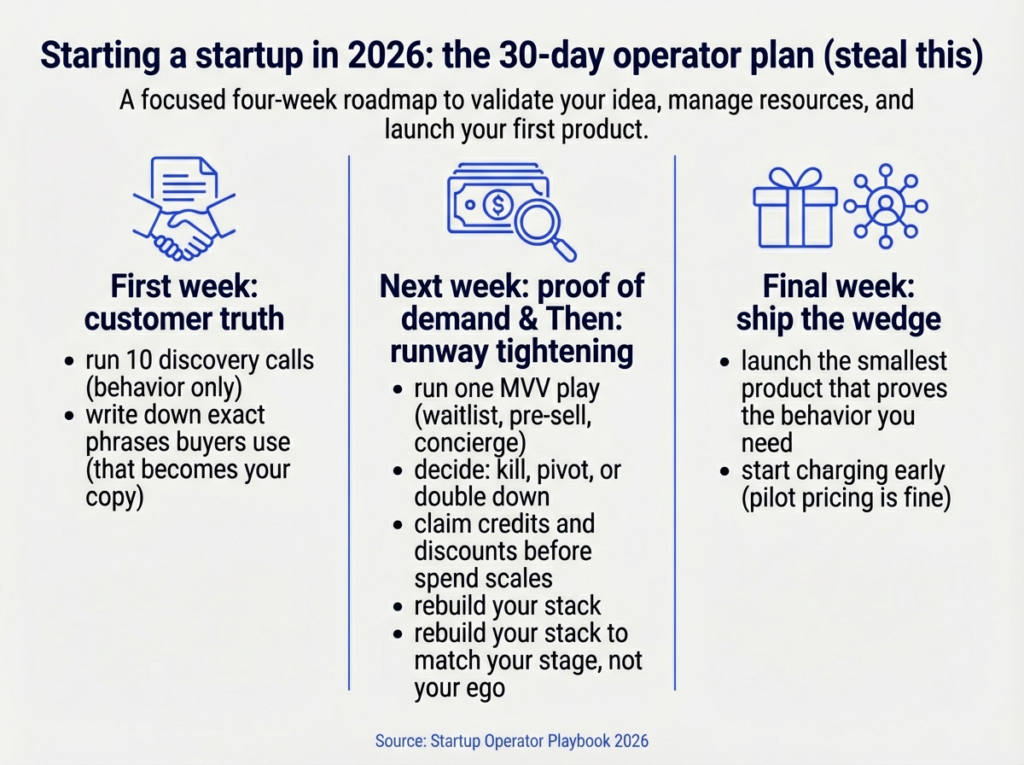
First week: customer truth
- run 10 discovery calls (behavior only)
- write down exact phrases buyers use (that becomes your copy)
Next week: proof of demand
- run one MVV play (waitlist, pre-sell, concierge)
- decide: kill, pivot, or double down
Then: runway tightening
- claim credits and discounts before spend scales
- rebuild your stack to match your stage, not your ego
Final week: ship the wedge
- launch the smallest product that proves the behavior you need
- start charging early (pilot pricing is fine)
Final thought
Starting a startup in 2026 is an execution game. Your advantage isn’t effort. it’s speed of learning and months of runway you don’t waste.
Treat perks, credits, and programs as leverage, not “nice-to-haves.” Every discount you claim and every high-signal program you join buys time for the only thing that matters: getting to paying customers.
Explore perks and accelerators on XRaise, and apply today.