

Startup accelerators can compress your learning curve fast, but only if you treat startup accelerators like a high-stakes trade, not a lottery ticket.
TL;DR
This guide explains what startup accelerators actually do (and what they don’t), so you stop applying for “validation.”




- Expect equity-for-speed: capital + intros + forced deadlines, usually in a tight 3–6 month window.
- “Spray-and-pray” applications burn months; thesis-fit shortlists beat volume every time.
- Demo Day is attention, not a term sheet. The real work is the 2–4 weeks after.
- You can capture a big chunk of the perks stack (credits/discounts) without giving up equity, if you know where to look.
- Use XRaise to prep investor-grade materials + claim perks now, then apply only where the network is worth the dilution.
What startup accelerators really are (the mechanics, not the mythology)
A startup accelerator is a fixed-term, cohort-based sprint built to force progress under a clock: weekly pressure, high-density feedback, and a hard “show your work” finale.
Common mechanics you’ll see:
- Cohorts (you + 10–30 companies) moving in parallel
- Mentors/operators rotating through office hours
- Investor exposure concentrated into a short window
- A deadline that makes “we’ll do it later” impossible
If you’re mixing this up with incubators, pause and read XRaise’s breakdown of the other path: startup incubators (2026 guide).
Accelerator vs incubator vs venture studio (don’t conflate the trade)
Founders lose months because they apply to the wrong type of program.
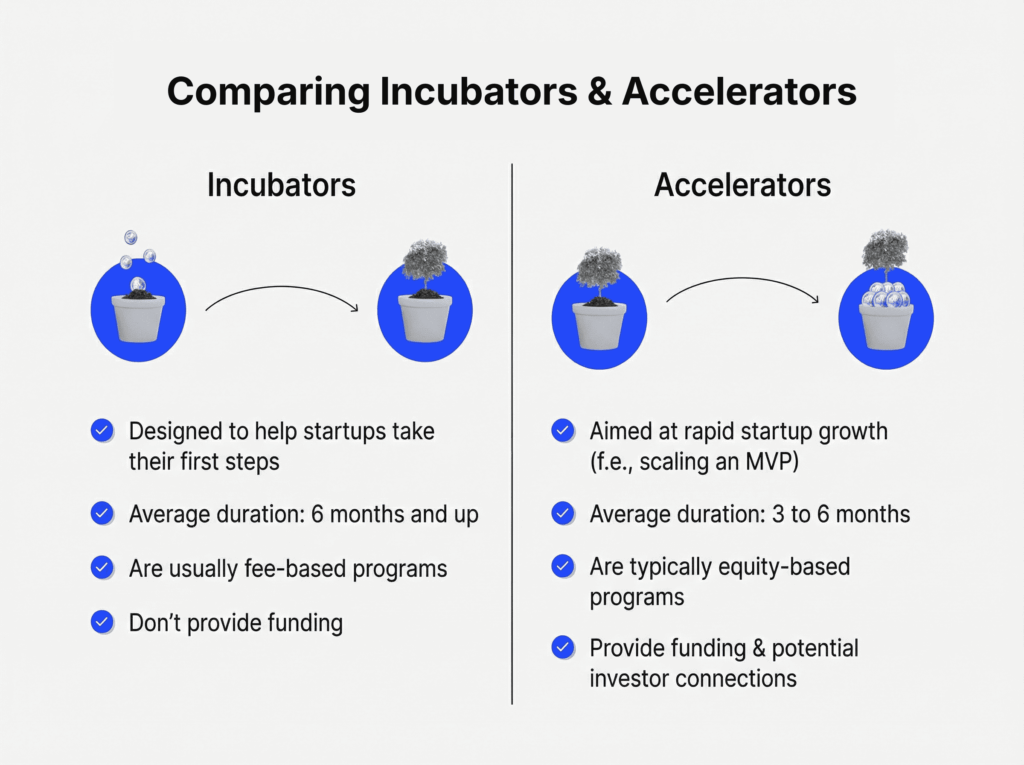
Choose based on what you’re missing:
- Accelerator: you have a team + MVP, you want speed + intros + fundraising structure.
- Incubator: you need longer runway to validate the problem and early GTM without the Demo Day tempo.
- Venture studio: you want a co-building partner and accept heavier equity because you’re buying execution capacity.
Operator rule: If you can’t say what you’re trading (equity/time/control) for what outcome (funding/intros/sales cycles), you’re not choosing, you’re hoping.
Startup accelerator equity: what you’re really paying for
The cleanest example is YC’s published deal mechanics:
- YC invests $500k total: $125k for a fixed 7%, plus $375k on an uncapped MFN SAFE.
That “7%” sounds small until you model outcomes:
- If you build something meaningful, that early slice becomes an expensive asset.
- If you don’t, dilution didn’t matter, because there was nothing to dilute.
So the real question isn’t “is YC worth it?”
It’s: Would this network + forcing function change my probability of winning?
If yes, equity is insurance. If no, it’s an unnecessary premium.
Startup accelerator benefits: what you get vs what’s hype
1) Capital is helpful, but rarely the main unlock
The check is oxygen, not altitude. It buys time; it doesn’t buy product-market fit.
2) Mentorship only matters if it’s specific
The only mentorship that changes outcomes is the kind that hits your exact bottleneck:
- enterprise sales motion
- regulated GTM
- marketplace liquidity
- pricing/packaging
- technical architecture at scale
Use alumni references as your lie detector. Ask:
- “Which mentor changed a decision you made?”
- “Who answered after Demo Day?”
- “What did you stop doing because of the program?”
3) Perks/credits can extend runway, if you don’t waste them
Credits don’t save you if your team burns them like free money.
Example: AWS Activate can be meaningful, but the range is wide and eligibility-driven, XRaise’s overview cites up to $300k depending on tier.
If you want the “runway extension” playbook, steal this operating mindset: Getting the Most Out of Startup Resources (2026).
4) Demo Day is attention, not closure
Demo Day creates meetings, not term sheets. A lot of rounds form after the event, not during it.
Treat Demo Day like a lead spike:
- your deck must be clean
- your metrics must be defensible
- your follow-up must be immediate
- your calendar must be ruthless

Startup accelerator fit: how to shortlist the right programs
Stop asking, “Is this accelerator prestigious?”
Start asking, “Is this accelerator built for my constraints?”
Fit questions that actually matter
- Does their portfolio match my model (B2B vs consumer, devtools vs biotech, etc.)?
- Do they have customer access in my industry, or just investors?
- Are they known for hands-on operators or “guest speaker tourism”?
- Do their terms create cap table friction later?
If you need a practical way to think about program selection by stage, XRaise lays out a useful map here: Startup Programs: leverage for real business growth (2026).
When startup accelerators are the wrong move
You’re not “anti-accelerator” for skipping. You’re pro-outcomes.
Skip if:
- You’re too early: no demo, no clear experiment, no execution capacity.
- You’re too late: strong traction + investor access already exists; the cohort is distraction.
- You’re applying for emotional reasons: validation, identity, fear of going alone.
- You can’t absorb the tempo: the program becomes theatre while your product stagnates.
Opportunity cost is the silent killer: 3 months in the wrong room can cost you the quarter where compounding advantages would’ve started.
Startup accelerator applications: the 5-program strategy
Spray-and-pray applications are a self-inflicted wound.
Build a shortlist like an investor would:
- 2 “reach” programs (brand/network monsters)
- 2 “fit” programs (your exact thesis + customer adjacency)
- 1 “wildcard” (new program with unusual distribution or partner access)
Then customize:
- your traction framing (what changed recently)
- your wedge (why this entry point)
- your team narrative (why you can win)
If you’re aiming at YC or Techstars specifically, XRaise has tactical guides you can model:
Operator callout: If your application can’t be skimmed in 90 seconds and still make sense, it’s not “detailed.” It’s unclear.
Accelerator perks without equity: the dilution-free hedge
A painful truth: lots of accelerator value is operational infrastructure (credits, tooling, distribution access) that doesn’t inherently require equity.
So the hedge looks like this:
- lock perks early to extend runway
- build investor-grade materials before any deadline
- apply only when you’re competitive and the network is additive
That’s exactly why founders use:
- XRaise Startup Perks to stack credits/discounts without dilution
- XRaise’s Accelerators to shortlist programs by fit
- XRaise AI Pitch Deck Builder to tighten the story fast
Your Action Plan:
- Assess fit: Are you at the right stage? Is your network weak enough to justify the equity cost? Be honest.
- Build your application foundation: Create a pitch deck that meets top-tier standards, whether you apply or not. → Use XRaise’s AI Pitch Deck Builder
- Hedge your bets: Lock in accelerator-level perks NOW, regardless of whether you apply. → Claim $500K+ in XRaise Perks
- Apply strategically: 5 targeted applications to programs with genuine thesis fit beat 20 spray-and-pray submissions every time.
Whether you’re accelerator-bound or building independently, XRaise gives you the unfair advantage, the tools, the perks, and the investor access without the equity cost.

Startup Perks AI Assistant
Have questions about credits? Let's chat instantly.
Where startup accelerators are heading in 2026
More programs will look similar on the surface: hybrid cohorts, bigger perk stacks, louder brands. The edge will come from fit and execution, not the logo, and founders will increasingly use tooling to arrive investor-ready before they ever touch an application. The founders who win will treat startup accelerators as one option inside a broader system: perks to extend runway, sharper narratives to convert meetings, and selective programs to unlock distribution.
Pick a 60–90 day window: tighten your story, stack credits to reduce burn, and only then apply to the programs where the network is a real multiplier.
Learn more and start building with XRaise’s Web App, then explore programs that can help you scale faster through XRaise’s Accelerators.