This week’s startup funding recap shows capital concentrating in two places: AI infrastructure that powers complex systems, and accelerators writing serious, founder-friendly checks. If you’re building in AI, fintech, or regional ecosystems, this wasn’t noise. It was direction.
TL;DR
This startup funding recap reveals where serious money is flowing in 2026: AI infrastructure, spatial computing, digital retirement platforms, and government-backed accelerators.
Related Posts




- Neo launches a $750K uncapped SAFE accelerator with major cloud credits.
- World Labs raises $1B, with Autodesk investing $200M into spatial AI.
- Temporal secures $300M Series D at $5B valuation for durable AI workflows.
- Vestwell raises $385M Series E, doubling valuation to $2B in fintech.
The pattern: infrastructure + distribution + capital efficiency.
1. Neo Residency: $750K per startup with uncapped SAFE terms
Ali Partovi’s Neo launched Neo Residency, a 3-month accelerator offering $750,000 per startup via uncapped SAFE plus $450K+ in cloud credits.

Startup Perks AI Assistant
Have questions about credits? Let's chat instantly.
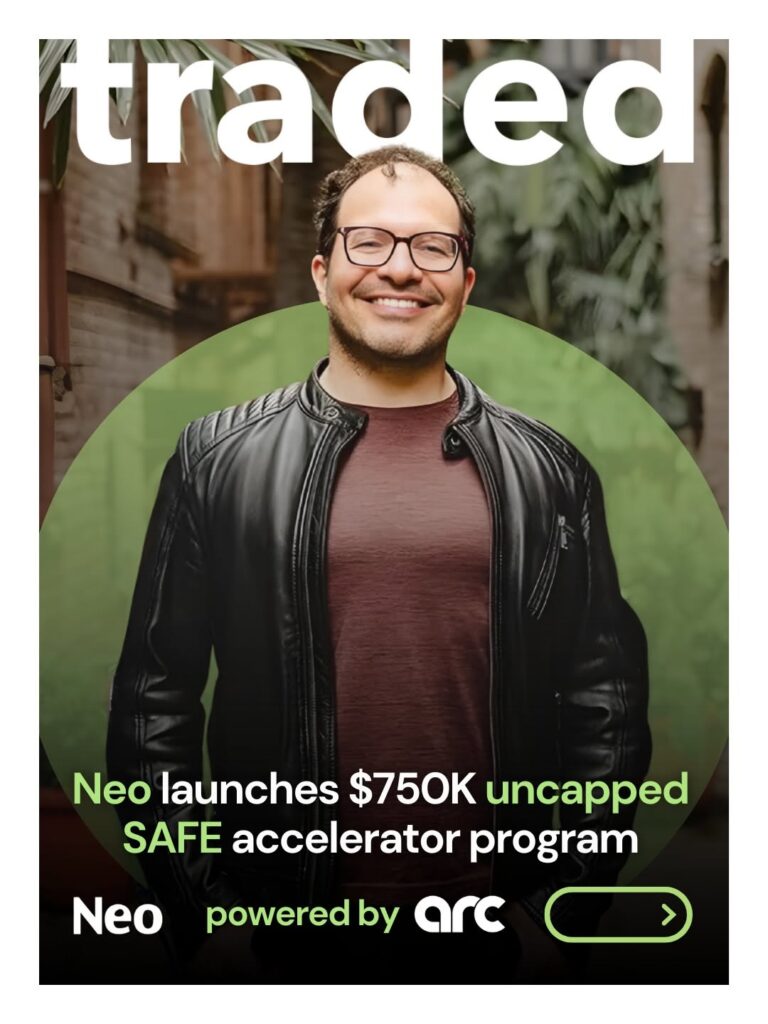
Only 12–15 startups will be accepted.
Why this is a big deal:
- Uncapped SAFE = dilution tied to future valuation, not pre-fixed equity.
- Ticket size rivals top-tier accelerators.
- Cloud credits reduce early burn.
- High-conviction mentor network.
This is not a demo-day machine. It’s a capital-heavy, network-dense cohort.
Signal for founders:
Accelerators are competing on terms, not just brand.
If you’re evaluating programs, compare:
- Check size
- Equity structure
- Credit stack
- Post-program network power
Reference framework:
Startup Accelerators in 2026: The Smart Way to Apply
If a program doesn’t change your runway or distribution curve, it’s expensive networking.
2. World Labs: $1B round validates spatial AI as a platform layer
World Labs, led by Fei-Fei Li, closed a $1 billion funding round.

Autodesk alone invested $200M. Other backers include Nvidia, AMD, Fidelity, Emerson Collective. World Labs builds “world models”, AI systems that generate and interact with 3D environments. Autodesk integration means:
AI-native 3D generation embedded directly into design workflows.
Why this matters:
- $1B rounds are platform bets.
- Strategic investment (Autodesk) signals ecosystem integration.
- Creative + architecture + design software is becoming AI-native.
This isn’t a toy. It’s infrastructure for creative industries. If incumbents are investing directly in startups, partnership leverage is a growth path, not just acquisition hope.
3. Temporal: $300M Series D proves AI workflow infrastructure is mission-critical
Temporal raised $300M Series D, led by a16z, valuing the company at $5B.
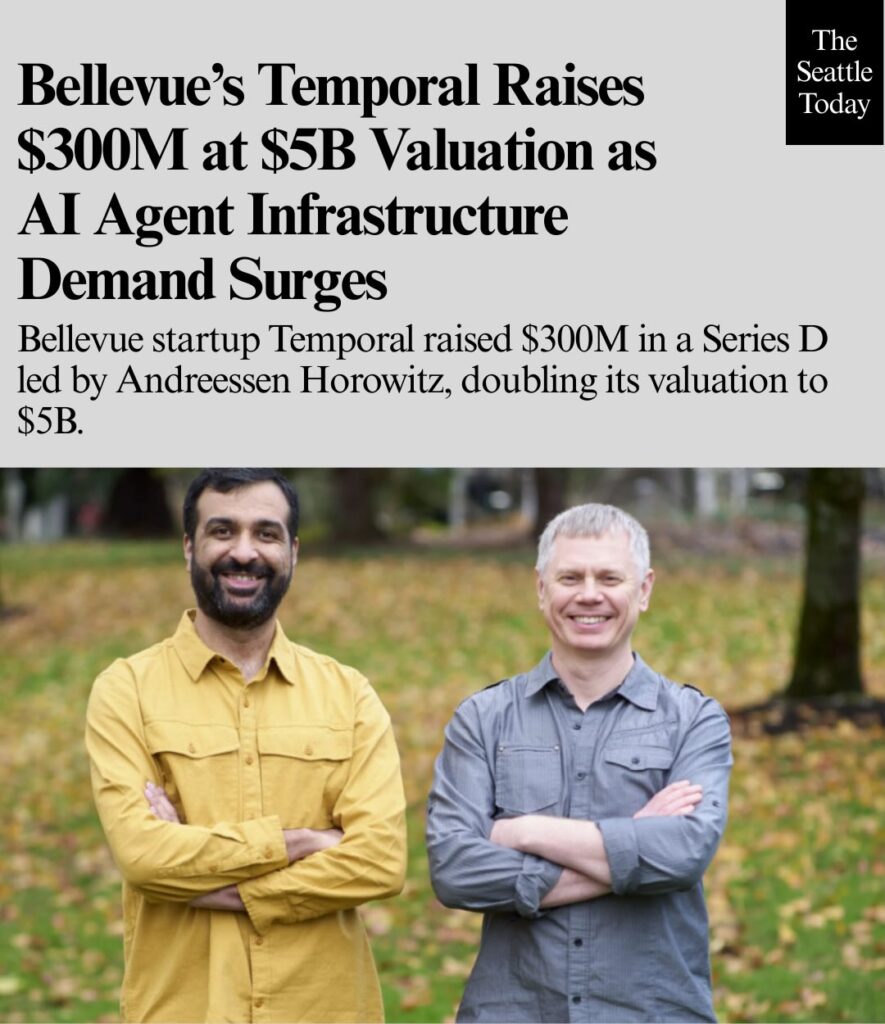
It provides a “durable execution layer” for AI workflows, critical for long-running, stateful systems.
Reported:
- 380% YoY growth
- 20M+ installs
- Customers include OpenAI and Taco Bell
Why this round matters:
- Agentic AI needs reliable orchestration.
- Devtools with enterprise adoption scale fast.
- Workflow reliability is not optional in production AI.
This confirms a trend:
Infrastructure that keeps AI stable is as valuable as AI itself.
If you’re building AI products, workflow durability isn’t a feature, it’s survival math.
Supporting reading:
AI Startup Funding Trends in 2026 and Beyond
4. Vestwell: $385M shows fintech infrastructure still attracts institutional capital
Vestwell raised $385M Series E, doubling valuation to $2B.
Co-led by Blue Owl and Sixth Street Growth.
Serves:
- 2M+ users
- $50B+ assets under management
This is not speculative fintech. It’s modernization of retirement infrastructure.
Signal:
- Large institutional capital flows into startups digitizing legacy finance.
- Distribution partnerships (asset managers + banks) drive scale.
- Real-world financial rails are being rebuilt quietly.
If you’re in fintech, note the pattern:
Infrastructure > flashy consumer apps.
What this startup funding recap tells founders
Across all five stories:
- AI infrastructure is a funding magnet.
- Strategic investors want ecosystem leverage.
- Accelerators are writing larger checks.
- Government-backed startup programs are growing.
- Institutional capital still flows into infrastructure-heavy fintech.
Brutal truth:
Founders who build durable, integrated systems win.
Founders who build surface-level tools struggle.
Your Action Plan:
- Assess fit: Are you at the right stage? Is your network weak enough to justify the equity cost? Be honest.
- Build your application foundation: Create a pitch deck that meets top-tier standards, whether you apply or not. → Use XRaise’s AI Pitch Deck Builder
- Hedge your bets: Lock in accelerator-level perks NOW, regardless of whether you apply. → Claim $500K+ in XRaise Perks
- Apply strategically: 5 targeted applications to programs with genuine thesis fit beat 20 spray-and-pray submissions every time.
Whether you’re accelerator-bound or building independently, XRaise gives you the unfair advantage, the tools, the perks, and the investor access without the equity cost.
Where this is heading next
This startup funding recap points to an infrastructure-heavy funding cycle. AI will continue to attract capital, but primarily at the orchestration, platform, and workflow layer.
In the next 90 days, strengthen your infrastructure story:
- Workflow reliability
- Ecosystem integration
- Capital efficiency
Learn more and start building with XRaise’s Web App, then explore programs that can help you scale faster through XRaise’s Accelerators.