Business to Startup is the gap where most founders stall: they spend on the wrong tools, skip the validation steps that would’ve saved months, and pay retail for things that should’ve been discounted or free.
TL;DR
Business to Startup is the fastest path from “I have an idea” to “we have proof + a launch-ready operating setup,” without burning time and cash on fake progress.




- What it means: Converting an idea into a scalable, testable startup system (problem proof → MVP → traction signals → clean foundation).
- Who it’s for: Founders who want to ship in weeks, not “someday,” and don’t want legal/ops debt to blow up later.
- How to execute: Run a 48-hour validation sprint, build the minimum MVP route, set the legal basics (entity/vesting/IP), then lock in perks before you pay retail.
- Next step: Build your deck fast with the XRaise AI Pitch Deck Builder and claim operational discounts on XRaise Startup Perks before you commit to paid tools.
Business to Startup: What It Means in 2026
Definition: Business to Startup = turning a concept into a repeatable growth system, where you can answer three questions with evidence:
- Who is it for? (a narrow segment you can reach)
- What pain is urgent? (they feel it now, not “someday”)
- Why you? (you’re 10x better on at least one dimension)
This is why “business vs startup” is not academic. It changes what you do on Monday.
A traditional business can optimize for profitability early. A startup often optimizes for speed of learning and scale potential. If you can’t say what your customer stops doing the day you exist, cut the idea or narrow the segment until you can.
If you want the “compounding mindset” version of this (how founders turn early moves into leverage), read XRaise’s take on How to Use Your First Startup to Grow Your Business.
Why Business to Startup breaks most founders
From your input, the failure pattern isn’t “bad ideas.” It’s bad sequencing:
- Paying for tools before you have proof
- Skipping validation because building feels productive
- Creating legal/ops debt that explodes later (vesting/IP/entity)
- Buying retail subscriptions while eligible for startup programs
Cash failure isn’t rare, CB Insights’ post-mortem analysis consistently surfaces “ran out of cash” as a top failure reason.
So the real question becomes:
Which steps create proof… and which steps just create activity?
Business to Startup: The 48-Hour Validation Sprint
From idea to startup hypothesis
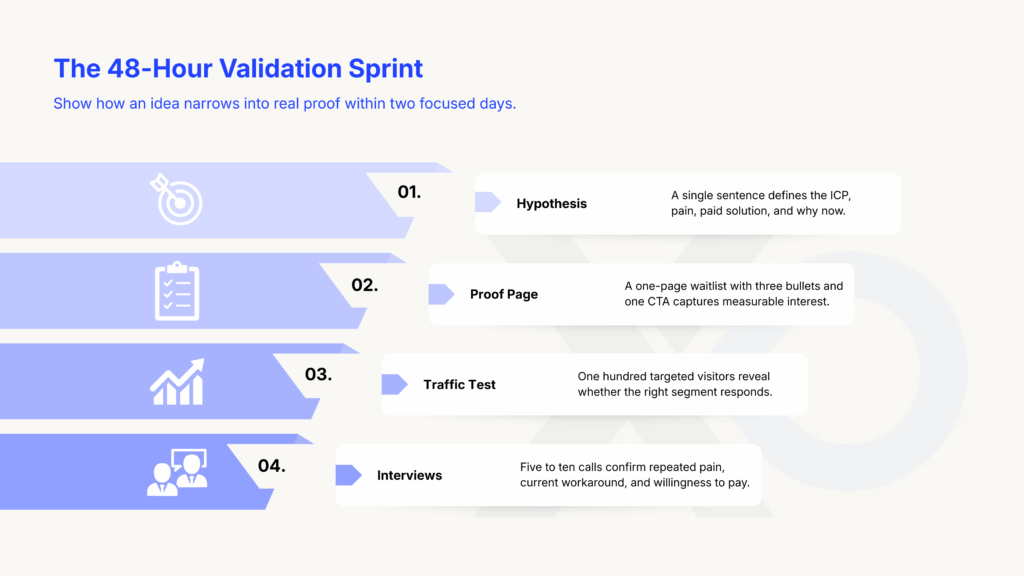
You don’t need a month to find out if you have signal. You need a sprint with hard outputs.
Step 1: Write the hypothesis (one sentence)
Use this exact shape:
“[Specific customer] has [pain] and will pay for [solution type] because [current workaround is failing].”
Make it narrow enough that you can find 20 people this week.
Step 2: Build a one-page proof asset (not a “site”)
One page. One claim. One action.
- Headline: the job-to-be-done
- 3 bullets: what changes for them
- One CTA: “Join waitlist” / “Request early access”
Step 3: Drive targeted traffic (100 visitors is enough)
You’re not trying to go viral. You’re trying to test a slice of a market.
- Post where your segment already hangs out
- DM people with a question, not a pitch
- Run a tiny paid test if you can target precisely
Step 4: Run 5–10 interviews (no pitching)
Ask about their workflow and the cost of the problem.
- “Walk me through the last time this happened.”
- “What did you try?”
- “What did it cost you, time, money, risk?”
If the pain is vague, the budget is unclear, and the current workaround is “fine,” you don’t have urgency.
If you want an “execution discipline” companion read, XRaise’s How to Grow Your Company Startup Faster is good for founders who need tighter weekly operating habits.
Competitor research without the paralysis loop
Competition is not the enemy. Misreading competition is.
Use this filter:
Competition is validating when:
- Customers complain loudly about existing options
- Incumbents are slow or priced for enterprises
- Multiple players exist, but none own a clear “10x wedge”
Competition is a red flag when:
- One well-funded leader dominates distribution
- The market is winner-take-all and you have no unfair angle
Do a quick scan, then stop:
- Who is buying ads and ranking?
- Who is hiring fast?
- What do reviews hate?
If your differentiation is “better UI,” you don’t have differentiation. Find the one dimension you can be 10x on (speed, workflow, compliance, cost, distribution).
Business to Startup foundations that prevent expensive future disasters
This is the unglamorous work that protects your company later.
Choose the structure that matches your funding path
- If you intend to raise venture: Delaware C-Corp is the default standard.
- If you’re bootstrapping: LLC can be simpler early.
Do these basics early (especially with co-founders)
- Founder agreement with vesting (the classic 4-year vesting / 1-year cliff structure is common)
- IP assignment (clean ownership is non-negotiable in diligence)
- Separate banking and clean bookkeeping
Even in your own input, the cost logic is right: doing it early is cheap compared to fixing it later.
For founders who are applying to programs or planning fundraising soon, XRaise’s Mastering startup programs in 2026: tips, tricks, and strategies is a practical “don’t waste cycles” guide.
Business to Startup: MVP Routes That Create Proof
Most MVPs fail because founders treat them like v1 of the “real product.”
They aren’t.
An MVP is a learning machine.
Minimum viable product plan
Pick the route that gives you paid proof fastest:
- Concierge MVP: you deliver manually, learn what people actually pay for
- Wizard-of-Oz MVP: it looks automated, but you’re behind the curtain
- Landing-page MVP: sell access before building the system
The right MVP route depends on your constraint:
- If you lack engineering: concierge/wizard wins
- If you lack distribution: landing page + partnerships wins
- If you lack clarity: interviews + manual delivery wins
If you can’t ship a test in 7 days, your MVP plan is too big.
Stop paying retail: perks are part of the build plan (not a “nice-to-have”)
Your input nails a real founder trap: SaaS creep.
You sign up for “just a few tools,” and suddenly you’re burning hundreds or thousands monthly before you have repeatable revenue. Perks don’t just save money. They buy time to run more experiments.
Examples from XRaise’s own library:
- Cloud credits: AWS Activate Credits for Startups and the decision guide Which Cloud Credit Program Is Right for Your Startup?
- Support stack: LiveChat Startup Perk for lean teams that need fast customer conversations
- Ops stack: Notion for Startups for documentation + workflow clarity
Then centralize the whole “perks hunt” into one place instead of 50 tabs: XRaise Startup Perks.
AI advantage: compress pitch + execution cycles without faking progress
AI doesn’t replace proof. It compresses the time between iterations.
Use it for:
- Drafting a structured pitch deck (then you add truth + numbers)
- Summarizing interview notes into patterns
- Generating experiment variants (landing page copy, outreach angles)
If fundraising is on your path, don’t wait until you’re “ready” to build the materials. Build them as a forcing function for clarity:
- Problem clarity
- ICP clarity
- Proof clarity
- Ask clarity
That’s exactly why the XRaise AI Pitch Deck Builder is useful early, because it forces structure while you’re still learning.
The “playing startup” traps to avoid (and what to do instead)
These are the expensive patterns your input calls out, translated into decision rules.
Trap: building before proof
Instead: Run the 48-hour sprint and don’t touch the roadmap until you have repeated pain language.
Trap: buying tools before you have a workflow
Instead: Define the workflow, then choose the minimum tool. Prefer perks-first on XRaise Startup Perks.
Trap: skipping legal foundations
Instead: If you have co-founders or contractors touching core IP, do vesting + IP assignment early.
Trap: trying to be “a startup” instead of shipping outcomes
Instead: Pick one weekly metric that represents proof (interviews booked, pilots started, retention signal) and build around it.

Startup Perks AI Assistant
Have questions about credits? Let's chat instantly.
Your Action Plan:
- Assess fit: Are you at the right stage? Is your network weak enough to justify the equity cost? Be honest.
- Build your application foundation: Create a pitch deck that meets top-tier standards, whether you apply or not. → Use XRaise’s AI Pitch Deck Builder
- Hedge your bets: Lock in accelerator-level perks NOW, regardless of whether you apply. → Claim $500K+ in XRaise Perks
- Apply strategically: 5 targeted applications to programs with genuine thesis fit beat 20 spray-and-pray submissions every time.
Whether you’re accelerator-bound or building independently, XRaise gives you the unfair advantage, the tools, the perks, and the investor access without the equity cost.
Where Business to Startup is heading next
The direction is clear: the winners won’t be the founders with the most ambition. They’ll be the founders who run the tightest proof loops,, validate faster, launch smaller, and use perks and automation to extend runway while they iterate.
For the next 30 days, run one validation sprint, ship one MVP route, and lock in the foundational ops (entity/vesting/IP) only when you see real signal, then repeat the cycle with tighter assumptions.
Learn more and start building with Business to Startup using XRaise’s Web App, then explore programs that can help you scale faster through XRaise’s Accelerators.