
Entrepreneur startups aren’t a lottery ticket, they’re a skill stack. This guide shows you what to do at each stage so you don’t learn the rules by burning runway.
TL;DR
Run Entrepreneur startups like a sequence of tests: define the game, validate demand, ship the smallest useful version, then earn traction with founder-led sales.
- “Startup” is a strategy choice (scalability + growth trajectory), not a title you put on LinkedIn.
- Validation beats vibes: use behavior questions, run one MVP test, and set kill criteria before you build.
- Your first customers come from unscalable work and tight feedback loops, not “marketing.”
- Funding is oxygen with strings: bootstrap if the market allows, raise only when speed is required.
- Extend runway with credits/perks and tighten fundraising with AI so you negotiate from strength, not panic.
What Entrepreneur startups are (and what they aren’t)
Not every new business is a startup. The difference isn’t prestige, it’s scalability.


- One clinic or café = business (great, but capacity-bound).
- A system that helps 10,000 clinics or cafés run operations = startup (software scales; headcount doesn’t have to).
Also, ignore the “hoodie dropout” myth. Research on high-growth entrepreneurship using U.S. Census-linked data found the average age of successful founders is around 45. See HBR’s summary and the underlying MIT paper, Age and High-Growth Entrepreneurship.
One more reality check: survival is hard. U.S. small business data puts five-year survival around ~50% in the period summarized by the U.S. Small Business Administration.
If you want the “founder job description” in 2026 (without founder theater), read Startup Founder Skills That Matter in 2026.
Pick your route: 4 kinds of Entrepreneur startups
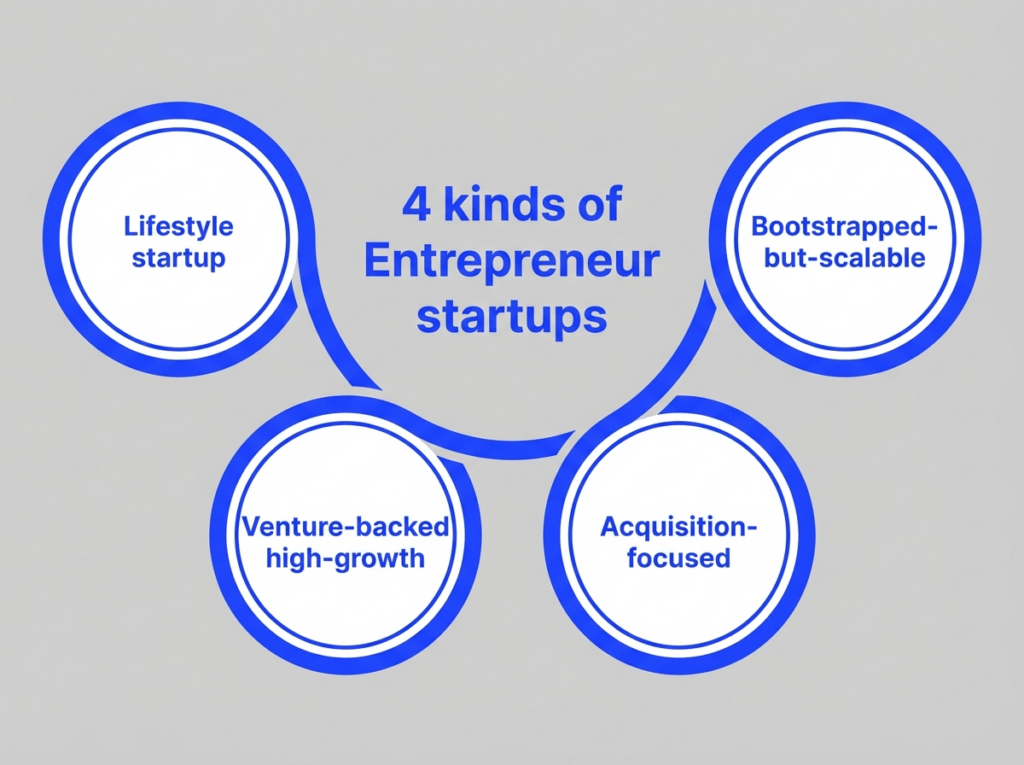
Your route decides your burn, hiring, and fundraising.
- Lifestyle startup: sustainable income + freedom.
- Bootstrapped-but-scalable: patient compounding, real margins, no forced exits.
- Venture-backed high-growth: speed, dilution, external timelines.
- Acquisition-focused: build a product a bigger company would rather buy than build.
The stage map for Entrepreneur startups (stop solving the wrong problem)
Most failures are stage mistakes.
Stage 1: Problem discovery (find “hair on fire” pain)
Your input’s test works: are people already hacking solutions together (spreadsheets, duct-tape workflows, angry forum posts)?
Stage 2: Validation before building (evidence, not confidence)
Founders skip this, ship anyway, and later call it “bad marketing.”
Stage 3: First product (built to learn)
Your first version should be aimed at one job-to-be-done and shipped fast enough to get real feedback.
Stage 4: First customers (repeatable motion starts here)
Early traction comes from you doing unscalable work and tightening the loop: customer → product → revenue.
Validation before building: proof > passion
This is where Entrepreneur startups die quietly, because founders build a beautiful product nobody needed.
Use behavior questions (The Mom Test rule)
Never ask: “Would you use this?”
Ask instead:
- “How do you solve this today?”
- “What have you tried?”
- “What did it cost (time/money/risk)?”
- “When did this last happen?”
MVP plays that teach you something
Use one of your input’s three MVP options:
- Concierge MVP: you deliver manually first.
- Wizard of Oz: it looks automated; you’re doing it behind the scenes.
- Landing page test: promise + waitlist; no signups = no urgency.
Set kill criteria before you start
Write thresholds while you’re still rational:
- “If we can’t get 10 qualified discovery calls in 2 weeks, the target customer is wrong.”
- “If we can’t get 50 waitlist signups in 30 days, the positioning is wrong.”
- “If nobody pays for the manual version, software won’t save it.”
Build the first version fast (and pick the right build path)
Here’s how to nail the key principle: iteration speed beats perfection.
No-code can get you to real usage
For many B2B workflows, no-code can carry you to early revenue. Start here: Top 10 No-Code Tools to Build Faster.
Technical co-founder vs hire: the simple rule
- If the product is the technology (deep AI/ML, infra, research risk) → you need technical leadership early.
- If tech is a means to an end (workflow, marketplace ops) → prototype first, hire later.
Rule of thumb: If the hardest risk is engineering, don’t cosplay it. If the hardest risk is distribution, don’t hide behind code.
First customers: traction comes from manual work
EaEarly customers won’t come from “marketing.” They’ll come from you.
Founder-led sales is your feedback loop
Every call is product discovery:
- Objections reveal story gaps.
- Drop-off reveals onboarding leaks.
- Requests reveal what the buyer actually values.
If follow-up is dropping leads, Folk for Startups: how founders fix follow-up is a practical setup.
Traction metrics that matter early (from your input)
- Retention > acquisition
- Word-of-mouth rate
- Engagement depth (core feature usage)
If you can’t name your “core action,” you’re still building a demo.
Funding Entrepreneur startups: choose oxygen based on the market (not ego)
Bootstrapping vs raising isn’t a moral debate. It’s a constraint problem.
Bootstrapping buys control; raising buys speed
From your input:
- Bootstrapping = control + patience + fewer forced exits.
- Raising = speed + dilution + pressure.
Fundraising takes months, plan like it does
Across guides, “average” timelines are commonly measured in months (often ~4–6) depending on stage and readiness. NYU’s fundraising process overview and Wise’s closing guide are good reference points.
What “investor-ready” actually means
Your deck has one job: reduce perceived risk.
Have crisp answers to:
- Who’s the buyer and what triggers urgency?
- What proof do you have (LOIs, pilots, paid tests, waitlists)?
- What does traction look like in your category?
- Can the team execute (technical + commercial balance helps)?
Program playbooks you can steal from:
If you’re raising from angels, borrow a tight outreach format (and the red-flag list) from Brad Feld’s seed math cheat code.
The leverage stack: AI + perks that extend runway (without dilution)
The smartest founders extend runway before fundraising gets urgent.
AI compresses fundraising grunt work
AI won’t create your story. It will help you structure it, keep artifacts consistent, and move faster through diligence.
Build the foundation with XRaise AI Pitch Deck Builder.
Perks are runway in disguise
Cloud and SaaS credit programs can be material, especially for AI workloads; big providers have expanded credit initiatives for startups in recent years. Reuters example on AWS credits for startups.
Practical internal reads:

Startup Perks AI Assistant
Have questions about credits? Let's chat instantly.
- Which cloud credit program is right for your startup?
- AWS credits for startups (up to $25,000)
- Browse more options in Startup Perks & Credits
Rule of thumb: Cut burn first. Raise second. Every month of runway is leverage.
If you want a structured “raise-ready” cadence, the Fundraising Sprint accelerator overview shows what a tighter process looks like.
Failure patterns Entrepreneur startups can avoid
- Building before validating: the most expensive way to learn you were wrong.
- Ignoring unit economics: growth doesn’t fix negative margins; it accelerates the crash.
- Starting a raise too late: desperation is visible, and it kills deals.
- Burnout: decision quality is a compounding advantage; protect it.
- Tool creep: if it doesn’t drive growth or learning, cut it.
Your Action Plan:
- Assess fit: Are you at the right stage? Is your network weak enough to justify the equity cost? Be honest.
- Build your application foundation: Create a pitch deck that meets top-tier standards, whether you apply or not. → Use XRaise’s AI Pitch Deck Builder
- Hedge your bets: Lock in accelerator-level perks NOW, regardless of whether you apply. → Claim $500K+ in XRaise Perks
- Apply strategically: 5 targeted applications to programs with genuine thesis fit beat 20 spray-and-pray submissions every time.
Whether you’re accelerator-bound or building independently, XRaise gives you the unfair advantage, the tools, the perks, and the investor access without the equity cost.
Where Entrepreneur startups are heading in 2026 (and what you do next)
The bar is rising, but so is founder leverage. The winners won’t be the loudest, they’ll be the most systematic: fast validation, tight narratives, and disciplined spending that keeps runway long.
Give yourself 30 days to run the fundamentals: 10–20 customer conversations, one MVP test with pre-set kill criteria, and a weekly cadence for shipping + selling.
Learn more and start building with XRaise’s Web App, then explore programs that can help you scale faster through XRaise’s Accelerators.