Most AI founders do not waste time because grants are impossible to find. They waste time because they apply to programs that fund a different company, stage, geography, or type of technical work.
The best AI startup grants are not necessarily the ones with the largest headline award. They are the opportunities that match your next milestone, accept your company structure, provide usable funding, and justify the application effort.
TL;DR
- AI startup grants usually fund defined R&D, validation, commercialization, or mission-linked projects.
- The strongest current paths include NSF America’s Seed Fund, EIC Accelerator, and national innovation programs such as NRC IRAP.
- Voice AI startup grants and generative AI startup funding usually sit inside broader speech, research, deep-tech, accessibility, health, climate, or innovation programs.
- Closed competitions can still reveal useful funding paths, but they should not be presented as currently available.
- Use the XRaise Grant Fit Score to classify opportunities as Apply, Monitor, or Reject.
- Compare grants with credits, accelerators, competitions, loans, and equity funding before committing time.
- Verify current eligibility, deadlines, funding structures, and program status directly with the official funder.
What are the best AI startup grants in 2026?
There is no single best grant for every AI startup.
A US deep-tech company developing novel AI technology may fit America’s Seed Fund powered by NSF. A European startup with a validated, high-impact technology may fit the EIC Accelerator. A Canadian technology company may be better suited to NRC IRAP.
Those programs are not interchangeable. They differ in:
- Geography
- Technology-readiness level
- Ownership
- Company size
- Research requirements
- Partnership requirements
- Funding structure
- Application process
- Commercialization expectations
The right question is not:
“Which AI startup grants offer the most money?”
It is:
“Which funding opportunity pays for the next milestone my company needs to prove, without creating a worse strategic constraint?”
AI startup grants and funding programs to check in 2026
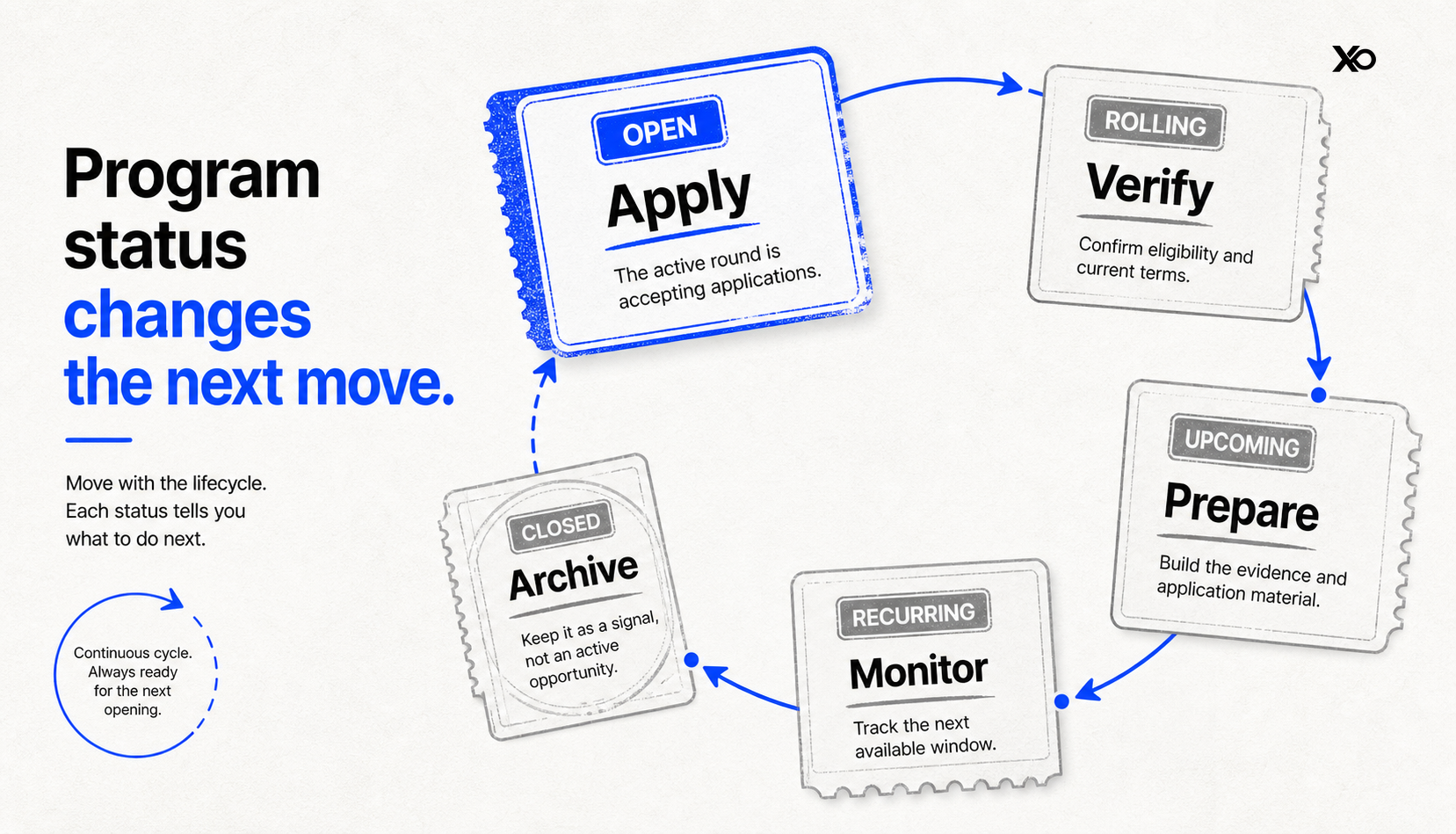
The table below includes currently relevant programs and useful 2026 pathways. “Closed” means the specific 2026 round is no longer available. It is included only because the program provides a meaningful signal about recurring or relevant funding routes.
| Program | Region & Status | Funding | Best Fit | Key Eligibility / Catch |
|---|---|---|---|---|
| America’s Seed Fund powered by NSF | United States Recurring/current program; no 2026 closing date shown on the main page |
Up to $2 million in seed funding; zero equity stated Zero equity |
Deep-tech AI, technical R&D, early product development Early-stage R&D; AI is an eligible technology area |
US ownership, fewer than 500 employees, US-based R&D, qualifying principal investigator, required registrations for full proposal |
| EIC Accelerator 2026 | EU Member States and Horizon Europe associated countries Open; short proposals may be submitted any time, with 2026 batching dates including September 2 and November 4 |
Grant below €2.5 million; investment component of €1–10 million Grant-only can be non-dilutive; blended and equity-only options also exist |
High-impact deep tech and commercialization TRL 6–8; scale-up-oriented startups and SMEs |
EU/associated-country eligibility; UK applicants can apply only for grant-only support under the stated rules |
| NRC IRAP | Canada Rolling / relationship-led; no fixed deadline stated on the reviewed page |
Advice and, in some cases, project funding; amount not publicly stated on the reviewed page Equity terms not stated on the reviewed page |
Canadian technology companies developing and commercializing innovation Innovation, R&D, and market-readiness projects |
Incorporated, for-profit, operating in Canada, up to 500 employees, with potential Canadian economic benefit |
| Advancing Sustainable AI Technology | United Kingdom research ecosystem Upcoming; expected to proceed subject to relevant approvals |
Total fund of £10 million; maximum award of £500,000 Not publicly stated |
Sustainable AI technologies and tools Research-led; startup eligibility not publicly stated on the planning page |
Confirm eligible applicant structure when the full call opens |
| Next Generation AI: Explainable AI | United Kingdom research ecosystem Upcoming; expected to proceed subject to relevant approvals |
Total fund of £10 million; maximum award of £500,000 Not publicly stated |
Fundamental, high-risk, high-reward AI research Research-led; startup eligibility not publicly stated |
Likely research-organisation or collaboration requirements; verify when the call opens |
| AI Champions: Frontier AI Phase 1 | United Kingdom Closed; April 29, 2026 deadline |
Share of up to £3 million for feasibility studies Grant competition; equity terms not stated on the reviewed page |
Frontier AI and technically novel ML UK SMEs; feasibility and technical validation |
UK-registered SME, novel model/system/training/algorithm work, defensible scale-up path |
| CRC Projects Round 19 | Australia Closed; May 12, 2026 deadline; future round not announced |
Matched funding between AUD $100,000 and $3 million; projects up to three years Grant with matched-funding requirement; equity terms not stated |
Industry-led AI research collaborations Australian SME lead with industry and research partners |
Australian incorporated trading corporation, ABN/GST registration, second industry organisation, Australian research organisation |
What this table means for founders
The table is not a ranking.
It is a filtering tool:
- US deep-tech founders should begin with ownership, R&D location, and principal investigator rules before considering NSF.
- European founders should distinguish the EIC grant-only route from blended finance or equity.
- Canadian founders should treat NRC IRAP as a relationship-led project-support path, not an instant online grant.
- UK research-driven founders should monitor upcoming AI calls but avoid treating planning-page entries as open applications.
- Australian founders should expect collaboration and matched-funding requirements for programs such as CRC-P.
- Closed programs remain useful as market signals, but they should not enter an active application pipeline.
Why AI startup grants matter in 2026
AI companies often need funding for:
- Model development
- Data preparation
- Compute and infrastructure
- Evaluation and safety testing
- Technical hiring
- Research partnerships
- Pilot deployments
- Regulatory preparation
- Commercialization
- Industry validation
Equity funding can support many of these activities, but it creates dilution and investor expectations. Startup credits can reduce cloud or API costs, but they usually do not fund salaries, research staff, customer discovery, or broad operating expenses.
Grants occupy a different position. They may support a defined project without taking equity, but they often restrict:
- Eligible costs
- Work location
- Partner structure
- Project milestones
- Procurement
- Intellectual property
- Reporting
- Commercial use
Grant funding can extend runway, but it is not automatically cheap money. The application has a cost, and funding may arrive slowly or reimburse approved expenses rather than provide immediate unrestricted capital.
What qualifies as an AI startup grant?
An AI startup grant is funding awarded to support a defined research, innovation, validation, commercialization, or mission-related project.
A grant usually has:
- A funder
- An eligible applicant type
- A defined project scope
- Allowable and non-allowable costs
- A timeline
- Milestones or reporting
- An evaluation process
- Geographic or ownership restrictions
The phrase “AI startup grants” covers several different categories.
Research and technical development grants
These support new algorithms, model methods, prototypes, technical capabilities, or scientific work.
They are strongest for founders who can explain:
- What is technically difficult
- What is genuinely novel
- What experiment will reduce uncertainty
- How success will be measured
- How the work could become commercially valuable
Feasibility and validation grants
These fund a bounded test of whether a technology works in practice.
Typical objectives include:
- Accuracy
- Latency
- Robustness
- Data quality
- Safety
- Cost per task
- Interoperability
- Benchmark performance
Commercialization grants
These support the move from validated technology to a product, pilot, or market-ready deployment.
They may fund:
- Demonstrators
- Customer pilots
- Industrial deployment
- Regulatory preparation
- Technical integration
- Commercial partnerships
Mission-linked grants
These are tied to a public or strategic problem, such as:
- Health
- Climate
- Energy
- Agriculture
- Accessibility
- Education
- Cybersecurity
- Defense
- Public infrastructure
A company does not qualify merely because it uses AI. The technology must usually address the stated problem in the required way.
Grants versus other startup funding options
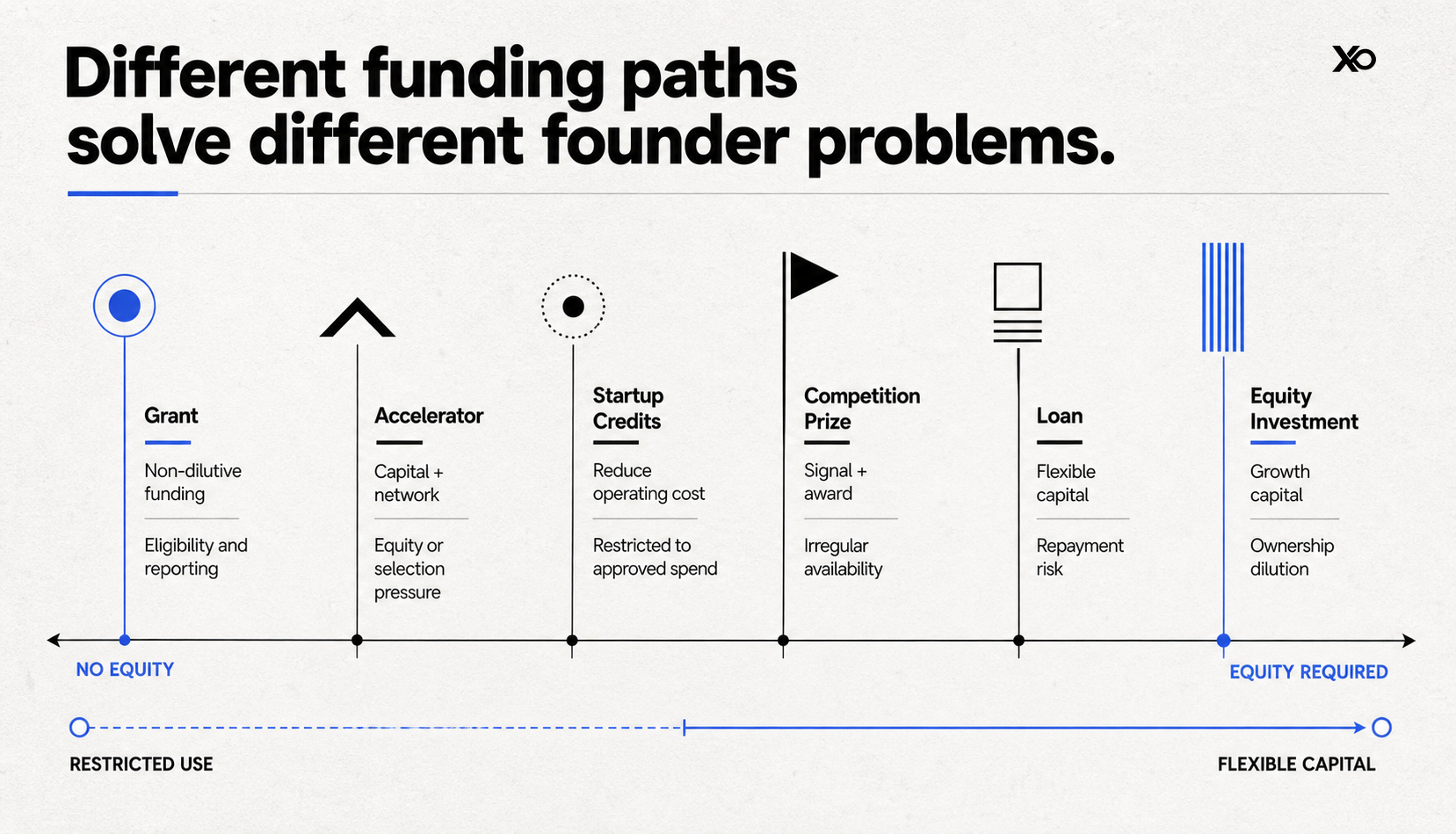
A $100,000 grant, $100,000 cloud credit balance, and $100,000 investment are not economically equivalent.
| Funding type | What it provides | Equity required? | Best use | Main trade-off |
|---|---|---|---|---|
| Grant | Project funding | Usually no | R&D, validation, commercialization | Restricted use and reporting |
| Accelerator | Capital plus support | Sometimes | Company formation, traction, network | Equity, cohort timing, or program demands |
| Startup credits | Discounted usage or services | No | Cloud, APIs, and software | Limited to specific vendors or spend |
| Competition prize | Cash, services, or recognition | Usually no | Prototype or milestone | Competitive and often one-time |
| Loan | Repayable capital | No direct dilution | Working capital or expansion | Repayment and underwriting |
| Equity investment | Unrestricted company capital | Yes | Hiring, growth, market expansion | Dilution and investor expectations |
When should a founder choose a grant?
A grant is usually the better path when:
- The project is clearly defined
- The work already belongs on the roadmap
- The company can tolerate a slower process
- The funding supports a meaningful milestone
- The restrictions are acceptable
- The team can handle reporting and cash-flow requirements
Another path may be better when:
- The company needs unrestricted cash immediately
- The product is mainly a standard application of existing AI tools
- The founder needs sales or hiring capital rather than R&D funding
- The opportunity requires a partner the company does not need
- A grant would delay an important customer or product milestone
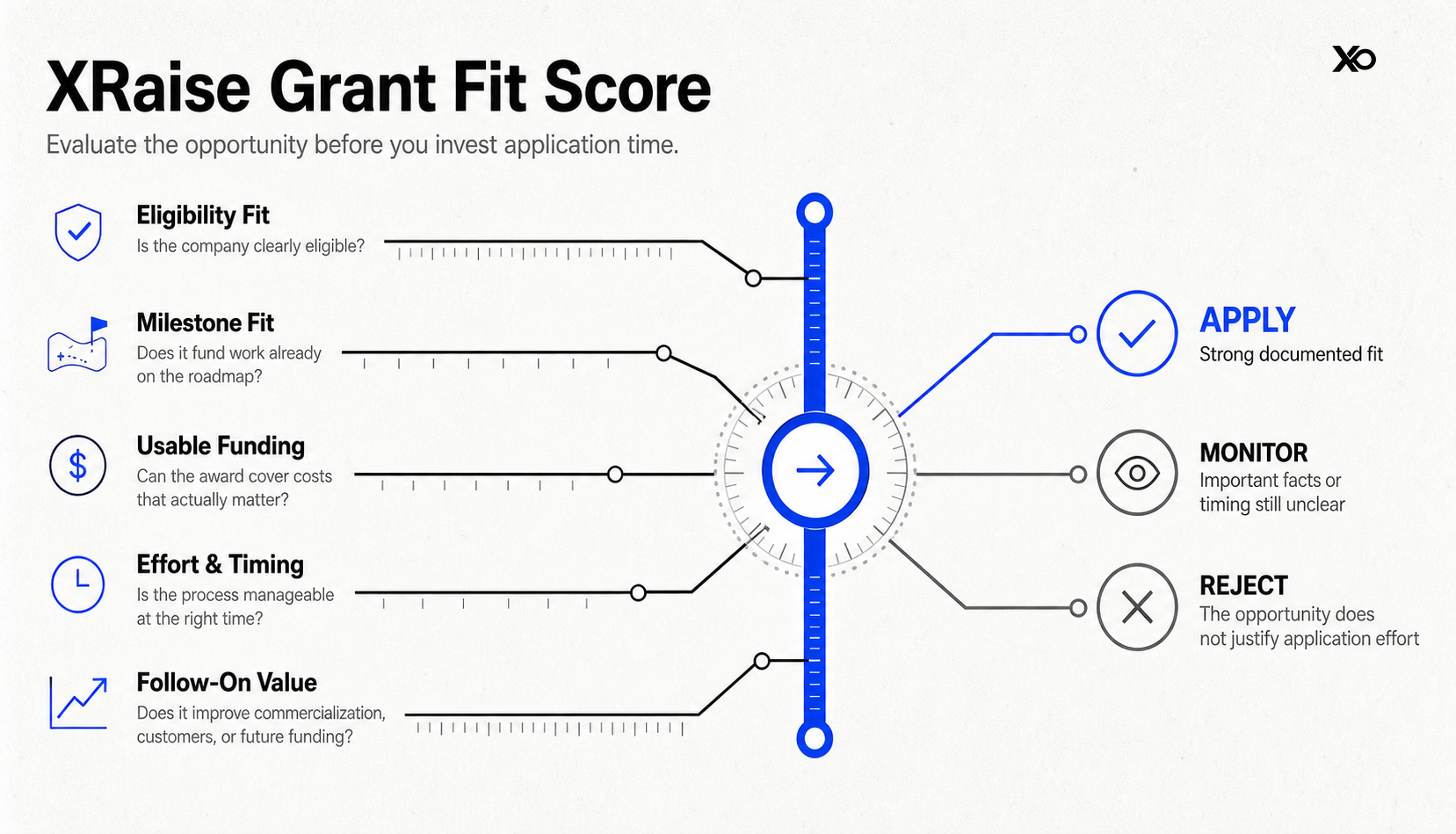
The XRaise Grant Fit Score
The XRaise Grant Fit Score is a simple decision model for classifying an opportunity as Apply, Monitor, or Reject.
Score each dimension from 0 to 2:
| Dimension | 0 | 1 | 2 |
|---|---|---|---|
| Eligibility fit | Clear mismatch | Important facts unclear | Strong documented fit |
| Milestone fit | Does not fund your next milestone | Partial fit | Directly funds planned work |
| Usable funding | Mostly restricted or unusable | Some useful coverage | Meaningful support for actual costs |
| Effort and timing | Closed, impossible, or too slow | Heavy but possible | Manageable and appropriately timed |
| Follow-on value | Little strategic value | Some credibility or learning | Strong path to commercialization, customers, or future funding |
Classify the result as:
- 8–10: Apply — the opportunity deserves serious preparation.
- 5–7: Monitor — clarify missing facts or wait for a better timing window.
- 0–4: Reject — do not spend application time now.
This is a founder decision aid, not a probability model. It does not predict acceptance.
Example
Imagine a Canadian voice AI startup with a working prototype, three employees, and a planned customer pilot. It does not yet have a university research partner.
| Opportunity | Eligibility | Milestone | Usable value | Effort/timing | Follow-on | Result |
|---|---|---|---|---|---|---|
| NRC IRAP | 2 | 2 | 1 | 2 | 2 | Apply |
| EIC Accelerator | 0 | 1 | 2 | 1 | 2 | Monitor |
| Closed UK Frontier AI round | 0 | 1 | 1 | 0 | 1 | Reject for this round |
The score does not say that NRC IRAP will fund the company. It says that the opportunity deserves more attention because the documented fit is stronger.
Main AI startup grant categories
Federal and national R&D grants
These are often the strongest path for companies developing genuinely novel technology.
NSF’s America’s Seed Fund states that it supports early-stage R&D, includes artificial intelligence among its technology areas, offers up to $2 million in seed funding, and takes zero equity. Its eligibility requirements include US ownership, fewer than 500 employees, US-based R&D, and principal investigator employment rules. The NSF eligibility page should be reviewed before preparing a full proposal.
Founder decision rule: Apply when the project involves meaningful technical uncertainty and measurable R&D. Wait when the company is mainly integrating existing models into a routine workflow.
European innovation funding
The EIC Accelerator is designed for startups and SMEs developing high-impact innovations. Its 2026 program describes grant funding below €2.5 million for TRL 6–8 activities, as well as investment options.
Founder decision rule: Consider it when the company has a validated technology, a credible scale-up path, and the geography and application effort make sense. It is usually too demanding for a concept-stage startup without technical and market evidence.
National innovation programs
National programs often combine technical assessment, advisory support, and project funding.
NRC IRAP requires a Canadian incorporated, for-profit business operating in Canada with up to 500 employees. It assesses the technical innovation, management and financial capacity, likelihood of results, commercialization plan, market potential, and Canadian benefit. It does not fund day-to-day operating costs, purely commercial work, work outside Canada, or research with limited commercialization potential.
Founder decision rule: Treat these programs as project-development relationships, not instant cash sources. Confirm the advisor process, eligible costs, and payment structure before budgeting around them.
Industry collaboration grants
Some funding requires a:
- University
- Research organization
- Industry partner
- Pilot customer
- Consortium
Australia’s CRC-P Round 19 included AI systems and technologies as a priority area. It required an Australian SME lead, another Australian industry organization, and an Australian research organization. The specific 2026 round is closed.
Founder decision rule: Pursue collaboration grants when the partner is essential to the technical or commercial project. Do not create a weak consortium merely to satisfy an application rule.
AI-specific challenge competitions
AI-specific competitions may focus on:
- Frontier models
- Explainable AI
- Sustainable AI
- Agentic systems
- Sector adoption
- Safety
- Accessibility
- Defense or national security
The UK AI Champions: Frontier AI Phase 1 competition was designed for UK SMEs developing technically ambitious AI and ML innovations. It is now closed, but its requirements show the type of evidence frontier-AI funders may expect: technical novelty, feasibility validation, defensibility, and a route to scale.
Founder decision rule: Use a challenge competition when the startup’s technical work directly matches the funder’s scope. Do not reshape the company around a temporary theme.
How should specialized AI startups look for grants?
Different AI companies need different funding strategies. The right search begins with the fundable problem, not the product category.
Voice and speech AI
Voice AI startup grants may appear under:
- Accessibility
- Healthcare
- Mental health
- Low-resource languages
- Public services
- Safety
- Industrial communication
- Human-computer interaction
A voice AI founder should define whether the project is about:
- New speech recognition capability
- Latency or reliability
- Voice biomarkers
- Privacy-preserving speech
- Accessibility
- Multilingual performance
- Audio intelligence
- A regulated use case
Founder decision rule: Search for the technical or public problem your voice system solves. “Voice AI” alone is usually not a sufficient grant thesis.
Generative AI
Generative AI startup funding may support:
- New model architectures
- Evaluation methods
- Data or safety infrastructure
- Domain-specific models
- Secure or private deployment
- Scientific discovery
- Public-interest applications
A startup building an application on top of existing models may be better suited to commercialization, sector, customer-pilot, accelerator, or equity funding.
Founder decision rule: Distinguish model or infrastructure innovation from application innovation. The grant path may be different.
Research-driven and deep-tech AI
Research-driven AI startups should examine:
- SBIR/STTR-style programs
- Research-council opportunities
- University-linked funding
- Deep-tech innovation programs
- Translational research grants
- Industry collaboration programs
They should be ready to explain:
- Technical risk
- Experimental design
- Research lineage
- IP ownership
- Team capability
- Commercialization
Regulated or mission-linked AI
Healthcare, climate, defense, education, and public-sector AI may qualify through a mission rather than a generic AI category.
Founder decision rule: Start with the mission, eligibility, and deployment environment. Then determine whether the grant supports the technical work needed to reach adoption.
How much does it cost to apply?
Many government grant programs do not charge an application fee. The real cost is internal effort.
Estimate:
- Founder hours
- Technical writing
- Financial modeling
- Legal and ownership review
- Partner coordination
- Registration
- External grant support
- Interviews
- Reporting after award
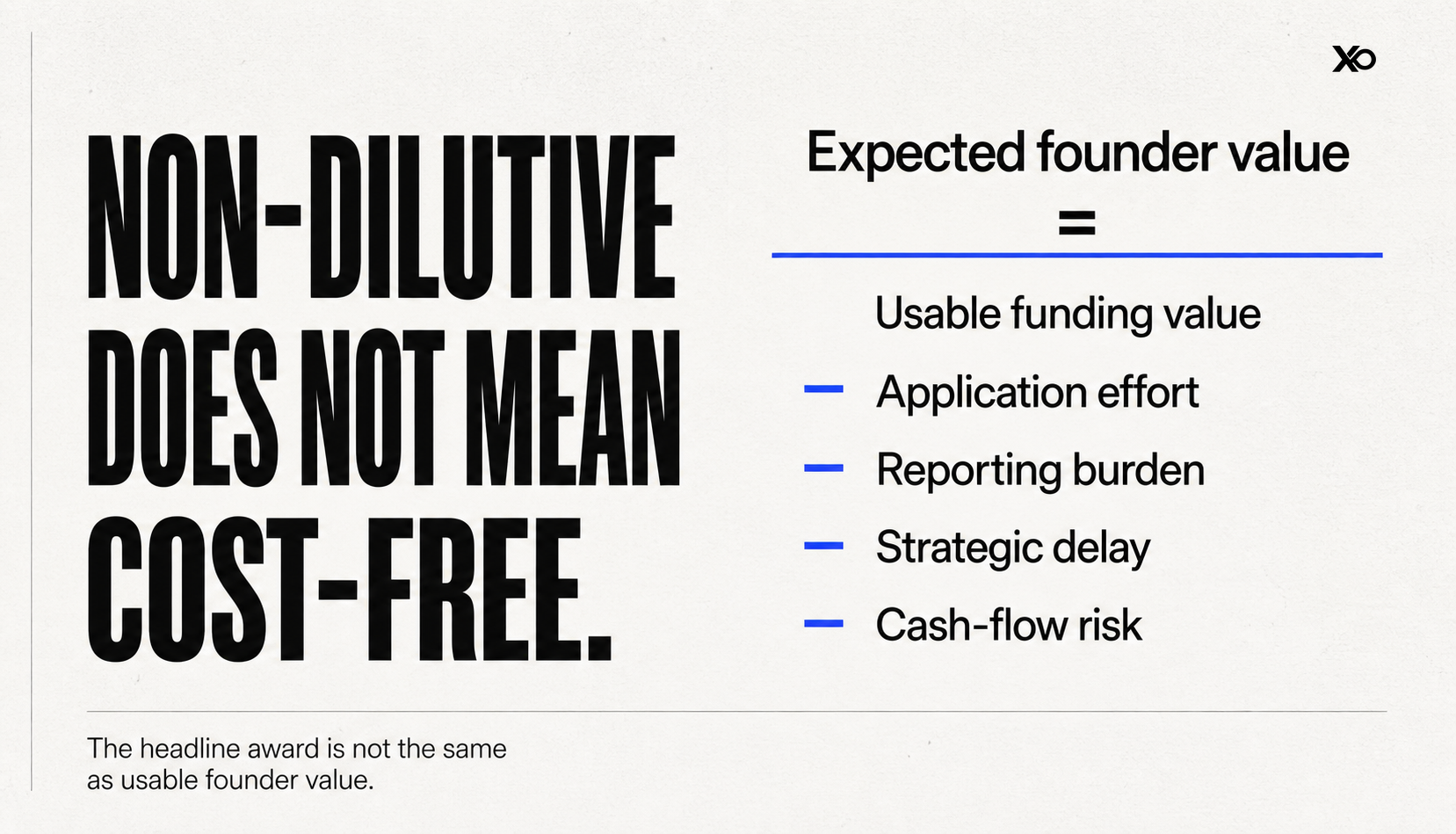
Use this model:
Expected founder value =
usable funding value
− application effort
− reporting burden
− strategic delay
− cash-flow risk
Do not invent an acceptance probability. Use qualitative judgments such as low, medium, or high.
An opportunity is more attractive when:
- The project is already planned
- The evidence already exists
- The funding unlocks a real milestone
- The eligibility fit is clear
- The application can strengthen future fundraising or partnerships
It is less attractive when:
- The company needs unrestricted cash immediately
- The project exists only to match the grant
- The program requires a partner you do not need
- The funding arrives after the milestone is no longer relevant
- The application distracts from customer or product work
What to do at each startup stage
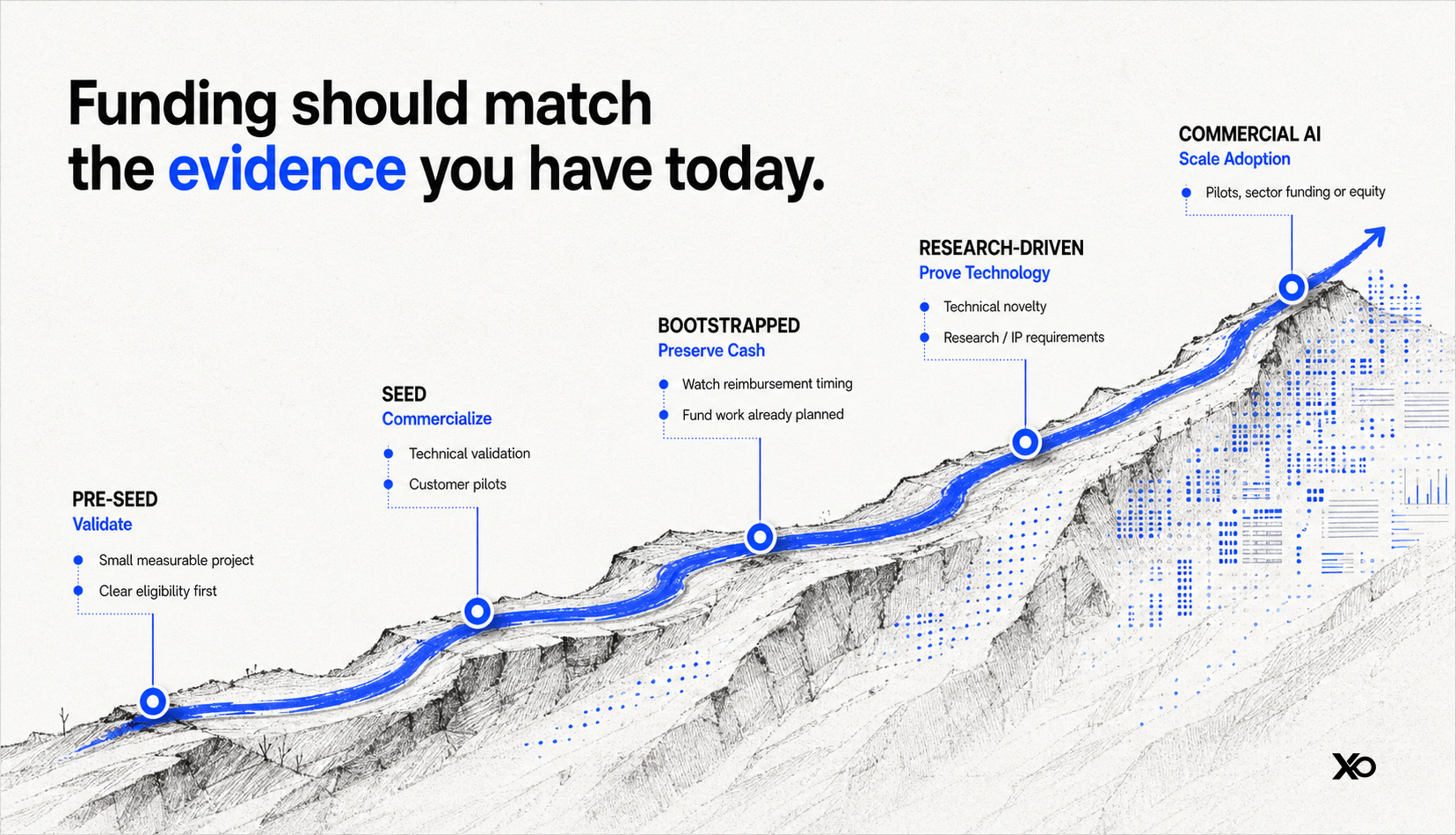
Pre-seed
Prioritize feasibility, eligibility clarity, and a small measurable project.
Avoid large applications built around an untested idea or programs requiring commercial evidence you do not have.
Seed
Prioritize technical validation, customer pilots, commercialization, and defined hiring.
Avoid using research grants to fund a sales problem or treating a grant award as proof of product-market fit.
Bootstrapped AI startups
Prioritize local innovation programs, payroll eligibility, reimbursement timing, and projects already planned.
Avoid programs that require the company to pre-finance expenses it cannot afford.
Research-driven startups
Prioritize technical novelty, research partnerships, IP ownership, principal investigator rules, and commercialization milestones.
Avoid describing ordinary SaaS development as breakthrough research.
Commercial AI startups
Prioritize challenge programs, pilot funding, sector grants, customer-backed projects, accelerators, or equity when speed matters more than non-dilution.
Avoid assuming every AI application qualifies as deep tech.
Common mistakes and anti-patterns
Applying because the award is large
The headline amount may cover a consortium, multiple years, or restricted expenses.
Do instead: calculate the usable value for your specific project.
Treating credits and grants as equivalent
Credits reduce the cost of a specific service. Grants fund defined projects.
Do instead: compare what the support can actually pay for.
Ignoring geography
Many programs require incorporation, employees, project activity, or economic benefit in a particular country.
Do instead: confirm location rules before writing.
Calling an existing product “research”
A standard integration of existing models may not meet a program’s technical novelty threshold.
Do instead: define the specific technical uncertainty and measurable experiment.
Ignoring cash timing
A grant may reimburse approved expenses or arrive after a long review period.
Do instead: model when money arrives, not only how much is advertised.
Treating a closed program as open
A relevant program can still be closed, recurring, or awaiting a future announcement.
Do instead: label every opportunity clearly as Open, Upcoming, Rolling, Recurring, Closed, or Future round not publicly announced.
Practical playbook
Step 1 — Define the fundable project
Write one sentence covering:
- The problem
- The technical or commercial work
- The measurable result
- The expected business or public impact
Step 2 — Build an eligibility profile
Record:
- Country and incorporation
- Employee count
- Ownership
- Funding stage
- Revenue
- Technology-readiness level
- Research partners
- Target market
- Mission area
- Existing funding
Use XRaise’s startup eligibility guide to structure this review, then confirm the current rules with the funder.
Step 3 — Separate funding types
Create separate lists for:
- Grants
- Competitions
- Accelerators
- Startup credits
- Loans
- Equity funding
- Research partnerships
This prevents false comparisons.
Step 4 — Search official program sources
Use official government funding finders, agency pages, research councils, and call documents.
The UKRI funding opportunity system, for example, distinguishes open, upcoming, and closed opportunities. That distinction is essential for current AI grants 2026 research.
Step 5 — Apply the XRaise Grant Fit Score
Score eligibility, milestone fit, usable funding, effort and timing, and follow-on value.
Classify the result:
- Apply
- Monitor
- Reject
Step 6 — Prepare reusable evidence
Maintain:
- Technical summary
- Product overview
- Market problem
- Team biographies
- Milestone plan
- Budget
- IP position
- Customer evidence
- Commercialization plan
- Impact statement
Step 7 — Recheck before submission
Verify:
- Current status
- Deadline
- Funding structure
- Equity terms
- Matching requirements
- Geography
- Company-size rules
- Eligible expenses
- Payment timing
- Reporting obligations
Related XRaise resources
Eligibility and funding preparation
- Review startup grant eligibility before applying
- Use an accelerator application checklist to strengthen funding materials
- Plan runway before choosing a funding path
Adjacent founder resources
- Compare cloud credits for AI startup workloads
- Review startup credits and related funding resources
- Explore startup opportunities that may reduce infrastructure and software costs
Internal link gap: no verified XRaise grant-specific hub or individual grant pages were available in the inspected folder.
FAQ
What are AI startup grants?
AI startup grants are funds awarded for defined AI research, technical validation, commercialization, or mission-related projects. They are often non-dilutive but normally include eligibility rules, allowable costs, milestones, and reporting requirements.
What AI startup grants are available in 2026?
Current or relevant 2026 pathways include NSF America’s Seed Fund, the EIC Accelerator, NRC IRAP, upcoming UKRI AI opportunities, and country-specific innovation programs. Some AI competitions from earlier in 2026 are already closed and should be treated as monitoring signals rather than active opportunities.
How do I find voice AI startup grants?
Start with the problem your speech technology solves, such as accessibility, healthcare communication, multilingual performance, safety, or industrial productivity. Then search the relevant government, research, and mission-specific programs.
What is generative AI startup funding?
Generative AI startup funding includes grants, investments, accelerator capital, competitions, credits, and research programs. The correct path depends on whether the company is developing novel model technology or applying existing models to a commercial workflow.
Are AI startup grants non-dilutive?
Many grants do not take equity, but non-dilutive does not mean unrestricted. Funding may be limited to specific staff, research, locations, partners, milestones, or expenses. Review the award agreement before relying on the money.
Can a SaaS startup qualify for an AI grant?
Possibly. A SaaS company is more likely to qualify when it has technical innovation, measurable uncertainty, a defined R&D project, or a mission-linked application. A routine AI integration may be a weaker fit.
What are the best AI research grants for early-stage founders?
The best option depends on geography and technical maturity. US founders may investigate NSF America’s Seed Fund, while European and national research programs may be relevant for companies with stronger technical evidence, research partners, or commercialization plans.
Are startup credits the same as AI startup grants?
No. Startup credits reduce the cost of using a particular cloud, API, or software provider. Grants provide project funding under a defined program. Credits may complement a grant but rarely replace it.
Should pre-seed founders apply for grants?
Pre-seed founders should apply when the project is clearly defined and the application will not delay validation. If the company has only an idea, customer discovery or a small prototype may create more value first.
Do AI grants require matching funds?
Some programs do and some do not. Australia’s CRC-P, for example, specifies matched funding. Other programs may use different cost-sharing or reimbursement rules. Confirm the current call document before budgeting.

Startup Perks AI Assistant
Have questions about credits? Let's chat instantly.
What should founders do when an AI grant is closed?
Keep the program on a monitoring list, study its eligibility and evaluation language, and look for a current successor or related call. Do not present the closed round as available.
Final takeaway
The best AI startup grants are not the ones that look largest in a search result. They are the ones that match your geography, technology, milestone, evidence, cash position, and commercialization plan.
Use the XRaise Grant Fit Score to decide whether to Apply, Monitor, or Reject. Then verify the current program terms directly with the official funder.
Explore available startup opportunities through XRaise and see which programs may fit your stage, geography, and funding goals.