TL;DR
- Check need before chasing offers.
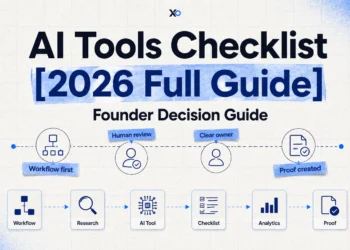
- Use the Need -> Qualify -> Fit -> Own -> Review model.
- Avoid perks that create tool sprawl.
- Model renewal pricing before adoption.
- Use XRaise to compare relevant offers before committing.
The Problem: Founders Pay Before Checking Founder Perks
Early-stage founders are under constant tool pressure.
The product needs to ship. Sales needs follow-up. Customers need support. The team needs docs. AI experiments need credits. Cloud costs are starting to show up. Marketing needs better workflows. Finance needs less manual tracking.
So the founder opens the pricing page and pays.


Sometimes that is fine. Speed matters. But many pre-seed and seed-stage teams pay for software, cloud tools, AI platforms, and operational products before checking whether they qualify for startup perks, startup discounts, startup credits, or free startup tools that could reduce early burn.
The mistake is not only missing savings. The deeper mistake is making a paid tool decision before understanding the full decision.
Before paying, founders should first compare relevant startup perks and tools so the purchase decision includes available credits, discounts, and eligibility paths.
A perk can change the timing, plan, provider, renewal risk, and ownership model. It can make a necessary tool easier to test. It can also make an unnecessary tool feel responsible.
That is why the right question is not:
“Can we get this cheaper?”
The better question is:
“Should this tool enter the stack, and if yes, what is the smartest way to pay for it?”
This checklist helps founders answer that before the subscription becomes another quiet drain on runway.
The Mental Model: Need -> Qualify -> Fit -> Own -> Review
Use this five-part model before paying for any meaningful startup tool:
- Need
- Qualify
- Fit
- Own
- Review
This keeps the perk decision connected to the operating decision.
Need
What current bottleneck does the tool solve?
Do not start with the category. Start with the workflow.
Be specific about the workflow before choosing the tool. Instead of “we need a CRM,” write “we need one place to track qualified founder-led sales conversations and next steps.” For analytics, the real question might be “we need to know where invited users fail to activate.” For AI credits, define the test clearly: “we need to see whether model usage can support the product experience without damaging margins.”
If the need is vague, the perk is premature.
Qualify
Can the startup actually claim the offer?
Startup discount eligibility may depend on company age, funding stage, incorporation status, domain email, region, accelerator membership, prior account usage, current plan, partner approval, or whether the startup has already received a similar offer.
Eligibility friction matters because founder time is not free. A large offer that takes hours to apply for and has weak odds of approval may be less useful than a smaller startup software discount the team can actually use this week.
Fit
Does the offer fit the tool, plan, timing, and workflow?
The risk is hidden in the terms. One perk may apply only to specific plans. Another credit may expire before the team is ready to use it. A discount can look strong while pushing the startup toward software that is too heavy for its stage. Free tools can work for solo founders, then break down once permissions, reporting, and customer data discipline matter.
Fit beats headline value.
Own
Who owns the tool after it enters the stack?
Every claimed perk needs an owner. The owner tracks setup, usage, seat growth, renewal dates, data access, cancellation paths, and whether the tool still supports the workflow.
Without an owner, the startup does not have a perk. It has a future cleanup task.
Review
When will the team decide whether the tool stays?
A perk should create a review moment before the renewal or credit expiration date. Founders should know what would prove the tool helped: faster shipping, clearer customer insight, lower infrastructure cost, better sales follow-up, improved activation, less admin work, or better operating visibility.
If the startup would not pay full price after the offer ends, do not build critical workflows around the tool without a replacement plan.
The Startup Perks Checklist
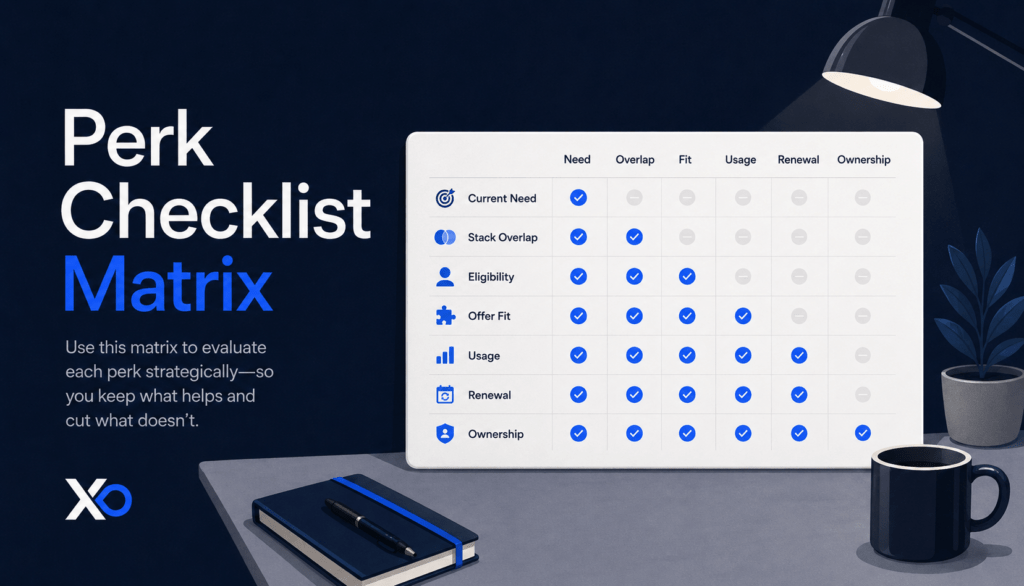
Use this checklist before paying for software, infrastructure, AI tools, or operational products.
1. Current need
- What workflow is painful right now?
- What decision or output should the tool improve?
- Is this a real bottleneck or a nice-to-have category?
- Would the team still want this tool if there were no discount?
2. Existing stack overlap
- What tool already does part of this job?
- Would this replace something or sit beside it?
- Which system will be the source of truth?
- What will we cancel, downgrade, or stop using if this works?
3. Startup discount eligibility
- Do we meet the stage, funding, age, and region requirements?
- Do we need incorporation documents, a company domain, investor proof, or accelerator status?
- Are existing customers excluded?
- Does the offer require a new account?
- How long might approval take?
4. Offer fit
- Does the perk apply to the plan we actually need?
- Are usage limits, seat limits, support levels, or add-ons included?
- Does the offer expire before we can use it well?
- Is the provider a good fit for our stage and team?
5. Usage and adoption
- Who will set up the tool?
- Who will use it weekly?
- What data will live inside it?
- What workflow will change because of it?
- What would prove adoption after 30 to 60 days?
6. Renewal and post-offer cost
- When does the free period, credit, or discount end?
- What is the full-price plan after the offer?
- What happens if seats, usage, storage, contacts, messages, compute, or API calls grow?
- Is cancellation easy?
- Would the tool still make sense at full price?
7. Ownership
- Who owns the tool?
- Who owns the renewal reminder?
- Who reviews permissions?
- Who decides whether to keep, downgrade, replace, or cancel?
This is the simplest way to turn startup perks from scattered offers into a founder decision system.

Startup Perks AI Assistant
Have questions about credits? Let's chat instantly.
How to run the startup perks checklist in 15 minutes
Founders do not need a complicated procurement process. They need a fast review that happens before the card is charged.
Use a 15-minute version when the tool is not mission-critical but still creates a recurring cost, login, data surface, or renewal risk.
Minutes 1 to 3: write the workflow sentence.
Do not write “analytics tool,” “AI platform,” “CRM,” or “project management.” Write the job in operational language: “show activation drop-off before onboarding changes,” “track warm investor introductions,” “reduce support reply time,” or “test inference cost for one customer workflow.” If the sentence is hard to write, the team is not ready to buy.
Minutes 4 to 6: check existing overlap.
Open the current stack list. Ask whether another product already handles 60% of the job. If yes, the decision is not only whether the new offer is useful. The decision is whether the startup should replace, consolidate, or keep the current workflow.
Minutes 7 to 9: check startup discount eligibility.
Look for stage requirements, prior account limits, region limits, partner requirements, expiration dates, and whether the offer applies to the plan the team will actually use. This is where founders often discover that a perk is real but not useful for their exact situation.
Minutes 10 to 12: model the renewal.
Write the full-price plan, expected seat count, usage driver, renewal date, and cancellation path. This does not need to be a perfect finance model. It only needs to answer whether the startup would still want the tool if the discount disappeared tomorrow.
Minutes 13 to 15: assign the owner and review date.
If nobody wants to own the tool, do not add it. The owner should know what success looks like after 30 to 60 days and what will happen before the discount ends.
The value of this startup perks checklist is not bureaucracy. It is speed with fewer regrets.
How to Use the Checklist by Tool Category
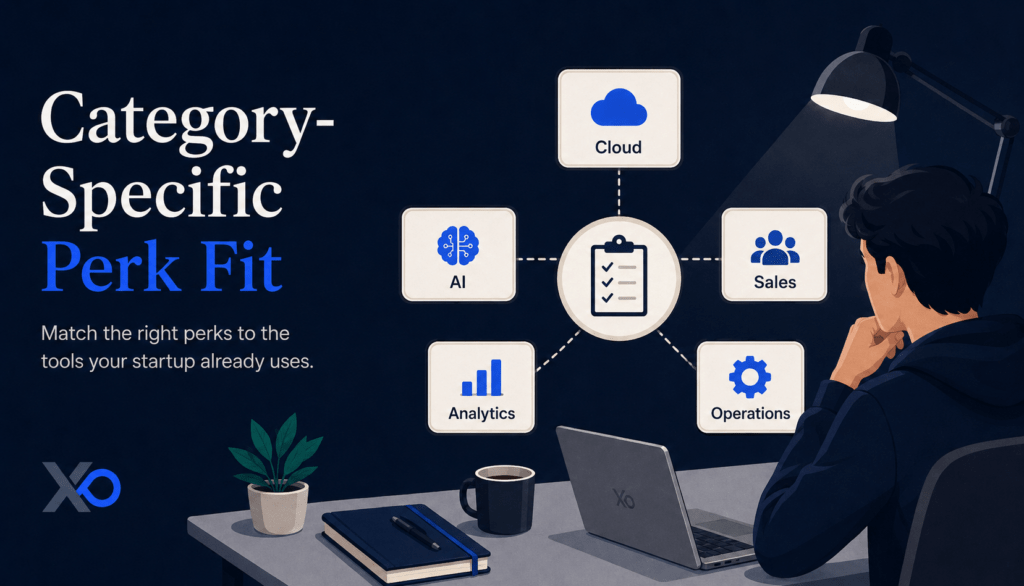
Cloud and infrastructure
Cloud credits can reduce early burn, especially for SaaS, AI, developer-tool, marketplace, and data-heavy startups. But they can also shape architecture before the workload is clear.
Before choosing a provider, check workload fit, team familiarity, post-credit costs, portability, and whether the credits support a real customer or product milestone. Startup credits should buy learning, not accidental lock-in.
For deeper infrastructure risk, read 5 Cloud Credit Mistakes, then compare options like AWS Activate, Google Cloud, Microsoft for Startups, and DigitalOcean.
AI platforms and APIs
AI founders should be especially careful with usage-based pricing. A free credit can make experimentation easier, but the product’s economics still need to work after credits expire.
Use the checklist to separate internal productivity tools from product infrastructure. A writing assistant is a workflow tool. A model provider, speech API, vector database, or GPU platform may become part of the product’s cost structure.
Sales, CRM, and GTM tools
Sales tools are useful when the founder has enough conversations that follow-up, qualification, and pipeline visibility are starting to break.
Do not claim a CRM or outbound tool just because there is a startup software discount. First define the ICP, sales stages, owner, and proof signal. The tool should improve follow-up quality, not create a dashboard for a sales motion that does not exist yet.
Analytics and product tools
Product analytics is valuable when it supports a decision: activation, retention, onboarding, feature adoption, conversion, or channel quality.
If the team has not defined the decision, the dashboard will become decoration. Use startup perks to reduce the cost of learning, not to collect metrics nobody uses.
Workspace and operations tools
Docs, project management, automation, finance, design, and team communication tools can save serious founder time. They can also create tool sprawl quickly.
Before adding another workspace or operational product, decide the source of truth. The best founder perks make one important workflow lighter. The worst ones give the team a second place to lose context.
For a broader view of which tools actually belong in an early stack, use this guide to startup tools for founders before comparing individual perks.
Startup Perks Checklist by Stage
The same offer can be smart for one startup and distracting for another. Stage changes the checklist because the risk changes.
Startup perks checklist for bootstrapped teams
Bootstrapped founders should treat every paid tool as a cash and attention decision.
The best startup perks are the ones that replace spending the team would have made anyway or reduce manual work tied to revenue, delivery, or customer learning. A discount on a tool nobody uses weekly is not savings. It is another surface to remember.
Use a stricter version of the checklist:
- Does this help us sell, build, support, or collect payment faster?
- Would we use it this month without the discount?
- Can one founder own it without creating admin drag?
- Does the full-price plan still make sense if revenue stays flat?
Bootstrapped teams should be especially careful with annual commitments. A one-year discount can still create a cash trap if the startup has to renew before the workflow is proven.
Startup perks checklist for pre-seed founders
Pre-seed teams are usually trying to turn assumptions into proof. That means perks should support experiments, not a polished operating stack.
Good uses include cloud credits for a real customer pilot, analytics for activation learning, a CRM for active founder-led sales, an AI tool for product testing, or a workspace that keeps customer insight and product decisions organized.
Weak uses include advanced reporting, complex automation, heavy customer success systems, or multiple overlapping tools that make the startup look more mature than it is.
At pre-seed, the review question is:
“Will this perk help us prove the next thing investors, customers, or the team needs to believe?”
If the answer is no, wait.
Startup perks checklist for seed-stage teams
Seed-stage startups usually have more team members, more users, more customer conversations, and more operational repetition. That makes some startup software discounts more valuable because the workflow is becoming repeatable.
But seed teams also face a new risk: keeping tools because they were easy to claim months ago.
At seed, the startup perks checklist should include adoption quality. Is the tool used by the right people? Does it support a source of truth? Has it changed a decision? Does it reduce founder load? Does it improve pipeline, onboarding, activation, support, engineering speed, or cost visibility?
Seed teams should run a monthly perk and renewal review. The goal is not to cut everything. The goal is to keep the tools that are becoming company infrastructure and remove the ones that were only useful during the discount window.
Decision Rules
Use these rules before claiming a startup perk, credit, or software discount. The goal is to make sure the offer supports a real workflow before it becomes part of the stack.
| Situation | Decision rule |
|---|---|
| The workflow is unclear | Do the manual version first. |
| The tool solves a current bottleneck and the offer is easy to claim | Apply before paying. |
| Startup discount eligibility is uncertain and the need is weak | Wait. |
| The perk overlaps with an existing tool | Decide what it replaces before adoption. |
| The offer expires before your team can use it | Save it for later. |
| The post-offer price would not make sense | Avoid making the tool core infrastructure. |
| Nobody owns setup, usage, and renewal | Do not claim the perk. |
| The perk lowers the cost of a tool you already need | Use it deliberately. |
| The tool has not created proof in 30 to 60 days | Downgrade, replace, or cancel it. |
A useful perk should reduce the cost of a decision the startup already needs to make. If it adds another dashboard, renewal, or unused workflow, it should wait.
Common Mistakes and Anti-Patterns
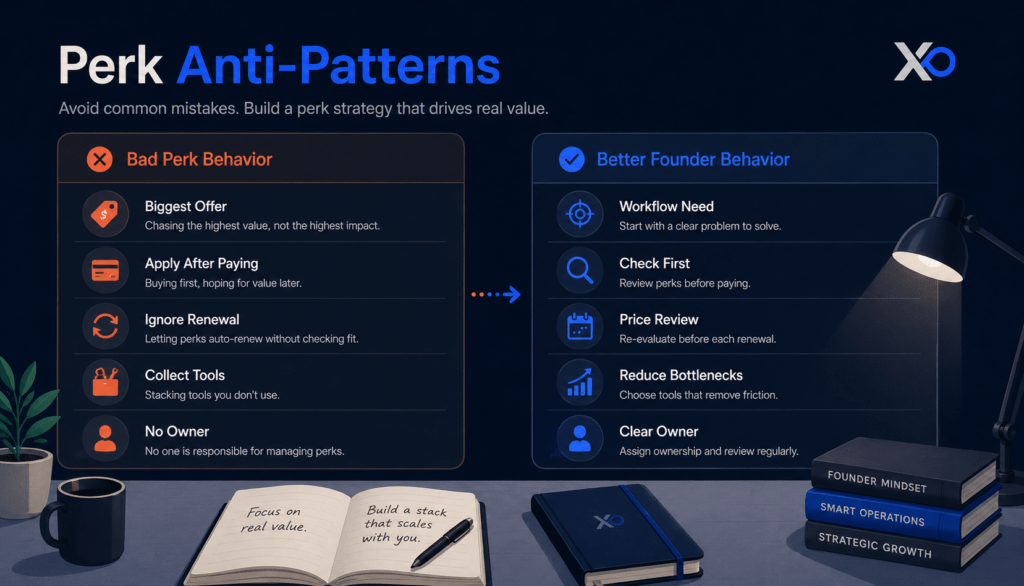
Mistake 1: treating the biggest offer as the best offer
A $10,000 credit is not automatically better than a smaller discount. The best offer is the one attached to the workflow your startup actually needs.
Headline value can pull founders toward tools that are too complex, too early, or too far from the next milestone.
Mistake 2: applying after paying
Many startup perks are designed for new customers, specific plan types, or partner application flows. If the founder pays first and checks later, the team may lose eligibility.
Check before the first invoice whenever possible.
Mistake 3: ignoring renewal pricing
Free periods and discounts end. Credits expire. Usage grows. Seats multiply. Add-ons appear right when the tool becomes part of the operating system.
Renewal pricing is not a finance detail. It is part of the original buying decision.
Mistake 4: collecting tools instead of reducing bottlenecks
Perks can make software collection feel like cost discipline. It is not.
A lean startup stack is not built from every available deal. It is built from tools that support proof, learning, revenue, or leverage.
Mistake 5: leaving ownership vague
If everyone uses the tool but nobody owns it, the renewal will drift. Permissions will sprawl. Usage will become unclear. Cancellation will feel harder later.
One owner per tool is a small rule that prevents a lot of operational drag.
What Should Founders Check Before Paying for Startup Tools?
Founders should check current need, existing overlap, startup discount eligibility, offer fit, usage expectations, renewal pricing, and ownership before paying for startup tools.
The most important part of the checklist is need. A perk is useful when it reduces the cost of a tool tied to a real bottleneck. It is risky when it makes an unnecessary tool feel cheap enough to adopt.
Are Startup Perks Worth It for Pre-Seed and Seed Teams?
Startup perks are worth it when they reduce the cost of necessary experiments, infrastructure, customer learning, sales follow-up, team workflows, or product decisions.
They are less useful when founders claim offers because they look valuable in isolation. Pre-seed and seed teams should use startup discounts to extend runway quality, not to build a mature-looking stack before the company has mature workflows.
How XRaise Fits into the Workflow
Use XRaise after naming the bottleneck and before paying full price.
The workflow is simple:
Need first. Compare relevant offers. Check eligibility. Choose the tool that fits. Assign an owner. Review before renewal.
That sequence keeps the founder in control of the decision. XRaise helps reduce search and comparison work, but the startup still decides whether the perk belongs in the stack.
Final Takeaway
The point of startup perks is not to claim more offers. It is to make better tool decisions before money, data, workflow, and team habits get committed.
Use the startup perks checklist before paying: need, qualify, fit, own, review.
Final rule:
Never let a discount choose your stack. Let the bottleneck choose the tool, then use the perk to reduce the cost.