TL;DR
- Check eligibility before checking offer size.
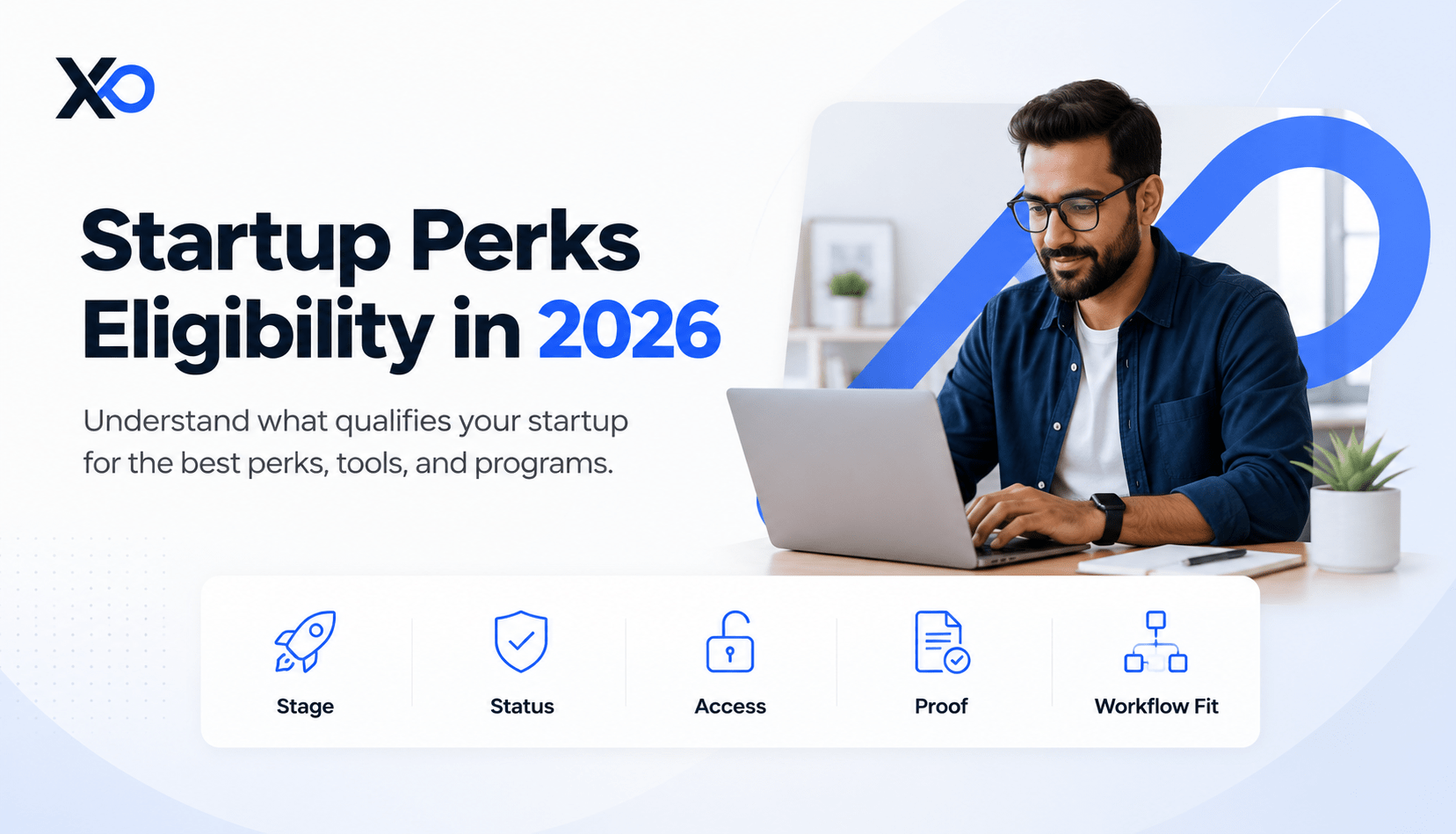
- Use the Stage -> Status -> Access -> Proof filter.
- Avoid perks blocked by old accounts or missing documentation.
- Prioritize offers tied to current workflows.
- Build a lightweight startup perks checklist before applying.
The Problem: Founders Treat Perks Like Savings Before They Check Access
Startup perks feel like found leverage. A cloud credit can reduce infrastructure spend. A CRM discount can make sales tooling easier to justify. An analytics offer can help a founder measure activation without adding another full-price subscription. A workspace or project management discount can support a small team that is trying to stay organized.
That is why founders often rush.
They see a useful-looking offer, skim the headline, open the application, and assume the remaining details are admin. Then the application asks for a company domain, incorporation date, funding status, accelerator membership, partner referral, investor proof, product website, LinkedIn page, business email, or confirmation that the company has never used the provider before.

Suddenly the perk is not a simple discount. It is an eligibility puzzle.
This is where startup perks eligibility becomes an operating question, not a paperwork question. If the founder does not qualify, the lost cost is not only the rejected application. It is the attention spent researching, applying, following up, opening accounts, and waiting for approval on an offer that was never likely to clear.
For pre-seed and seed teams, that attention matters. The same hour could have gone into customer calls, activation work, investor updates, hiring, support, or a better software decision.
The better question is not, “Is this a good perk?”
Ask:
“What would have to be true for us to actually access this offer?”
Eligibility is only one part of the decision. A startup can qualify for a discount and still waste time or create tool sprawl by claiming the wrong offer. To avoid broader perk decision traps, read 7 Startup Perks Mistakes.
Why Startup Discount Eligibility Is Often Narrower Than It Looks
Startup discount eligibility is usually designed around provider risk.
Software companies want to support early teams, but they also need to prevent duplicate claims, mature companies pretending to be early-stage, agencies applying as startups, existing customers trying to re-enter new-user programs, or accounts using credits without a serious business use case.
That is why many startup software offers include filters.
Some filters are stage-based. The company may need to be pre-seed, seed, bootstrapped, early revenue, under a certain age, below a funding threshold, or not yet on an enterprise contract.
Some filters are access-based. The offer may require accelerator membership, investor affiliation, incubator participation, partner referral, or a verified application path.
Some filters are account-based. The company may need to be a new customer, use a new workspace, apply before creating a paid account, or avoid combining the offer with another discount.
Some filters are proof-based. The provider may ask for a company website, legal entity name, business email, funding proof, product description, deck, LinkedIn profile, or evidence that the applicant is building a real startup.
Some filters are geographic. A perk may be available only in certain countries, regions, currencies, or legal jurisdictions.
None of this means the offer is hostile to founders. It means startup credits and discounts are usually conditional. The founder’s job is to identify the condition before committing time.
The Core Framework: Stage -> Status -> Access -> Proof
Use this mental model before applying:
Stage -> Status -> Access -> Proof
If a perk passes all four, it is probably worth considering. If it fails one, the founder should either fix the gap, save the offer for later, or skip it.
Stage
Stage asks whether the offer is meant for a company like yours right now.
Check company age, funding stage, team size, revenue level, product maturity, and whether the provider defines “startup” in a specific way. A pre-incorporation founder may qualify for some community programs but fail offers that require a legal company. A seed-stage team may qualify for stronger startup credits than a solo idea-stage founder, but may fail offers designed only for new or unfunded companies.
The practical test:
“Does our current company stage match the offer’s stated startup definition?”
Status
Status asks whether your relationship with the provider blocks the offer.
This is one of the most overlooked startup perks checklist items. Existing account history can matter. A provider may exclude companies that already used a free trial, created a paid workspace, claimed credits under a different program, or registered with the same domain in the past.
Before applying, check who on the team already created accounts. Search old billing emails. Ask whether an advisor, contractor, or previous employee opened a workspace. If the offer is for new customers only, account history can decide the outcome before the application starts.
The practical test:
“Have we done anything with this provider that could make us ineligible?”
Access
Access asks whether you can enter the correct application path.
Some startup perks for founders are open applications. Others require a partner, investor, accelerator, incubator, founder community, cloud program, or startup platform. A founder may meet the stage requirements but still fail because the application must come through a specific channel.
This is where founders often waste time. They read the offer, assume they qualify, then discover they need a referral code, a partner dashboard, or membership in a qualifying program.
The practical test:
“Can we apply through the required access path today?”
Proof
This step asks whether you can provide the documents and signals needed for approval.
The required proof may be lightweight: a company website, business email, product description, LinkedIn page, or founder identity. For more formal programs, it may include incorporation records, funding confirmation, accelerator acceptance, investor affiliation, a pitch deck, tax details, or billing information.
The mistake is applying before proof is ready. A weak or incomplete application can create delays, rejections, and back-and-forth that make the perk more expensive in founder time than expected.
The practical test:
“Can we show enough evidence that we are the type of startup this offer supports?”
A Practical Startup Perks Checklist Before Applying
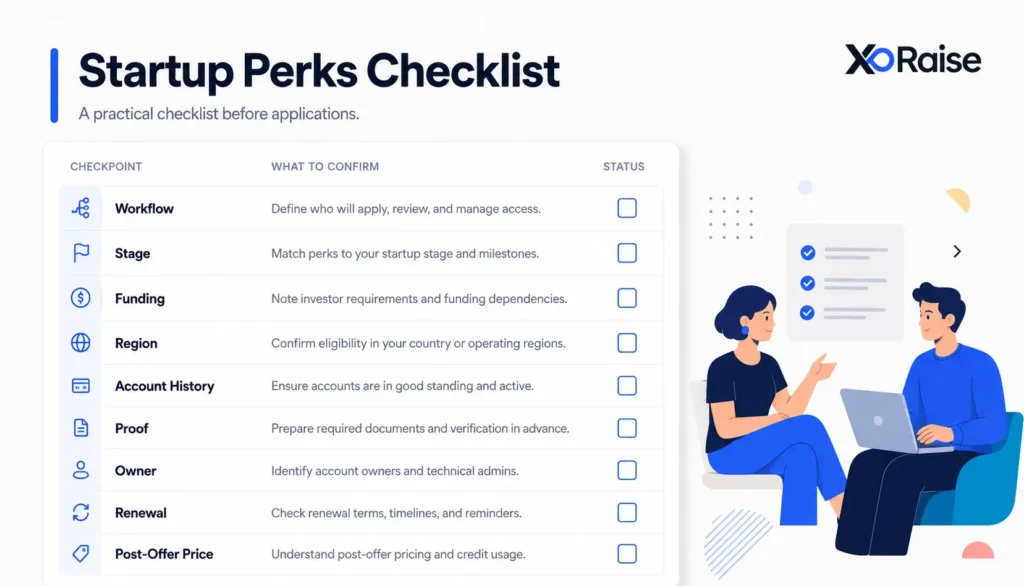
Before applying to any startup perk, capture the answer to these questions in one place:
- What workflow would this perk support?
- What stage does the offer require?
- Does funding status matter?
- Is there a company age limit?
- Is the offer country or region restricted?
- Does accelerator, investor, or partner membership matter?
- Is it only for new customers?
- Have we used this provider before?
- What proof is required?
- Who owns the application and renewal review?
This should take five to ten minutes. If it takes longer, that is useful signal. Either the offer has unclear eligibility, or the team does not yet have its own startup information organized.
The goal is not bureaucracy. The goal is to make startup perks eligibility visible before the founder enters a slow application loop.
How to Prioritize Perks You Are More Likely to Qualify For
Not every relevant perk deserves the same attention.
Start with offers where the workflow need is current and the eligibility path is clear. These are the highest-quality opportunities because they combine business value with low application friction.
Then consider offers with strong value but one solvable eligibility gap. For example, maybe the team needs to update its company website, verify a business email, collect proof of accelerator participation, or clarify account ownership. If the tool is genuinely important, fixing that gap may be worth it.
Save unclear offers for later. If the company is too early, not yet incorporated, missing proof, outside the supported region, or blocked by existing account history, do not keep rechecking the application every week. Put it in a “later” bucket with the condition that would make it worth revisiting.
Skip offers that require heavy effort for a tool the company does not need. A large discount does not matter if the startup has no workflow owner, no near-term use case, and weak eligibility.
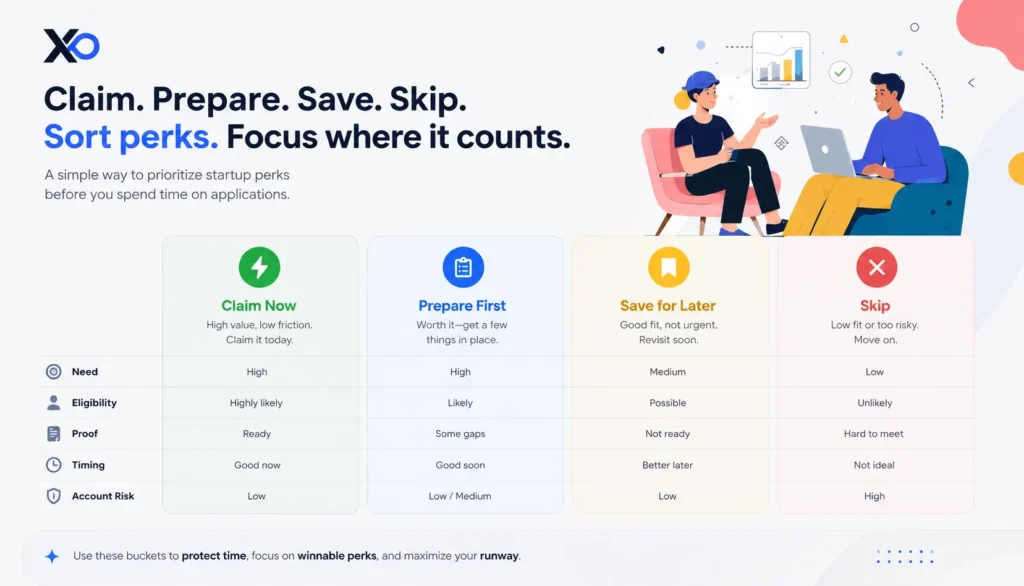
Use four buckets:
Claim now: clear need, clear eligibility, required proof ready, low account risk.
Prepare first: useful offer, but one missing document or access path.
Save for later: good fit eventually, but stage or timing is wrong today.
Skip: weak workflow need, unclear terms, blocked account history, or heavy application friction.
For workflow tools, prioritize eligibility only after the need is clear. That might mean comparing HubSpot for Startups, Mixpanel, Notion for Startups, or Make Startup Program.
Decision Rules
Use these rules before applying for a startup perk, credit, accelerator benefit, or software discount. The goal is to avoid claiming offers that create extra work before the startup is ready to use them.
| Situation | Decision rule |
|---|---|
| The offer does not support a current workflow | Wait. |
| Stage requirements are unclear | Verify them before applying. |
| Funding status is outside the stated range | Skip it or save it for later. |
| The offer requires accelerator or partner access you do not have | Find the correct application path before starting. |
| Your company already has an account | Check whether existing account history blocks the offer. |
| Required proof is missing | Prepare the application materials before submitting. |
| Approval would arrive after the tool is useful | Prioritize another option. |
| Two offers solve the same job | Apply first to the one with clearer eligibility. |
| The post-offer price would not work | Do not build a core workflow around the perk. |
| Nobody owns the application, renewal, and usage review | Do not claim it yet. |
A good offer should match the startup’s stage, workflow, eligibility, and ownership. If the path is unclear, the safer move is to verify first instead of adding another tool, renewal, or unused benefit to the stack.
Common Mistakes and Anti-Patterns
Mistake 1: applying because the headline value is high
A big credit number can make an offer feel automatically worth chasing. But the best startup credits are the ones tied to a tool the company can access and use now.
If the offer requires a stage, geography, partner path, or proof the company cannot meet, the headline value is irrelevant. Treat claimability as part of the value.
Mistake 2: ignoring existing account history
Founders often forget that someone may have created an account months ago during a test. That old workspace, free trial, paid invoice, or domain registration can affect startup discount eligibility.
Before applying, check the provider relationship. It is better to know the account issue before submission than discover it after a slow rejection.
Mistake 3: collecting documents after the application starts
Some founders begin the form, then go looking for incorporation details, funding proof, accelerator confirmation, billing information, product descriptions, and team emails.

Startup Perks AI Assistant
Have questions about credits? Let's chat instantly.
That turns a simple application into a stalled task. Keep a lightweight proof folder ready for startup software offers: legal name, website, founder email, company description, pitch deck, incorporation date, funding stage, and relevant memberships.
Mistake 4: confusing partner access with general eligibility
A startup may match the provider’s target stage but still need to apply through a partner, investor, accelerator, or approved startup channel. General eligibility means the company type fits. Access eligibility means the company can enter the right door.
Founders should check both.
Mistake 5: applying to perks before choosing the tool category
Perks should reduce the cost of a tool decision. They should not decide the category for you.
If the team does not know whether it needs a CRM, analytics platform, cloud provider, automation tool, or workspace system, do not let discounts create the roadmap. Define the bottleneck first, then compare offers.
For a broader view of how perks can create hidden work, read 7 Startup Perks Mistakes.
How to Use This at Your Stage
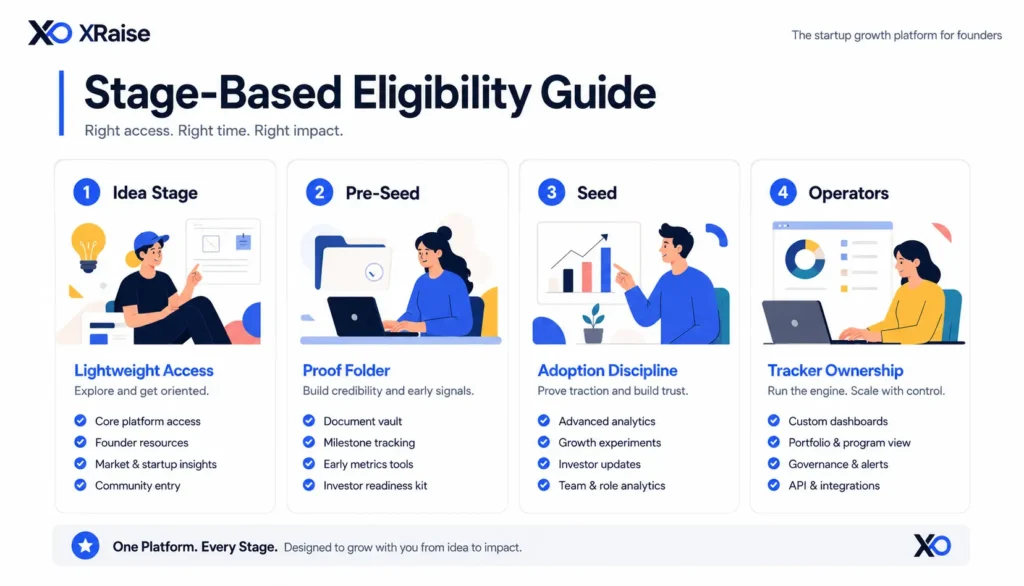
Idea-stage and pre-incorporation founders
Focus on lightweight tools and offers that do not require formal company proof. If a perk requires incorporation, funding, or business verification, save it for later. Your job is to avoid burning time on applications built for companies one step ahead of you.
Pre-seed founders
Build your proof folder early. You may not have much revenue or funding, but you can usually prepare a clear company description, website, business email, founder profile, product demo, and stage summary. This makes startup perks eligibility easier to check quickly.
Seed-stage teams
Your risk shifts from “can we qualify?” to “should we adopt this?” At seed, many teams can access stronger startup discounts, but the wrong tool can still create stack drag. Prioritize perks that support sales, activation, infrastructure, customer support, analytics, or operations already becoming repeatable.
At this stage, eligibility should connect to runway quality. For that broader lens, read Startup Runway Extension.
Startup operators
Turn eligibility into a repeatable operating system. Maintain a perk tracker with owner, status, application path, required proof, account history, renewal date, post-offer price, and decision bucket. Operators can save founders hours by making the messy parts visible before the application begins.
What Should a Startup Perks Checklist Include Before Applying?
Founders should check company stage, funding status, company age, geography, partner or accelerator requirements, existing account history, required documents, approval timing, post-offer pricing, and whether the tool supports a current workflow.
The fastest way to avoid wasted applications is to separate “we want this offer” from “we qualify for this offer.” Startup perks eligibility is the bridge between those two ideas.
Are Startup Credits Worth Applying For if Eligibility Is Unclear?
Startup credits are worth applying for when the upside is meaningful, the tool supports a real workflow, and the eligibility gap can be clarified quickly.
If the offer is only mildly useful and the rules are vague, wait. Founder time is also a scarce resource. A smaller offer with a clear path may be better than a bigger offer with unclear access, long approval, or weak fit.
Final Takeaway
The best startup perk is not the biggest offer. It is the offer your company can qualify for, use soon, own clearly, and keep only if it still makes sense after the discount ends.
Final rule:
Check eligibility before effort.