TL;DR
- Startup perks save money only when they solve a current bottleneck.
- Use the Need -> Fit -> Cost -> Owner filter.
- Avoid offers that create tool sprawl or admin drag.
- Check eligibility, renewals, and post-offer costs before claiming.
- Use XRaise to find relevant perks, then choose deliberately.
The Problem: Startup Perks Can Become Operational Noise
Most startup perks mistakes start with a reasonable instinct: if a tool is discounted, free, or credited, maybe the startup should take it.
That instinct makes sense. Pre-seed, seed, bootstrapped, SaaS, AI, and technical founders all feel pressure to reduce costs. A discounted CRM, cloud credit, analytics offer, project management plan, automation tool, or AI platform can stretch runway and reduce the cash cost of experimentation.
But a perk is not free if it creates a workflow the company did not need.



Every claimed offer can create another login, dashboard, billing account, security setting, renewal reminder, integration path, permission layer, and decision surface. If the tool does not solve a current bottleneck, the founder has added another small system to remember.
This is why startup perks mistakes are not only about missing savings. They are about turning discounts into distraction.
The real question is not, “Is this a good offer?”
Ask:
“Does this offer reduce the cost of a tool we already need, or does it create a new thing to manage?”
Founders can use Startup perks and tools through XRaise to compare relevant offers, but the decision should still start with the bottleneck, not the discount.
Why Discounted Tools Still Cost Founder Time
A startup discount lowers the invoice. It does not remove the operating cost.
There is discovery cost. Founders compare offers, read terms, check eligibility, and decide whether the perk applies to their stage.
There is setup cost. Someone needs to create the account, invite users, configure settings, connect integrations, migrate data, and teach the team how to use it.
There is attention cost. Another dashboard means another place where work, metrics, customer data, tasks, or alerts may live.
There is renewal cost. Discounts expire. Credits run out. Trials convert. Annual plans renew. If nobody owns the calendar, the founder discovers the real price after the stack has already absorbed the tool.
There is stack cost. The new tool may overlap with something the startup already uses, creating confusion over which system is trusted. If the perk affects your broader software stack, it helps to compare it against your overall startup tool stack decisions before adding another account or dashboard.
Startup perks for founders should be evaluated like operating decisions, not like found money.
The Need -> Fit -> Cost -> Owner Filter
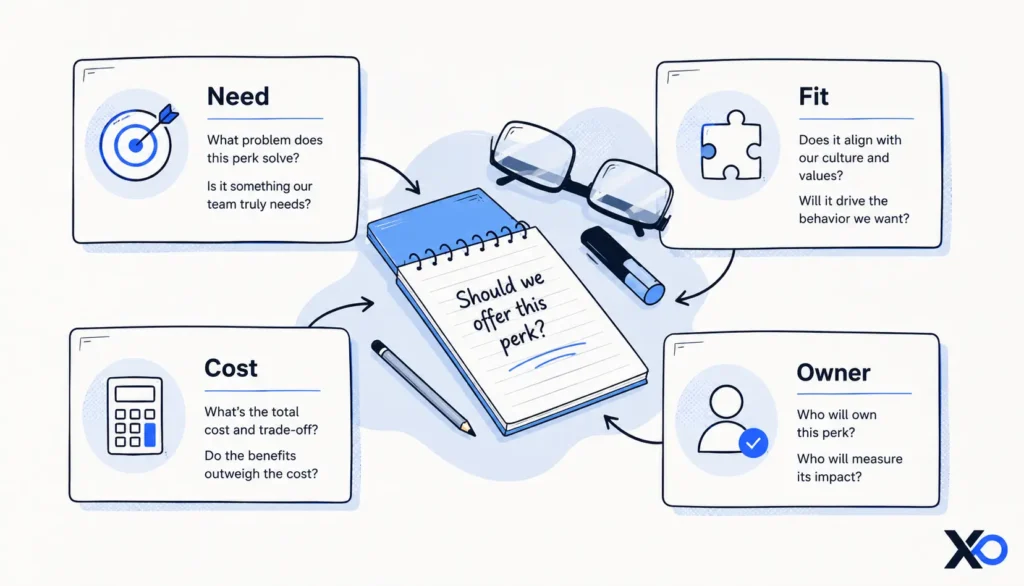
Before claiming a perk, run it through four questions:
- Need
- Fit
- Cost
- Owner
This is the simplest way to avoid most startup perks mistakes.
Need
What current bottleneck does this perk solve?
Do not answer with a category like “sales,” “analytics,” “AI,” “cloud,” “automation,” or “collaboration.” Use a workflow sentence:
- We need to track founder-led sales follow-up.
- We need to understand where activated users drop.
- We need to reduce cloud costs for a real customer pilot.
- We need one place for product decisions and launch notes.
- We need to automate a handoff that already happens every week.
If there is no current workflow, the perk is probably premature.
Fit
Does the tool fit the stage, team, and workflow?
A powerful platform may be perfect for a seed-stage team with repeatable revenue motion and too heavy for a bootstrapped founder still testing the first customer segment. A cloud credit may be strategic for an AI startup with real compute needs and distracting for a simple SaaS app.
Fit beats offer size.
Cost
What happens when the perk ends?
Founders should check post-offer pricing, seat expansion, usage-based billing, support costs, add-ons, migration effort, and whether the discount applies to the plan they will actually need.
The real cost is not the first month. It is the cost of keeping the tool after the startup has built work around it.
Owner
Who will own the tool?
Every claimed perk needs one accountable person. The owner checks usage, decides whether the tool is still needed, watches renewal dates, and makes sure it has not become duplicate infrastructure.
Without an owner, a perk becomes a quiet future chore.
Mistake 1: Claiming Perks Because the Offer Looks Valuable
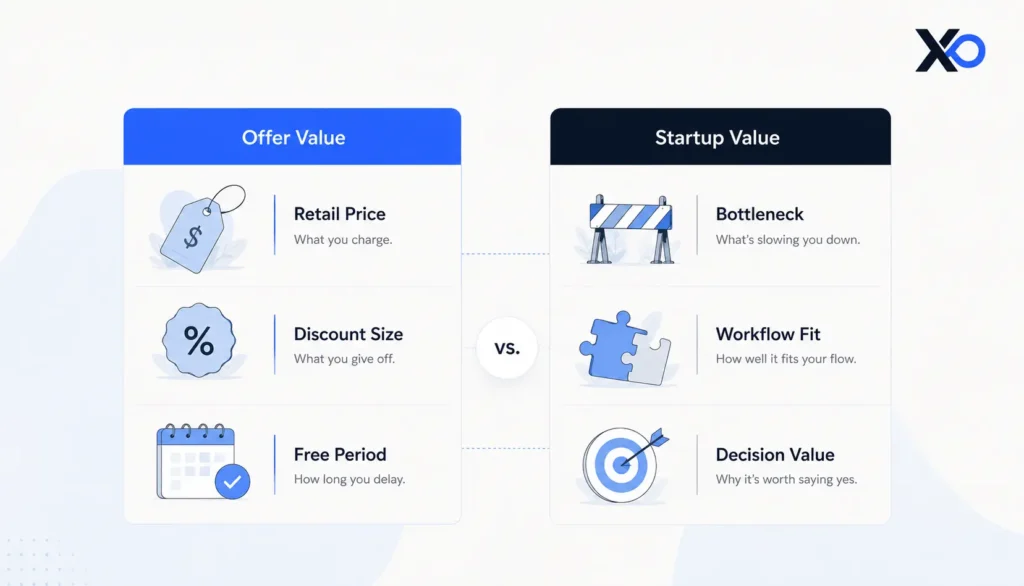
The biggest startup perks mistakes happen when founders optimize for perceived value instead of current need.
A $10,000 credit sounds useful. A 90% discount sounds responsible. A free annual plan feels too good to ignore. But offer value is not the same as startup value.
The right test is not the retail price of the perk. The right test is whether the tool helps the startup make progress on a real bottleneck.
For example, a sales platform can be useful if the founder has a defined ICP, active conversations, and a follow-up problem. It is noise if the startup has no repeatable sales motion and no one will keep the pipeline clean.
If sales follow-up is already the bottleneck, a focused offer like HubSpot for Startups can make sense because the workflow need exists before the perk.
A startup perk should reduce the cost of a decision you already understand. It should not create the decision.

Startup Perks AI Assistant
Have questions about credits? Let's chat instantly.
Mistake 2: Ignoring Eligibility Friction
Startup discount eligibility can look simple from a distance and messy in practice.
Some offers require company age, funding stage, accelerator participation, domain verification, founder email approval, prior usage limits, region availability, partner codes, or proof that the startup has not used the provider before.
That means the eligibility process has a time cost.
Before applying, ask:
- Do we clearly qualify?
- What documents, links, or accounts are required?
- How long might approval take?
- Is the offer still useful if approval is delayed?
- Will this require a new account or can it apply to our existing setup?
Do not spend founder time on a perk that was never claimable for your startup.
Mistake 3: Creating Overlapping Tools
Tool overlap is one of the most common ways startup credits and discounts become expensive.
Tool overlap usually starts with reasonable choices. One project tool becomes two. A workspace gets duplicated. Customer notes stay in one system while a new CRM appears beside it. Analytics dashboards multiply because the offer feels useful, even when the workflow is already covered.
Now the team has two systems for the same job. Data gets split. Notifications multiply. Decisions become harder because nobody knows which tool is the source of truth.
Before claiming a perk, ask:
- What existing tool already does part of this job?
- Would this replace something or sit beside it?
- Which system will be the source of truth?
- What will we cancel, downgrade, or stop using if this works?
If the answer is “nothing,” the perk may be adding stack noise.
Mistake 4: Forgetting the Renewal and Post-Offer Price
Many founders review the discount and skip the renewal. That is dangerous because the first invoice is rarely the real decision. The real decision comes when the free period ends, credits expire, seats increase, usage grows, or the company needs a higher plan.
Post-offer costs can change the math quickly:
- A free plan becomes a paid annual renewal.
- A startup discount applies only to the first year.
- A usage-based product gets expensive as customers grow.
- A team adds seats because the tool became part of daily work.
- An add-on required for the real workflow is not discounted.
Set the renewal reminder before the tool enters the stack. Put the owner, renewal date, discount end date, current plan, expected future plan, and cancellation path in one place.
If nobody is willing to own the renewal, do not claim the perk.
Mistake 5: Using Perks to Adopt Tools Before the Workflow Is Proven
A perk can make premature adoption feel rational.
Premature tooling creates quiet stack noise. Automation tools need a stable process first. Product analytics needs a clear decision to support. Customer success software needs a repeatable onboarding motion. AI tools need a real output gap, not just curiosity.
The better sequence is:
Need -> Manual test -> Tool fit -> Perk -> Adoption.
Do the manual version first when possible. Learn the shape of the workflow. Identify the repeated pain. Then use startup perks to reduce the cost of a tool that supports the workflow.
This keeps the perk in service of the operating system instead of letting the offer design the operating system.
Mistake 6: Treating All Team Access as Harmless
Discounted tools often feel low-risk, so founders invite teammates quickly.
That can create permission sprawl. Customer data, product notes, sales records, financial files, analytics access, AI prompts, and internal documents may end up across too many systems with unclear access rules.
Simple permission discipline saves cleanup later.
Before rolling out a perk broadly, decide:
- Which data belongs in the tool?
- Who needs admin access?
- Who needs read-only access?
- What happens when a contractor, advisor, or employee leaves?
- Does the tool create a security or compliance issue for customer conversations?
Startup perks for founders should make operations lighter, not create a future access audit.
Mistake 7: Not Reviewing Whether the Perk Actually Saved Time
The final mistake is assuming the perk worked because the startup claimed it. A discount is only useful if the tool creates value after adoption. Did it reduce manual work, improve decision quality, help sales follow-up, clarify activation, lower infrastructure cost, or save founder time?
If the answer is unclear, the tool should be reviewed.
Use a 30-day or 60-day check:
- Is the tool used weekly?
- Does it have an owner?
- Did it replace manual work or duplicate another system?
- Did it help make a decision?
- Would we pay full price when the perk ends?
- If we removed it today, what would break?
If nothing meaningful would break, the startup probably does not need the tool.
Decision Rules
Use these rules before claiming any startup perk, credit, or software discount. The goal is not to collect more offers; it is to decide which ones actually support the company’s next real workflow.
| Situation | Decision rule |
|---|---|
| The perk does not solve a current bottleneck | Skip it. |
| Eligibility is unclear and the upside is small | Wait. |
| The tool overlaps with an existing system | Decide what it replaces first. |
| The post-offer price would not make sense at full cost | Do not build core workflows around it. |
| Nobody owns renewal tracking | Do not claim the offer. |
| The workflow is still manual and changing every week | Test the process before adopting software. |
| The perk lowers the cost of a tool you already need | Use it deliberately. |
| The tool saves founder time within 30 to 60 days | Keep testing it. |
| The tool creates more dashboards than decisions | Cut it. |
A good perk should make the startup sharper, not heavier. When an offer reduces real spend, supports a real workflow, and has a clear owner, it is worth considering. When it adds another dashboard, renewal, or unused system, it should wait.
How to Evaluate Startup Discounts Before Claiming Them
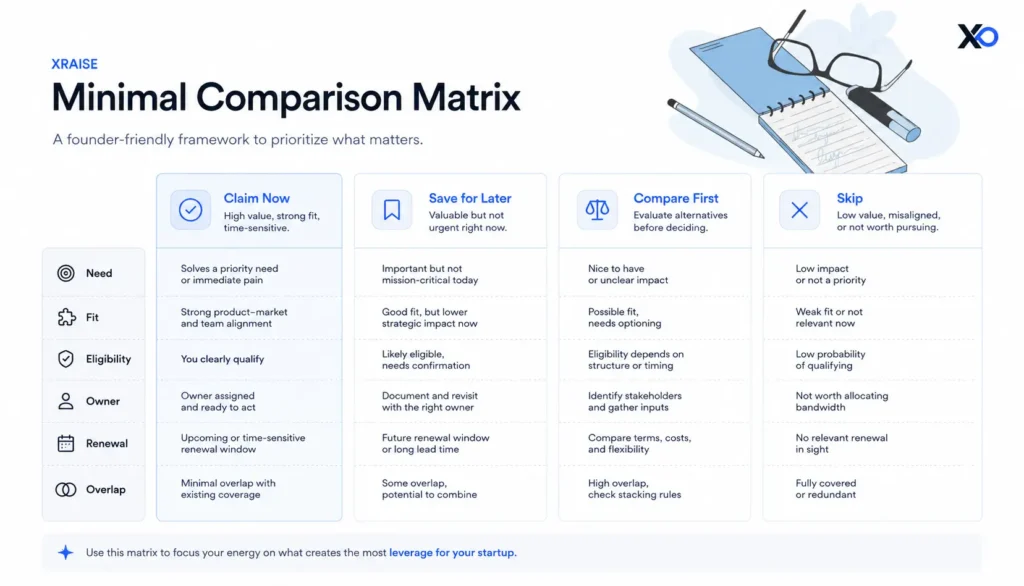
Use a one-page perk review before adding anything to the stack.
Write down the perk, current bottleneck, workflow owner, eligibility requirements, setup effort, data involved, existing overlap, discount end date, post-offer price, expected usage, and review date.
Then bucket the offer:
Claim now: clear need, strong fit, known owner, low setup friction, manageable post-offer cost.
Save for later: relevant tool, but the workflow is not ready yet.
Compare first: useful category, but multiple options may solve the same job.
Skip: unclear need, heavy setup, weak eligibility, high renewal risk, or obvious stack overlap.
This turns startup discounts from a scavenger hunt into a founder decision process.
How XRaise Fits into the Workflow
XRaise can help founders find startup perks, credits, discounts, and software offers that are more relevant to their stage and category.
The important part is the order.
Do not start by claiming everything. Start by naming the bottleneck. Then use XRaise to compare options, check relevant offers, and reduce the cost of tools your startup can actually use.
For example:
- If sales follow-up is the bottleneck, compare sales and CRM options.
- If activation is unclear, compare analytics tools.
- If cloud costs block a real pilot, compare infrastructure credits.
- If internal work is scattered, compare workspace or project tools.
- If a repeatable process is ready for automation, compare automation offers.
The founder keeps the decision. XRaise makes the search and comparison easier.
What Should Founders Check Before Claiming Startup Perks?
Founders should check need, eligibility, workflow fit, owner, renewal date, and post-offer cost before claiming startup perks.
The most important question is whether the perk solves a problem the startup already has. If the offer creates a new tool to configure, monitor, and eventually renew, the discount may waste more founder time than it saves.
Are Startup Discounts Worth It for Early-Stage Founders?
Startup discounts are worth it when they reduce the cost of a tool tied to proof, revenue, learning, infrastructure, or team leverage.
They are less useful when founders claim them because the retail value looks high. A lean startup stack is not built from every available offer. It is built from tools that support current decisions.
Final Takeaway
Startup perks should save founder time, not just reduce invoices.
The best offer is not the one with the biggest headline value. It is the one that fits a current workflow, clears eligibility without drama, has a real owner, and still makes sense when the discount ends.
Final rule:
Claim perks for bottlenecks, not for possibility.