Lovable for startups is a fast, practical way to go from idea to working prototype without getting stuck in code setup or clunky drag-and-drop tools. If you’re a founder trying to validate an MVP, launch a landing page, or build an internal tool quickly, Lovable for startups can compress weeks of work into hours, while still producing real, developer-friendly code.
TL;DR
This article provides a short overview of what Lovable for startups is, who it’s best for, and when to use it.




- Designed for early-stage founders and small teams who need to ship an MVP or landing page fast
- Best fit for non-technical founders, designers/PMs, and developers who want to skip boilerplate
- Ideal timing: Use Lovable for startups when you have a clear workflow to test and need a demo-able product in days
- Key benefits include chat-based full-stack generation, real React + TypeScript output, Supabase/Stripe integrations, and one-click publishing
What Is Lovable for Startups?
Lovable for startups is an AI-powered platform that builds websites and web apps through conversation. Instead of writing code or assembling blocks in a no-code editor, you describe what you want in plain English, like:
- “Create a dashboard with user logins and payments.”
- “Build a SaaS landing page with pricing tiers and a signup flow.”
- “Make a client portal with invoicing and Stripe checkout.”
Lovable then generates a working project and exposes a real codebase (React + Tailwind + TypeScript), so you can export it, extend it, and keep control as the product evolves.
Why Lovable for Startups Matters
Most startups don’t fail because they used the wrong framework. They fail because they didn’t learn fast enough. Lovable for startups helps you learn faster by shrinking the loop:
Build → show users → collect feedback → iterate
When founders can ship something real quickly, they can validate:
- onboarding clarity
- pricing willingness
- feature priority
- user workflows
- product positioning
If you’re exploring other founder tools that support fast building, these are useful context pieces:
Lovable for Startups: Who It’s For
Lovable for startups works best when speed matters and engineering time is limited.
| Persona | Fit | Why it works |
|---|---|---|
| Non-technical founder | ✅ Strong | Builds MVPs without hiring immediately |
| Small startup team | ✅ Strong | Rapid prototyping + fast iteration |
| Designer / PM | ✅ Strong | Turns mockups into functional UI quickly |
| Developer | ✅ Strong | Skips boilerplate; keeps code ownership |
| Compliance-heavy product | ⚠️ Caution | Needs careful logic + permission review |
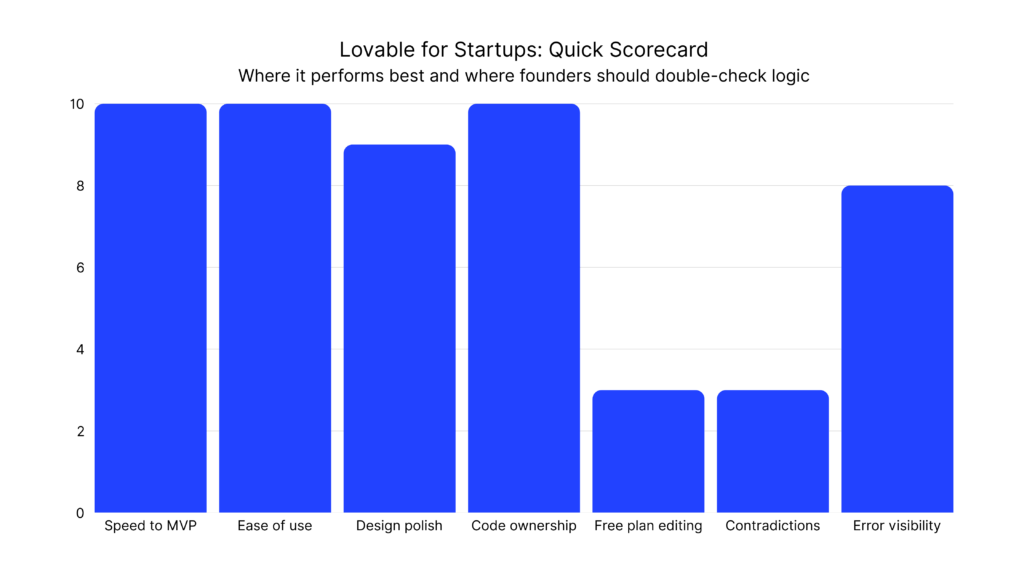
A Quick Chart: Where Lovable for Startups Wins
This is a simple visual summary:
My Hands-On Workflow with Lovable for Startups
Your real-world test is exactly how Lovable for startups should be evaluated: can it actually build something practical?

Startup Perks AI Assistant
Have questions about credits? Let's chat instantly.
1) Signing up and first impressions
The experience is clean, prompt-first, and beginner-friendly. Email verification adds a bit of friction, but it’s quick and works. The onboarding questions help personalize the workspace.
2) Dashboard: workspace + gallery
The first screen feels like a mix of:
- a workspace (prompt box at the top)
- a template library (community projects you can remix)
That’s a smart design choice because Lovable for startups isn’t just “build from scratch”, it’s also “start from examples and adapt.”
3) Building a real SaaS example
You tested a “Client Portal + Invoicing” SaaS with:
- onboarding + roles
- dashboard KPIs
- time tracking
- invoices with PDF preview
- Stripe payments
- client portal access
- Supabase backend request (auth + multi-tenancy + storage)
Lovable responded by breaking the spec into features and (crucially) flagged that Supabase connection was required for real backend functionality. That’s a strength: it reduces fake demo output.
Key Features of Lovable for Startups
Here’s the feature list translated into startup outcomes.
| Feature | What it does | Why startups care |
|---|---|---|
| Chat-based generation | Build apps by describing them | Ship MVPs faster |
| React + Tailwind + TypeScript | Real modern code | Easier to maintain later |
| Supabase integration | Auth + DB + storage | Real backend fast |
| Stripe integration | Payments + billing | Monetize earlier |
| Visual editor | Granular UI tweaks | Faster polish, fewer prompt cycles |
| Figma import | Design to code | Less handoff friction |
| GitHub sync | Export + customize | Full ownership, no lock-in |
| One-click deploy | Publish to subdomain | Share demos instantly |
| Version rollback | Undo changes | Safer experimentation |
This is where Lovable for startups stands out: it’s fast and produces a codebase teams can keep.
Error Handling in Lovable for Startups: What You Learned
Your testing surfaced two important truths about Lovable for startups:
✅ Error visibility is strong
When the preview broke with “Missing Supabase environment variables,” Lovable showed logs and offered “Try to fix,” which resolved the issue and restored the preview. That’s the right direction: it feels closer to real development workflows.
⚠️ Contradictions don’t get challenged
You intentionally gave conflicting requirements about role-based permissions. Lovable didn’t ask clarifying questions, it tried to merge both requests. That can create security or logic flaws.
| Risk | What it looks like | What to do |
|---|---|---|
| Missing env variables | Blank preview + runtime error | Keep config steps explicit |
| Conflicting requirements | RBAC + “everyone can edit everything” | Ask Lovable to restate constraints first |
| Over-trusting output | “AI built it so it’s correct” | Treat output like a junior dev: review |
| Free plan editing limits | Read-only editor | Use GitHub export + local IDE |
If you use Lovable for startups seriously, the rule is simple: speed is amazing, but logic still needs review.
Customizing Design with Lovable for Startups
Customization happens through three paths:
1) Prompts (fast, broad changes)
You can request themes, layouts, typography, animations, or component redesigns in natural language.
2) Visual editor (precise, fast polish)
Instead of spending credits regenerating sections, you can click an element and adjust spacing, text, colors, and alignment, more like a design tool.
3) GitHub sync (full control)
For teams that want complete flexibility, Lovable for startups becomes most powerful when paired with GitHub:
- export the generated project
- edit in your IDE
- extend with libraries and custom logic
- deploy however you want
Pricing & Plans: How Lovable for Startups Thinks About Usage
Lovable uses credits. Small edits consume fewer credits; larger builds consume more. Your notes highlight:
- free plan = good for learning + experimentation
- paid tiers = required for serious work (privacy, domains, advanced team features)
| Capability | Free | Paid tiers |
|---|---|---|
| Projects | Public only | Private + team workspace options |
| Editor | Limited (read-only noted) | More control |
| Credits | Capped monthly | More credits + rollover |
| Domains | No custom domain | Custom domain support |
| Team controls | Basic | Roles, permissions, advanced options |
Alternatives to Lovable for Startups
Lovable isn’t the only option. Your notes compare it well with Bolt.new.
| Feature | Lovable | Bolt.new |
|---|---|---|
| Core workflow | Chat-based full-stack generation | Prompt-to-code inside IDE |
| Best for | Founders, designers, fast MVPs | Developers who want full control |
| Editing | GitHub export; limited in-app | Full in-browser IDE editing |
| Backend | Supabase integration | Node runtime, Supabase/Prisma |
| Frontend | React + Tailwind | Next/Vue/Svelte/Astro/Expo |
| Deploy | One click + GitHub | Netlify-style deploy flow |
If you want a more traditional no-code builder alternative, Bubble for Startups is often considered.
FAQ: Lovable for Startups
Is Lovable for startups good for MVPs?
Yes, especially for MVPs, landing pages, internal tools, and early SaaS prototypes.
Does Lovable for startups replace developers?
Not fully. It removes setup and scaffolding time, but logic and security still need human review.
What’s the biggest limitation?
It may accept contradictory instructions without pushing back, so you need to review requirements carefully.
Final Thoughts: Should You Use Lovable for Startups?
If your goal is speed, getting from idea to functional demo quickly, Lovable for startups is one of the most founder-friendly ways to ship. It’s approachable, prompt-native, and generates real modern code you can keep. Just remember: Lovable for startups accelerates building, but you still own the responsibility for product logic and permission rules.
For the most accurate product updates and documentation, visit the official Lovable site:.