
If you want to win a startup application, you need to understand startup application criteria, not guess them. If you’re still deciding where to apply, this breakdown of startup accelerators in 2026 helps you understand which programs actually fit your stage.
TL;DR
This article provides a clear breakdown of startup application criteria used by top accelerators and investors.

- What matters most: Team quality dominates all startup application criteria, followed by market and traction
- What to show: Clear product, real metrics, and proof of execution, not ideas or storytelling
- How to win: Align your application with investor evaluation frameworks and avoid vague claims
- What to do next: Build a tight, evidence-backed application using the right metrics and structure
What startup application criteria really mean
Most founders misunderstand startup application criteria.
| What founders think matters | What actually gets evaluated |
|---|---|
| Idea originality | Team execution ability |
| Pitch deck design | Clarity of thinking |
| Storytelling | Evidence and metrics |
| Big vision claims | Speed of progress |
| Market hype | Real problem validation |
Accelerators like Techstars and investors like Andreessen Horowitz evaluate one thing:
Can this team build a breakout company, and what could kill it?
Everything else is a proxy.
That’s why applications are scanned fast. As Paul Graham explains, reviewers may read ~100 applications per day.
If your signal isn’t obvious → you lose.
How accelerators prioritize startup application criteria
Most top accelerators follow a similar hierarchy.
The real order:
- Team
- Market
- Traction
- Idea
This is explicitly reinforced by programs like Techstars.
Why team dominates
| Weak founder signal | Strong founder signal |
|---|---|
| Talks about ideas | Ships and iterates |
| Waits for perfect plan | Moves fast with imperfect data |
| Avoids mistakes | Learns and adapts quickly |
| Relies on vision | Proves execution |
| Works solo in silos | Builds and leads teams |
Brutal truth:
A mediocre idea with a strong team wins more often than a great idea with a weak team.
How investors evaluate startup application criteria differently
Accelerators and VCs look similar, but optimize differently. The best founders understand that startup application criteria change slightly by evaluator, but clarity and evidence always stay constant.
Accelerators optimize for:
- Learning speed
- Founder potential
- Cohort fit
Programs like Y Combinator and 500 Global invest early and shape founders.
Investors optimize for:
- Risk vs return
- Market size
- Scalability
Firms like Sequoia Capital care less about polish, and more about:
- Massive outcomes
- Defensibility
- Long-term upside
Key difference:
Accelerators bet on people evolving
Investors bet on outcomes compounding
This is why strong startup founder skills often outweigh idea quality in early-stage selection.
Startup application criteria you must prove

Every strong application answers the same set of questions.
1. Team (non-negotiable)
Most teams think they’re signaling strength, but reviewers translate your words very differently.
| What you say | What they actually see |
|---|---|
| “We are passionate” | No execution proof |
| “We have a great idea” | Idea without validation |
| “We plan to build…” | No shipping history |
| “We’re a strong team” | Unclear roles or skills |
| “We built X, grew Y, learned Z” | Proven execution signal |
The shift is simple: stop describing intent, start proving execution.
2. Problem and product clarity
This is where most applications lose clarity, because vague language hides the actual product.
| What you say | What they actually understand |
|---|---|
| “Platform for innovation” | No clear product |
| “AI-powered solution” | Generic, interchangeable claim |
| “We connect users and businesses” | Unclear use case |
| “All-in-one tool” | No specific functionality |
| Clear, concrete product explanation | Immediate understanding |
If a reviewer can’t picture your product in seconds, your application already lost.
3. Market size and timing
Market alone isn’t enough, timing is what makes it investable.
| What you say | What they actually see |
|---|---|
| “It’s a big market” | No clear entry point |
| “Everyone needs this” | No defined customer segment |
| “We’re early in the trend” | Uncertain timing |
| “This will grow fast” | Assumption without proof |
| Clear “why now” with real drivers | Credible, investable timing |
If you can’t prove why now, reviewers assume it’s either too early, or already too late.
4. Traction and momentum
Most founders misread traction, they report numbers, but fail to show momentum.
| What you show | What they actually see |
|---|---|
| Revenue only | Narrow, incomplete traction |
| User signups | Vanity metric |
| One-time growth spike | No consistency |
| Static product | No learning loop |
| Continuous progress + iteration | Strong execution momentum |
Traction is not a snapshot, it’s proof that you’re learning and moving faster than everyone else. Early traction patterns often follow what’s outlined in this first startup growth guide.
5. Go-to-market strategy
Most go-to-market sections fail because they describe intentions, not actual acquisition reality.
| What you say | What they actually see |
|---|---|
| “We’ll use marketing” | No real strategy |
| “We’ll run ads” | Generic, untested approach |
| “We’ll go viral” | No controllable channel |
| “We target everyone” | No clear customer focus |
| Specific channels + conversion insights | Real GTM understanding |
If you can’t explain exactly how users come in, and why, they assume you don’t know how to grow.
6. Business model and economics
This is where credibility breaks, because sloppy metrics signal sloppy thinking.
| What you show | What they actually see |
|---|---|
| “We’ll monetize later” | No real business model |
| Inflated revenue claims | Misleading or misunderstood data |
| Mixed metrics (ARR vs bookings) | Lack of financial clarity |
| No unit economics | Unsustainable growth |
| Clear, consistent metrics | Investable business model |
If your numbers aren’t precise and consistent, nothing else in your application will be trusted.
7. Capital and runway logic
Most founders treat funding as a goal, investors treat it as a tool tied to milestones.
| What you say | What they actually see |
|---|---|
| “We need $1M to grow” | No clear capital plan |
| “We’ll use funds for hiring” | Vague allocation |
| “We want more runway” | No milestone linkage |
| Random round size | No strategic thinking |
| Capital tied to milestones | Strong financial discipline |
If capital isn’t clearly tied to outcomes, investors assume you’ll burn it without progress.
8. Competition and defensibility
This is where naive optimism gets exposed, because ignoring competition signals lack of market understanding.
| What you say | What they actually see |
|---|---|
| “No competitors” | No market awareness |
| “We’re better than all” | Unproven claim |
| “We have a unique idea” | Likely not defensible |
| “Others are outdated” | Weak competitive analysis |
| Clear advantage + strategy | Real defensibility signal |
If you can’t explain why you win, investors assume you won’t.
How to compare startup application criteria across programs
Not all accelerators are equal, and most founders get rejected because they don’t compare them correctly.
| What to compare | What it actually means |
|---|---|
| Industry fit | SaaS vs AI vs fintech vs deep tech specialization |
| Stage fit | Idea vs pre-seed vs post-revenue alignment |
If your startup doesn’t match both dimensions, rejection isn’t random, it’s expected.
Funding and equity
Funding isn’t just about how much you get, it’s what you give up and what you gain in return.
| Program type | What you get | What you give up |
|---|---|---|
| Y Combinator | ~$500K + strong network | Standard equity dilution |
| Techstars | Structured funding + SAFE | Equity + specific terms |
| 500 Global | ~$150K | ~6% equity |
The real decision isn’t capital, it’s whether the network and support justify the dilution.
Location vs value
Location isn’t just geography, it directly impacts access, cost, and opportunity.
| What you consider | What it actually means |
|---|---|
| Top locations (SF, SV) | Strong networks + high opportunity |
| Relocation requirement | Time, cost, and commitment |
| Being “in the ecosystem” | Faster access to investors + talent |
The trade-off is simple: more opportunity comes with more cost, choose based on what your startup can absorb.
Common mistakes that kill applications
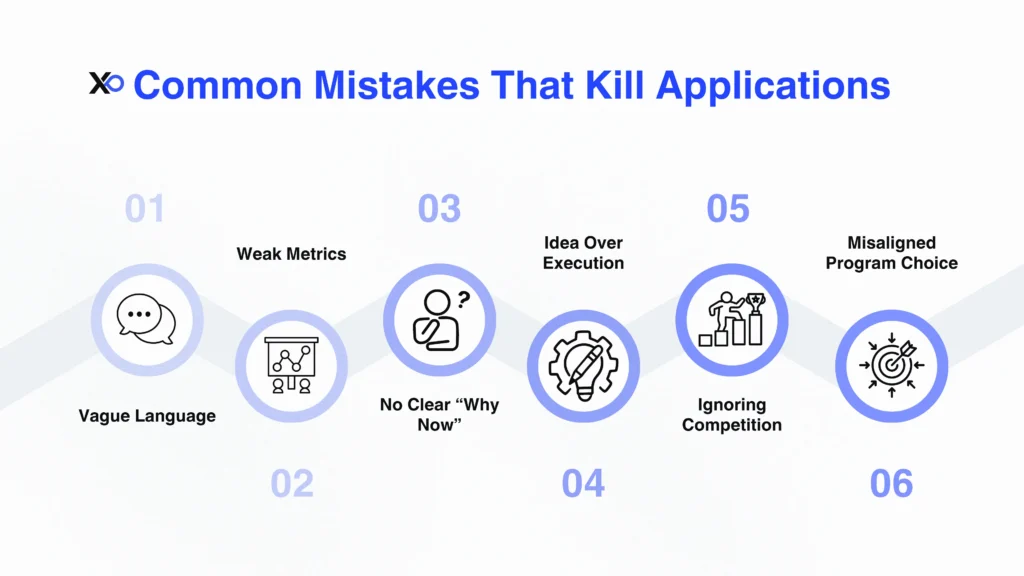
Most rejections are predictable.
1. Vague language breaks startup application criteria
- “Revolutionary”
- “Disrupting industry”
These mean nothing.
2. Weak metrics
- No numbers
- Inconsistent definitions
Investors notice instantly.
3. No clear “why now”
If timing isn’t obvious → opportunity looks weak.
4. Over-indexing on idea
Idea ≠ execution.
Execution wins.
5. Ignoring competition
Claiming “no competitors” = lack of understanding.
6. Misaligned program choice
Applying to the wrong accelerator wastes time.
How to shortlist accelerators using startup application criteria
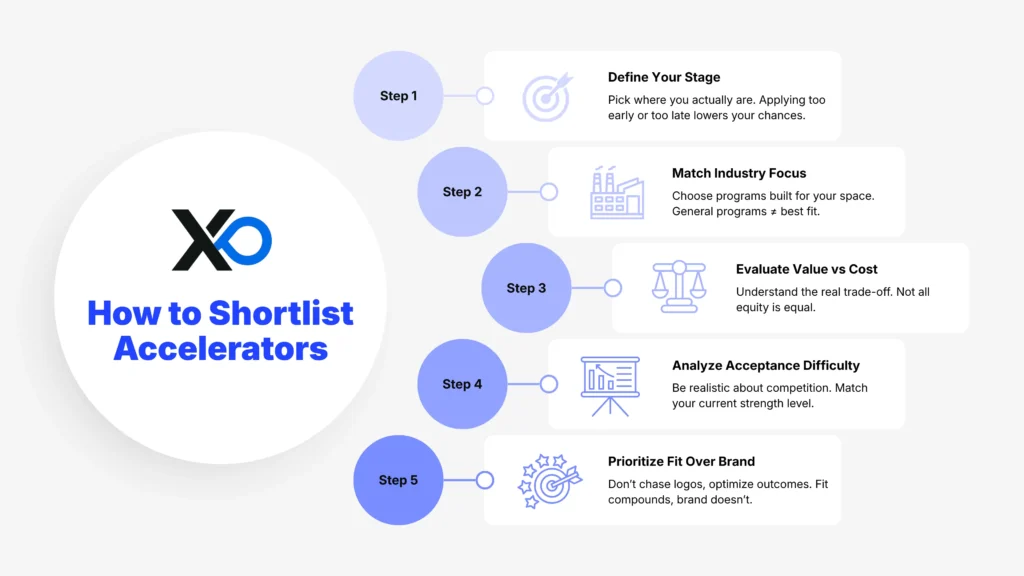
Use this filter:
1. Define your stage
- Idea
- MVP
- Revenue
2. Match industry focus
- SaaS
- AI
- Fintech
- Deep tech
3. Evaluate value vs cost
- Equity taken
- Network strength
- Mentorship quality
4. Analyze acceptance difficulty
- Competitive programs require stronger signal
5. Prioritize fit over brand
The “best” accelerator is:
The one aligned with your startup
A strong startup programs strategy helps you choose programs based on fit, not brand.

Startup Perks AI Assistant
Have questions about credits? Let's chat instantly.
Your Action Plan
- Assess fit across team, traction, and market
- Build → XRaise AI Pitch Deck Builder
- Hedge → $500K+ perks
- Apply smart to aligned programs
Final thoughts on startup application criteria
Startup application criteria are not hidden, they are just ignored.
If you align your application with real evaluation logic, your odds change dramatically. Founders who want to improve both their application and cost structure should also review XRaise’s startup perks articles while planning their next round.
Learn more and start building with XRaise’s Web App, then explore programs that can help you scale faster through XRaise’s Accelerators.