Last updated: June 2026
TL;DR
- The best cloud credits for startups in 2026 usually come from AWS Activate, Google for Startups Cloud, Microsoft for Startups, Cloudflare for Startups, DigitalOcean Startups, and targeted infrastructure programs that fit your stack.
- The main benefit is runway extension, but the main risk is building around credits that expire, exclude key services, or hide weak unit economics.
- Cloud startup credits are best for SaaS, AI, data, developer tools, marketplaces, and infrastructure-heavy startups with a clear 6-12 month usage plan.
- Before choosing a provider, review available startup cloud credits, eligibility, usage limits, and renewal risk through XRaise.
What Are Cloud Credits for Startups?
Cloud credits for startups are promotional credits that reduce eligible infrastructure spend on cloud platforms. They can cover services like compute, storage, databases, networking, AI services, app hosting, edge infrastructure, or developer tooling, depending on the program.
The important phrase is “eligible spend.” A credit balance does not always apply to every product, support plan, marketplace service, GPU workload, third-party model, domain registration, or overage. Founders should treat credits like temporary financing for infrastructure, not permanent free cloud.



Used well, startup cloud credits help a team build, test, launch, and learn without burning early cash too quickly. Used poorly, they create a delayed bill that appears right when usage starts growing.
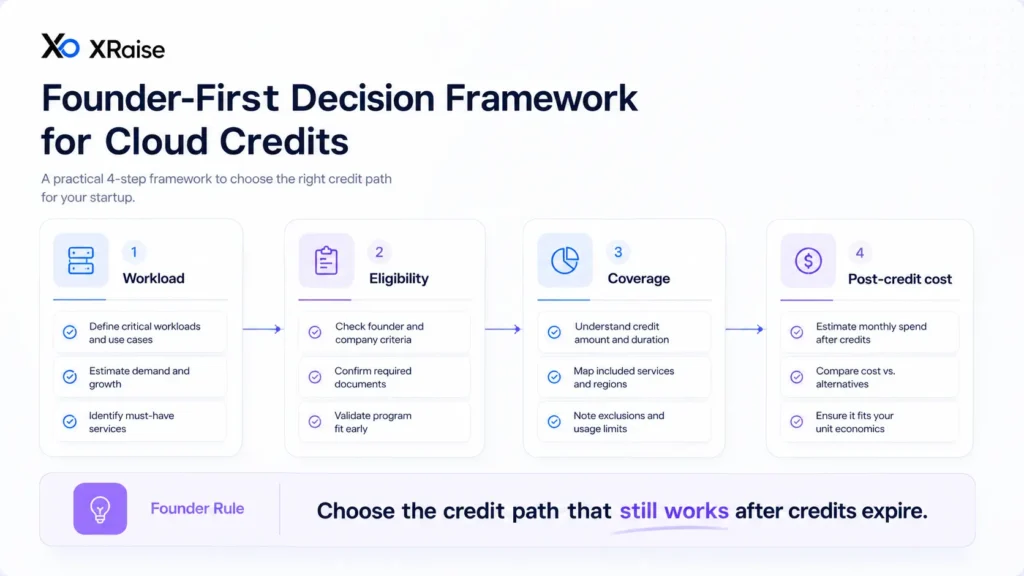
The best cloud credit is not always the largest number. It is the credit that replaces spend your startup would actually incur, inside a platform your team can operate, with a bill you can survive when the credits expire.
Best Cloud Credit Programs for AI and Infrastructure in 2026
The best cloud credit path depends less on the headline amount and more on where your product will actually spend money.
| Program | Best for | Founder fit |
|---|---|---|
| AWS Activate | Broad cloud infrastructure, AI, backend-heavy SaaS | Best all-purpose ecosystem |
| Google for Startups Cloud | AI-first, data-heavy, Firebase, GCP products | Strong for AI and data teams |
| Microsoft for Startups | Azure, enterprise SaaS, Microsoft-aligned startups | Strong for B2B and Azure AI |
| Cloudflare for Startups | Edge, security, CDN, Workers, global apps | Strong companion to a primary cloud |
| DigitalOcean Startups | Simpler SaaS and lean engineering teams | Easier early operations |
| Render and Neon | App hosting and Postgres-heavy products | Useful targeted infrastructure credits |
Founders can review the XRaise startup perks directory to compare relevant startup perks, credits, and founder resources in one place.
AWS Activate Startup Credits
AWS Activate is often the first program founders compare because AWS has broad coverage across compute, databases, storage, analytics, AI, security, observability, DevOps, and enterprise infrastructure.
The program currently lists two main paths: Activate Founders with $1,000 in AWS credits for eligible early-stage, self-funded startups, and Activate Portfolio with up to $100,000 for startups affiliated with an AWS Activate Provider. Activate credits can also be used across more than 200 AWS services and for eligible third-party foundation models through Amazon Bedrock.
This makes AWS a strong fit for startups that expect infrastructure complexity, enterprise readiness, high-volume workloads, or multi-service architecture. It is also useful when a startup wants access to a deep partner ecosystem, marketplace options, and mature tooling for security and compliance.
The tradeoff is operational complexity. If no one owns budgets, permissions, tagging, cost alerts, and rightsizing, credits can subsidize waste. AWS can be the safest long-term infrastructure choice for many teams, but only when someone treats cloud spend like a product metric.
Founders can review AWS Activate startup credits through XRaise before applying.

AWS Activate for Startups
$1,000 in credits for cloud infrastructure and AI workloads.
Google for Startups Cloud Credits
Google for Startups Cloud is especially relevant for AI-first startups, data products, Firebase teams, and companies building around Google Cloud services.
The program currently presents a pre-funded path with up to $2,000 in credits to help build an MVP. For early-stage startups, Google Cloud and Firebase costs may be covered up to $200,000, or up to $350,000 for AI startups, over the first two years in the program. That makes it one of the strongest visible startup cloud credit programs for AI and data-heavy companies in 2026.
This path is a strong fit when the product depends on AI, analytics, data pipelines, Firebase, BigQuery, Gemini, Vertex AI, or scalable infrastructure tied closely to Google’s cloud ecosystem.
The founder caveat is eligibility. The highest amount is not a universal offer. Stage, funding, product type, technical fit, and verification all matter. A bootstrapped founder may still benefit from the starter path, but should not plan around the top AI credit ceiling unless the startup clearly qualifies.
Founders can compare Google Cloud startup credits through XRaise when evaluating GCP as a primary cloud path.

Google Cloud for Startups
Up to $200,000 credits for cloud hosting, AI, and dev tools.
Microsoft for Startups and Azure Credits
Microsoft for Startups has two practical paths founders should understand. The open Azure startup credit offer provides up to $5,000 in Azure credits, with $1,000 available immediately for eligible new Azure customers. Microsoft also describes an investor-backed offer for startups affiliated with the Microsoft for Startups Investor Network, where most approved startups begin with $100,000 in Azure credits and may earn more.
Azure credits are a strong fit for enterprise SaaS, AI products using Azure services, startups selling into Microsoft-heavy customers, and teams that also benefit from Microsoft developer, productivity, and go-to-market resources.
The important detail is that the open path and investor path are not the same. A founder should not plan around investor-level Azure credits without a qualifying referral route. For founders selling to enterprise buyers, though, Microsoft can be more than a cloud credit program. It can become part of a credibility, compliance, and partnership story.
Founders can review Microsoft for Startups Azure credits through XRaise.

Microsoft Azure for Startups
Up to $5,000 in Azure credits for scalable cloud apps.
Cloudflare for Startups
Cloudflare is not a full replacement for AWS, Google Cloud, or Azure, but it can be one of the highest-leverage cloud startup credits for teams with traffic-heavy products, global users, edge workloads, security needs, or developer platform usage.
It currently presents startup program tiers up to $350,000 in credits for eligible startups, with credits covering usage-based services and several core security or networking features included as program benefits. Covered areas can include Workers, Durable Objects, Workflows, R2, D1, Queues, Vectorize, Pages, Images, Stream, Cache Reserve, Argo Smart Routing, and Workers AI, subject to product-specific caps and exclusions.
Cloudflare is often best used alongside a primary cloud. It can reduce load, improve performance, strengthen security, and move some edge compute or bandwidth-sensitive workloads away from the core cloud bill.
The founder caution is coverage. Some products have caps, some features require enablement, and some services are excluded. If your startup wants Cloudflare credits for AI, R2 storage, or edge compute, map the expected usage before assuming the full headline amount applies.
DigitalOcean Startup Credits
DigitalOcean Startups is useful for founders who want simpler infrastructure without taking on the full operational weight of a hyperscaler too early.
It says accepted startups can receive cloud infrastructure credits for 12 months, with the amount varying by approved startup partner. It also highlights expert one-on-ones, startup community access, marketplace exposure, and Standard-tier support for 15 months.
This is often a better fit for lean SaaS, dev tools, agencies turning into product companies, and small teams that care about speed and predictability. A startup does not always need a complex multi-service hyperscaler setup to reach its next milestone.
Founders building GPU-heavy AI workloads should check coverage carefully, because DigitalOcean separates some GPU benefits and exclusions from standard startup credits.
Founders can review DigitalOcean startup credits through XRaise.

DigitalOcean for Startups
12 months cloud credits for scaling infrastructure and AI workloads.
Targeted Infrastructure Credits: Render, Neon, Oracle, and AI Paths
Not every useful credit comes from a primary cloud provider. Some startups get more practical value from targeted infrastructure credits that reduce a specific part of the stack.
Render can be useful for startups that want to ship apps, APIs, workers, and managed services without early DevOps drag. Neon can be valuable for Postgres-heavy startups, especially AI and SaaS products that need branching, scalable database workflows, and modern developer velocity. Oracle Cloud Free Tier is not a startup credit program in the same sense as AWS Activate or Google for Startups Cloud, but its Always Free resources and trial credits can still help technical founders test infrastructure.
AI startups should also pay attention to ecosystem-specific paths. Founders can review AWS credits for startups when AI infrastructure is central to the product.
AWS for Startups
Up to $100,000 credits for AWS cloud and AI workloads.
The founder rule: targeted credits are strongest when they map to a real bottleneck. A database credit helps if the database is central. App hosting credits help if deployment speed is the constraint. A free tier helps if experimentation is the goal.
Major Cloud Credit Paths at a Glance
If your infrastructure plan is narrowing to AWS, Google Cloud, or Azure, use this snapshot to think about workload fit, AI/data needs, ecosystem alignment, and post-credit cost. For a dedicated side-by-side view of AWS Activate, Google Cloud, and Microsoft for Startups, use the XRaise cloud credits comparison.
| Cloud path | Strongest fit | Watch before choosing |
|---|---|---|
| AWS Activate | Broad infrastructure, flexible services, Bedrock, scale | Complexity, governance, post-credit cost |
| Google Cloud | AI-first, data, Firebase, GCP-native products | Eligibility tier and credit expiration |
| Microsoft Azure | Enterprise SaaS, Azure AI, Microsoft ecosystem | Open vs investor offer differences |
If your startup already knows its likely long-term cloud, start there. If not, choose based on workload, team skill, customer requirements, and the future monthly bill after credits expire.
How to Evaluate Eligibility and Usage Limits
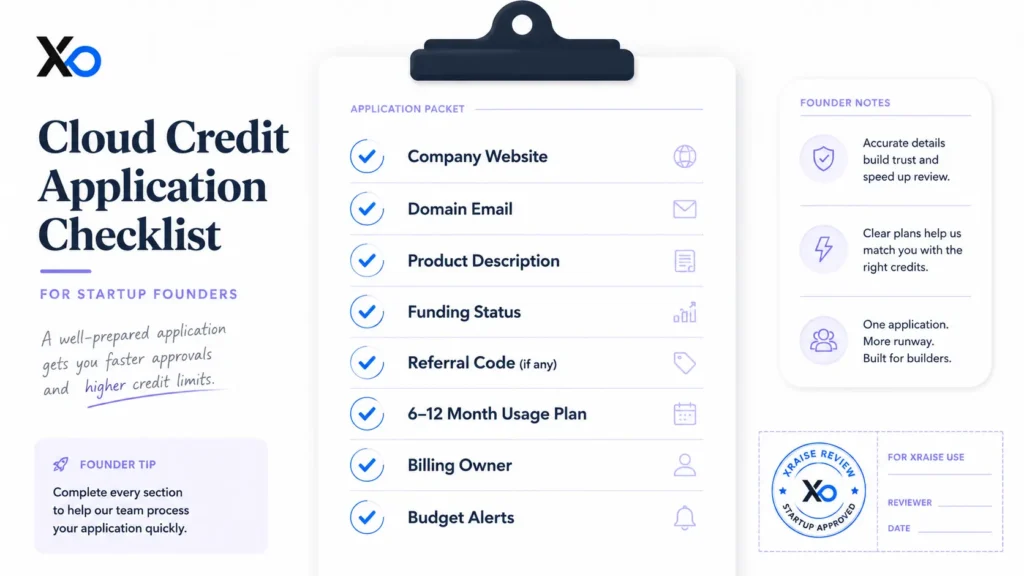
Startup cloud credit programs usually depend on company stage, funding status, product type, incorporation age, affiliation, and technical use case. Some programs require a working website, company-domain email, legal entity, investor referral, accelerator relationship, public founder profile, or partner organization ID.
Before applying, check:
| Question | Why it matters |
|---|---|
| What services are covered? | Credits may exclude support, marketplace, GPUs, domains, or third-party products. |
| When do credits expire? | A large amount is less useful if your usage is not ready. |
| Who owns billing? | Someone must monitor budgets, alerts, and overages. |
| What happens after credits? | The post-credit bill affects runway and margins. |
The strongest applications are specific. “We are building an AI platform” is weak. “We are building an AI support workflow tool using managed Postgres, object storage, API workers, model inference, and analytics for B2B SaaS companies” gives reviewers a clearer reason to believe you can use the credits well.
When Cloud Credits Help Runway
Cloud credits help most when they replace costs the startup would have paid anyway. That includes infrastructure for MVP development, customer pilots, AI experiments, staging environments, data pipelines, analytics, developer tools, and early production workloads.
They are especially useful when the next milestone is clear: launch the product, support the first 100 customers, validate model inference costs, move from prototype to production, or pass technical review for enterprise buyers.
The strongest founder move is to map credits to milestones:
| Milestone | Useful credit strategy |
|---|---|
| MVP build | Use smaller credits to test stack choices. |
| First customers | Add budgets, logs, backups, and usage alerts. |
| AI workload validation | Compare model, inference, GPU, and data costs early. |
| Seed-stage scale | Use larger credits to reach revenue proof before burn rises. |
Credits should buy learning time. They should not make an unprofitable architecture look healthy.

Startup Perks AI Assistant
Have questions about credits? Let's chat instantly.
When Cloud Credits Create Architecture Pressure
Cloud credits can quietly push teams toward bad architecture decisions. A large credit package may make a provider feel “free” even when the team lacks the skill, time, or future budget to operate that stack.
The biggest risks are overbuilding, ignoring usage alerts, choosing services because credits cover them, postponing pricing decisions, and discovering too late that the real monthly bill is too high.
AI startups need extra discipline. Model inference, vector databases, storage, logs, observability, and data movement can grow quickly. A subsidized cloud bill can hide the true cost of serving each customer.
Migration risk also matters. If your early architecture uses proprietary services heavily, moving later may be expensive. That does not mean you should avoid managed services. It means you should choose them intentionally, with the post-credit business model in mind.
How to Choose the Right Cloud Credit Path
Start with the workload, not the offer page.
For broad, infrastructure-heavy products, AWS Activate is usually the safest program to compare first. When AI and data are central, Google for Startups Cloud deserves close attention. Enterprise SaaS teams that rely on Azure AI may find Microsoft for Startups the strongest strategic fit. Smaller teams that want simpler infrastructure may get more practical value from DigitalOcean than from a larger hyperscaler credit. For performance, edge, security, or bandwidth-heavy products, Cloudflare should be part of the stack conversation.
Use this founder decision rule: choose the credit program that reduces real spend, fits your team’s operating ability, and still makes sense when the credits end.
Key Takeaways
- The best cloud credits for startups are the credits that match real infrastructure spend, not the biggest advertised number.
- AWS, Google Cloud, Microsoft Azure, Cloudflare, and DigitalOcean each fit different founder stages, workloads, and operating styles.
- Credits can extend runway, but only if founders track eligibility, exclusions, expiration, usage ownership, and post-credit billing before usage grows.
- XRaise helps founders compare startup cloud credit programs, perks, and resources with clearer decision context before committing to an infrastructure path.
FAQ
What are the best cloud credits for startups in 2026?
The best cloud credits for startups in 2026 include AWS Activate, Google for Startups Cloud, Microsoft for Startups, Cloudflare for Startups, DigitalOcean Startups, and targeted credit paths for AI, app hosting, or database-heavy workloads.
Which startup cloud credit program gives the most credits?
Google for Startups Cloud and Cloudflare for Startups both publicly list paths up to $350,000 for eligible startups. AWS Activate and Microsoft for Startups investor paths can also provide large credits for qualified startups. Maximum amounts depend on eligibility.
Can bootstrapped startups get cloud credits?
Yes. Bootstrapped startups may qualify for starter paths such as AWS Activate Founders, Google Cloud’s pre-funded credits, Cloudflare’s self-funded tier, DigitalOcean partner-based credits, or other early-stage startup cloud credit programs.
Are cloud credits actually free?
Cloud credits reduce eligible cloud charges, but they are temporary and may exclude specific services. Founders still need billing alerts, usage planning, and a post-credit cost model.
How should founders choose between AWS, Google Cloud, and Azure credits?
Choose based on workload fit, customer requirements, team capability, eligibility, and the bill after credits expire. AWS is broad, Google Cloud is strong for AI and data, and Azure is strong for Microsoft-aligned B2B startups.
Final Thoughts
Cloud credits for startups can be a real runway advantage when they support the infrastructure your company already needs. The best choice is not simply AWS, Google Cloud, Azure, Cloudflare, or DigitalOcean. It is the path that helps your team build the next milestone without creating future lock-in, surprise billing, or weak margins.
Before applying, use the cloud credit program chooser to compare provider fit and the cloud credit runway planning guide to check expiration and post-credit costs; then verify official terms before committing your startup’s architecture.
This article is written for XRaise.ai and is intended to help founders compare startup cloud credits, infrastructure perks, and runway decisions more clearly. Program details, pricing, eligibility, credit amounts, and offer terms can change, so readers should verify official terms before applying, claiming, or committing budget.
Related reading: Google Cloud credits for startups · AWS vs Azure for startups · best startup perks for founders