A free business startup is not about pretending everything costs $0.
It is about using free tools, startup credits, perks, and smart sequencing before you pay retail.
TL;DR
A free business startup works when founders validate first, keep the stack lean, and claim credits before costs scale.

- Free business startup does not mean “no cost forever.” It means reducing cash burn while you prove demand.
- Startup credits can unlock serious runway. AWS Activate offers eligible startups up to $100,000 in credits.
- The biggest beginner mistake is paying retail before checking free tiers, discounts, and startup perk programs.
- Use free tools for validation, then stack credits and perks before infrastructure, CRM, legal, and growth costs expand.
What Does Free Business Startup Really Mean in 2026?
A free business startup is not a fantasy.
It means you delay unnecessary spending until you have proof that the idea deserves more resources.
That is a different mindset from the old startup playbook.
| Old startup path | Smarter startup path |
|---|---|
| Incorporate fast | Validate demand first |
| Buy tools | Use free tools |
| Hire help | Build lean with what you have |
| Build the full product | Build the smallest useful version |
| Hope customers appear | Sell before scaling costs |
The goal is not to be cheap forever; The goal is to avoid spending money before the business has earned the right to spend it.
A founder with $2,000 can waste it in one week on tools, branding, software, and legal extras.
A disciplined founder can use the same $2,000 as emergency runway while free tools, cloud credits, and startup perks carry the operating stack.
That gap matters. Cash does not only buy software. It buys time to learn.
Free, Freemium, and Startup Credits Are Not the Same Thing
Most beginners confuse “free,” “freemium,” and “startup credits,” but each one works differently.
| Type | What it means | Best for | Watch out for |
|---|---|---|---|
| Free tools | Cost $0 to start and can often be used long term | Early validation, docs, design, basic workflows | May lack advanced features |
| Freemium tools | Free basic plan with paid upgrades | Small teams testing tools before scaling | User caps, storage limits, missing integrations |
| Startup credits | Free usage credits for eligible startups | Cloud, SaaS, CRM, AI, hosting, growth tools | Eligibility rules, expiration dates, usage limits |
The smart move is to use free tools first, upgrade with credits when needed, and avoid paying retail too early.
Startup credits are different.
Startup credits give eligible founders access to paid infrastructure or software without paying cash upfront. AWS Activate, for example, says eligible startups can apply for up to $100,000 in credits. Google Cloud’s startup program says startups can access up to $200,000 in cloud credits, or up to $350,000 for AI-first startups. Microsoft for Startups also promotes credits and startup benefits for founders building on Microsoft tools.
That is why startup credits are not “nice to have.; They can change your runway.
A founder using only free tools may survive until the free limits break.
A founder who stacks credits early can build, test, host, sell, and support users before retail software costs hit the bank account.
Start With Validation Before You Spend Anything
The most expensive early mistake is not buying the wrong tool.
It is building the wrong thing.
Before you pay for a logo, a developer, a CRM, or paid ads, prove that someone cares.
Start with the cheapest validation path possible:
| Step | What to do | What it proves |
|---|---|---|
| 1 | Search Reddit, LinkedIn, and founder communities | People are already talking about the problem |
| 2 | Check Google Trends | Demand is growing, stable, or fading |
| 3 | Build a simple landing page | You can explain the idea clearly |
| 4 | Add one promise and email capture | People are willing to show interest |
| 5 | Talk to 10–20 potential users | The pain is real, not assumed |
| 6 | Ask what they tried and would pay for | The problem has buying intent |
Do not ask, “Do you like this idea?”
That creates fake encouragement.
Ask:
- “How are you solving this today?”
- “What does this cost you?”
- “When did this problem last happen?”
- “What happens if you ignore it?”
- “Would you pay for a faster or cleaner solution?”
A free business startup begins with evidence, not excitement.
Use this simple signal check before spending more money:
| Signal | What it means | Next move |
|---|---|---|
| Clicks | People are curious enough to act | Improve the landing page and offer |
| Replies | The problem creates a reaction | Start conversations and ask follow-up questions |
| Booked calls | People may have real pain | Validate urgency, budget, and current alternatives |
| Waitlist signups | The promise is interesting | Test messaging and audience quality |
| Problem repeated in their words | The pain is real | Build the smallest useful version |
| No signal | The offer is unclear or weak | Narrow the audience, sharpen the problem, and test again |
Build a Free Business Startup Stack That Covers the Basics
Your first stack should help you move, not impress people.
You need tools for:
- communication
- planning
- design
- landing page
- CRM
- payments
- bookkeeping
- customer support
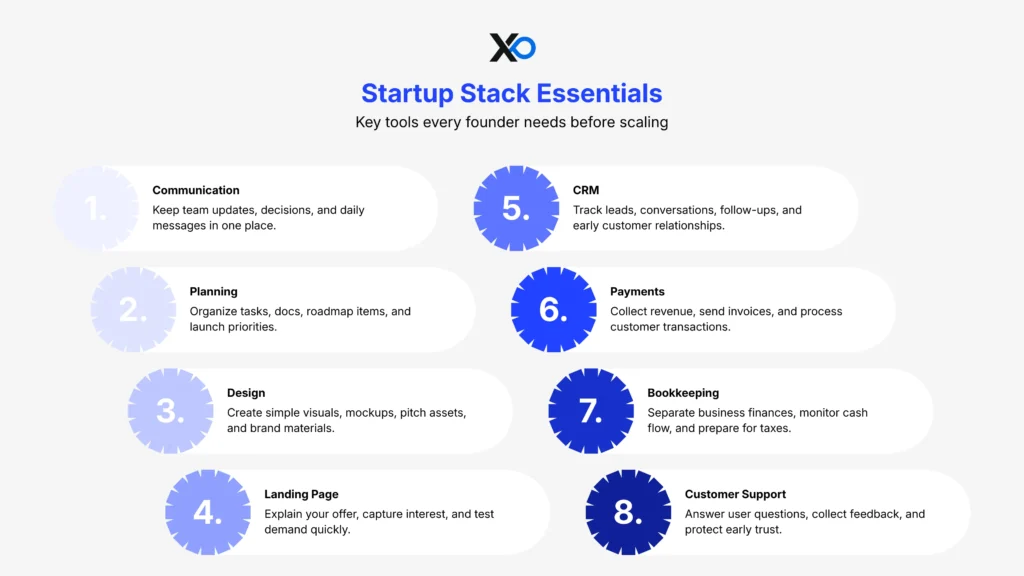
Start simple. Use only tools that help you validate, build, sell, or retain customers.
| Need | Tool options |
|---|---|
| Internal work | Notion, Google Docs, Slack, Trello |
| Design | Canva, Figma |
| Landing page | Carrd, Framer, Webflow, Notion |
| Customer tracking | HubSpot Free CRM, spreadsheet |
| Payments | Stripe |
| Bookkeeping | Wave, finance tracker |
If a tool does not help you move faster, skip it. Five tools used well beat fifteen tools nobody owns.
Choose Startup Credits by Industry and Stage
Do not chase the biggest credit amount. Chase the credit that removes your next bottleneck.
A $100,000 cloud credit is useful if you are building AI, data, infrastructure, or software with real usage. It is less useful if you are still validating an idea with a landing page and user calls.
Use this simple filter:
| Stage | Prioritize credits for |
|---|---|
| Idea stage | Landing pages, design, docs, CRM, basic analytics |
| MVP stage | Hosting, payments, support, product analytics |
| Pre-seed | Pitch deck tools, cloud, CRM, legal, fundraising tools |
| Seed | Cloud, data, hiring, payroll, compliance, sales tools |
Then match by industry:
| Startup type | Best credit focus |
|---|---|
| AI startup | GPU, model hosting, data storage, inference |
| B2B SaaS | Hosting, CRM, analytics, onboarding, security |
| Fintech | Compliance, security, payments, legal setup |
| Marketplace | Payments, identity, support, email, analytics |
The best startup perk is not the biggest one. It is the one that helps you move faster right now.
For a deeper breakdown, read XRaise’s guide to cloud credits for startups before choosing your infrastructure perks.
Compare Programs Before You Apply Everywhere
Do not apply to every startup program you find. Compare for fit first.
Startup programs are not all built the same. One may offer credits, another may focus on mentorship, investor access, equity funding, or simple brand visibility.

Startup Perks AI Assistant
Have questions about credits? Let's chat instantly.
Use this quick filter:
| Check | What to ask |
|---|---|
| Eligibility | Do we actually qualify? |
| Stage fit | Is this built for our current stage? |
| Industry fit | Does it support our market? |
| Credit value | How much do we get, and when does it expire? |
| Equity terms | What do we give up? |
| Network | Are the mentors, founders, or investors relevant? |
| Speed | Can we access value quickly? |
| Time cost | Will this distract us from customers? |
A smaller credit you can use today may beat a larger credit with slow approval.
A niche program with the right buyers may beat a famous accelerator with the wrong network.
The goal is not to collect logos. It is to reduce burn, find leverage, and move faster.
You can also use XRaise’s startup programs strategy guide to compare programs before applying.
Understand Equity Trade-Offs Before “Free” Gets Expensive
Not all startup support is truly free.
Credits, SaaS discounts, and grants usually do not take equity. Accelerators and investment programs sometimes do.
Before joining, ask:
| Question | Why it matters |
|---|---|
| What do we give up? | Equity, time, relocation, or reporting may be required |
| Is the network relevant? | Generic mentors rarely justify ownership |
| Will it help us raise or sell? | The program should improve your odds of real progress |
| Can we get this value elsewhere? | Perks, credits, or grants may be enough |
Equity can be worth it if the program gives strong feedback, investor access, customer introductions, or hard-to-reach expertise.
It is not worth it for generic workshops and a logo.
Location vs Value: Do Not Relocate for Vibes
Startup hubs can help, but relocation is not automatically worth it.
Before moving for a program, calculate the real cost:
| Cost | What to check |
|---|---|
| Rent | Can your runway handle higher living costs? |
| Travel | Will flights, transport, or visas add pressure? |
| Focus | Will moving slow down product or sales? |
| Team impact | Can your team work well from that location? |
| Customer access | Are your real buyers actually there? |
| Opportunity cost | What do you lose by relocating? |
Ask one question:
Does this location increase our odds of customers, capital, or talent?
If the answer is not clear, do not move for prestige. Instead, use remote programs, online networks, startup credits, and customer calls to create momentum.
Success Rate Analysis: Look Past the Logo
Do not judge a startup program by brand alone. A famous name helps only if the outcomes match your needs.
Check this before applying:
| What to check | Why it matters |
|---|---|
| Alumni in your industry | Proves the program understands your market |
| Fundraising outcomes | Shows whether founders raise after joining |
| Customer access | Helps if you need pilots, users, or enterprise buyers |
| Mentor relevance | Generic advice is not enough |
| Investor network | Useful only if you are ready to raise |
| Program recency | Old success stories may not reflect current quality |
| Selectivity | Shows how competitive and credible the program is |
Also ask what the program is built to do.
Different programs solve different problems. For example, one may help you raise, while another may open doors to pilots, infrastructure support, enterprise buyers, storytelling help, or local visibility.
Success means one thing:
Did founders like us get the outcome we need?
Common Free Business Startup Mistakes
The biggest mistakes are predictable.
Mistake 1: Paying retail too early.
Before buying any tool, check whether a free tier, startup discount, credit, or XRaise perk exists.
Mistake 2: Claiming credits too late.
Many programs have eligibility rules. Some depend on company age, funding stage, provider partners, or startup status. Waiting can reduce your options.
Mistake 3: Building before validation.
A free tech stack still costs time. Do not waste three months building something nobody asked for.
Mistake 4: Over-tooling.
Free tools can create hidden complexity. Keep the stack small until the workflow breaks.
Mistake 5: Ignoring real future costs.
Credits expire. Free tiers change. Paid plans become necessary. Know your real cost structure before usage scales.
Mistake 6: Applying to every accelerator.
Bad-fit applications waste time. Build a shortlist by stage, industry, terms, location, and outcome.
Mistake 7: Treating perks as strategy.
Perks reduce burn. They do not replace customers.
The founder who wins is not the one who collects the most free tools.
It is the one who turns saved cash into more validation, faster shipping, and stronger customer proof.
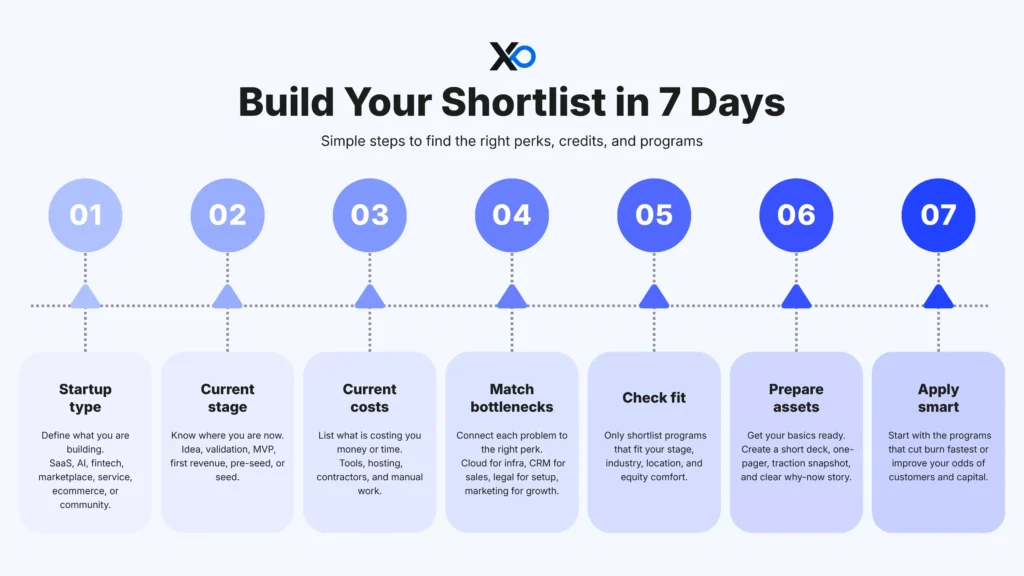
How to Build Your Shortlist in 7 Days
Here is the simple version.
Day 1: Define the startup type.
Are you SaaS, AI, marketplace, fintech, service, community, ecommerce, or infrastructure?
Day 2: Define the current stage.
Idea, validation, MVP, first revenue, pre-seed, or seed.
Day 3: List current costs.
Write down every tool, subscription, hosting cost, contractor cost, and manual workflow.
Day 4: Match perks to bottlenecks.
Cloud credits for infrastructure. CRM discounts for sales. Legal perks for formation. Pitch tools for fundraising. Marketing tools for acquisition.
Day 5: Check accelerator fit.
Only shortlist programs that match your stage, industry, location tolerance, and equity comfort.
Day 6: Prepare your core assets.
Build a short deck, one-page summary, traction snapshot, and clear “why now” answer.
Day 7: Apply smart.
Start with the programs and perks that reduce burn fastest or increase your odds of customers and capital.
Your Action Plan
- Assess fit: Define your stage, industry, burn rate, and next bottleneck.
- Build: Use the XRaise AI Pitch Deck Builder to turn your idea, traction, and market story into a fundable deck.
- Hedge: Claim $500K+ in perks where eligible so software, cloud, and growth costs do not crush your runway.
- Apply smart: Prioritize the perks, credits, and accelerators that match your real startup stage.
Free Business Startup: The Smart Founder Move
The future of starting a company is not about spending more early.
It is about proving more before you spend.
A free business startup works when you validate demand, keep your stack lean, claim credits early, and choose programs based on fit instead of hype.
Your next action step is simple: identify your top three upcoming costs, then find the credit, perk, or program that reduces each one before you pay retail.
Learn more and start building with XRaise’s Web App, then explore programs that can help you scale faster through XRaise’s Accelerators.