To get into a16z accelerator, you need more than a strong idea.
You need proof that your team can move fast, learn sharply, and build a venture-scale company.
TL;DR
- Who it’s for: Early-stage founders building high-growth startups, especially in AI, B2B, fintech, developer tools, creative tools, and vertical software.
- Acceptance edge: Strong founder-market fit, fast execution, clear insight, and real external validation.
- Timing: SR007 applications close May 17, 2026, with the cohort running July 27 to October 11, 2026.
- Key benefit: a16z speedrun invests up to $1M and gives access to operators, investors, credits, and Demo Day support.
What Does a16z Accelerator Look for in Startups?
a16z speedrun looks for founders who can go from zero to one quickly.


The team is not only asking, “Is this a good idea?”
They are asking, “Can this team create a company that grows fast enough for venture capital?”
That changes the whole application.
A polished pitch is useful. But it is not the main signal. The stronger signal is whether you have already done founder-quality work.
That means you have tested the problem, understood the buyer, and can explain why the market is changing. Strong applicants have also built something, sold something, learned something important, or created visible demand.
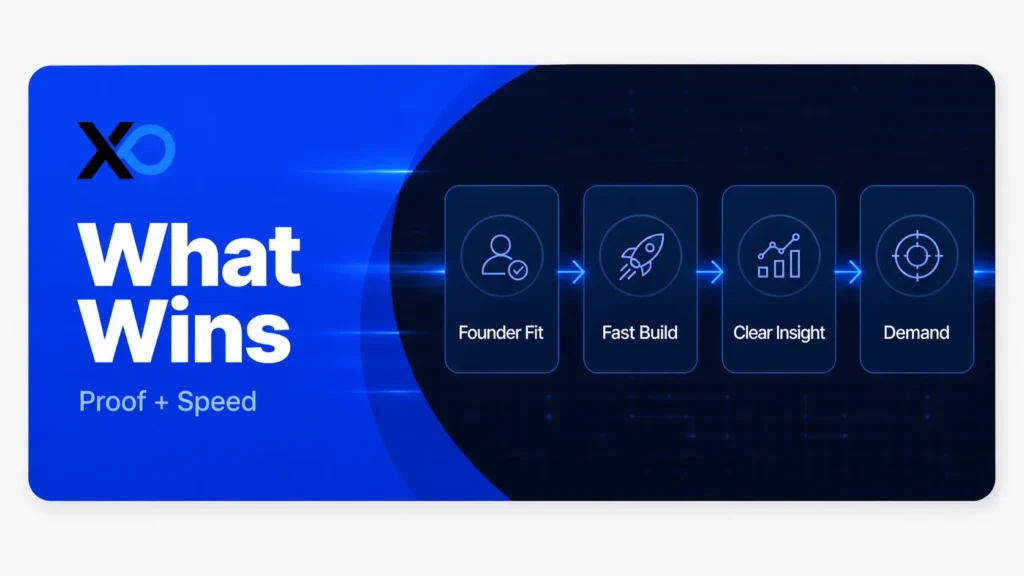
The best applications usually show four things:
| Factor | What They Look For | Weak Signal |
|---|---|---|
| Founder quality | Clear skill, speed, credibility, and founder-market fit | Generic bios or unclear roles |
| Execution speed | Product, demos, pilots, usage, or rapid learning | Idea-only application |
| Unique insight | A sharp reason this should exist now | Trend-chasing with no depth |
| Communication | Clear one-liner, proof, and next steps | Long, vague explanations |
The program is very selective. Recent cohorts have had roughly 60 to 70 teams, with an acceptance rate below 0.4%.
So the real bar is not “interesting.”
The bar is “hard to ignore.”
Who Gets Accepted into a16z Accelerator?
Founders who get accepted usually have a clear reason to win.
That reason can come from technical depth, domain experience, customer access, previous execution, research, founder chemistry, or unusual speed.
The proof can look different depending on the founder. What matters is whether the signal is strong enough to make the team feel unusually qualified.
What Founder Signals Matter Most?
| Founder Type | Strong Acceptance Signal | Weak Signal |
|---|---|---|
| Repeat founder | Built, scaled, sold, or learned from a previous company | “I have startup experience” with no clear outcome |
| Domain operator | Worked inside the broken workflow and knows the buyer deeply | Generic market interest |
| Technical founder | Can build something hard or defensible quickly | Outsourced product with no technical edge |
| Research-driven founder | Has unique insight from deep study or technical work | Trend-based idea with no earned secret |
| Customer-led founder | Has users, pilots, waitlist demand, or buyer pull | No evidence anyone cares yet |
The format does not matter as much as the signal.
a16z speedrun appears to reward founders who can explain the company with clarity and proof, not just ambition.
| What Founders Must Explain | What a Strong Answer Shows |
|---|---|
| Why this problem matters now | A real market shift, urgent pain, or broken workflow |
| Why they understand it better | Founder-market fit, customer access, or earned insight |
| What they have built or validated | MVP, demo, usage, pilots, revenue, or design partners |
| Why it can become large | Clear buyer, large pain, strong wedge, and expansion path |
| Why this team moves faster | Complementary skills, speed, execution history, and focus |
Recent public patterns suggest strong fit for AI-first startups. That includes AI+B2B, fintech automation, developer tools, creative tooling, logistics, healthcare, defense, robotics, media, and vertical software.
But category alone will not carry the application.
An AI startup with no customer insight is weak.
A niche startup with deep pain, strong speed, and real demand can be much stronger.
When Should You Apply to a16z Accelerator?
You should apply when your startup has enough clarity to survive investor-level pressure.
That does not mean you need perfect traction. Early validation is helpful, but it is not always required.
The better question is simple: can you show one serious proof point that makes the opportunity feel real?
What Proof Should You Have Before Applying?
| Apply When You Have | Why It Helps |
|---|---|
| A working MVP | Shows you can build, not just pitch |
| A strong demo | Makes the product easier to understand fast |
| A sharp waitlist | Shows early demand from the right audience |
| Paying users | Proves someone values the solution enough to pay |
| Design partners | Shows real buyer interest and product feedback |
| Customer interviews | Proves you are learning from the market |
| Repeat usage | Suggests the product solves a real problem |
| Early revenue | Creates a stronger investor-readiness signal |
| Technical breakthrough | Shows a defensible reason to believe |
| Founder expertise | Makes founder-market fit easier to trust |
The worst time to apply is when you are still exploring random ideas.
Speedrun is not designed for founders who need someone to tell them what to build. It is better for founders who already have direction and need compression.
Use this readiness check before applying.
| Apply Now | Wait Before Applying |
|---|---|
| You can explain the company in one sentence | You still struggle to describe the user |
| You know the pain clearly | The problem keeps changing every week |
| You have at least one proof point | You only have internal excitement |
| You can defend the next 90 days | You do not know what to build next |
| You know why this team can win | Founder roles or commitment are unclear |
That means sharper feedback, faster product work, investor readiness, hiring support, and a stronger fundraising launch.
If your company still has no clear user, no clear pain, and no clear founder edge, wait.
If you can explain the company in one sentence and defend the next 90 days, apply.
How to Get Accepted into a16z Accelerator
To get accepted, treat the application like a short pre-seed memo.
Do not write like you are filling out a form.
Write like you are building conviction.
Start with the bottom line.
| Question | Strong Answer |
|---|---|
| What are you building? | A clear product, not a vague category |
| Who is it for? | A specific user or buyer |
| Why now? | A real market shift or urgent pain |
| Why you? | Founder proof tied to the problem |
| What is working? | External validation, not internal belief |
Your opening should remove confusion fast.
Weak:
“We are building an AI platform to transform productivity.”
Stronger:
“We help commercial lenders automate borrower document review, cutting manual underwriting time from days to hours.”
The stronger version names the buyer, workflow, pain, and outcome.
That is what reviewers need. Then bring your strongest proof forward.
| Proof | Why It Matters |
|---|---|
| Shipped products | Shows execution |
| Sold into the market | Shows buyer access |
| Worked inside the workflow | Shows founder-market fit |
| Built fast | Shows speed |
| Users return | Shows real pull |
| Pilots or design partners | Shows external demand |
Do not bury traction.
Revenue helps, but it is not the only signal. Usage, retention, pilots, referrals, waitlist growth, and strong demo response can also matter.
The key is simple:
Someone outside the team must care.
How Does the a16z Accelerator Interview Work?
The interview is short, direct, and high-signal.
The process can include a brief video pitch, a 15-minute interview, and follow-up requests for references, data, or more detail.
That means you do not have time for a slow story.
Use the first conversation like a movie trailer. Show enough to create conviction, not every detail.
| Interview Moment | What to Prove |
|---|---|
| One-liner | What you do, who it helps, and why it matters |
| Why now | The market shift, urgent pain, or new opening |
| Founder story | Why this team is unusually credible |
| Proof | Users, pilots, revenue, usage, waitlist, or demo response |
| Next step | What you will ship, validate, or close in the next 90 days |
| Pressure questions | Clear thinking without exaggeration |
Your one-liner sets the frame. The founder story builds credibility. Strong proof makes the opportunity believable.
A weak answer says:
“We think this is a big market.”
A strong answer says:
“We spoke to 42 operations leaders. Thirty-one use spreadsheets for this workflow. Twelve agreed to pilot. Three asked for pricing before we had a full product.”
That kind of answer creates belief.
How to Win the a16z Accelerator Interview
To win the interview, be clear, fast, and honest.
Be direct about traction. Stay honest about unresolved risks. Avoid founder theater.
The best founders sound serious because they know what is working, what is uncertain, and what they will test next.
| Question | Strong Signal |
|---|---|
| Why this team? | Clear founder-market fit |
| Why now? | Real market shift or urgent pain |
| What proof exists? | Users, pilots, revenue, or waitlist pull |
| Why big? | Large pain and expansion path |
| What is your wedge? | Specific entry point |
| Why not incumbents? | Speed, focus, or technical edge |
| Next 90 days? | Focused product or GTM plan |
| What does capital unlock? | Faster hiring, learning, or growth |
| Biggest risk? | Honest answer + test plan |
Keep answers short enough to control the room.

Startup Perks AI Assistant
Have questions about credits? Let's chat instantly.
Use numbers, customer language, and concrete proof.
Do not say “massive traction” if you mean 80 waitlist signups.
Say:
“We have 80 waitlist signups from two founder-led posts. Ten are target buyers. Four booked calls. Two asked for pilots.”
That is more believable.
The goal is not to sound perfect. It is to sound like a founder who sees reality clearly and moves anyway..
Why Startups Get Rejected
Most startups do not get rejected because the idea is bad.
They get rejected because the signal is too weak.
The rejection patterns are usually predictable.
| Rejection Trigger | Why It Hurts |
|---|---|
| Team lacks clear edge | Hard to trust founder-market fit |
| Product is unclear | Reviewers cannot understand the wedge |
| Market feels small | Venture-scale outcome feels unlikely |
| Insight sounds copied | No earned secret or unique angle |
| No external validation | Demand is still unproven |
| Traction is inflated | Trust breaks quickly |
| Application is vague | Conviction cannot build |
| Deck link fails | Creates friction and weak attention to detail |
| Founder roles are unclear | Team execution risk increases |
| Company feels like a feature | Market ambition looks too narrow |
Do not over-explain features before proving the problem.
Reviewers need to understand the pain, buyer, market shift, wedge, and proof.
Applying with multiple ideas is another red flag.
It signals that the team is still searching for conviction.
a16z speedrun wants founders who move quickly. But speed is not the same as randomness.
Is a16z Accelerator Worth It?
a16z speedrun is worth it for founders who can use pressure, capital, and network access well.
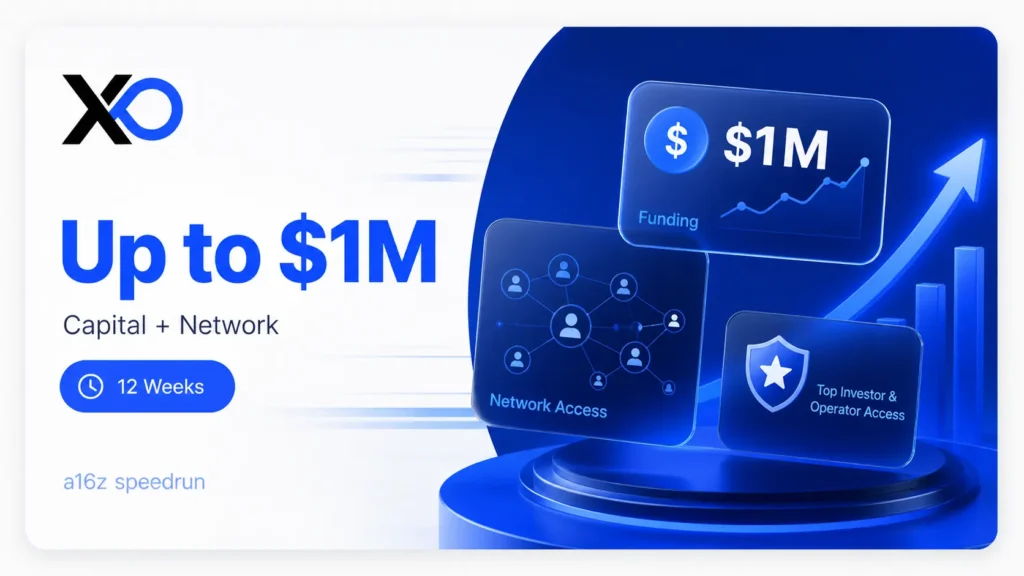
The program is 12 weeks, in person in San Francisco. It invests up to $1M per accepted company, including $500K upfront for 10% in a SAFE and another $500K in the company’s next round within 18 months.
It also includes operator support, fundraising help, partner credits, Demo Day preparation, and access to a large investor network.
That is a serious package. But it comes with trade-offs.
| Benefits | Trade-offs |
|---|---|
| Up to $1M investment | 10% upfront ownership on the initial SAFE |
| a16z network and investor access | Very high selection bar |
| 12-week focused program | Requires in-person commitment |
| Demo Day visibility | Not ideal for unfocused founders |
| Operator support and credits | Fast pace can expose weak teams |
The program makes the most sense when the founder already has direction.
If you need basic startup education, it may feel intense.
If you already have momentum, it can multiply that momentum.
Alternatives to a16z Accelerator
a16z speedrun is not the only strong accelerator path.
Founders should compare it with programs like Y Combinator, Techstars, 500 Global, and sector-specific accelerators.
The right choice depends on your stage, category, geography, funding needs, and preferred network.
| Good Fit | Not a Fit |
|---|---|
| You are early but moving fast | You are still choosing an idea |
| You can commit full-time | You cannot join in person |
| You have a strong founder edge | Your team roles are unclear |
| You want pre-seed capital and investor access | You only want light mentorship |
| You can explain external validation | You have no proof beyond belief |
Use alternatives if another program gives you a better category network, better geography, or better timing.
But if your startup fits speedrun’s bar, the upside is unusually strong.
How to Apply on XRaise
Before you apply, make sure your a16z Accelerator application is not just complete.
It should be clear, focused, and ready for investor-level review.
That is where the XRaise breakdown can help. Use it to understand the program details, check fit, review timing, and prepare the right application materials before moving forward.
Read the full application guide here.
Before applying, prepare:
| What to Prepare | Why It Matters |
|---|---|
| One-sentence company description | Removes confusion fast |
| Founder proof | Shows why this team can win |
| Short deck | Helps reviewers understand the story |
| Demo or demo video | Makes the product easier to judge |
| LinkedIn profiles | Adds credibility and context |
| External validation | Proves someone outside the team cares |
| 90-day plan | Shows focus after acceptance |
| Fit with speedrun | Explains why this program makes sense |
Earlier consideration can help, but strength matters more than speed alone.
Final Thoughts
Getting into a16z speedrun is not about looking like an accelerator applicant.
It is about looking like a founder a16z would want to back early.
That means clear founder-market fit, fast execution, specific insight, and proof that the world is already reacting.
Apply if you can show speed, clarity, and market pull.
Do not apply if you are still searching for the idea, hiding weak proof behind buzzwords, or hoping the brand will create the company for you.
The strongest applicants do not sound polished.
They sound inevitable.
For additional details, visit the official a16z speedrun site.