
Most founders don’t realize they’re overpaying for the best startup tools, sometimes by $10,000 to $50,000 in the first year alone. From cloud infrastructure to analytics and CRM platforms, choosing the right startup tools for founders can dramatically extend runway, especially when free startup tools, credits, and discounts are available. Here’s how to avoid wasting money on your startup stack.
TL;DR
Early-stage founders waste thousands of dollars on tools they don’t yet need, and often overpay for the ones they do. This guide covers the 25 best startup tools across cloud infrastructure, analytics, engineering, sales, support, and collaboration. For most of these tools, startup credits, perks, and discounts exist that can save you $10,000 to $200,000+ in year one. XRaise helps founders discover which programs they qualify for and simplifies the entire application process.



Introduction
When you’re building a startup in 2026, the best startup tools aren’t the ones your favorite VC tweets about. They’re the ones that fit your stage, your team size, and your actual problem right now. Most early-stage founders spend too early on tools built for companies three times their size, or they pay full price for software they could have gotten free through a startup program.
This guide covers 25 essential tools across every major category (infrastructure, analytics, dev tooling, CRM, support, design, and fundraising) and tells you not just why each tool matters, but when you actually need it, and how to pay as little as possible for it.
Because runway is your most valuable resource. Spend it on what builds the business, not on software invoices.
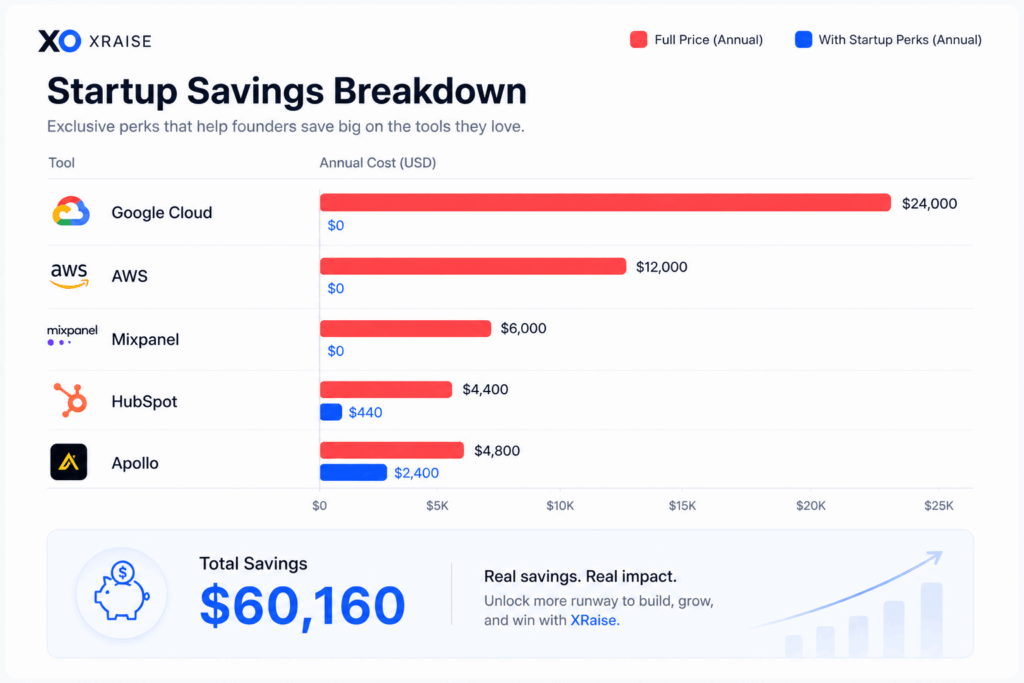
Why Founders Overpay for Startup Tools
Many early-stage founders overpay for startup tools because they optimize for perceived scale instead of actual needs. Instead of choosing the best startup tools for their current stage, they often adopt complex and expensive solutions too early.
For example, a small team might invest in enterprise-level support tools, advanced cloud infrastructure, or full CRM systems before reaching product-market fit. While these tools are powerful, they are rarely necessary in the early stages.
The Cost of Choosing the Wrong Startup Tools
This mismatch leads to unnecessary spending, increased complexity, and slower execution. More importantly, it reduces runway which is one of the most critical resources for any startup.
The best startup tools are not always the most feature-rich or expensive. Instead, they are the ones that solve your immediate bottleneck and help you move forward faster.
How Smart Founders Reduce Tool Costs
Smart founders approach tool selection differently. They focus on timing, use free tiers whenever possible, and take advantage of startup credits and discounts offered by leading SaaS companies.
In fact, many of the best startup tools offer generous startup programs, including credits and discounts worth $10,000 to $200,000 or more. The challenge is that most founders either don’t know these programs exist or don’t have the time to apply for them.
That’s exactly where platforms like XRaise help by making it easier to discover, qualify for, and apply to the right startup perks without wasting time.
Before committing to any paid tools, it’s worth checking whether your startup qualifies for available credits or discounts many founders save thousands without changing their stack.
25 Best Startup Tools for Founders in 2026
| Tool | Category | Best For | Founder Stage | XRaise Offer / Perk | When to Use It |
|---|---|---|---|---|---|
| Google Cloud | Infrastructure | AI/ML, data pipelines | Seed to Series A | Up to $200,000 credits | Production workloads, AI-native builds |
| AWS Activate | Infrastructure | Full-stack cloud | Pre-seed to Series A | Up to $100,000 credits | From day one in production |
| Microsoft Azure | Infrastructure | Enterprise, OpenAI API | Seed to Series B | Up to $150,000 credits | Enterprise sales, compliance needs |
| DigitalOcean | Infrastructure | Lightweight apps, MVPs | Pre-seed to Seed | 12 months cloud credits | Early-stage, simple infra |
| Lambda Labs | Infrastructure | GPU compute, model training | Seed to Series A | Up to $7,500 credits | Fine-tuning and model training |
| OpenAI via Azure | AI Infrastructure | AI-native products | Seed to Series B | $5,000 Azure credits | Enterprise AI deployments |
| Mixpanel | Analytics | Product analytics | Seed to Series A | $50,000 credits | After first 100 active users |
| Statsig | Analytics | A/B testing, feature flags | Seed to Series B | Available on XRaise — verify current offer | When running structured experiments |
| GitLab | Dev Tools | CI/CD, DevSecOps | Pre-seed to Series A | Free Ultimate plan, 12 months (~$18,000 value) | When you need full DevSecOps |
| JetBrains | Dev Tools | IDE, developer productivity | Pre-seed to Series B | 6 months free (~$4,000+ value) | From first line of code |
| GitHub | Dev Tools | Version control, collaboration | Pre-seed to Series B | Not listed on XRaise — check GitHub directly | From day one |
| Linear | Dev Tools | Issue tracking, sprints | Seed to Series A | Not listed on XRaise — check Linear directly | When team is 3+ engineers |
| HubSpot | CRM / Sales | Full GTM stack | Seed to Series A | Up to 90% off (~$4,000 saved) | When you start structured outbound |
| Close CRM | CRM / Sales | Sales-focused teams | Seed to Series A | Available on XRaise — verify current offer | When outbound is your primary channel |
| Apollo.io | Sales / Outbound | Prospecting, lead data | Pre-seed to Series A | 50% off first year | When you launch structured outbound |
| ReachInbox | Sales / Outbound | Cold email at scale | Pre-seed to Seed | Up to 80% off | When doing cold email campaigns |
| Intercom | Customer Support | In-app messaging, support | Seed to Series A | Free first year (~$1,300+ saved) | Once you have active paying users |
| Zendesk | Customer Support | Ticket-based support | Seed to Series B | 6 months free | When support volume grows past 50 tickets/week |
| Webflow | No-Code / Website | Marketing site, CMS | Pre-seed to Seed | Free CMS plan | Before writing any website code |
| Tally | No-Code / Forms | Forms, surveys, lead capture | Pre-seed to Seed | 50% off for 12 months | From day one |
| Linko | No-Code / Link | Branded links, bio pages | Pre-seed to Seed | 1 year Business free | When building an online presence |
| Slack | Collaboration | Team communication | Pre-seed to Series B | 25% off upgrades | As soon as you have a co-founder |
| Miro | Collaboration | Visual collaboration, ideation | Pre-seed to Series A | $500 credits | During product and design sprints |
| Asana | Productivity | Project and task management | Seed to Series A | 6 months Advanced free | When managing multiple workstreams |
| DocSend | Fundraising | Investor decks, tracking | Pre-seed to Seed | Up to 90% off (~$4,300 saved) | Before your first investor meeting |
Best Startup Tools for Cloud and AI Infrastructure
Cloud and AI infrastructure is where early-stage startups can lose the most money, or save the most. These six tools cover every major provider, and every one of them has a startup program worth applying to before you run your first workload.
1. Google Cloud
Best for: AI/ML workloads, data pipelines, startups building on Google’s ecosystem
Why founders use it: Google Cloud offers a mature, developer-friendly platform with best-in-class services for data warehousing (BigQuery), ML infrastructure (Vertex AI), and container orchestration (GKE). If your product is AI-native or data-intensive, Google Cloud is often the most cost-efficient choice at scale.
When you actually need it: Once you’re past prototyping and need production-grade infrastructure, or when your AI models require serious compute. Don’t over-provision early. Google Cloud’s free tier and trial credits can carry you far in the first 3 months.
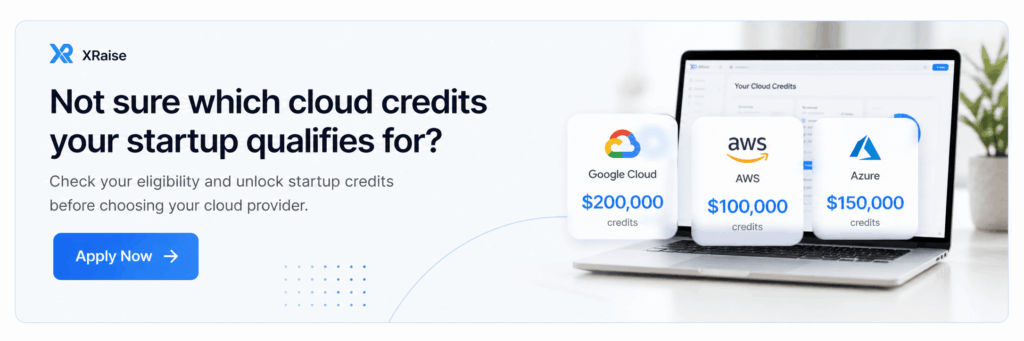
How to get it cheaper: Through XRaise, qualifying startups can access up to $200,000 in Google Cloud credits. Apply before you architect anything , the credits can meaningfully change your infrastructure decisions.
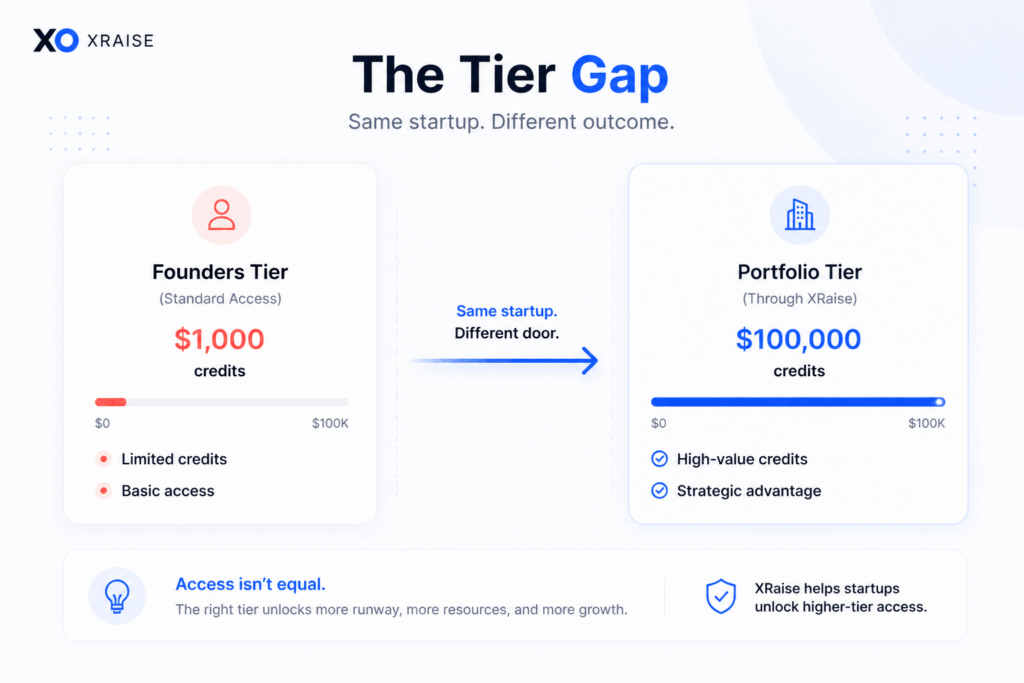
If you’re planning to use Google Cloud, it’s worth checking which credit tier you actually qualify for before applying. Many founders only access the basic level, while higher tiers are available depending on how you apply.
You can explore available Google Cloud credits here.
2. AWS Activate
Best for: Full-stack cloud infrastructure, global deployments, startups that need a broad service catalog
Why founders use it: AWS is the most widely used cloud platform in the world, with the largest ecosystem of managed services, integrations, and community support. If you’re hiring engineers in 2026, most of them already know AWS.
When you actually need it: From day one if you’re building a production application. AWS’s free tier is generous, but the Activate program is where the real value is.
How to get it cheaper: XRaise-connected startups can access up to $100,000 in AWS Activate credits, covering compute, storage, and ML services. Common wins include $25,000 in AWS credits for AI-focused teams.
Many founders apply for the basic tier without realizing higher tiers exist. It’s worth checking how you apply before committing.
You can explore AWS startup credits here.
3. Microsoft Azure
Best for: Enterprise-facing startups, Microsoft-integrated dev stacks, OpenAI API users
Why founders use it: Azure is the default choice if your target customers are enterprise or mid-market companies running Microsoft infrastructure. It’s also the primary distribution channel for OpenAI’s API at scale, which matters enormously for AI-native products.
When you actually need it: When you’re selling to enterprise, or when your AI usage requires the reliability and compliance guarantees of Azure OpenAI Service.
How to get it cheaper: Through XRaise, startups can unlock up to $150,000 in Microsoft Azure credits, which can be applied across compute, storage, databases, and OpenAI API usage.
Many founders underestimate how much Azure credit they actually qualify for.
You can explore available Microsoft Azure startup credits here.
4. DigitalOcean
Best for: Early-stage teams, solo founders, developer tools, lightweight web apps
Why founders use it: DigitalOcean is the most developer-friendly cloud provider for small teams. Setup is fast, pricing is predictable, and the documentation is genuinely good. It’s not where you scale to millions of users, but it’s a solid place to start.
When you actually need it: At the very beginning, when you want a simple VPS, managed database, or app platform without the complexity of AWS or GCP.
How to get it cheaper: XRaise offers access to 12 months of DigitalOcean cloud credits for qualifying startups, enough to run your early infrastructure completely free while you validate product-market fit.
You can explore available DigitalOcean startup credits here.
5. Lambda Labs
Best for: AI/ML startups that need GPU compute for training and fine-tuning
Why founders use it: Lambda offers on-demand and reserved GPU cloud instances at significantly lower costs than AWS or Azure for raw compute. If you’re training models or running inference at scale, Lambda can meaningfully reduce your GPU bill.
When you actually need it: When you’ve moved past using APIs and need to fine-tune, train, or self-host models. Don’t spin up GPU clusters before you’ve validated your model architecture.
How to get it cheaper: XRaise offers up to $7,500 in Lambda credits for qualifying startups, meaningful runway for early model training and experimentation.
6. OpenAI via Azure
Best for: AI-native products requiring GPT-4o, embeddings, or fine-tuned models at production scale
Why founders use it: Using OpenAI through Azure gives you enterprise-grade SLAs, data privacy guarantees, compliance certifications, and access to the same models. This is critical when selling to enterprise customers who won’t accept consumer API terms.
When you actually need it: Once you’re in enterprise sales conversations or when your product is processing sensitive customer data that requires compliance coverage.
How to get it cheaper: Through XRaise, startups can access $5,000 in Azure credits that apply directly to OpenAI API usage via Azure, a useful bridge for teams ramping up AI inference costs.
Best Startup Tools for Product Analytics and Experimentation
You can’t improve what you can’t measure, but you also don’t need enterprise analytics on day one. Here’s when these tools actually earn their cost.
7. Mixpanel
Best for: Product analytics, funnel analysis, retention tracking
Why founders use it: Mixpanel is the gold standard for event-based product analytics. It answers the questions that matter most in early growth: where are users dropping off? Which features drive retention? What does the path to conversion actually look like?
When you actually need it: Once you have 100+ active users engaging with your product in meaningful ways. Before that, you can get by with basic funnel tools or even Google Analytics.
How to get it cheaper: XRaise offers $50,000 in Mixpanel credits for qualifying startups, enough to run full product analytics for 12 to 18 months without spending a dollar.
8. Statsig
Best for: Feature flags, A/B testing, experimentation at scale
Why founders use it: Statsig combines feature flagging and rigorous statistical A/B testing in a single platform. It’s become a popular experimentation tool for AI and SaaS startups that want solid experimentation infrastructure without building it in-house.
When you actually need it: When you’re running structured product experiments and need statistical confidence in your results. Don’t invest in experimentation infrastructure before you have enough traffic to produce statistically significant results, typically 1,000+ monthly active users minimum.
How to get it cheaper: Statsig is available through XRaise. Check the XRaise platform for the current offer and eligibility requirements.
Best Startup Tools for Developer and Engineering Teams
Your engineering stack should be boring and productive. Here are four tools that show up in almost every technical startup’s workflow.
9. GitLab
Best for: CI/CD pipelines, DevSecOps, teams that want one platform for the entire dev lifecycle
Why founders use it: GitLab bundles source control, CI/CD, security scanning, container registry, and project management into a single platform. For small engineering teams, this reduces toolchain complexity significantly.
When you actually need it: From the moment you have more than one engineer, or when you need automated pipelines. Many teams start on GitHub and migrate to GitLab when they need tighter CI/CD control.
How to get it cheaper: Through XRaise, qualifying startups get GitLab Ultimate free for 12 months, an $18,000 value, which includes advanced security scanning, compliance dashboards, and enterprise features.
10. JetBrains
Best for: Developer productivity, IDE tooling for Python, Kotlin, Java, Go, and more
Why founders use it: JetBrains IDEs (IntelliJ IDEA, PyCharm, WebStorm, GoLand, and others) are among the most powerful and ergonomic development environments available. Engineers who use JetBrains tools consistently report higher productivity than with alternatives.
When you actually need it: From day one if your engineers write code. This is not a tool to defer. A bad IDE slows down your entire team.
How to get it cheaper: XRaise offers 6 months of JetBrains free, a $4,000+ value, for qualifying startups. That covers your entire team across all JetBrains products.
11. GitHub
Best for: Version control, open-source collaboration, code review, GitHub Actions
Why founders use it: GitHub is where the world’s code lives. Its network effects, ecosystem integrations, and GitHub Actions CI/CD pipeline make it the default choice for most startups. GitHub Copilot has also made it a leading AI-assisted coding environment.
When you actually need it: From your first commit. There is no reason to delay this tool.
How to get it cheaper: GitHub offers its own startup and open-source programs. Check GitHub’s official startup program directly for free Team plan access.
12. Linear
Best for: Engineering-led issue tracking, sprint management, product roadmapping
Why founders use it: Linear is the issue tracker that engineers actually enjoy using. It’s fast, opinionated, and keyboard-driven, and it keeps engineering work organized without becoming a bureaucratic burden. It has become a go-to project management tool for technical startups.
When you actually need it: Once your team has 3+ engineers working in parallel. Before that, a simple shared document or Notion board does the job.
How to get it cheaper: Linear offers a generous free tier for small teams. Check Linear’s own startup program for discounts available to early-stage companies.
Best Startup Tools for Sales, CRM, and Outbound
Your go-to-market stack should match where you are in your sales motion. Here are four tools that cover every stage from “we just launched” to “we’re building a repeatable outbound engine.”
13. HubSpot
Best for: Full GTM stack: CRM, email marketing, sales pipelines, content, customer service
Why founders use it: HubSpot is the most complete all-in-one marketing and sales platform available at startup-friendly pricing. It scales from a simple free CRM all the way to full marketing automation and enterprise sales tooling.
When you actually need it: When you’re moving from founder-led sales to a structured sales process, typically when you have a defined ICP and are doing repeatable outbound or inbound campaigns.
How to get it cheaper: Through XRaise, eligible startups can get up to 90% off HubSpot, saving approximately $4,000 in year one. This is one of the highest-value startup perks available on the platform.
14. Close CRM
Best for: Sales-first teams doing high-volume outbound and inside sales
Why founders use it: Close is a CRM built by salespeople for salespeople. It puts calling, emailing, and SMS outreach front and center, with built-in sequencing and reporting that doesn’t require a RevOps engineer to configure. It’s especially popular among B2B SaaS teams doing high-volume outbound.
When you actually need it: When outbound is your primary growth channel and you need a CRM that accelerates sales velocity rather than just tracking it.
How to get it cheaper: Close CRM is available through XRaise. Check the platform for the current offer and eligibility requirements.
15. Apollo.io
Best for: B2B prospecting, lead enrichment, email sequencing, sales intelligence
Why founders use it: Apollo combines a massive B2B contact database with outbound sequencing tools in one platform. It’s replaced the combination of ZoomInfo plus separate outreach tools for most early-stage teams because it’s significantly cheaper and faster to set up.
When you actually need it: The moment you start structured outbound. Even if you’re doing founder-led sales, Apollo’s contact data and enrichment saves hours of manual research.
How to get it cheaper: Through XRaise, startups can access 50% off Apollo.io for the first year, cutting one of your core GTM costs in half from day one.
16. ReachInbox
Best for: Cold email outreach at scale with AI-assisted personalization
Why founders use it: ReachInbox is designed specifically for high-volume, deliverability-optimized cold email campaigns. It handles warm-up, rotation across multiple sending domains, and AI-powered personalization, which is critical for founders who rely on cold email as a primary acquisition channel.
When you actually need it: When you’re running cold outbound campaigns and need to protect deliverability while scaling send volume beyond what a single inbox can handle.
How to get it cheaper: Through XRaise, startups can access up to 80% off ReachInbox, making enterprise-grade email infrastructure accessible at near-zero cost in the early stages.
Before paying full price for your GTM stack, check whether your startup qualifies for discounts on tools like HubSpot, Apollo.io, Close, and more. The credits and discounts available in this category alone can save most early-stage founders thousands of dollars in year one.
Best Startup Tools for Customer Support and Success
Support tooling is where founders most commonly over-invest too early. Here’s a clearer way to think about timing.
17. Intercom
Best for: In-app messaging, onboarding flows, proactive customer support
Why founders use it: Intercom sits inside your product and enables you to message users contextually, based on their behavior, lifecycle stage, or support request. It’s the standard for SaaS companies that want to combine support, onboarding, and product-led engagement in one surface.
When you actually need it: Once you have active paying customers who need in-product support. Don’t install this before you have users. It adds complexity without value.
How to get it cheaper: Through XRaise, qualifying startups receive Intercom free for the first year, a $1,300+ value. This is one of the most-claimed perks on the platform.
18. Zendesk
Best for: Ticket-based customer support, help center, enterprise support workflows
Why founders use it: Zendesk is the enterprise standard for structured support ticketing. It’s the right tool when your support volume is high enough to require routing, SLA management, macros, and reporting, typically when you’re past the “founder handles all support” stage.
When you actually need it: When your inbound support requests exceed 50 tickets per week or when enterprise customers require formal SLA reporting.
How to get it cheaper: Through XRaise, qualifying startups receive 6 months of Zendesk free, enough time to scale your support operation before committing to a paid plan.
Best Free Startup Tools for Websites, Forms, and No-Code
These three tools collectively let you build your public presence, capture leads, and manage your online brand, often at zero cost in the early stages.
19. Webflow
Best for: Marketing websites, landing pages, CMS-driven content
Why founders use it: Webflow gives non-developers the ability to build professional, fully custom websites without writing frontend code. For founders who want to iterate quickly on messaging and design without depending on an engineer, it’s the best tool available.
When you actually need it: Before you launch, or whenever your existing site becomes a conversion bottleneck. You don’t need a developer to update your pricing page if you’re on Webflow.
How to get it cheaper: Through XRaise, qualifying startups receive a free Webflow CMS plan, letting you build a professional marketing site at no cost.
20. Tally
Best for: Lead capture forms, user surveys, waitlists, onboarding questionnaires
Why founders use it: Tally is a clean, flexible no-code form builder. It’s free to start, supports conditional logic, integrates natively with Notion, Google Sheets, and Zapier, and produces forms that look and feel modern.
When you actually need it: From day one. Whether you’re capturing a waitlist, surveying early users, or running an NPS survey, Tally handles it cleanly.
How to get it cheaper: Through XRaise, startups receive 50% off Tally for 12 months, covering Pro features like custom branding, payment collection, and form analytics at half price.
21. Linko
Best for: Branded link management, bio-link pages, link shortening for founders and indie hackers
Why founders use it: Linko is a modern link-in-bio and branded link management tool. It’s useful for founders managing social presence, sharing decks or landing pages cleanly, and building a professional online footprint without a full website.
When you actually need it: When you’re actively building a public presence, sharing content, running social, or directing people to multiple destinations from one link.
How to get it cheaper: Through XRaise, qualifying startups receive 1 year of Linko Business free, removing any cost barrier to entry entirely.
Startup Tools for Founders Managing Collaboration and Productivity
These tools don’t directly build the product, but the wrong choices here can slow down your entire team without you noticing.
22. Slack
Best for: Team communication, async collaboration, integrations hub
Why founders use it: Slack is the standard for startup communication. Its real value isn’t the chat itself. It’s the integrations. When your GitHub alerts, Stripe notifications, Mixpanel reports, and support tickets all surface in Slack, your team can stay aligned without constant context switching.
When you actually need it: As soon as you have a co-founder or first employee. Email alone does not scale for a fast-moving startup team.
How to get it cheaper: Through XRaise, startups receive 25% off Slack upgrades, meaningful savings when you’re paying per seat for a growing team.
23. Miro
Best for: Visual collaboration, product ideation, design sprints, architecture diagrams
Why founders use it: Miro is a virtual whiteboard that actually works. For remote and distributed founding teams, it’s the closest practical substitute for standing at a physical whiteboard together, and it’s genuinely useful for product planning, user journey mapping, and team workshops.
When you actually need it: During product discovery, sprint planning, and design reviews. Less critical once your team has stable processes, but invaluable in the messy early stages.
How to get it cheaper: Through XRaise, qualifying startups receive $500 in Miro credits, enough to run collaborative sessions across your entire team without paying out of pocket.
24. Asana
Best for: Cross-functional project management, roadmaps, OKR tracking
Why founders use it: Asana handles the coordination layer between teams (engineering, marketing, sales, and operations) when multiple workstreams are running in parallel. It’s more structured than Notion for project tracking and easier to adopt for non-technical team members than Linear.
When you actually need it: When you have more than 5 people working on simultaneous projects and need visibility across workstreams. Before that, a shared doc or Linear covers it.
How to get it cheaper: Through XRaise, qualifying startups receive 6 months of Asana Advanced free, unlocking timeline views, workload management, and advanced reporting at zero cost.
Best Startup Tools for Fundraising and Investor Updates
One tool earns its cost the moment you send your first deck to an investor.
You can also read “Best Cloud Credits for AI Startups Building in 2026”
25. DocSend
Best for: Sending pitch decks, tracking investor engagement, managing fundraising data rooms
Why founders use it: DocSend gives you a shareable link for your pitch deck that tracks exactly who opened it, how long they spent on each slide, and whether they forwarded it. For founders in active fundraising mode, this data is genuinely useful. It tells you which investors are engaged and where your deck loses them.
When you actually need it: Before your first investor meeting. Sending a PDF attachment to investors in 2026 is a missed opportunity. You want the tracking data and the clean presentation DocSend provides.
How to get it cheaper: Through XRaise, qualifying startups receive up to 90% off DocSend, saving up to $4,300 over the life of the discount. This is one of the highest-value deals available on the platform for fundraising-stage founders.
How to Choose the Right Startup Tools Without Wasting Runway
The default failure mode is assembling a full enterprise stack on day one because it feels like progress. It isn’t. Here’s a cleaner mental model:
- Pre-product: Your only required tools are a code repository (GitHub or GitLab), a cloud provider (DigitalOcean or AWS free tier), and something to capture early interest (Tally or a Webflow landing page). That’s it.
- Pre-revenue: Add basic analytics (Mixpanel), communication (Slack), and a simple CRM or contact tracker (HubSpot free tier). Resist everything else.
- Post-revenue / early traction: Add support tooling (Intercom), structured sales tools (Apollo.io, HubSpot paid), and collaboration tools (Miro, Asana) only as team size demands it.
- Fundraising: Add DocSend the week you start sending decks. Not before.
The other framework worth applying: don’t pay for a tool before you’ve used its free tier to the point of friction. Most of the best tools have free or trial tiers that are genuinely useful. Pay only when the free tier is the specific bottleneck to your next milestone.
Finally, never pay full price for startup software before checking whether a startup program exists. The programs covered in this article represent over $500,000 in available credits and discounts. The gap between a founder who knows about them and one who doesn’t is entirely a function of information.
How XRaise Helps Founders Get Startup Tools Cheaper
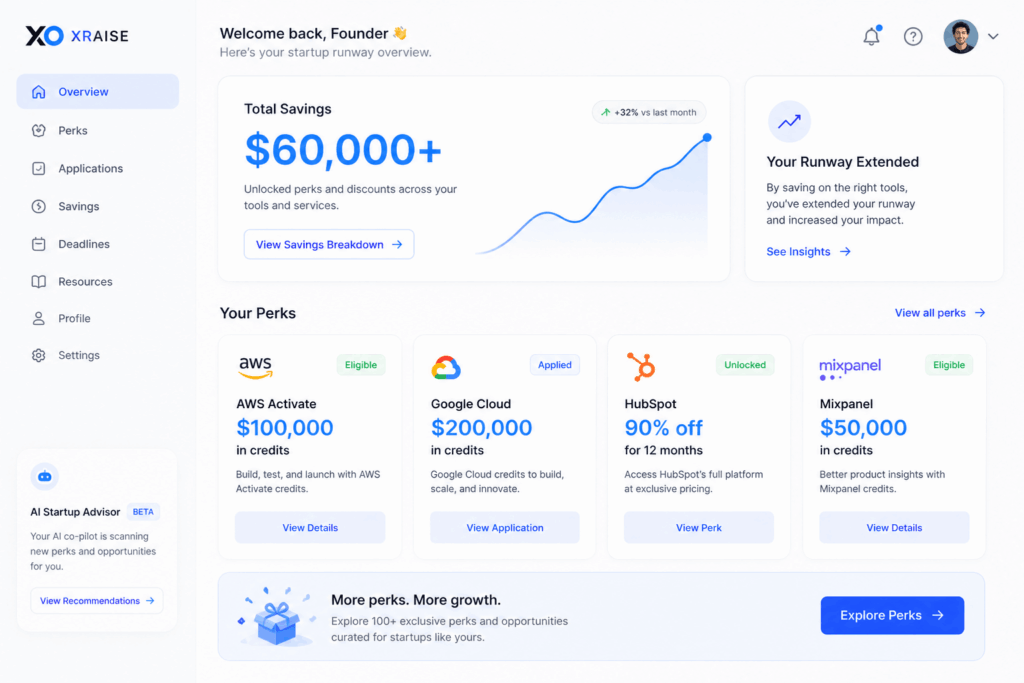
XRaise is a platform built to solve one specific problem: most founders leave tens of thousands of dollars in software credits and startup perks unclaimed simply because they don’t know they exist, or because the application process is too tedious to prioritize.
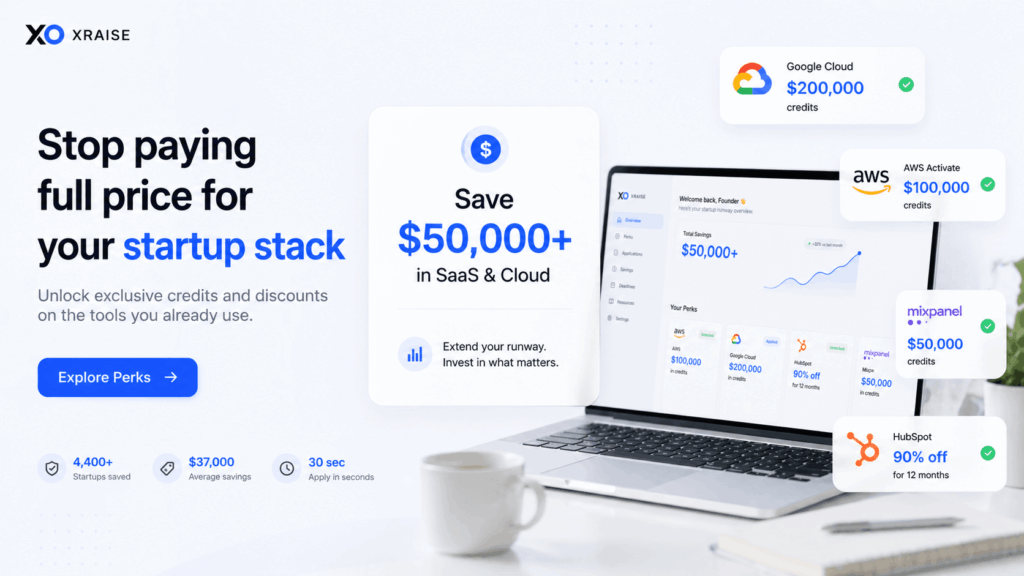
The platform has helped over 4,400 startups unlock technology credits, with users reporting an average of $37,000 in credits unlocked per company. It covers cloud providers, developer tools, CRM platforms, analytics tools, and more. The platform simplifies discovery, eligibility matching, and the application process so founders can stay focused on building.
The process is straightforward: you complete your startup profile once, and XRaise matches you with relevant programs, generates application drafts based on your profile, and lets you submit directly from the platform. Many founders discover programs they didn’t know existed, and some unlock credits in categories they were already planning to pay full price for.
Explore startup perks on XRaise and see which tools you may qualify for in under 30 seconds. Founders on the platform report unlocking an average of $37,000 in technology credits per company. You can browse available startup programs and perks here.
Key Takeaways
- Stage-fit beats category-best: The right startup tool is the one that solves your current bottleneck, not the most powerful tool in the category. Build your stack incrementally as your team, revenue, and complexity grow.
- Startup credits and perks are real money: Programs like Google Cloud (up to $200,000), AWS Activate (up to $100,000), and Azure (up to $150,000) represent months of runway. Claiming them before you begin architecting can fundamentally change your cost structure.
- Most GTM tools have startup discounts: HubSpot (up to 90% off), Apollo (50% off), ReachInbox (up to 80% off), and DocSend (up to 90% off) are all accessible at a fraction of full price through startup programs. You just have to apply.
- XRaise removes the friction: Finding and applying for startup perks is time-consuming. XRaise simplifies discovery, eligibility matching, and the application process across hundreds of programs, helping founders unlock significant credits without the manual work.
FAQ
What are the best startup tools for early-stage founders in 2026?
The best startup tools for early-stage founders depend on your stage. Pre-product teams typically need a cloud provider (AWS, DigitalOcean, or Google Cloud), a version control tool (GitHub or GitLab), and a simple landing page or form tool (Webflow or Tally). As your product gains traction, you can gradually add product analytics (Mixpanel), team communication tools (Slack), and a CRM (HubSpot free tier). The key principle is simple: only adopt new tools when their absence becomes a clear bottleneck to your next milestone.

Startup Perks AI Assistant
Have questions about credits? Let's chat instantly.
What free startup tools are worth using in 2026?
Several best startup tools offer free tiers that are highly valuable for early-stage companies. HubSpot’s free CRM, GitHub’s free plan, Slack’s free tier, Tally’s free forms, and Webflow’s free Starter plan can cover a large portion of your operational needs during the first 6 months. In addition, startup credit programs from Google Cloud, AWS, Azure, and similar providers can significantly reduce or even eliminate infrastructure costs for eligible startups.
What startup tools for founders have the best credit programs?
Among the best startup tools, cloud infrastructure programs offer the highest total value. Google Cloud provides up to $200,000 in credits, Microsoft Azure offers up to $150,000, and AWS Activate provides up to $100,000. On the SaaS side, tools like Mixpanel ($50,000 in credits), GitLab (free Ultimate plan for 12 months, worth approximately $18,000), DocSend (up to 90% off), HubSpot (up to 90% off), and JetBrains (6 months free, $4,000+ in value) represent some of the most valuable startup perks available.
What are startup perks and how do founders access them?
Startup perks are discounts, credits, and free tiers offered by software companies to early-stage startups. These programs exist because SaaS companies want to onboard startups early and grow alongside them. Founders can access these perks by applying directly to each vendor’s startup program or by using platforms like XRaise. XRaise aggregates hundreds of startup perks, helping founders discover relevant offers, check eligibility, and apply more efficiently in one place.
This article was written for XRaise, a platform that helps early-stage startups discover and claim startup perks, credits, and software discounts. All credit values and offer details are approximate and subject to program terms. Verify current offers directly with each vendor or through the XRaise platform.