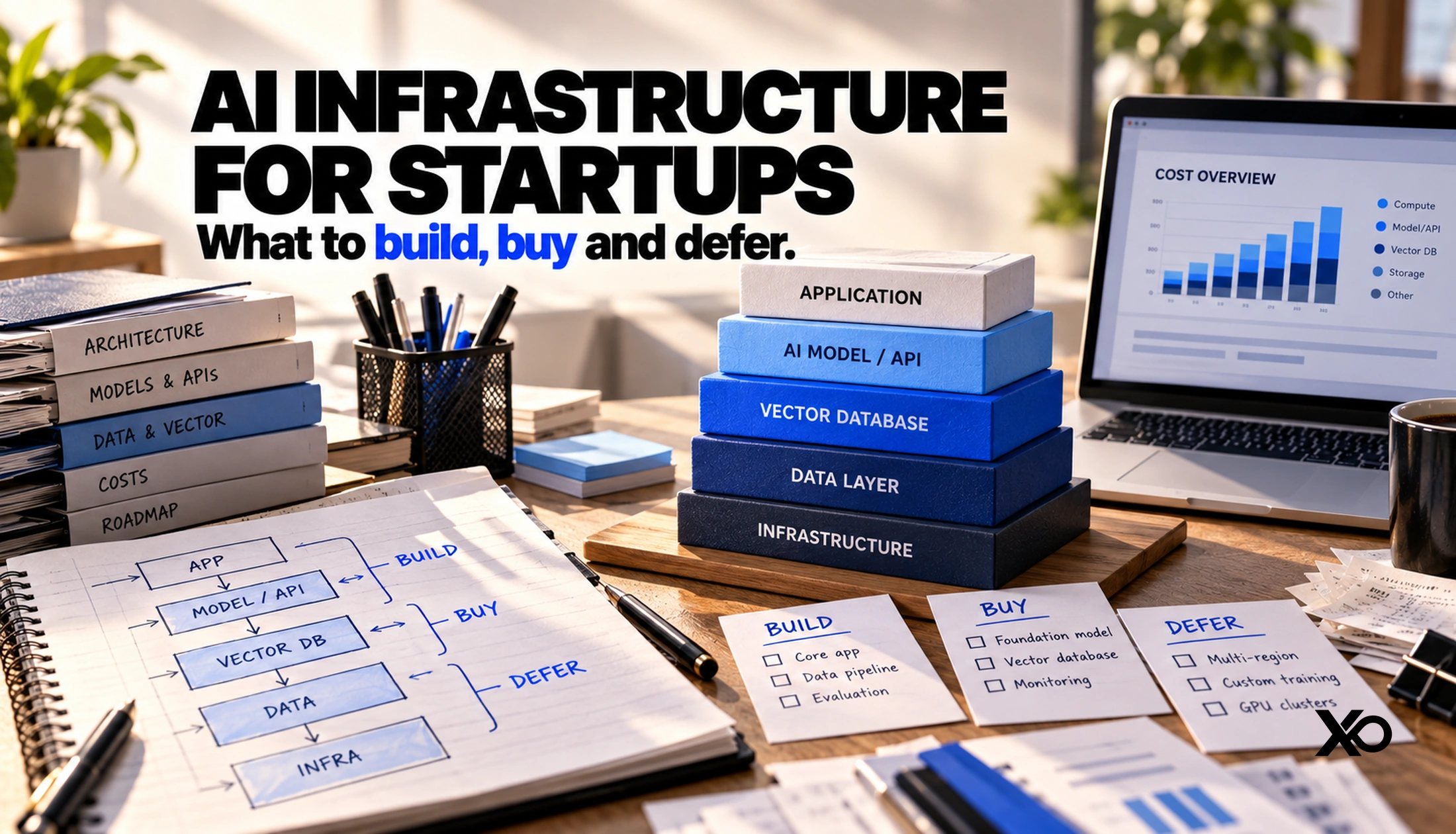
AI infrastructure for startups usually starts with model access, an application backend, durable data storage, and a way to deploy, evaluate, secure and meter the product. It does not automatically need its own GPUs, a separate vector database, an agent framework or multiple clouds. Start with the smallest system that can deliver an acceptable customer outcome and reveal why it fails.
The expensive mistake is confusing a successful demo with a production system—or confusing a sophisticated architecture with a useful product. This guide helps founders decide what belongs in an AI infrastructure stack for startups, what can stay managed, and which evidence should trigger the next investment.
TL;DR
- Use one decision loop: deliver a minimum stack, measure a bottleneck, test an upgrade, then keep or reverse it.
- Cover four responsibilities: Run the product, Ground its answers, Check its behavior, and Control its exposure.
- Begin evaluation and access control before external users; defer elaborate infrastructure, not accountability.
- Compare total cost per accepted outcome, including retries, idle compute and human review.
- Self-host when measured economics or requirements justify ownership and someone can operate the system.
- Treat credits as temporary funding for a suitable workload, not a reason to choose an unsuitable stack.
The decision loop: minimum stack, measured bottleneck, justified upgrade
An AI infrastructure stack is the combination of model services, application logic, data systems and operating controls that turns a model capability into a dependable product. It includes the work around inference: getting authorized information, handling failures, checking results and paying for repeated attempts.




Use this XRaise editorial decision loop throughout the product’s life:
Minimum stack → Measured bottleneck → Tested upgrade → Keep or reverse.
First define one customer task and an acceptable result. Then observe where the existing system prevents that result: quality, response time, operating cost, access restrictions or reliability. Test the smallest change that addresses that constraint. Keep it only if the improvement survives representative traffic and its operating burden is acceptable.
This matters in 2026 because founders can assemble sophisticated services before they understand their workload. A vendor demo cannot tell you whether customers will accept the output, how often a workflow retries, or who will handle an incident. Those questions determine the architecture more than a fashionable list of components.
Separate product infrastructure from team productivity software. XRaise’s startup tool stack guide covers the latter. Here, the object of the decision is the system delivering your AI product to customers.
Four responsibilities your AI infrastructure must cover
Think in responsibilities before vendors. One service may cover several responsibilities; a responsibility does not imply a separate subscription.
| Responsibility | Minimum capability | Evidence for adding more |
|---|---|---|
| Run | A model connection, application logic and deployment | A measured latency, throughput or workflow limit |
| Ground | Reliable source data, storage and appropriate retrieval | Answers fail because relevant authorized information is missing |
| Check | A representative test set and request-level diagnostics | Failures cannot be reproduced or safely compared across releases |
| Control | Authentication, permissions, limits and an incident owner | Customer obligations or exposure exceed existing controls |
Run: connect the model to a bounded workflow
The application layer receives a request, prepares inputs, calls a model, validates outputs and returns a result. Deployment and inference compute sit here too. Use a direct, understandable workflow when the steps are known. Add queues for work that can finish later, rather than forcing every operation into an interactive response.
Anthropic’s engineering guidance on effective agents distinguishes predefined workflows from model-directed agents and recommends increasing complexity only when needed. That supports a practical question: does the model need to choose its own actions, or would explicit application code be easier to test? An agent framework is an implementation option, not an admission requirement for an AI startup.
Ground: make useful information available
Grounding connects an answer to relevant information: account records, product documentation, customer files or other approved sources. Sometimes an ordinary database query supplies everything needed. Sometimes keyword search, semantic retrieval or a combination is appropriate.
Keep the original source records authoritative. A search index or embedding collection should not become the only surviving copy of customer information. Plan how corrections, deletions and permission changes propagate into derived data.
Check: know whether the system works
Evaluation asks whether outputs meet the intended standard. Observability helps explain what happened on an actual request. You need both questions answered early, even if the first implementation is a small reviewed test set and structured logs.
A successful HTTP response does not prove a correct answer. Track useful outcomes, not merely requests processed. For a support assistant, that could mean an answer supported by an authorized source, with escalation when evidence is missing.
Control: bound access, actions and spending
Keep provider keys on the server, enforce tenant permissions, limit expensive operations and assign someone to respond to failures. A prototype using synthetic data can have simpler controls than a customer-facing service handling confidential records. It cannot silently inherit permission to use real customer data.
For workflows that change external systems, separate proposing an action from authorizing it. Let application rules decide which actions require human confirmation. More autonomy increases the importance of explicit boundaries.
What an AI startup needs at prototype stage
A prototype should prove one workflow, not an entire platform. A reasonable starting stack is one hosted model endpoint, a small backend, a managed relational database if persistence is necessary, and a familiar deployment service. Add object storage only when the product handles files. Use synthetic or appropriately approved data while testing the concept.
Write a small set of representative tasks before comparing models. Include ordinary requests, incomplete inputs, unsupported questions and cases where the correct outcome is to refuse or ask for clarification. Record what makes an answer acceptable and who reviews borderline cases. This becomes the seed of your evaluation set.
Avoid building a generalized provider router, distributed agent system or dedicated GPU fleet simply because the architecture could support one. Keep a thin boundary around model calls so you can change a provider without rewriting business logic. That is different from building a universal abstraction for every future model feature.
The prototype exit condition is behavioral: someone outside the building process can complete a meaningful task, and you can explain the important failures. Funding stage or calendar age alone does not prove readiness.
What changes when real users arrive?
Real users introduce identity, repetition, mistakes and expectations. The immediate investment should be in operating discipline: authentication, tenant isolation, input limits, request timeouts, controlled retries, backups and a way to disable a failing feature.
Retries need boundaries. A failed request may already have consumed model tokens or completed an external action. Use identifiers to recognize repeated work and design operations so retrying cannot create duplicate charges, messages or records. Limit retry attempts and tell the user when the workflow cannot finish safely.
Separate interactive work from background processing. A user asking a question needs a timely answer; importing a document collection can usually run through a queue with progress and retry handling. This separation often removes a bottleneck before any change of model or cloud is necessary.
Managed deployment still has operating limits. Google’s Cloud Run autoscaling documentation explains how scaling interacts with concurrency and backing services such as databases. Maximum-instance settings also have documented exceptions, so do not treat them as a guaranteed spending cap. Enforce important usage limits in the application as well.
Name the person who owns an incident and rehearse one recovery: restore data, roll back a bad release or temporarily disable the model feature. A managed vendor can operate infrastructure without owning your customer’s experience.
A stage-by-stage AI infrastructure roadmap
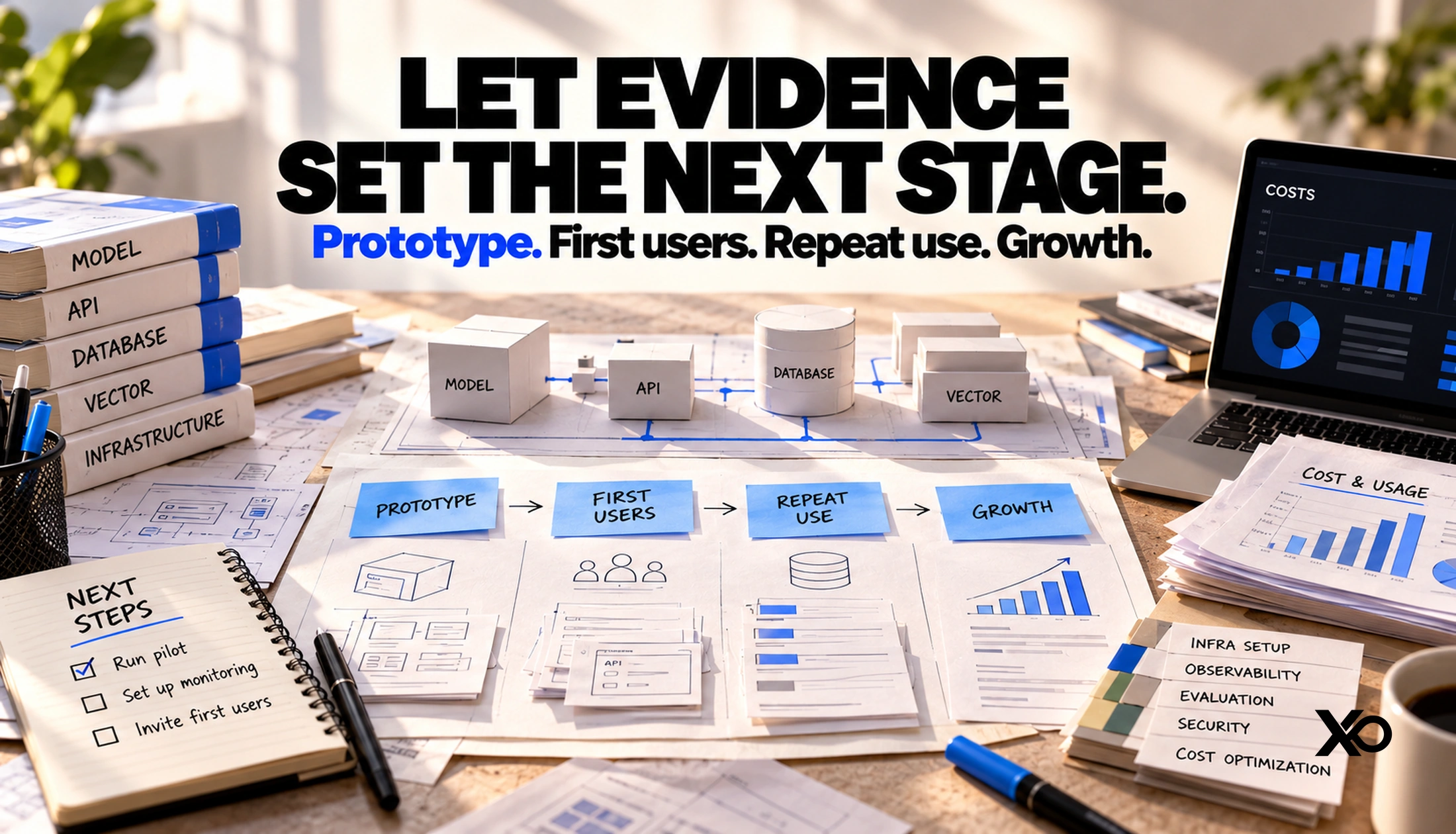
Use the stage model as a diagnostic, not a mandatory sequence. A startup handling sensitive enterprise data may need stringent controls before its first pilot; a high-volume consumer workflow may encounter inference economics first.
| Stage | Keep managed or simple | Do not build yet | Upgrade trigger |
|---|---|---|---|
| Prototype | One model path and a reviewed test set | General-purpose platform | The workflow proves useful outside a demo |
| First users | Hosting, database, auth and basic logs | Multi-cloud failover | Real failures, access needs or recovery gaps |
| Early product-market signal | Existing services with workflow-level metering | Custom infrastructure without a benchmark | Repeat use reveals a persistent constraint |
| Growing production load | Everything that still meets requirements | A wholesale rewrite | A measured capacity, quality or unit-cost limit |
| Scale or compliance | Services that satisfy documented obligations | Ownership for its own sake | Contractual controls or sustained operating economics |
At each transition, ask what changed in the workload. More customers might mean more requests, larger documents, longer conversations or stricter access requirements. These are different problems. Buying GPU capacity does not repair incorrect retrieval permissions, and a new vector database does not shorten an unnecessarily long prompt.
Keep the decision loop visible in your planning document. Record the bottleneck, current baseline, proposed change, success condition, owner and reversal path. Infrastructure work then competes with product work on evidence rather than architectural prestige.
How to choose the model and inference layer
Choose a model using your own tasks and constraints. Compare accepted-output rate, response-time distribution, context needs, tool behavior, deployment options and fully loaded cost. Test difficult cases and typical cases separately; a good average can conceal an unacceptable failure mode.
Model access and compute ownership are separate decisions. A hosted API supplies model inference without your team managing the serving fleet. Running an open-weight model means you also choose a serving runtime, capacity, deployment process and operational support. Check the model’s license and permitted use before treating downloadable weights as an unrestricted substitute.
Do not compare only advertised token rates. A cheaper model may need longer prompts, more attempts or additional review. Conversely, a smaller model that reliably completes a narrow task may be a better fit than a more capable general model. Measure the complete workflow with the same acceptance criteria.
Anthropic’s current pricing documentation separates input and output tokens, cache operations and additional tool charges. It also lists a 50% input/output discount for asynchronous Batch API processing. These illustrate different billing dimensions; they are not a universal price model for every provider or a claim that batch processing suits an interactive feature. Provider examples were checked on October 11, 2026.
Keep prompts, evaluation cases and important transformations under your own version control. When upgrading a model, rerun the same tests and make rollback practical. A provider switch should preserve your product’s commitments, not just its API syntax.
When should you move beyond managed APIs?
Investigate alternatives when a specific requirement remains unsatisfied after simpler fixes: sustained inference spend, a deployment boundary, predictable low latency, specialized model behavior or control over serving configuration. A complaint that an API feels expensive is not yet a migration case.
First separate workload costs. Measure request volume, input and output size, concurrency, retries and idle periods. Test prompt reduction, bounded outputs, suitable caching and asynchronous work where the user experience permits them. Apply each change against the quality baseline so savings do not come from quietly delivering worse results.
Then benchmark the proposed model and hardware with realistic concurrency. Include loading time, spare capacity, failures and the person-hours needed to operate it. Peak benchmark throughput is not the same as capacity your application can safely use all day.
Runpod’s Serverless billing documentation distinguishes flex workers that can scale to zero from active workers that remain running. Billing can include worker startup, execution and idle timeout, plus storage. That makes workload shape important: short bursts and sustained traffic can favor different configurations. A quoted GPU rate alone cannot settle the decision.
Set a reversal condition before migrating. If quality falls below the required level, operations exceed the available team capacity or expected savings disappear, retain the managed path. Self-hosting is a business decision with an operating plan, not a graduation badge.
Build vs buy: which infrastructure should you own?
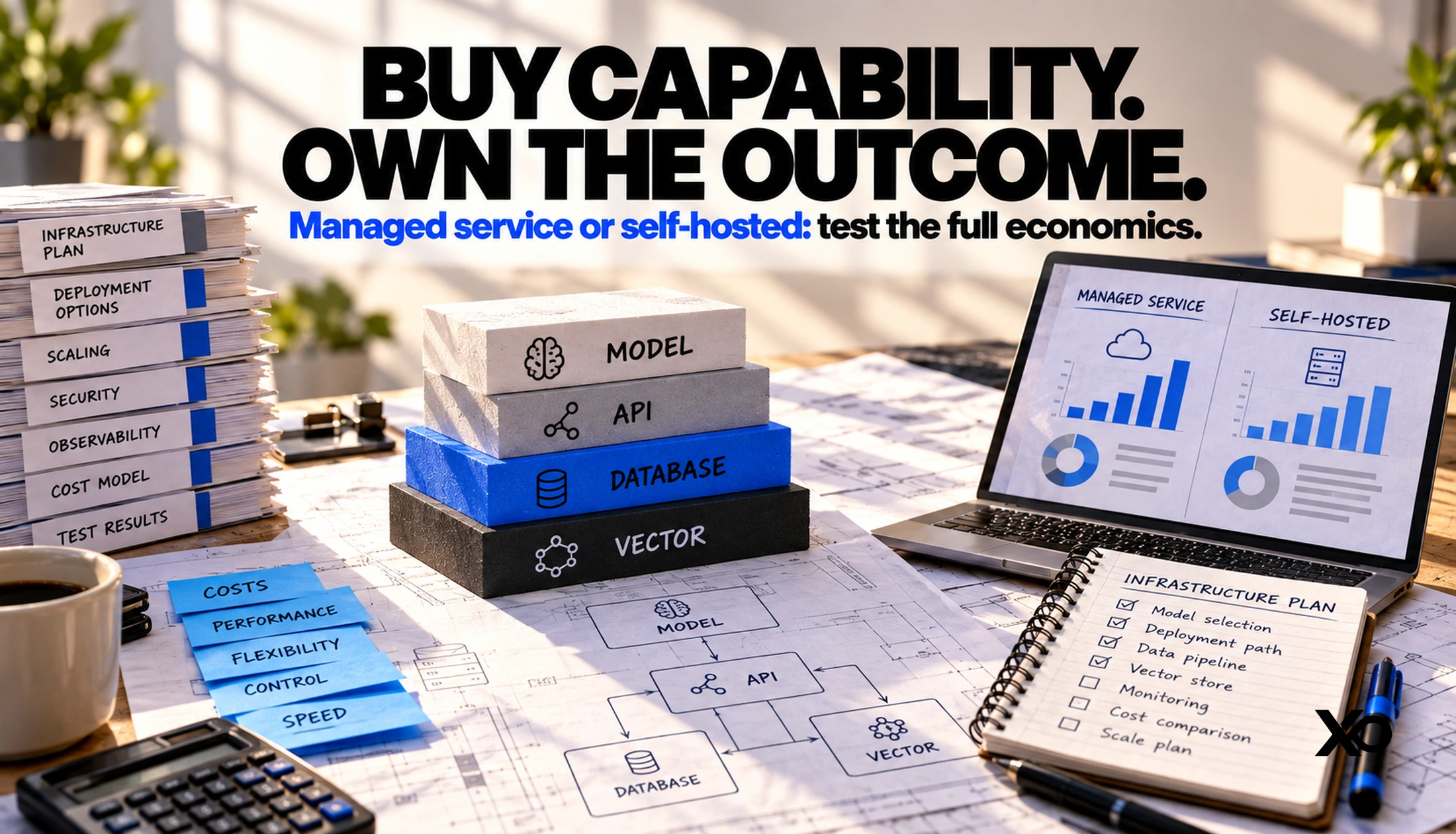
Own the parts that define product behavior and customer trust: task design, domain rules, evaluation criteria, data permissions and the ability to recover or exit. Buying a service can be sensible even when its underlying software could be run independently.
| Decision factor | Managed service tends to fit when | Self-hosting deserves a test when |
|---|---|---|
| Team capacity | Shipping the product consumes available engineering time | A named operator can maintain the system |
| Workload | Demand or model requirements are still changing | A repeatable workload supports a credible benchmark |
| Control | Available service controls satisfy the requirement | A necessary configuration or boundary is unavailable |
| Economics | Fully loaded operating cost is acceptable | Savings survive idle capacity, support and migration |
| Exit | Data and workflow can be moved with reasonable effort | Portability or customization materially changes value |
There is a useful middle ground: managed compute running your chosen model, while you retain application and evaluation ownership. It does not remove operations, but it can divide responsibility differently from either a fully hosted model API or a self-managed fleet.
Ask prospective vendors what you can export and what must be reconstructed. Data export alone may omit workflow history, annotations, evaluation results or configuration. An API-compatible replacement can still behave differently on tool calls, structured outputs or failure handling. Test the exit on a small workload before it becomes urgent.
Where AI infrastructure costs actually come from
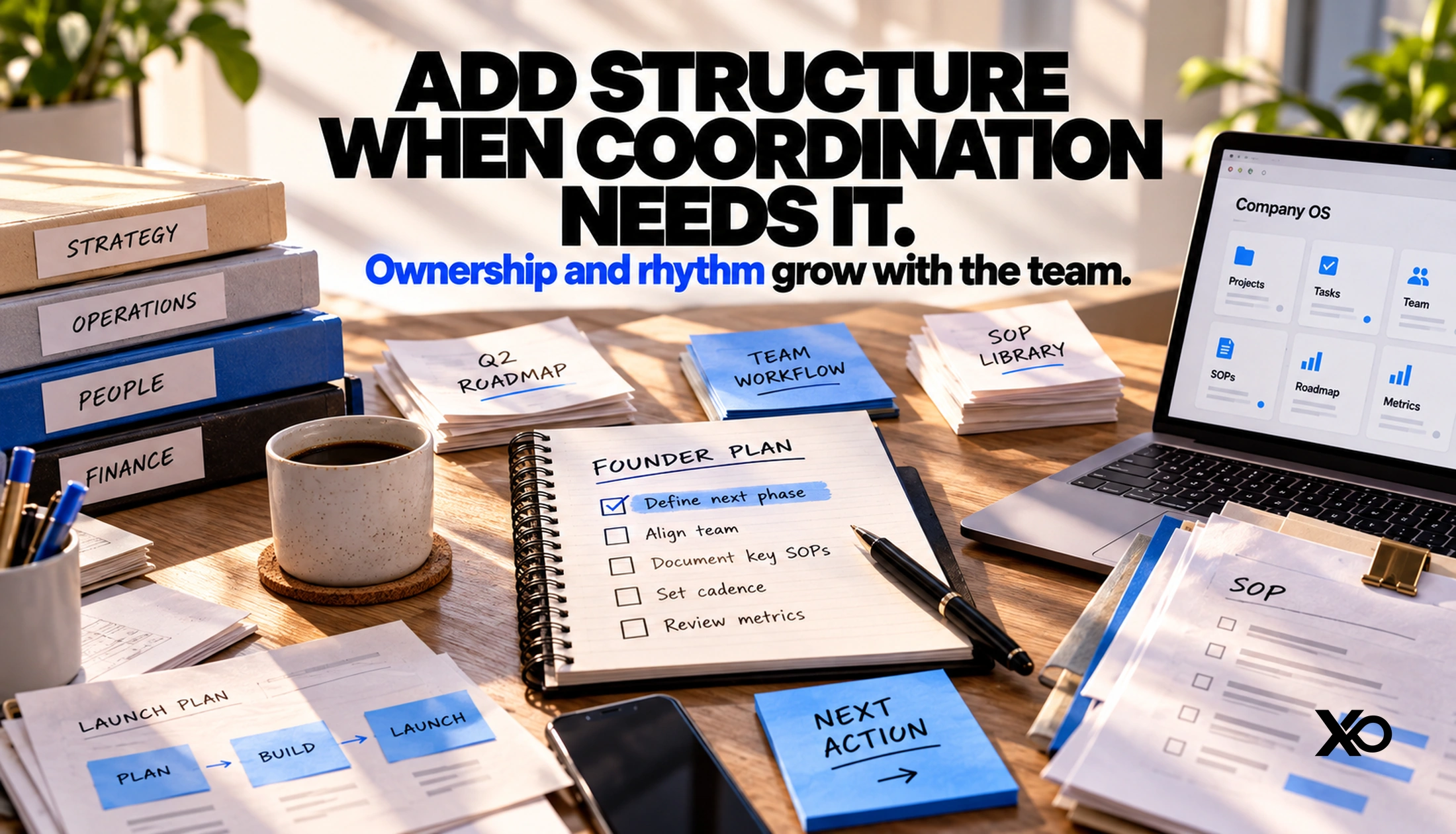
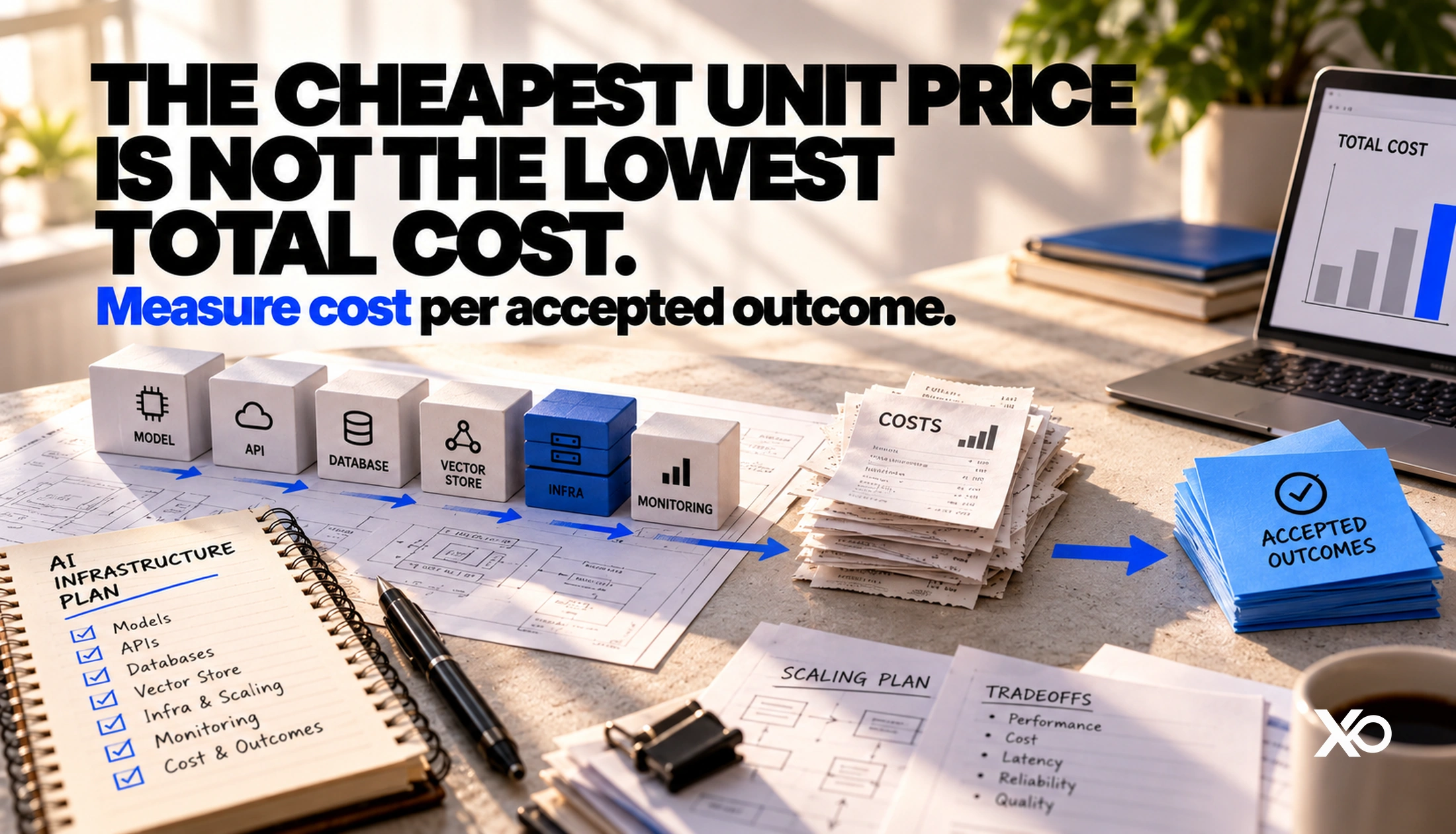
Build a cost worksheet around the customer outcome, then attach each service to that workflow. The cheapest unit price is not necessarily the lowest total cost.
| Cost category | What to include | Common blind spot |
|---|---|---|
| Model and compute | Tokens, tool calls, GPU runtime and retries | Failed attempts and idle capacity |
| Data and retrieval | Storage, embeddings, indexing and updates | Reprocessing changed content |
| Hosting and network | Application runtime, queues and data transfer | Cross-service and cross-region traffic |
| Checking and operations | Traces, evaluations, alerts and incident work | Debugging time and human review |
| Security and change | Access controls, reviews, migration and training | Exit effort and new operating obligations |
A practical denominator is cost per accepted outcome: attributable workflow spend divided by outputs that meet your acceptance standard. Keep shared infrastructure and engineering costs visible alongside that measure. Do not disguise an approximate allocation as precise margin accounting.
For example, a document assistant can appear cheap per request while repeatedly retrieving the wrong passages and requiring manual correction. Track the accepted answer, retrieval work, model calls and review time together. The right intervention might be improved source preparation rather than a cheaper model.
Model quiet, expected and burst demand using observed or explicitly hypothetical inputs. Show fixed commitments separately from usage charges and repeat the calculation without promotional credits. Set alerts, but also implement application-level quotas and a response to exhausted limits. An alert that nobody owns is not a cost control.
Data, retrieval and storage: do you need a vector database?
An AI startup does not automatically need a dedicated vector database. Begin with the information problem. Exact account fields call for structured queries; named terms may suit keyword search; meaning-based matching may justify embeddings and semantic retrieval. Retrieval-augmented generation, or RAG, supplies relevant context to a model, but does not guarantee correct answers.

Startup Perks AI Assistant
Have questions about credits? Let's chat instantly.
A separate vendor is not the only way to add vector search. Supabase documents vector storage and querying through the pgvector Postgres extension. That can let a team test semantic retrieval within a database environment it already understands. It is an option to benchmark, not a claim that Postgres wins every retrieval workload.
Evaluate a specialized store when measured indexing, retrieval latency, filtering behavior or operational requirements justify separation. Use representative data and access filters in the benchmark. Comparing unfiltered searches against production queries with permissions gives misleading results.
Permissions belong inside retrieval, before unauthorized content reaches the model. Supabase’s RAG permissions guide demonstrates using row-level security to restrict which records a similarity search returns. The feature still requires correct policy design, configuration and tests.
Track source freshness, deletion behavior and retrieval failures separately from generation quality. If the needed passage never reaches the model, changing the model can hide the real problem. Keep enough provenance to explain which authorized material supported an answer without retaining unnecessary sensitive content.
When observability and evaluation become necessary
Start both before external users depend on the product. Increase tooling when the basic approach stops answering important questions. A small application can begin with request identifiers, model and prompt versions, timings, error classes and a reviewed set of test cases. It does not need an elaborate monitoring platform to start measuring.
Record the path of a workflow, not only its final response. LangSmith’s observability documentation describes a trace as the related runs belonging to one operation. This is useful when a request performs retrieval, model calls and tools: a slow answer can then be traced to the step responsible. Review what the chosen tracing configuration captures before enabling it on customer content.
Evaluate quality changes before release and sample production outcomes afterward. Google’s guidance on generative AI evaluation emphasizes testing responses against defined criteria rather than relying on a convincing demo. Use human review where correctness is contextual, and do not assume an automated model judge is an unquestionable ground truth.
Maintain a short incident-derived test set. When a real failure occurs, add a sanitized case that would catch it again. Revisit tests as the product’s promise changes; passing obsolete examples can create false confidence.
Security and deployment boundaries are early decisions
Data handling requirements can change the stack before scale does. Identify which information enters prompts, retrieval indexes, application logs, model-provider systems and observability services. For each destination, check retention, deletion, location and access controls for the actual product, account and contract you intend to use.
Do not assume that a consumer subscription’s terms describe its provider’s API, or that choosing a cloud region determines every downstream model service’s processing location. If a requirement is material to a customer agreement, get the relevant service documentation and contractual confirmation before making a promise.
Test tenant isolation using deliberately mismatched accounts. Keep production credentials out of prompts and client-side code. Treat retrieved text and model outputs as untrusted inputs to application logic. If an AI workflow can send messages, approve spending or edit records, enforce permissions and limits outside the model.
Choose a deployment approach your team can operate. A managed container service or familiar application platform may be enough; a cluster scheduler becomes useful when its capabilities solve a real deployment problem. Buying operational complexity without an owner increases the number of ways a small team can fail.
What not to over-engineer too early
Premature complexity usually appears as a solution without a measured failure. Before approving one of these projects, ask for the baseline and the test that would establish value:
- Multi-cloud failover: validate a real continuity requirement and the consistency, testing and staffing costs first.
- Kubernetes: require a concrete scheduling or deployment need and an operational owner.
- Custom model routing: identify stable task classes and quality gates before adding selection logic.
- A separate vector platform: prove that the existing retrieval approach fails a relevant benchmark.
- Self-hosted inference: include capacity management and incident work in the economic case.
- An elaborate agent framework: establish why explicit workflow steps cannot deliver the outcome.
These are useful capabilities in the right context. The mistake is treating them as milestones that every startup must reach. A simpler architecture that meets the promise can remain the correct architecture as the business grows.
Use credits to fund a test, not choose the architecture
Once the workload and provider fit are clear, compare funding options. XRaise’s cloud credits comparison is a separate resource for that decision. Keep offer eligibility, covered services and expiry distinct from the technical evaluation.
For a defined GPU experiment, the RunPod startup guide and Lambda credits guide can help identify questions to check before committing. Do not assume a listing’s maximum credit value will be awarded or that all infrastructure charges are covered.
If exploring a model-credit route, read the OpenAI credits listing and billing-route explanation before assuming which account receives value. Use XRaise’s credit expiry and runway planning guide to model the first full-price bill. This article makes no new offer-value or eligibility promise.
A founder checklist before adding another vendor
Run a focused infrastructure review with the person who builds the product and the person accountable for its cost. The output should be a decision, not a diagram with more boxes.
- State the failure. Describe a customer-visible problem or a documented requirement the current system cannot satisfy.
- Capture the baseline. Save representative tasks, outcome quality, latency, usage and operating effort.
- Try the smallest fix. Consider workflow simplification, better data or service configuration before another platform.
- Test the alternative. Use the same acceptance rules, realistic traffic and actual permission boundaries.
- Assign ownership. Name who handles alerts, upgrades, billing and customer impact.
- Define the exit. Record what success means, when to review it and how to reverse the change.
For the next planning cycle, select one measurable constraint and one bounded experiment. Keep the rest of the stack stable so the result is interpretable. After the test, update your cost worksheet, operating notes and evaluation cases before expanding the rollout.
FAQ
What infrastructure does an AI startup need for an MVP?
An MVP needs a way to run the workflow, store necessary data, check output quality and control access and spending. Managed model access, a backend, appropriate storage and familiar hosting can cover these responsibilities without a large platform team.
Is an AI infrastructure stack different from an AI tool stack?
Yes. Product infrastructure runs the AI capability customers use. An AI tool stack usually refers to software your team uses for tasks such as coding, research or sales. The two can share vendors while serving different purposes.
Should startups use model APIs or self-host models?
Choose based on workload evidence, deployment requirements and operating capacity. APIs can reduce serving responsibilities; self-hosting can offer different control and economics. Neither choice guarantees the lowest total cost or the best output quality.
When should a startup self-host an LLM?
Test self-hosting when a repeatable workload, necessary control or deployment requirement supports the case. Include realistic utilization, evaluation results, migration work and an accountable operator. There is no universal revenue or request-count threshold.
How much does AI infrastructure cost?
There is no defensible single budget without a workload. Estimate model or GPU usage, storage, retrieval, hosting, monitoring, engineering and review effort. Compare scenarios using the same accepted customer outcome, including the period after credits expire.
Does an AI startup need a vector database?
Only if its information needs justify vector retrieval, and even then a separate service is optional. Structured queries, keyword search or vectors in an existing database may suffice. Let retrieval tests and operating requirements determine the choice.
When does an AI startup need GPUs?
A startup needs to provision GPU infrastructure when its chosen training, fine-tuning or inference workload requires it and the team owns that compute path. Calling a hosted model API does not require operating your own GPU fleet.
What should founders build rather than buy?
Prioritize ownership of differentiated workflow logic, evaluation criteria, data permissions and customer-facing behavior. Buy commodity capabilities when the service meets requirements at an acceptable total cost. Preserve an exit path for important dependencies.
What should you do next?
Map your startup’s AI infrastructure as four responsibilities: Run, Ground, Check and Control. Under each, write the existing owner and the evidence of a real problem. If you cannot name the bottleneck, do not add another service yet.
Choose one justified upgrade, test it against the minimum stack, and keep the reversal path open. The goal is an AI product that earns customer trust at a sustainable operating cost—not an architecture that looks finished before the product has found its market.