
TL;DR
- Start with a recurring workflow, not a software category.
- Require every tool to improve a measurable proof point.
- Keep one source of truth for each important job.
- Compare total operating cost, not the first-month price.
- Add tools only when manual work becomes a real bottleneck.
- Audit seats, overlap, renewals, and integrations every month.
- Check XRaise for relevant perks and credits before paying full price.
Why a Startup Tool Stack Matters Now
Software is unusually easy to add and surprisingly hard to remove. A founder can open a free workspace, connect a trial, invite the team, import customer data, and build a workflow before anyone has agreed that the tool solves the right problem. Once information, habits, and integrations settle into it, a cheap experiment becomes part of the company’s operating architecture.
That matters for pre-seed, seed, bootstrapped, SaaS, AI, and technical founders because software cost is more than the invoice. Every product adds setup, permissions, onboarding, notifications, data hygiene, integrations, renewal decisions, and eventual migration work. The subscription may cost $20 per user while the attention cost is much larger.
AI features intensify the problem. Several products may now summarize calls, draft content, search internal knowledge, automate tasks, and analyze data. Buying each feature from a different vendor can create an impressive-looking stack that duplicates capability and scatters context.



The answer is not to avoid software. The right startup tool stack can compress development time, preserve customer knowledge, improve follow-up, reveal product behavior, and reduce infrastructure cost. The operating challenge is to add each product at the moment when its leverage exceeds its full cost.
Why a Startup Tool Stack Matters Now
Early founders often buy the operating model they imagine needing in a year. They add a full CRM before the sales motion is repeatable, advanced analytics before defining activation, multiple project systems before work has stable owners, or automation before the manual process works.
Each decision feels defensible in isolation:
- The free trial reduces immediate risk.
- The annual plan appears cheaper per month.
- The team expects to grow into the product.
- A respected startup uses it.
- A perk makes the headline price attractive.
- The tool promises to consolidate work later.
Together, those decisions produce tool sprawl. The team starts copying data between systems, debating which record is current, paying for inactive seats, and maintaining automations that hide weak process design. Founders gain more dashboards but not necessarily better decisions.
Overspending in a startup tool stack is therefore both a cash problem and a systems problem. A lean startup stack protects runway by reducing recurring spend, but it also keeps the company understandable. Fewer well-owned systems usually make it easier to see what customers want, what work is blocked, and what should happen next.
The Startup Tool Stack Problem: Premature Scale Feels Productive
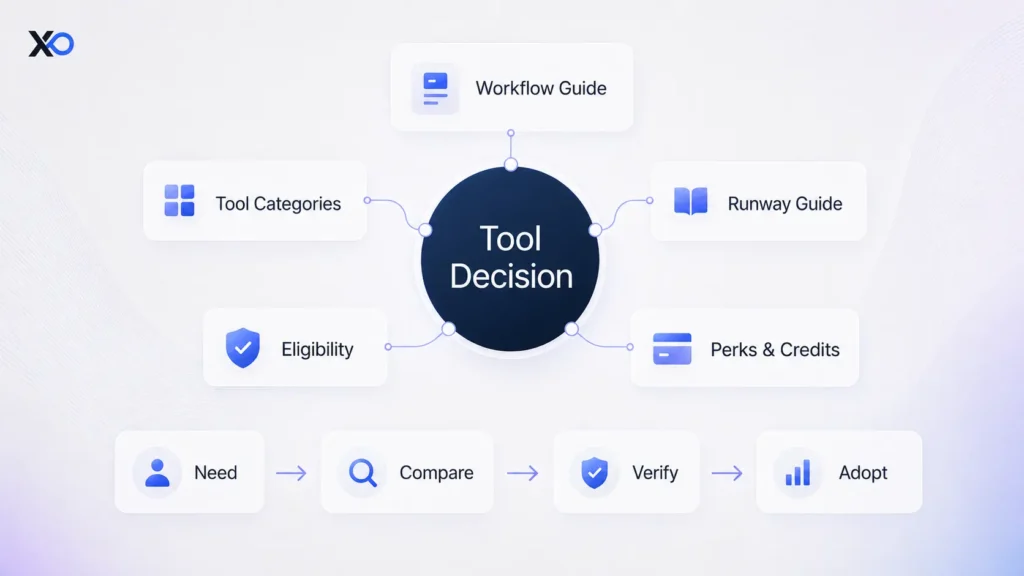
Use three gates before adding software.
1. Workflow: what recurring job needs support?
Describe the work without naming a vendor. “Capture discovery notes in one searchable place” is a workflow. “Buy a knowledge base” is already a solution. “Follow up with qualified leads within one business day” is a workflow. “Implement a CRM” is not.
A real workflow has a trigger, steps, owner, frequency, input, and output. If the team cannot explain those elements, adding software will probably formalize confusion.
2. Proof: what result should improve?
Decide what evidence would justify the tool. A product analytics system might reveal whether users reach the activation event and return. A CRM might reduce missed follow-ups and clarify which segment converts. An error-monitoring product might shorten time to detect and resolve production failures.
The proof should connect to a decision. If a dashboard changes nothing about product, customers, cost, or execution, it is reporting activity rather than creating leverage. The XRaise guide to choosing tools that create proof, not noise develops this proof-first logic in detail.
3. Cost: what does the tool require after purchase?
Count more than the sticker price. Use this simple model:
True tool cost = subscription + usage + implementation + maintenance + switching risk - verified savings
Subscription includes seats and plan fees. Usage includes compute, messages, storage, contacts, events, and overages. Implementation includes setup, migration, training, and integrations. Maintenance includes admin, data cleanup, permissions, and broken workflows. Switching risk covers export limits, proprietary data structures, and dependency on vendor-specific features.
Verified savings can include a free tier, negotiated price, startup software discounts, or startup credits. Savings belong at the end of the decision, not the beginning. A discount should make the right system cheaper; it should not make the wrong system look necessary.
Build Your Startup Tool Stack Around Operating Layers
A founder does not need every layer at once. Use the categories below as a map of possible capabilities, then activate only the layers required by the company’s current workflows and proof questions.
Build and infrastructure for your startup tool stack
This layer covers source control, hosting, databases, cloud services, deployment, observability, security, and AI infrastructure. Technical teams need some version of it early, but architecture should remain proportional to real usage.
Use it when a prototype needs to become reliable enough for customer testing or production. Wait on complex multi-cloud setups, advanced orchestration, large observability suites, and enterprise controls until workload, reliability, or compliance requirements justify them.
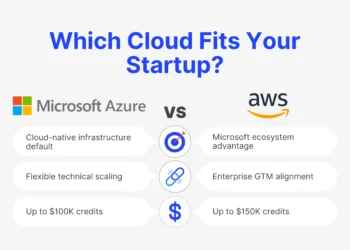
Compare deployment speed, expected usage cost, reliability needs, portability, developer familiarity, data location, security, and the price after credits expire. Infrastructure startup credits can materially reduce spend, but a generous offer should not push the team into unnecessary technical lock-in. AI and infrastructure-heavy founders can compare cloud credits for startup workloads before selecting around headline value.
Customer knowledge inside the startup tool stack
This layer stores interview notes, research, decisions, requirements, and customer language. At idea and MVP stage, it may be the most important non-technical system because it prevents learning from disappearing across calls and private documents.
Use a dedicated workspace when multiple people need to find and synthesize the same evidence. Wait if the team is still tiny and a shared document can reliably hold the work. Compare search, templates, sharing, permissions, export quality, integrations, and whether the team will maintain it.
The essential rule is one canonical home for customer evidence. If call notes live in one product, decisions in another, feature requests in a third, and founder memory everywhere else, adding search will not solve the underlying fragmentation.
Communication and execution across the startup tool stack
Chat, task management, planning, whiteboards, and documentation can improve coordination as the team grows. They can also duplicate one another. Many suites now include messages, docs, projects, calendars, whiteboards, and AI assistance, so founders should compare the combined workflow before buying separate products.
Use an execution system when ownership or deadlines are being lost. Wait if the founders can coordinate reliably with a short weekly plan and shared list. Compare adoption friction, guest access, notification control, permission models, mobile use, export, and the number of places a teammate must check.
Choose one place where committed work is tracked. Chat may discuss the work, and documents may explain it, but only one system should answer: who owns the next action, and when is it due?
Where sales and CRM fit in the startup tool stack
A CRM becomes useful when real prospects, follow-ups, deal stages, and customer context exceed founder memory. It is premature when the team has not defined an ideal customer, qualification logic, or sales motion.
Start with the smallest system that prevents missed follow-up. Compare contact limits, pipeline flexibility, email and calendar sync, reporting, automation, data export, implementation time, and renewal pricing. Avoid paying for marketing, support, and operations modules merely because they come in the same platform.
When founder-led sales becomes repeatable, founders can review the HubSpot startup perk on XRaise before moving from a lightweight contact tracker to a paid customer platform.

HubSpot for Startups
Up to 90% discount on an AI-powered customer platform.
Analytics and feedback in the startup tool stack
Analytics should answer a limited set of questions about activation, retention, feature use, conversion, and customer friction. It should not begin as an attempt to record every possible event.
Use product analytics when real users are moving through a product and behavior affects the next roadmap decision. Wait when the MVP changes so rapidly that instrumentation will be discarded every week. Compare event limits, identity handling, retention and cohort analysis, governance, data quality, warehouse compatibility, privacy, and cost at expected volume.
Define the value event first. Then instrument the few steps that reveal whether users reach it and return. If product behavior has become decision-critical, founders can compare Mixpanel startup analytics credits.

Mixpanel for Startups
$50,000 in credits for product analytics for growth.
Marketing systems in the startup tool stack
This layer can include landing pages, forms, email, design, social scheduling, SEO, advertising, and content production. It is particularly prone to overlap because suites and AI features promise to cover the same work.
Use a product when a repeatable channel requires publishing, capturing, nurturing, or measuring demand. Wait when positioning and audience are still changing after every customer conversation. Compare channel fit, contact and send limits, brand control, approval flow, analytics, data portability, and whether the product creates reusable customer insight.
Do not buy a broad marketing stack to compensate for unclear messaging. Early founders usually learn more from a narrow campaign with direct customer response than from a complex system producing more content across more channels.
When support belongs in the startup tool stack
Direct founder support is often an advantage early. A ticketing or customer-success system becomes valuable when requests repeat, response ownership is unclear, issues need history, or customers expect defined service levels.
Use it when customer volume makes a shared inbox or founder memory unreliable. Wait if adding the tool would distance the team from the few users it most needs to understand. Compare channel coverage, customer history, routing, knowledge base, automation, reporting, integrations, AI review requirements, and price per seat or contact.
Automate classification and routing before automating judgment. Customer conversations still contain product, positioning, churn, and expansion evidence that founders need to see.
Automation rules for the startup tool stack
Automation can connect forms, CRM records, notifications, reports, onboarding steps, and internal data. It earns its place after a manual workflow is stable, frequent, and expensive enough to improve.
Wait when edge cases are still teaching the team how the process should work. Compare connectors, operation limits, error handling, monitoring, version control, permissions, maintainability, and the consequence of failure.
Give every automation an owner and a failure path. If a proven process is consuming repeated founder time, the XRaise guide to Make credits for startup workflow automation can help the team assess a lower-cost test.

Make.com for Startups
Free Teams plan for AI-powered no-code automations.
Finance and operations in the startup tool stack
Bookkeeping, banking, spend management, payroll, contracts, equity, and compliance become more important as transactions, employees, contractors, and obligations increase. This layer protects cash visibility and reduces operational risk, but several products may overlap in payments, cards, expenses, and reporting.
Use these systems when the cost of error or missing records becomes material. Compare entity and region support, accountant workflows, reconciliation, approvals, security, audit trails, integrations, export, support, and total price as headcount grows.
At minimum, keep a subscription register with product, owner, card, billing interval, renewal date, cancellation notice, current seats, monthly equivalent cost, and proof job. That single record often exposes waste earlier than another spend dashboard.
How to Choose a Startup Tool Stack Without Overspending
Use the following decision rules across every category.
Require a one-sentence job
Complete this sentence: “We are adding this product to help [owner] perform [workflow] so that [proof] improves by [review date].” If the team cannot fill it in, delay the purchase.
Prefer one system per source of truth
Do not demand that one product do everything. Do require clarity about where the canonical record lives. There should be one authoritative pipeline, one committed task system, one customer evidence home, one billing record, and one product event definition.
Make free startup tools prove value
Free plans are useful for discovery, but “free” does not remove setup or switching cost. Run a bounded test with real work, an owner, and a decision date. Upgrade only when a specific limitation blocks a valuable workflow, not because the team approaches an arbitrary growth milestone.
Compare the next price, not only today’s price
Model cost at current headcount and at the next plausible level of users, contacts, events, storage, compute, or messages. Include the post-trial or post-credit price. Annual contracts should follow proven adoption; they should not be used to manufacture commitment.
Consolidate only when workflows genuinely converge
A suite can reduce integrations, bills, and context switching. It can also create compromise and lock-in. Consolidate when one platform competently supports connected workflows and has a clear owner. Keep specialist products when the workflow is strategically important and the quality difference changes outcomes.
Set an exit condition before entry
Decide what would cause the team to cancel: low active use, no improvement in the proof metric, duplicate capability, unreliable data, rising unit cost, or excessive maintenance. Confirm data export and cancellation terms before important information accumulates.
Startup Tool Stack Use Cases for Founders
A bootstrapped SaaS team before revenue
The team needs to ship, interview users, publish a landing page, and track a small number of product behaviors. A repository, simple hosting, shared customer-notes workspace, lightweight form, and basic analytics may be enough. A full CRM, customer-success platform, data warehouse, and complex project suite can wait until customer volume creates a bottleneck.
An AI startup with rising usage cost
The technical stack is already necessary, but variable inference, storage, and observability costs are becoming material. The team should model unit economics by customer workflow, set usage and billing alerts, compare portability, and claim relevant credits only after choosing the architecture on technical and economic fit. The saving should extend experiments, not hide an unsustainable workload.
A seed startup adding go-to-market teammates
Founder memory no longer supports pipeline, onboarding, and customer follow-up. The company may now justify a CRM, clear customer knowledge system, and one execution platform. It should define stages, ownership, reporting, and required integrations before vendor selection, then remove the spreadsheets and duplicate tools the new system replaces.
Startup Tool Stack Mistakes and Anti-Patterns
Buying for the company you hope to become
Founders choose enterprise capability for future scale. The team then pays in money and process before it has the volume to benefit. Buy for the next credible operating constraint, with an upgrade path for later.
Letting the perk choose the product
A large discount or credit makes a product feel strategically important. The team adopts it without comparing workflow fit, renewal cost, or lock-in. Choose the category and requirements first, then use startup perks to reduce the cost of the winner.
Keeping overlapping tools to avoid a hard decision
Two task systems, multiple documentation homes, or parallel CRMs remain active because migration feels inconvenient. The ongoing ambiguity costs more. Choose the canonical system, plan the migration, archive the old source, and communicate the cutover date.
Paying annually before adoption is proven
The lower monthly equivalent looks responsible, but unused annual software is prepaid waste. Start with a reversible plan when uncertainty is high. Commit longer only after the workflow, owner, utilization, and result are established.
Ignoring per-seat and usage expansion
A product looks inexpensive for two founders but becomes costly after hiring or higher event volume. Model the likely bill at the next stage and set alerts before variable charges become surprising.
Automating an unstable process
The workflow still changes, so every exception creates repairs and hidden failures. Run it manually until the pattern and edge cases are understood; automate the stable core and keep human review where judgment matters.
Measuring logins instead of outcomes
High activity can coexist with no business value. Review whether the system improves speed, reliability, customer learning, conversion, retention, or cost. A product with frequent logins but no decision impact may still be overhead.
Practical Startup Tool Stack Comparison
| Tool category | Add now when | Wait if | Proof to review | Hidden cost to check |
|---|---|---|---|---|
| Build and infrastructure | Real users need a reliable product | Architecture changes weekly | Deployment reliability and unit cost | Usage, migration, lock-in |
| Knowledge and discovery | Customer learning is getting lost | A shared document still works | Faster retrieval and better decisions | Hygiene and permissions |
| Team execution | Ownership or deadlines are unclear | A short shared plan is sufficient | Fewer dropped commitments | Notification and admin load |
| CRM and sales | Real leads and follow-ups exceed memory | ICP and stages are still guesses | Follow-up speed and conversion clarity | Seats, contacts, implementation |
| Product analytics | User behavior changes roadmap decisions | The MVP has too few stable events | Activation and retention insight | Event volume and data quality |
| Marketing | A repeatable channel needs support | Positioning changes constantly | Qualified demand and learning | Contacts, sends, content review |
| Support and success | Requests need routing and history | Founder-led support remains manageable | Response quality and recurring themes | Seat, contact, and channel pricing |
| Automation | A stable workflow repeats frequently | Edge cases still define the process | Time saved without error growth | Operations, monitoring, maintenance |
| Finance and operations | Transactions and obligations need control | Activity is still minimal | Cash visibility and fewer errors | Entity support and scaling price |
How the Startup Tool Stack Changes at Each Stage
| Startup stage | What matters most | Tools/resources to consider | What to avoid | What to measure |
|---|---|---|---|---|
| Idea stage | Customer understanding and fast tests | Shared notes, calls, forms, simple landing page | CRM suites, automation, complex analytics | Interviews, response quality, test completion |
| MVP stage | Shipping and reaching first value | Repository, hosting, issue tracking, basic event analytics | Enterprise infrastructure and broad GTM stack | Activation, failures, learning cycle time |
| Pre-seed | Repeatable learning and cash visibility | Customer evidence home, lightweight CRM, finance tracker | Duplicate collaboration products | Qualified pipeline, activation, monthly tool cost |
| Seed | Reliable execution and early repeatability | Product analytics, structured CRM, support, selected automation | Buying every departmental suite at once | Retention, conversion, response time, unit cost |
| Early revenue | Customer consistency and operating control | Billing, support history, spend controls, focused integrations | Automating exceptions and vanity reporting | Gross margin, churn, expansion, payback |
| Growth stage | Governance, scale, security, and consolidation | Role-based systems, data governance, advanced controls | Keeping legacy tools without owners | Cost per employee/customer, adoption, reliability |
Idea-stage founders may get more value from a decision guide than from a discount. During MVP and pre-seed, it is better to compare free tiers and eligibility before activating time-limited benefits. Seed and early-revenue teams should use the XRaise startup perks directory to search for offers tied to tools they already intend to adopt. Growth-stage teams need consolidation, security, procurement, and renewal negotiation more than another collection of products.
Startup Tool Stack Implementation Playbook
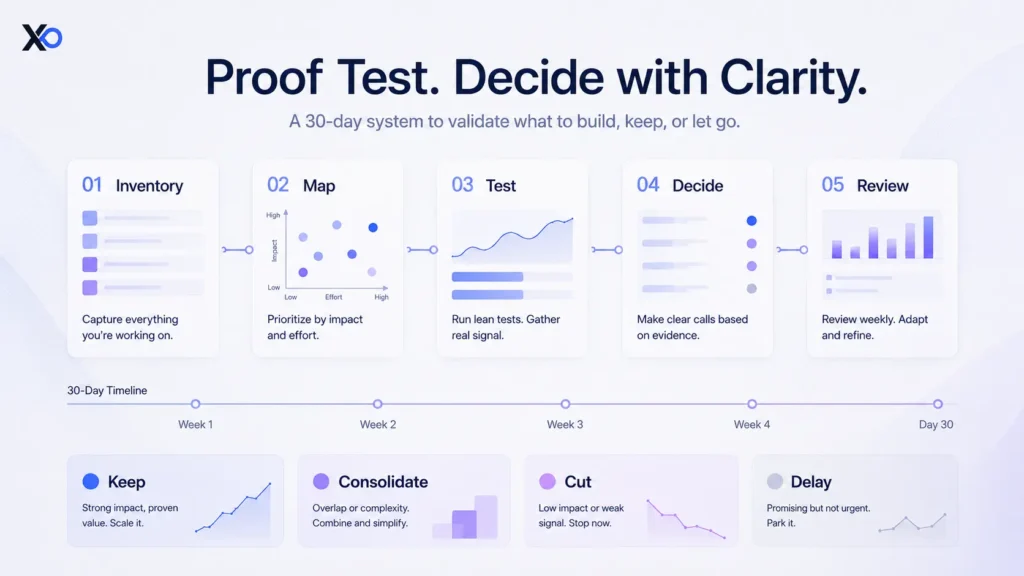
Step 1 – Inventory every tool and commitment
List paid products, free products holding important data, trials, browser extensions, cloud services, and founder-paid accounts. Record owner, workflow, cost, seats, renewal, contract term, integrations, source-of-truth status, and cancellation path.
Step 2 – Map tools to workflows and proof
Give each product one primary job and one result. Mark products with no clear workflow, no owner, or no decision attached. Those are review candidates, even if their invoice is small.
Step 3 – Find overlap and calculate true cost
Group products by capability: communication, docs, projects, CRM, analytics, design, AI assistance, automation, and reporting. Compare overlapping features and calculate subscription, usage, admin, and switching cost. Protect data before cancelling anything.
Step 4 – Decide keep, consolidate, cut, or delay
Keep products that reliably support important work. Consolidate when one system can own a connected workflow. Cut unused or duplicative products after export and migration. Delay upgrades and new categories until a defined trigger appears.
Step 5 – Run a 30-day proof test for new software
Assign an owner, move one real workflow into the product, capture a baseline, and choose a review date. Measure outcome improvement, maintenance burden, active use, and failure points. Do not expand seats or integrations until the first test succeeds.
Step 6 – Check perks, credits, and full renewal economics
Once a product passes the test, explore startup perks through XRaise and verify eligibility, activation timing, exclusions, and the price after the benefit ends. The runway guide can also help founders review software spend within a wider burn-reduction plan.
Step 7 – Establish a monthly tool-review rhythm
Review new requests, inactive seats, usage thresholds, failed integrations, upcoming renewals, and unowned systems. Require a short business case for additions and a migration plan for replacements. A 20-minute monthly review is usually easier than a painful annual cleanup.
FAQ
What startup tools does an early-stage founder actually need?
Most early teams need only enough software to build, talk to customers, preserve learning, track money, and coordinate the next action. The exact products depend on the business model. Add CRM, analytics, support, marketing, and automation only when a recurring workflow becomes hard to manage manually or its absence blocks an important decision.
How do I build a startup tool stack from scratch?
Map the recurring workflows required for the next milestone. Give each workflow an owner and proof metric, then choose the lightest system that supports it. Define one source of truth for each important record. Test with real work for 30 days before expanding seats, integrations, or contract length.
What are the best free startup tools in 2026?
The best free options are products whose limits still support a current workflow without creating risky lock-in. Free plans change, so compare current provider terms, export options, usage caps, and the next paid tier. Treat “free” as a low-cost test—not as proof that a product belongs permanently in the stack.
How can startups reduce software costs without slowing the team?
Remove inactive seats, consolidate duplicate capability, match plans to real usage, delay annual contracts until adoption is proven, and set renewal reminders. Then compare relevant startup software discounts and credits. Preserve the tools that improve important workflows; cutting a high-leverage system merely because it has a visible invoice can be false economy.
When should a founder pay for SaaS tools for startups?
Pay when the free or manual approach creates a specific bottleneck that affects customers, speed, reliability, revenue, or evidence. Name the expected improvement and review date first. Upgrade because a limitation blocks valuable work, not because the company reached an arbitrary stage or the vendor is running a promotion.
How often should founders run a startup tool audit?
Review additions, seats, utilization, integrations, and upcoming renewals monthly. Run a deeper quarterly audit of workflows, sources of truth, cost expansion, data export, and overlap. Also trigger a review after major hiring, a new go-to-market motion, a migration, fundraising, or a material change in product usage.

Startup Perks AI Assistant
Have questions about credits? Let's chat instantly.
Are startup perks and startup credits always worth claiming?
No. They are valuable when they reduce the cost of a product or workload the company already needs. They can create waste when activation is too early, the product is a poor workflow fit, the renewal is unaffordable, or the benefit creates lock-in. Choose first, verify terms, then claim at the right time.
Should a startup use an all-in-one suite or specialist software?
Use a suite when connected workflows benefit from shared data and the product is good enough across the required jobs. Use a specialist when the workflow is strategically important and performance materially changes customer or business outcomes. Compare integration burden, ownership, export, pricing, and switching risk, not feature count alone.
How many startup tools are too many?
There is no universal number. The stack is too large when products lack owners, duplicate sources of truth, create more reconciliation than insight, or cost more to maintain than the workflow value they provide. Tool count should follow workflow complexity, not team ambition.
How can XRaise help founders avoid overspending on startup software?
XRaise helps founders discover relevant perks, credits, and discounts after they have identified a real software need. Use it to compare possible savings and eligibility before paying full price, then confirm current offer terms and model the normal renewal cost before making the product part of the stack.
Final Takeaway
A startup tool stack should grow as evidence and operating complexity grow, not as vendors, promotions, or founder anxiety grow. Start with the workflow. Define the proof. Calculate the full cost. Then choose the lightest system that improves the result and give it a clear owner.
Before buying another product, run a startup tool audit and use XRaise to compare startup perks, credits, and discounts. The goal is not to assemble the cheapest collection of software. It is to build a lean operating system that protects attention, supports decisions, and extends runway.