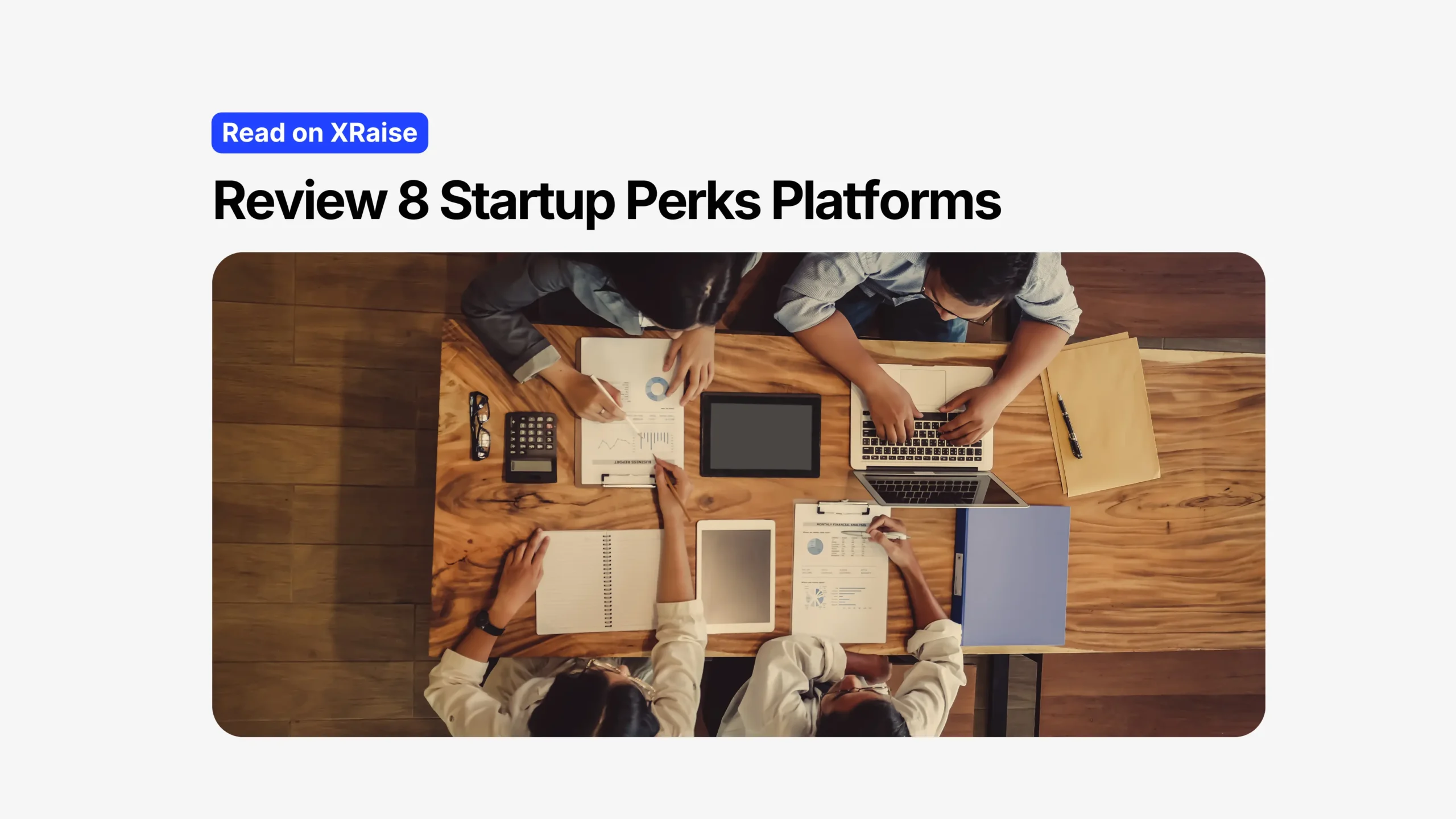
Startup perks platforms can help founders reduce software, cloud, hiring, legal, and operations costs before those bills start eating runway. For early-stage teams, this matters because the first startup stack usually grows faster than the company. One tool becomes five tools. Five tools become recurring subscriptions, unused seats, renewal dates, and overlapping features nobody tracks.
The real challenge is not finding more offers. Founders can find plenty of startup credits, startup discounts, startup software deals, and founder resources. The harder part is knowing which offers actually fit the company’s stage, budget, and workflow. That is why comparing startup perks platforms matters. A good platform helps you discover relevant resources faster. A bad fit can push you toward tools you do not need yet, annual plans you forget to cancel, or software that creates more admin than savings.
This guide compares the main startup perks platforms, explains what to verify before joining, and shows how to choose the right resource based on your biggest cost, startup stage, and operating priorities.


TL;DR
- Startup perks are useful when they match tools you already need, not when they push you into extra subscriptions.
- The best platform depends on your priority: cloud credits, SaaS discounts, hiring support, global expansion, or spend control.
- Always verify eligibility, region limits, renewal pricing, and whether the “deal” is better than the provider’s own startup program.
- Use XRaise to discover startup perks, credits, grants, and accelerators before paying full price or searching manually.
What are startup perks?
Startup perks are discounts, credits, free plans, partner offers, and founder resources designed to reduce the cost of building and operating a startup. They usually cover the tools and services founders need early: SaaS tools, cloud infrastructure, marketing software, hiring platforms, finance tools, legal support, developer tools, productivity software, and sometimes accelerator or grant opportunities. For early-stage teams, startup perks matter because the first stack often gets built too quickly.
A founder signs up for a CRM to track leads. Then they add analytics, email marketing, a landing page builder, a support tool, a cloud provider, a design tool, a hiring platform, and a finance product. Each bill looks manageable alone. Together, they become a quiet burn problem.
That is where startup perks platforms can help. Some platforms focus mainly on startup software deals. These are useful when founders want discounts on tools they already plan to use, such as CRM, design, analytics, documentation, support, or marketing software.
Other platforms focus more on startup credits. These are especially useful for cloud infrastructure, AI workloads, hosting, data storage, advertising, or developer tools where usage can become expensive fast.
Some platforms go broader and combine startup discounts with founder resources, accelerators, grants, jobs, partner networks, and operational support. These are better for founders who want one place to discover multiple types of startup support instead of searching across dozens of vendor pages.
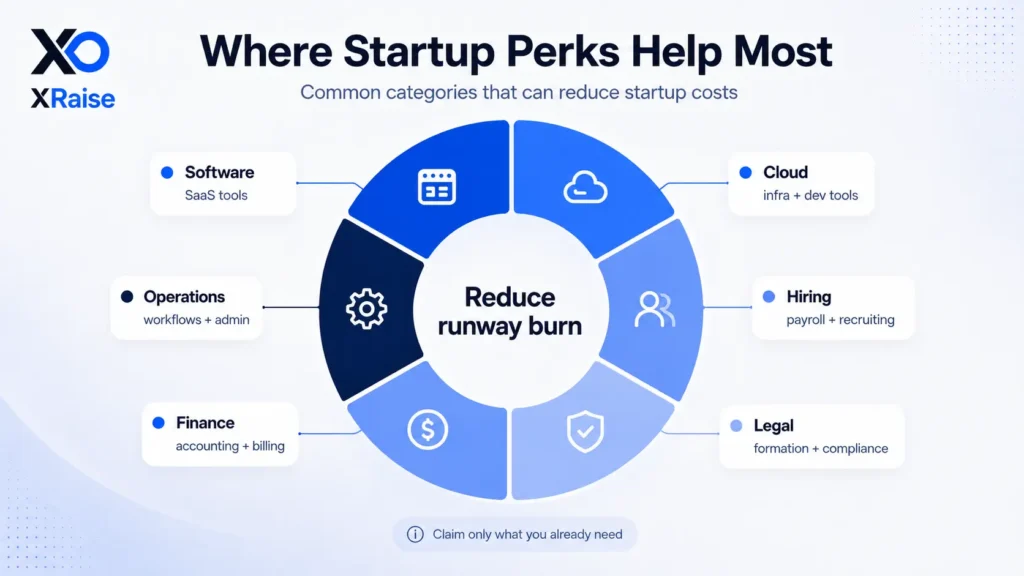
The important point is simple: a perk is only valuable when it reduces a cost your startup actually needs to carry. If a perk helps you lower cloud spend, test a sales tool, access legal support, or reduce the cost of a product already in your workflow, it can protect runway.
But if it pushes your team into a tool you do not need, a paid plan you forget to cancel, or a workflow nobody owns, it is not real savings. The brutal truth: a $5,000 credit for a product you do not need is not a financial win. It is distraction. A smaller discount on a tool your team already uses every week may be much more valuable than a large headline credit that never turns into real operating savings.
Best startup perks platforms compared
The best startup perks platforms are not all built for the same founder. Some are broad founder hubs, some are SaaS deal marketplaces, some support incorporation or remote operations, and some focus on spend control. Your best choice depends on stage, geography, budget, and what costs are rising fastest.
Quick comparison table
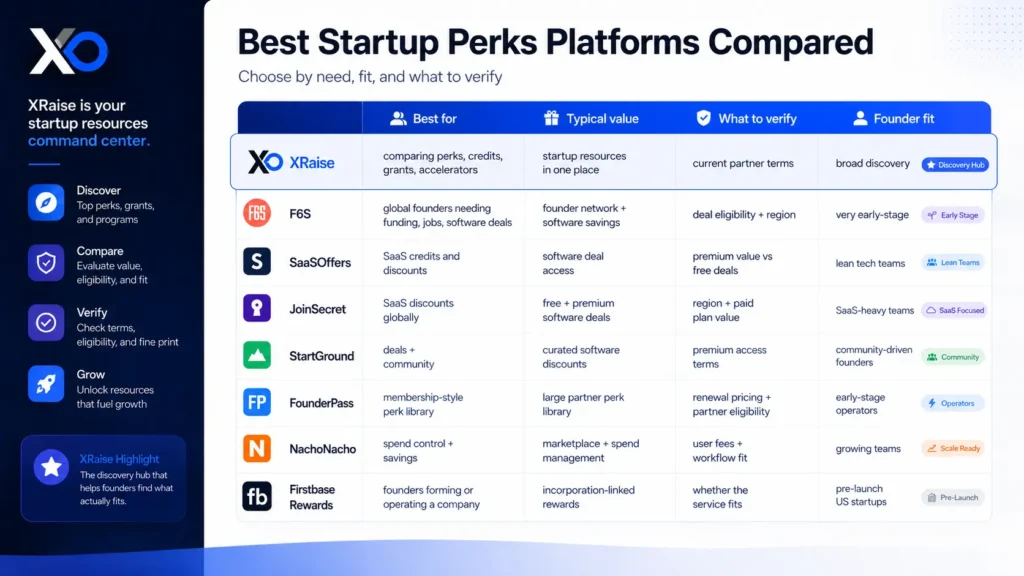
| Platform | Best for | Typical value | What to verify | Founder fit |
|---|---|---|---|---|
| XRaise | Founders comparing perks, credits, grants, and accelerators | Startup resources in one place | Current partner terms | Broad discovery |
| F6S | Global founders needing funding, jobs, and software deals | Free founder network and software savings | Deal eligibility and region | Very early-stage |
| SaaSOffers | Founders looking for SaaS credits and discounts | Startup software deal access | Premium value vs free deals | Lean tech teams |
| JoinSecret | Startups searching SaaS discounts globally | Free and premium software deals | Region and paid plan value | SaaS-heavy teams |
| StartGround | Founders wanting deals plus community | Curated software discounts | Premium access terms | Community-driven founders |
| FounderPass | Founders wanting a membership-style discount library | Partner perk library | Renewal pricing and partner eligibility | Early-stage operators |
| NachoNacho | Teams controlling SaaS spend | Marketplace plus spend management | User fees and workflow fit | Growing teams |
| Firstbase Rewards | US founders forming or operating a company | Incorporation-linked rewards | Whether Firstbase service fits | Pre-launch US startups |
Broad founder resource platforms
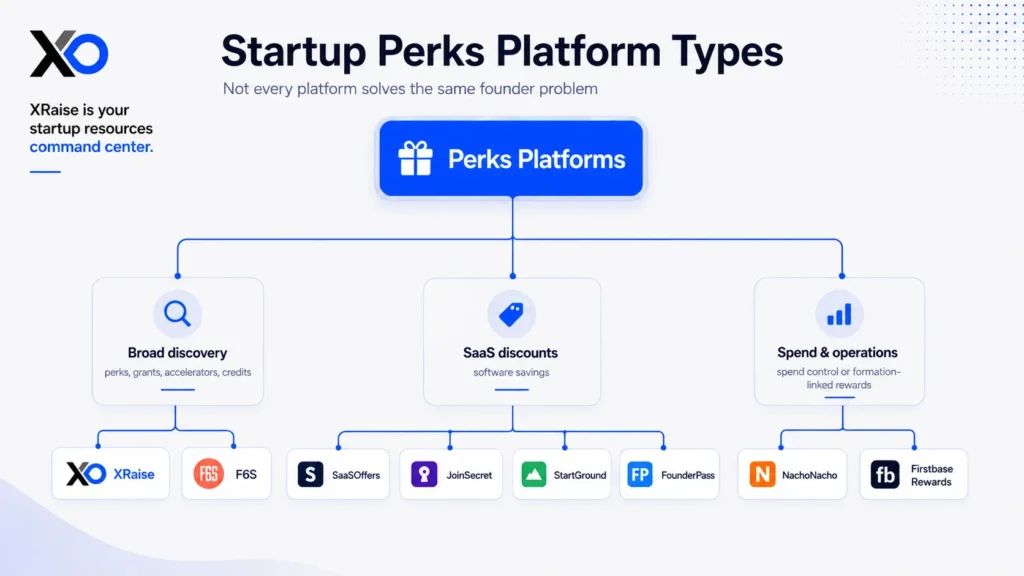
XRaise and F6S are strongest when founders want more than basic software discounts.
These platforms are useful because they help founders discover different types of startup support from one place. That can include startup perks, startup credits, startup discounts, accelerators, grants, jobs, partner offers, and broader founder resources. This matters most for early-stage teams that are still figuring out what they need first.
For example, a founder may not know whether the biggest opportunity is a cloud credit, a SaaS discount, an accelerator, or a grant. A broader resource platform helps them compare options before committing time or budget. Use this type of platform when your startup needs a wider discovery path, not just one discount on one tool.
SaaS discount marketplaces
SaaSOffers, Secret, StartGround, and FounderPass are better fits when the main goal is reducing software costs. These platforms are more focused on startup software deals. They are useful when your team already knows which SaaS categories it needs, such as CRM, analytics, design, documentation, customer support, developer tools, or marketing software.
This is helpful for founders who already have a working stack and want to lower the cost of tools they were planning to use anyway.
The key is to avoid collecting discounts just because they look valuable. A SaaS marketplace works best when you search with a clear need, compare the offer, verify the terms, and claim only the tools that fit your workflow. Use this type of platform when software spend is the main cost you want to reduce.
Spend-control and operating platforms
NachoNacho and Firstbase Rewards serve a slightly different need.
NachoNacho is more relevant when a growing team wants software savings plus better spend visibility. This can matter when a startup already has multiple tools, several paid seats, and unclear ownership across the stack. At that stage, the problem is not only finding more startup discounts. The bigger problem may be unused tools, duplicate subscriptions, forgotten renewals, or teams paying for software nobody actively uses.
Firstbase Rewards is more relevant for founders who need company setup, operations, and startup rewards connected to formation support. This can be useful for pre-launch or newly formed companies that want operational tools, legal support, finance resources, hiring support, or business setup resources in one place. Use this type of platform when your startup needs operational structure, not just a list of discounts.
How should founders choose a startup perks platform?
Founders should choose a startup perks platform by matching it to the cost they need to reduce first. Cloud-heavy startups should prioritize cloud credits. SaaS-heavy teams should compare software deals. Remote teams should check hiring, payroll, and equipment support. Growing teams should consider spend-control tools.
If you are still deciding what belongs in your stack, start with this guide to the best startup tools for founders before claiming extra offers.
Use this simple decision path.
Choose by your biggest cost
The easiest way to choose startup perks is to start with the cost category hurting your runway most.
| Biggest startup cost | Best perk category to check first | Founder action |
|---|---|---|
| Infrastructure | Cloud credits and developer tools | Start with hosting, compute, storage, database, and developer workflow offers. |
| Sales and marketing | CRM, email, analytics, landing page, and ad credits | Look for perks that help you test channels before scaling spend. |
| Hiring | HR, payroll, contractor, recruiting, and compliance tools | Prioritize offers that reduce admin work and hiring friction. |
| Messy software stack | SaaS spend visibility and management tools | Fix unused tools and duplicate subscriptions before adding more discounts. |
This keeps the decision practical: reduce the cost you already have before chasing new offers.
Choose by stage
Your startup stage should shape which perks you claim first. The earlier you are, the more important it is to keep the stack simple.
| Startup stage | What to prioritize | What to avoid |
|---|---|---|
| Pre-launch | Free tools, cloud credits, basic CRM, documentation, and one finance system | Overbuilding the stack before workflows are clear. |
| Seed stage | Sales pipeline, onboarding, product analytics, support, cloud infrastructure, and finance tools | Adding tools without repeatable processes or clear owners. |
| Growth stage | Renewal tracking, unused seat cleanup, approval workflows, and vendor overlap checks | Paying for duplicate tools or forgotten subscriptions. |
The safer move: start with one or two platforms, claim only what matches an active workflow, and document renewal dates from day one.
Use this when / avoid this when
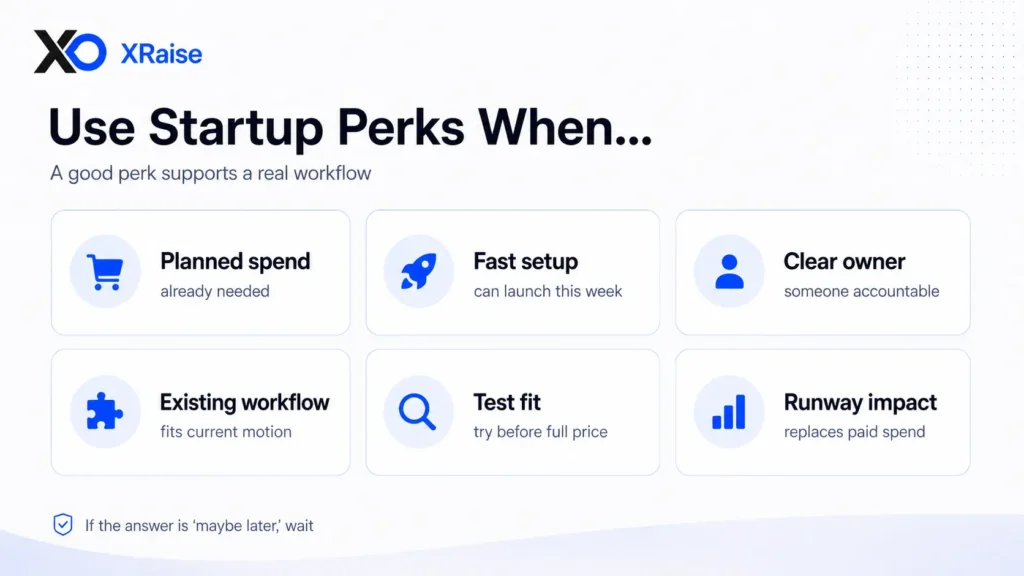
Use startup perks when the discount lowers a cost you already planned to carry. Avoid them when the offer pushes you into tools, annual plans, or workflows your team is not ready to manage. The goal is runway extension, not a bigger software graveyard.
Use this when
Use startup perks when you already know the tool category you need.
For example, if your AI product needs cloud infrastructure, cloud credits may directly extend runway. If your outbound motion is starting, CRM or email credits may help. If your team is hiring across countries, payroll or contractor-management discounts can be practical.
Use perks when they reduce committed spend, shorten setup time, or help you test a tool before paying full price.
Avoid this when
Avoid startup perks when the offer creates fake urgency. A discount is not a strategy. If you do not have a clear owner, workflow, or success metric for the tool, skip it. Also avoid deals that require annual commitment before you have tested the product. The first startup stack should stay flexible because your GTM, product, and team structure may change quickly.
Before you pay for it, ask: “Would we buy this without the discount?”
If the answer is no, the perk is probably not a priority.
Founder decision framework: pick by runway impact
The best decision framework is simple: choose the startup perks that reduce unavoidable costs first. Founders should rank each opportunity by immediate need, real savings, setup effort, renewal risk, and whether the tool supports a workflow that already exists inside the company.
Use this scorecard before claiming any offer.

Startup Perks AI Assistant
Have questions about credits? Let's chat instantly.
| Criteria | Strong signal | Weak signal | Founder action |
|---|---|---|---|
| Current need | Tool solves an active problem | “Might use later” | Wait |
| Runway impact | Replaces paid spend | Adds new spend | Prioritize replacement |
| Setup effort | Can launch this week | Requires process redesign | Delay |
| Renewal risk | Easy to cancel | Annual lock-in | Track renewal |
| Team ownership | Clear owner | Nobody accountable | Do not claim yet |
| Workflow fit | Supports existing process | Creates new process | Test first |
A useful startup discount should make a real operating cost lower. It should not create a new system your team has to babysit.
This is where XRaise fits naturally. Use XRaise to compare startup perks and credits before wasting weeks searching manually or paying full price for tools your startup may already qualify to access at a discount.
Founders usually get this wrong
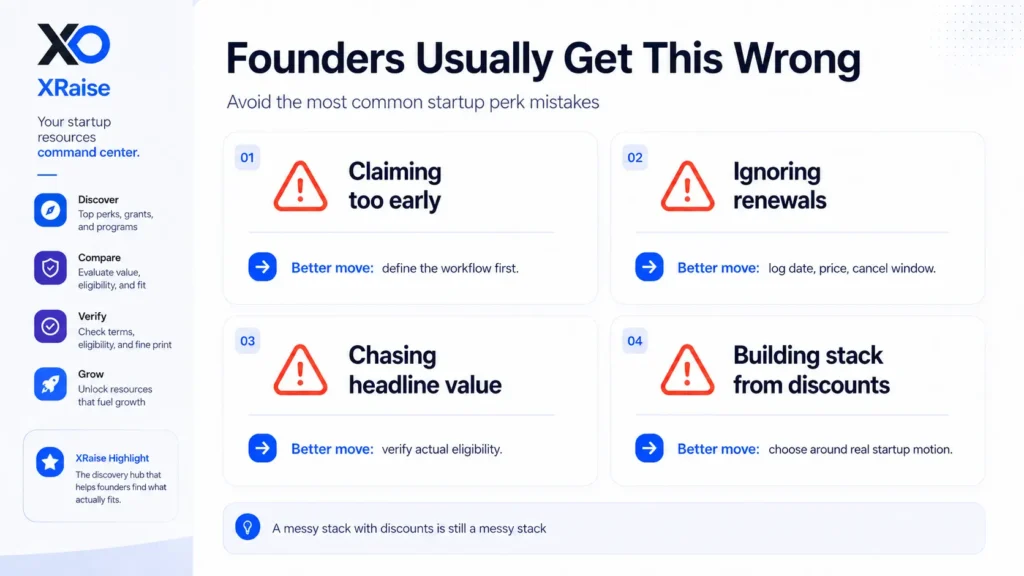
Founders usually get startup perks wrong by chasing headline value instead of usable value.
A large credit number can look impressive, but the real question is more practical: does your startup qualify, can your team use the offer before it expires, and would you have paid for that tool anyway? Startup perks should reduce real costs. They should not create a bigger software stack, more admin work, or another subscription your team forgets to cancel.
Common mistakes to avoid
| Mistake | Why it hurts | Better move |
|---|---|---|
| Claiming tools too early | The team signs up before the workflow exists, then the tool becomes another unused account. | Define the workflow first, then claim the perk. |
| Ignoring renewal pricing | A tool feels cheap during the free or discounted period, then becomes expensive once the team depends on it. | Record the renewal date, full-price plan, cancellation window, and seat count before activating. |
| Comparing perks by headline value | “Up to” numbers are not guaranteed savings. Eligibility, region, funding stage, and billing rules can change the real value. | Treat every offer as conditional until verified on the official provider page. |
| Building a stack from discounts | The company chooses tools because they are discounted, not because they support the actual operating system. | Choose tools around your real motion: product, sales, support, finance, hiring, or analytics. |
Mistake 1: Claiming tools too early
A founder sees a good offer and signs up immediately. The problem is that the team may not have the workflow yet. Nobody owns the tool, nobody measures the outcome, and nobody remembers why the account was created.
That is how startup software deals turn into clutter. The smarter move is to define the workflow first. Decide what the tool needs to do, who will own it, and what success looks like. Then claim the perk if it reduces the cost of a tool you actually need.
Mistake 2: Ignoring renewal pricing
Many founders focus on free months, startup discounts, or limited-time credits. That is understandable, but it can become expensive later. A tool may be cheap during onboarding and costly after the discount ends. By then, your data, workflows, team habits, and customer processes may already depend on it.
Before activating any startup perks, check the full-price plan, renewal date, cancellation window, seat limits, and upgrade triggers. The safer move is to track every offer in one simple sheet from day one.
Mistake 3: Comparing perks by headline value
Headline value can be misleading. A platform may advertise large startup credits, but the actual value depends on eligibility, geography, company stage, funding status, usage limits, expiration dates, and provider approval.
This does not mean the offer is bad. It means founders need to treat the number as a starting point, not a guarantee. Use the headline value to decide whether the offer is worth checking. Then verify the current terms on the official provider page before making a decision.
Mistake 4: Building a stack from discounts
Discounts should support your startup’s operating system. They should not define it. A founder should not choose a CRM, analytics platform, email tool, or finance system only because it appears on a startup perks platform. The tool still needs to fit the team, workflow, budget, and stage.
The better move is to decide what your startup needs first, then use startup perks platforms to reduce the cost of that decision. In other words: strategy first, discounts second.
Best startup perks by founder priority
The best startup perks depend on the founder’s immediate priority. Budget-limited teams should start with free or low-cost resources. Remote teams should check payroll, legal, and equipment support. SaaS-heavy teams should compare software discounts. Scaling teams should watch spend management and renewals.
Cost-conscious founders
Start with free resources first. Look for credits that replace near-term spend: cloud, email, CRM, analytics, design, hosting, and customer support. Do not pay for premium access unless one unlocked deal clearly exceeds the membership cost.
AI and SaaS founders
Focus on cloud, infrastructure, developer tools, support, analytics, and product workflows. AI teams should be especially careful with usage-based tools. A credit can help, but only if you understand what happens when usage grows.
If infrastructure is your biggest cost, compare cloud credits for startups before choosing one provider too early. For AWS-heavy teams, review AWS Activate credits for startups and check whether your company qualifies before building more infrastructure spend.
Remote-first teams
Check for payroll, HR, compliance, equipment, communication, and documentation perks. Remote teams often waste money on overlapping collaboration tools. Choose one source of truth before adding more apps.
Global founders
Prioritize platforms with broad geographic coverage. Also check currency, billing, eligibility, tax, and region restrictions. A strong deal in one market may not apply to your company.
How XRaise helps founders discover useful startup perks
XRaise helps founders find startup perks, credits, grants, accelerators, and other startup resources in one place. That matters because founders often waste time searching across scattered partner pages, old promo posts, expired lists, and confusing eligibility pages instead of building.
For general startup perks, the smarter move is not to chase every offer.
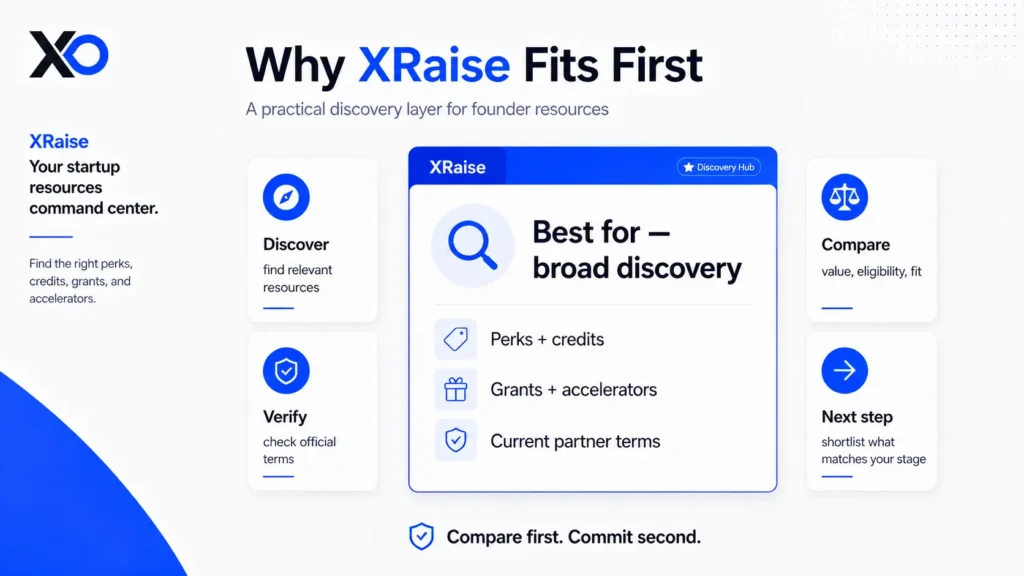
The better move is to compare first.
Check what your startup may qualify for. Shortlist only the resources that match your stage, budget, and current tool needs. Then verify the latest terms on the official provider page before committing.
Explore related startup perks and credits on XRaise before paying full price for your next tool.
FAQ
Startup perks questions usually come from founders trying to separate real savings from noise. The right answer depends on stage, tool category, eligibility, and whether the offer reduces a cost the startup already planned to carry. Use perks as a decision filter, not a shopping list.
What are the best startup perks for early-stage founders?
The best startup perks for early-stage founders usually reduce unavoidable costs: cloud infrastructure, CRM, email, analytics, design, documentation, support, finance, and hiring tools. The exact best fit depends on your business model. A SaaS startup may value cloud and product analytics more, while a services-heavy startup may value CRM, proposals, and finance tools.
Are startup perks worth it?
Startup perks are worth it when they replace real spending or let you test an important tool before committing. They are not worth it when they push you into unused software, annual plans, or tools your team is not ready to manage. Always compare the discount against setup time, renewal pricing, and actual workflow fit.
How should startups compare perk platforms?
Startups should compare perk platforms by category coverage, eligibility rules, pricing, geography, partner quality, renewal risk, and whether the platform supports your current stage. Do not choose only by advertised savings. A smaller, usable discount on the right tool is better than a huge credit you cannot activate or use.
What mistakes should founders avoid with startup discounts?
Founders should avoid claiming too many tools, ignoring renewal dates, assuming eligibility, and choosing software only because it is discounted. The smarter move is to map your current workflows first, identify painful costs, then use discounts to reduce those specific costs. Verify current terms on the official provider page before making a decision.
How can XRaise help founders find startup credits and perks?
XRaise helps founders discover startup credits, discounts, accelerators, grants, and other founder resources in one place. That makes it useful when you want to compare options before paying full price or wasting time across scattered vendor pages. Use XRaise as a discovery layer, then confirm the latest provider terms before activating an offer.
Conclusion
Startup perks are most useful when they protect runway without adding operational mess.
The goal is not to collect every discount, credit, free trial, or software offer you can find. The goal is to reduce the cost of tools and resources your startup already needs. Founders should start with unavoidable costs first: cloud infrastructure, core software, sales tools, finance systems, hiring support, legal needs, and operations. Then compare startup perks based on eligibility, real savings, setup effort, renewal pricing, and whether the tool fits the company’s current workflow.
The brutal truth: a messy stack with discounts is still a messy stack. A discounted tool nobody owns is still wasted spend. A large credit for a product your team does not need is still distraction. A free trial that turns into an expensive renewal is still a runway leak. The smarter move is to build a lean operating system first, then use startup perks to make that system cheaper.
Use XRaise to discover founder resources that match your stage, compare useful offers, and avoid missing startup perks, credits, discounts, grants, and accelerators that could save time and runway.