Last updated: June 2026
AWS vs Azure for Startups is not just a cloud comparison. It is a runway, hiring, AI, and go-to-market decision.
The right choice helps your startup reduce cloud spend, ship faster, and avoid painful platform changes later.
TL;DR




This article provides a practical founder-first answer.
- Best overall: AWS is the safer default for most cloud-native startups.
- Best for lean teams: AWS works well if you need flexible infrastructure and simple entry credits.
- Best for scaling teams: Azure can win if your startup sells into Microsoft-heavy enterprises.
- Biggest tradeoff: AWS has more flexibility, while Azure has stronger Microsoft ecosystem leverage.
- What to do next: Match your cloud choice to credits, workload, team skills, and buyer environment.
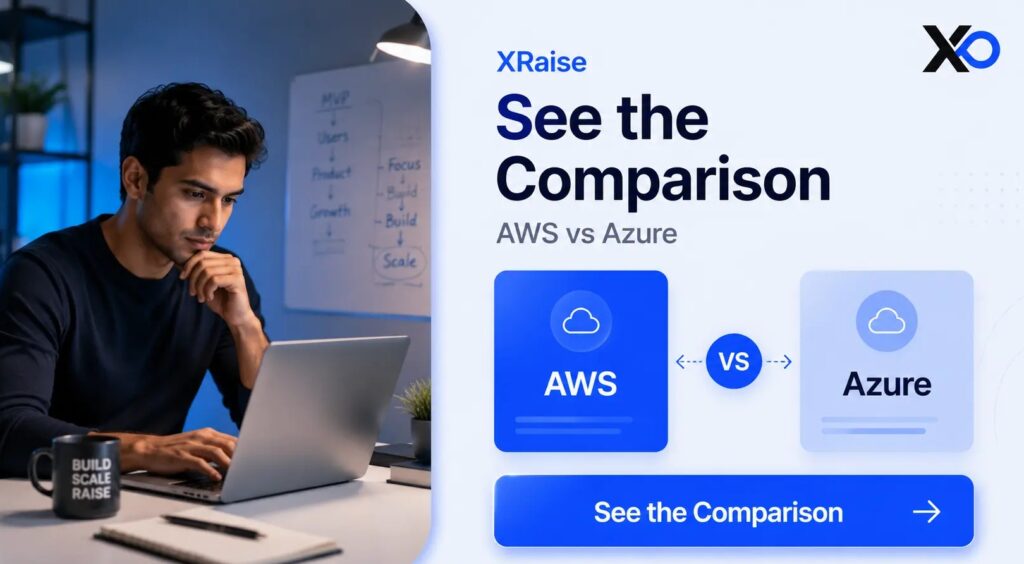
AWS vs Azure for Startups: quick comparison table
| Criteria | AWS | Azure | Best |
|---|---|---|---|
| Best for | Cloud-native apps, SaaS, AI infrastructure | Enterprise SaaS, Microsoft-aligned teams | Depends |
| Pricing | Strong credits, Spot, Savings Plans | Strong credits, bundles, startup tiers | Depends |
| Setup | Flexible, but can feel complex | Easier for Microsoft-native teams | Azure |
| Integrations | Broad developer ecosystem | GitHub, Microsoft 365, Entra | Azure |
| Automation | Lambda, EventBridge, Step Functions | Functions, Logic Apps, Power Platform | Tie |
| Reporting | CloudWatch, Cost Explorer | Azure Monitor, Cost Management | Tie |
| Startup fit | Strong technical default | Strong enterprise GTM fit | Depends |
| XRaise perk | $1,000+ AWS credit paths | Up to $5,000 Azure credits on XRaise | Both |
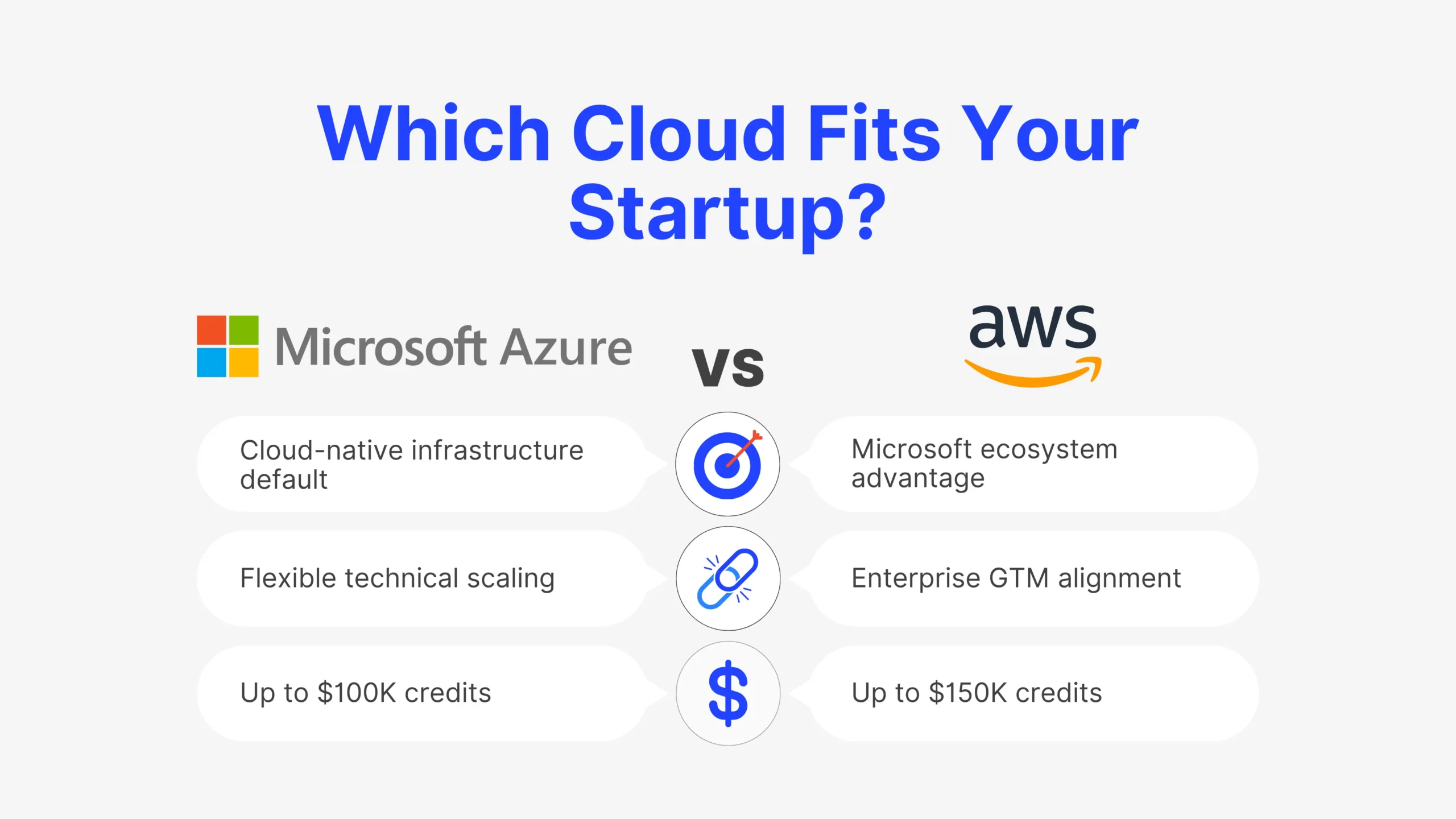
AWS says eligible startups can apply for up to $100,000 in AWS Activate Credits, while the Activate Founders package offers $1,000 for self-funded startups.
Microsoft’s Founders Hub benefits guide lists Azure credit levels up to $150,000, and Microsoft for Startups also promotes Azure credits, AI tools, and scale support for founders.
For deeper internal reading, founders can compare AWS Activate Credits for Startups, Azure Credits for Startups, and Best Cloud Credits for AI Startups on XRaise.
How we compared AWS vs Azure for Startups
This comparison focuses on startup decision factors, not abstract cloud rankings.
Use these criteria to compare AWS and Azure from a startup operator’s view:
| Criteria | What to Compare |
|---|---|
| Pricing and credits | Startup credits, free tiers, and total cost |
| Setup speed | How fast your team can launch |
| Developer experience | Tools, docs, SDKs, and workflow fit |
| AI and ML support | Model access, ML tools, and AI infrastructure |
| Integrations | Fit with your existing stack |
| Security and identity | Access control, compliance, and user management |
| Reporting and cost controls | Budget tracking, alerts, and usage visibility |
| Startup-stage fit | Best fit for pre-seed, seed, or growth teams |
In short, AWS often creates more technical leverage, while Azure can create more commercial leverage when Microsoft is already part of the buyer environment.
AWS review for startups
AWS is the stronger default for many startups because it covers nearly every common infrastructure need. A founder can start with storage, compute, and serverless. Later, the same team can grow into databases, analytics, AI models, containers, and global infrastructure.
That matters because early architecture choices become harder to change after customers arrive.
Where AWS wins in the AWS vs Azure for Startups comparison
AWS stands out when a startup needs broad infrastructure choices without locking into one narrow workflow.
| AWS strength | Why it matters for startups |
|---|---|
| Broad service range | Build apps, databases, AI, storage, and serverless in one cloud |
| Flexible architecture | Start small, then scale into more advanced infrastructure |
| Strong AI stack | Use SageMaker, Bedrock, compute, and data tools as needs grow |
| Large market share | More hiring options, tutorials, partners, and community support |
| Deep ecosystem | Easier to find integrations, templates, agencies, and expert help |
That mix makes AWS a strong default for startups that value technical flexibility, long-term scalability, and cloud-native depth.
Where AWS falls short
AWS can become difficult when a small team uses too many services without clear ownership.
| AWS challenge | What founders should do |
|---|---|
| Complex billing | Set budgets, alerts, and cost owners early |
| Many service choices | Start with the few services your product actually needs |
| Permissions can get messy | Create clear IAM rules before the team grows |
| Regions add complexity | Choose regions based on users, cost, and compliance |
| Cloud operations need ownership | Assign one person to manage usage, tags, and access |
AWS is powerful, but startups get the most value when they keep the setup simple and controlled.
Use this table to decide if AWS fits your startup:
| AWS is a strong fit if your startup… | Why it matters |
|---|---|
| Builds SaaS products | AWS gives strong infrastructure flexibility |
| Works on AI infrastructure | Useful for compute-heavy technical teams |
| Creates developer tools | Strong ecosystem for technical products |
| Builds data products | Good fit for storage, pipelines, and analytics |
| Runs marketplaces | Scales well as usage and traffic grow |
| Needs platform-heavy infrastructure | Gives engineers more control |
| Already has AWS experience | Reduces setup time and learning curve |
For startups that need technical flexibility more than Microsoft buyer alignment, AWS is usually the stronger choice.
Get $1,000 in AWS Activate Credits to start building with lower cloud costs.
Need a higher AWS credit path for scaling workloads? Apply for Up to $100K AWS Credits.
Azure review for startups
Azure is the better strategic choice when Microsoft is part of your company’s operating environment.
That includes GitHub, Microsoft 365, Entra ID, Azure OpenAI, enterprise security reviews, and buyers that already use Microsoft systems.
For many B2B SaaS startups, Azure is not just infrastructure. It can become part of the sales story.
Where Azure wins in the AWS vs Azure for Startups comparison
Azure is strongest when a startup needs cloud infrastructure plus Microsoft ecosystem leverage.
| Azure strength | Why it matters for startups |
|---|---|
| Microsoft alignment | Fits teams using Microsoft 365, GitHub, Entra, or Azure OpenAI |
| Enterprise trust | Helps B2B startups sell into Microsoft-heavy companies |
| Strong identity layer | Entra can support security, access, and compliance workflows |
| Startup credits | Eligible founders may access high-value Azure credit tiers |
| Bundled tools | Microsoft 365, GitHub Enterprise, and support can reduce extra costs |
That makes Azure a strong choice when cloud spend, software costs, and enterprise sales all connect.
Where Azure falls short
Azure can feel harder when a startup is not already working inside the Microsoft ecosystem.
| Azure challenge | What founders should do |
|---|---|
| Microsoft dependency | Use Azure when Microsoft alignment clearly helps sales or operations |
| Pricing can feel unclear | Review credits, regions, support, and usage limits before scaling |
| Service names can confuse teams | Start with the few services your product truly needs |
| Setup may feel heavy | Use Azure when your team already understands Microsoft tools |
| Lock-in risk | Avoid deep ecosystem dependence unless it creates real business value |
Azure is powerful, but it works best when Microsoft alignment is a strategic advantage, not just an added layer of complexity.
Who should choose Azure
Choose Azure if your startup sells to enterprises, handles regulated data, uses Microsoft identity, or builds AI products for Microsoft-heavy customers.

Startup Perks AI Assistant
Have questions about credits? Let's chat instantly.
It is also a strong option when Azure credits are easier for your company to unlock than AWS credits.
Claim Up to $5,000 in Azure Credits through XRaise to build, test, and launch with lower cloud costs.
AWS vs Azure for Startups: Pricing notes for Azure
This pricing comparison shows where AWS and Azure can reduce early cloud costs for startups.
| Pricing area | AWS pricing note | Azure pricing note | Startup takeaway |
|---|---|---|---|
| General pricing model | Pay-as-you-go for most cloud services, with no long-term contracts required. | Pay-as-you-go is available after free amounts or credit limits. | Both work for lean startups, but usage discipline matters. |
| Free credits | New AWS customers can get up to $200 in AWS Free Tier credits. | Azure free account includes $200 credit for 30 days. | AWS gives more room to experiment over time; Azure gives a fast 30-day test window. |
| Free services | AWS Free Tier includes select free usage and 30+ always-free services. | Azure includes free monthly amounts for 20+ services for 12 months and 65+ always-free services. | Azure is attractive for broad early testing across many services. |
| Serverless functions | AWS Lambda includes 1M free requests and 400,000 GB-s per month. | Azure Functions Consumption includes 1M free requests and 400,000 GB-s per month. | Both are startup-friendly for early serverless experiments. |
| Kubernetes | Amazon EKS standard support costs $0.10 per cluster per hour, plus underlying resources. | AKS Free tier includes free cluster management for dev, testing, and non-production workloads. (Microsoft Learn) | Azure can be cheaper for Kubernetes experiments; AWS may fit deeper production infrastructure needs. |
| Cost planning | AWS provides pricing calculators and usage-based pricing options. | Azure also offers pricing calculators, savings plans, and pay-as-you-go options. | Cost control depends more on monitoring than the logo you choose. |
For dev, test, serverless, and Kubernetes experiments, Azure can look attractive early. However, AWS may become stronger when your startup needs deeper infrastructure flexibility, broader service control, and more technical customization.
XRaise also has a useful internal guide on Which Cloud Credit Program Is Right for Your Startup for founders comparing AWS, Azure, and other cloud paths; for a dedicated side-by-side AWS, Azure, and Google provider view, use the XRaise cloud credits comparison.
AWS vs Azure for Startups: features and workflows
Setup
AWS gives startups more infrastructure flexibility.
However, Azure may feel faster for teams already using Microsoft accounts, GitHub, Entra ID, or Microsoft developer tools.
Collaboration
Azure has a clear advantage when the team already works inside Microsoft 365 and GitHub.
AWS still works well with modern engineering workflows, but collaboration is less tied to one productivity suite.
Automation
AWS offers strong automation through Lambda, EventBridge, Step Functions, CloudFormation, and CDK.
Azure offers Functions, Logic Apps, Bicep, Azure DevOps, and Power Platform connections.
Both can automate serious workflows. The better choice depends on your team’s habits.
Reporting
Both platforms provide cost, logging, and monitoring tools.
Still, founders should not rely on default dashboards alone. Set budget alerts, tagging rules, and owner accountability before production traffic grows.
Integrations
AWS has broader cloud-native reach.
Azure has deeper Microsoft ecosystem reach.
So the right question is simple: does your startup need broad technical optionality or stronger Microsoft alignment?
AWS or Azure: which cloud fits your startup stage?
| Situation | Choice | Why |
|---|---|---|
| Pre-seed MVP | AWS | Strong default and broad documentation |
| Pre-seed with Azure credits | Azure | Credits may reduce burn sooner |
| Seed SaaS | AWS | Flexible infrastructure for product growth |
| B2B SaaS selling to enterprises | Azure | Microsoft alignment can help sales |
| AI app with heavy infrastructure | AWS | Strong AI infrastructure and model ecosystem |
| Enterprise AI product | Azure | Better Microsoft buyer fit |
| Kubernetes testing | Azure | AKS Free tier helps experiments |
| Multi-cloud strategy | Either | Architecture discipline matters more |
Early startups should avoid over-engineering. Pick one cloud, build clear cost controls, and revisit the decision when usage or customers justify it.
When should you consider alternatives?
Sometimes neither AWS nor Azure is the fastest answer.
| Scenario | Meaning |
|---|---|
| You only need a simple frontend app | Vercel or Netlify may be faster |
| You need managed app hosting | Render, Railway, or Fly.io may reduce setup |
| GPU access is the main bottleneck | GPU-first providers may matter more |
| Your team lacks DevOps skills | A simpler platform can prevent mistakes |
| You want portability | Use containers and avoid deep lock-in |
In short, hyperscalers are powerful. Yet not every startup needs hyperscaler complexity on day one.
For a broader tool-stack view, XRaise also covers 25 Best Startup Tools for Founders in 2026.
FAQ about AWS vs Azure for Startups
Is AWS or Azure better for startups?
AWS is better for most cloud-native startups. Azure is better for Microsoft-aligned B2B startups.
Which cloud gives better startup credits?
Azure has a higher public headline ceiling. AWS has strong Activate paths and broad startup support.
Is AWS cheaper than Azure?
Not always. AWS can be cheaper with strong cost controls. Azure can be cheaper when credits and bundled tools matter.
Is Azure better for AI startups?
Azure is strong for enterprise AI and Microsoft-heavy buyers. AWS is strong for broad AI infrastructure and model experimentation.
Is AWS better for SaaS startups?
Often, yes. AWS is a strong default for SaaS teams that need flexible infrastructure.
Can AWS Activate credits be used for AI?
Yes. AWS says Activate Credits support AWS technology, including infrastructure, data services, and AI/ML models.
Can startups get Azure credits through XRaise?
Yes. Based on XRaise perk data, eligible startups can access Azure credits through XRaise, then verify official Microsoft terms.
Which cloud is easier to set up?
Azure is easier for Microsoft-native teams. AWS is easier for teams already familiar with cloud-native infrastructure.
Which cloud is better for enterprise sales?
Azure often has the edge because many enterprise customers already use Microsoft identity, security, and productivity tools.
Should startups use both AWS and Azure?
Usually, no. Multi-cloud adds complexity before most startups need it.
Final thoughts
AWS vs Azure for Startups comes down to stage, credits, team skills, workload, and buyer environment.
Choose AWS if you want the stronger general-purpose cloud default. It is best for cloud-native apps, AI infrastructure, SaaS platforms, and technical teams that value flexibility.
Choose Azure if your startup is tied to Microsoft tools, enterprise buyers, Entra identity, GitHub workflows, or Microsoft startup benefits.
For most early startups, AWS is the safer engineering default. or Microsoft-centered B2B startups, Azure can be the stronger business decision.
Explore XRaise’s Perk Hub For More Startup Tools and Offers.
Related reading: Azure credits for startups · Google Cloud credits for startups