TL;DR
- Choose AWS if your startup needs broad infrastructure depth and your team already knows AWS.
- Choose Google Cloud if AI, data, Firebase, BigQuery, Gemini, or Google-native workflows are central.
- Choose Azure if enterprise B2B, Microsoft ecosystem fit, Azure AI, or Marketplace motion matters.
- Do not choose by the biggest headline amount; compare workload fit, coverage, eligibility, and cost risk.
- Before applying, compare startup cloud and software resources through XRaise and verify official terms.
Quick Verdict
AWS is usually the right comparison point when your team already operates comfortably on AWS and needs broad infrastructure coverage, managed services, or Amazon Bedrock model access.
Google Cloud may fit better when the product is AI-first, data-heavy, Firebase-based, or BigQuery-heavy. It is also worth reviewing if Google-native AI and analytics workflows are likely to shape the build.
Azure deserves closer attention when you are building B2B software for Microsoft-heavy customers. Enterprise procurement, Microsoft Marketplace, GitHub, Azure AI, or Microsoft Foundry may make it a stronger strategic fit.
Related Posts




Wait before applying if the workload is not defined, eligibility is unclear, or the team cannot model post-credit costs yet.
What Is Being Compared and Why It Matters
This is a cloud credits comparison across three major startup cloud paths: AWS Activate credits, Google Cloud startup credits, and Azure startup credits through Microsoft for Startups.
All three can help a startup reduce early infrastructure burn. All three can also shape architecture, hiring, data decisions, AI stack choices, billing habits, and migration risk.
Avoid the shallow version of the decision:
“Which provider gives us the most credits?”
The better version is:
“Which provider helps us prove the next product and business milestone with the least future regret?”
As of September 2026, the official program pages show different credit structures and eligibility paths:
- AWS promotes up to $5,000 for self-funded founders, up to $200,000 for eligible provider-backed pre-Series B startups, and additional invite-only credits for AI startups ready to scale through AWS Activate Credits.
- Google Cloud promotes $2,000 for pre-funded startups, up to $200,000 for eligible Seed to Series A startups, and up to $350,000 for eligible AI-first startups through the Google for Startups Cloud Program and its AI startup program.
- Microsoft says the standard Microsoft for Startups path begins with up to $200 in Startup credits and can unlock $5,000, $25,000, $50,000, and up to $150,000 as verification, service adoption, and sustained Azure usage milestones are met. Eligible Investor Network-backed startups may unlock up to $200,000 and expanded support through Microsoft for Startups benefits.
Those numbers matter, but they are ceilings, not strategy. The actual fit depends on workload, eligibility, coverage, timing, usage discipline, and the bill after credits expire.
If you are still building the shortlist, review startup perks before paying full price so the cloud decision sits inside the rest of your early-stage software budget.
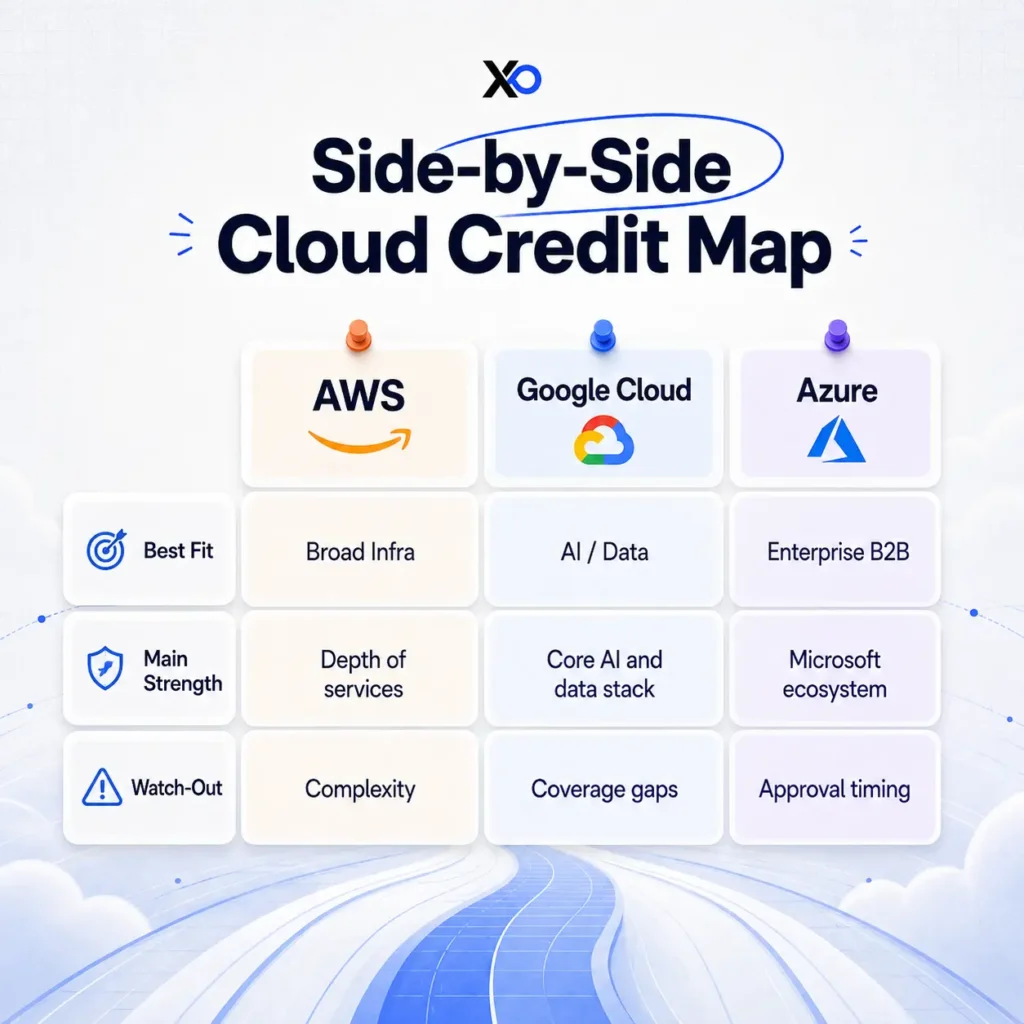
| Option | Best for | Main strength | Watch out for |
|---|---|---|---|
| AWS Activate credits | Broad SaaS, infrastructure, dev tools, data platforms, production-heavy startups | Service depth, mature cloud ecosystem, broad infrastructure coverage | Complexity, service sprawl, IAM/billing overhead, lock-in before proof |
| Google Cloud startup credits | AI-first, data-heavy, Firebase, BigQuery, Gemini, analytics-led products | AI/data workflow fit and Google-native product velocity | Assuming every AI cost is covered, data movement costs, third-party model spend |
| Azure startup credits | B2B SaaS, enterprise software, Microsoft ecosystem startups | Azure AI, Microsoft Foundry, GitHub, Marketplace, enterprise motion | Choosing enterprise ecosystem benefits before enterprise motion is real |
Best-Fit Summary
AWS is usually the safest default when your startup needs infrastructure breadth and your team can manage the platform without slowing product work. Founders leaning this direction can review AWS Activate on XRaise before checking the official AWS terms.
Google Cloud is strongest when AI and data are core product machinery, especially around Gemini, Gemma, Vertex AI, BigQuery, Firebase, Cloud Run, or large-scale data workflows. If that sounds like your product, review Google Cloud startup options on XRaise before you commit your build path.
Google Cloud for Startups
$2,000 Start credits, Scale credits up to $200,000, or up to $350,000 for qualified AI-first startups.
Azure is strongest when the cloud decision is tied to a B2B enterprise path, Microsoft-native customers, GitHub, Microsoft Marketplace, Azure AI, or Microsoft procurement. B2B founders in that lane should review Microsoft for Startups on XRaise alongside the provider requirements.

Microsoft Azure for Startups
Standard Azure Startup credits begin at $200 and can unlock up to $150,000 through milestones.
The practical winner is not universal. The right cloud credits for startups are the credits that reduce the cost of the workload you are ready to prove.
Deep Comparison by Decision Factors
Workload fit
Start with the workload. A conventional SaaS product, an AI agent platform, a developer tool, a healthcare data product, and a consumer app do not need the same cloud path.
AWS fits broad infrastructure needs especially well, especially when several managed services, deployment patterns, storage options, networking depth, and production maturity matter.
Google Cloud fits AI and data workflows when the product loop depends on data ingestion, model calls, evaluation, analytics, and feedback.
Azure fits enterprise-oriented workflows where identity, compliance, procurement, support, customer IT expectations, or Microsoft-native tools are part of the customer story.
AI fit
AI cloud credits are valuable only when they lower the cost of a repeated production AI workload.
AWS can be attractive for teams that want multiple foundation model providers through Amazon Bedrock while keeping core infrastructure in AWS.
Google Cloud is especially relevant when Gemini, Gemma, Vertex AI, Google Cloud AI infrastructure, or BigQuery-connected AI workflows are part of the core product.
Azure is relevant when Azure AI, Microsoft Foundry, GitHub workflows, and Microsoft enterprise context matter.
Team experience
A cloud your team knows is worth more than founders usually admit.
Technical familiarity should shape the cloud choice. A founder who has already shipped and operated AWS workloads can save weeks by staying close to that experience. Teams already prototyping with Firebase, BigQuery, or Google Cloud Run may learn faster on Google Cloud. Azure may reduce context switching when engineers and customers already work around GitHub, Microsoft identity, enterprise IT expectations, and Azure services.
Do not let credits turn your team into beginners on a critical path.
Time to value
Early-stage startups should optimize for the first useful product output, not the most sophisticated cloud stack.
AWS can be fast when the team knows which services to use. Google Cloud can be fast for Firebase MVPs, data-heavy prototypes, and AI workflows. Azure can be fast when B2B customers expect Microsoft-native environments.
The wrong path is the one that turns a cloud credit program into a three-month infrastructure project.
Lock-in and portability
Provider-specific services are not always bad. Use them deliberately when they create proof faster. Stay portable when the workload is experimental, the product direction is moving, or the team does not understand future cost.
Pricing and Offer Comparison
Cloud credit programs are promotional credit paths layered on top of usage-based cloud pricing. Ask not only “How much can we get?” but “What usage will the credits actually offset?”
| Option | Startup offer or pricing model | Best cost fit | What to verify |
|---|---|---|---|
| AWS Activate credits | Up to $5,000 for self-funded founders; up to $200,000 for eligible provider-backed pre-Series B startups; additional invite-only AI startup credits | Startups with real AWS infrastructure usage, production workloads, or Bedrock-related AI plans | Credit tier, Activate Provider Org ID, eligible services, expiration, support coverage, billing alerts |
| Google Cloud startup credits | $2,000 for pre-funded startups; up to $200,000 for eligible Seed to Series A; up to $350,000 for eligible AI-first startups | AI-first, data-heavy, Firebase, BigQuery, Cloud Run, or Gemini/Gemma-oriented teams | Program tier, AI-first eligibility, covered Google Cloud services, third-party model costs, year-two discount terms |
| Azure startup credits | Standard milestone path from $200 through $5,000, $25,000, $50,000, and up to $150,000; eligible Investor Network-backed startups may unlock up to $200,000 | B2B startups using Azure services, Azure AI, Microsoft Foundry, GitHub, or Microsoft enterprise motion | Milestone requirements, eligible Azure services, sustained workload and usage thresholds, Marketplace/go-to-market fit, and whether an optional Investor Network referral applies |
Model three cost scenarios before you commit:
- Current usage: the cost of the product as it runs today.
- Growth usage: the cost if customer usage grows 5x or 10x.
- Stress usage: the component most likely to spike, such as AI inference, logs, storage, egress, databases, GPUs, or background jobs.
The best comparison includes the paid bill after credits are gone.
This is also where founders should put cloud credits inside a broader runway plan, because a credit only helps if the full-price version of the stack still works.

Startup Perks AI Assistant
Have questions about credits? Let's chat instantly.
Eligibility and Requirements Comparison
Eligibility matters because headline amounts are not guaranteed. Stage, funding path, provider affiliation, geography, product type, prior credits, account history, and review can all affect access.
| Option | Who it fits | Common requirements | What to confirm |
|---|---|---|---|
| AWS Activate credits | Self-funded startups, provider-backed pre-Series B startups, and some AI startups ready to scale | Founded in the last 10 years, pre-Series B, paid AWS account, new or higher credit request, Org ID for Portfolio tier | Whether you qualify for Founders, Portfolio, or invite-only AI credits; eligible services and expiration |
| Google Cloud startup credits | Pre-funded MVP teams, funded Seed to Series A startups, and AI-first Scale startups | Program tier depends on funding/stage; AI program has AI-first requirements and prior-credit limits | Whether your funding qualifies, whether AI-first status applies, which services/models are covered |
| Azure startup credits | Early-stage B2B startups building software, AI, or technology solutions | Microsoft docs describe pre-seed through Series C, privately held independent companies in eligible regions, with application paths available with or without an optional Investor Network referral code | Whether your startup qualifies, which milestone applies, whether sustained usage is required, and whether an investor referral changes benefits |
Check the official program page before applying or claiming. You can also check startup eligibility before applying for credits, then treat XRaise as the discovery layer and the provider page as the final eligibility source.
What to Choose at Each Startup Stage
| Startup stage | Best choice | Why | What to avoid |
|---|---|---|---|
| Idea stage | Usually wait or use the simplest free tier | The workload is not real enough to justify architecture commitment | Applying before the credit window can be used |
| MVP stage | Google Cloud for Firebase/data/AI MVPs; AWS for broad infra MVPs; Azure for B2B/Microsoft MVPs | Pick the cloud that gets a working product to users fastest | Building a mature stack before usage exists |
| Pre-seed | AWS, Google Cloud, or Azure based on workload and team familiarity | Credits should reduce the cost of proof and pilots | Choosing only by maximum advertised amount |
| Seed | Provider aligned with repeatable usage, reliability, and customer motion | Infrastructure starts affecting margins and reliability | Ignoring post-credit cloud costs |
| Early revenue | The cloud that supports unit economics and customer trust | Cost, support, compliance, and operations matter more | Staying on a poor-fit cloud because migration feels annoying |
| Growth stage | The provider that supports scale, procurement, support, and long-term architecture | Provider commitments become strategic | Treating credits as a substitute for cloud cost discipline |
Idea-stage teams should avoid over-optimizing. MVP and pre-seed teams should choose for speed to proof. By seed and early revenue, the cloud bill starts connecting to gross margin, reliability, support, security, and runway.
Best Option by Use Case
If your priority is broad cloud infrastructure
Choose AWS because its service breadth supports SaaS, data systems, dev tools, marketplaces, APIs, and production infrastructure in one mature ecosystem.
If your priority is AI product building
Choose Google Cloud if your AI workflow depends on Gemini, Gemma, Vertex AI, BigQuery, or Google-native data systems. Choose AWS for Bedrock and broad model-provider optionality. Choose Azure when Microsoft enterprise AI adoption is part of the buyer story.
If your priority is enterprise B2B sales
Choose Azure when Microsoft ecosystem fit can reduce sales friction through Marketplace, identity expectations, and Azure-native customer comfort.
If your priority is simple SaaS speed
Choose the provider your team can operate fastest: AWS for familiarity, Google Cloud for Firebase-led products, or Azure for Microsoft-heavy teams.
If your priority is cost control
Choose the provider where you can understand, tag, cap, and review usage from week one.
| Founder situation | Best option | Why |
|---|---|---|
| Technical team already strong in AWS | AWS | Familiar operations may beat a bigger but unfamiliar credit |
| AI-first product using Gemini or data-heavy pipelines | Google Cloud | AI and data workflow fit may reduce build friction |
| B2B startup selling to enterprise Microsoft customers | Azure | Cloud choice can support procurement, trust, and go-to-market motion |
| Bootstrapped founder with undefined workload | Wait or start tiny | Avoid starting a credit clock before the product can use it |
| Seed SaaS team with rising production usage | AWS, Google Cloud, or Azure by workload | Model the actual usage and choose the provider with best long-term cost behavior |
| Startup with unknown future AI runtime | Keep architecture portable | Avoid provider-specific AI lock-in before usage patterns are clear |
Hidden Constraints Founders Should Not Ignore
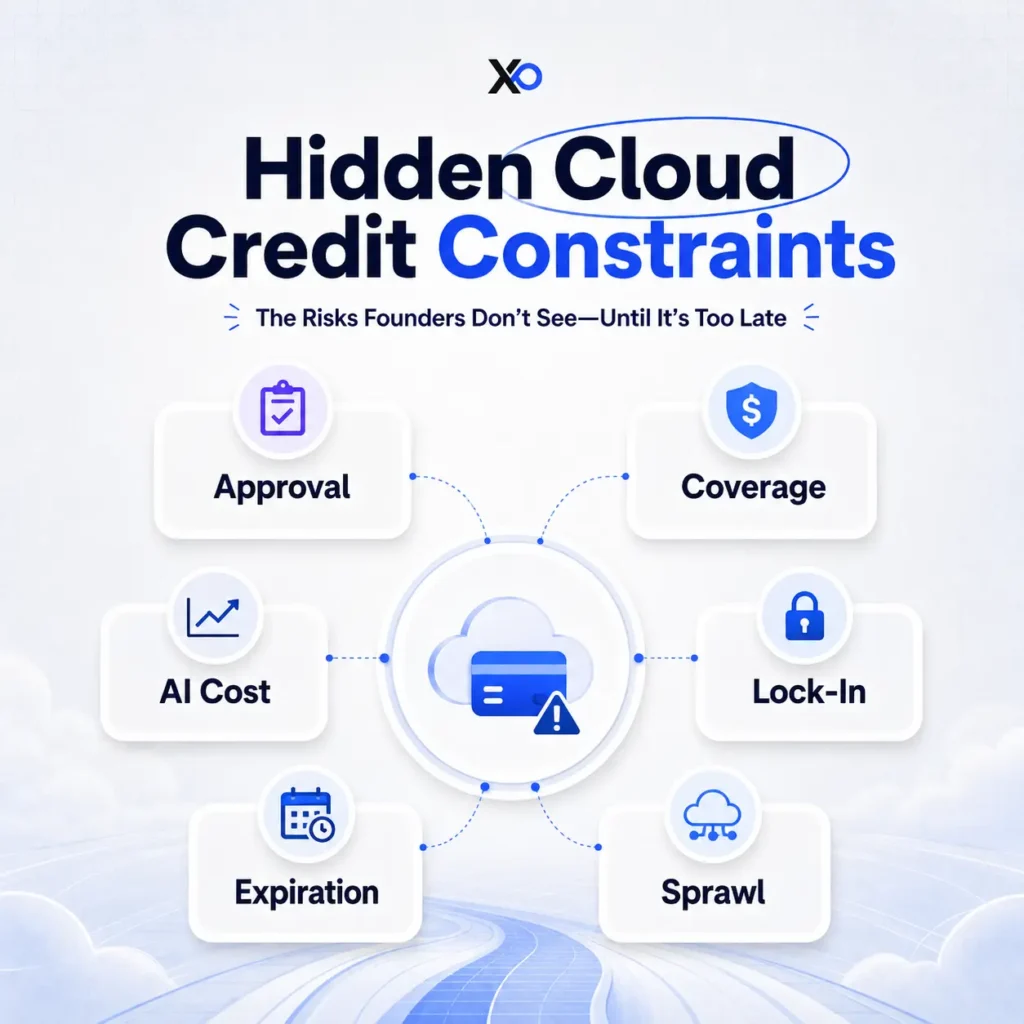
For a deeper mistake map, founders can avoid cloud credit mistakes before choosing a provider. The short version is that credits become dangerous when they hide cost, timing, or architecture tradeoffs.
“Up to” does not mean approved
Program pages advertise maximums. Your approved amount may depend on stage, funding, prior credits, provider affiliation, geography, account history, product type, or review.
Credits may not cover every service
Cloud credits are not universal cash. Marketplace tools, third-party services, support plans, training, some AI models, tax, prior charges, or external providers may be excluded.
AI costs can move faster than SaaS costs
AI usage may scale through inference, retries, evaluation, vector search, storage, fine-tuning, logs, and GPU jobs.
Managed services can create silent lock-in
A managed database, queue, search layer, model workflow, analytics platform, or identity system can be a smart shortcut. It can also make migration expensive later.
Credits can expire before the company is ready
Applying too early can waste the credit window. Applying too late can leave the architecture already shaped.
Multi-cloud can become premature complexity
Some startups try to claim every credit and spread workloads across providers. That can create account sprawl, permissions drift, billing confusion, duplicated monitoring, and unclear ownership.
Which Option Should You Choose?
Choose AWS if your startup needs broad infrastructure depth, your team already knows AWS, or Bedrock and the AWS service catalog fit the product.
Choose Google Cloud if your startup is AI-first, data-heavy, Firebase-based, analytics-led, or aligned with Gemini, Gemma, BigQuery, Vertex AI, or Google Cloud AI infrastructure.
Choose Azure if your startup is B2B or enterprise-oriented, your customers are Microsoft-heavy, or Azure AI, Microsoft Foundry, GitHub, Microsoft Marketplace, and Microsoft go-to-market resources reinforce the business model.
Wait if the workload is unclear, the team cannot operate the provider confidently, the credits will expire too early, or full-price usage would break margins.
The founder rule: choose the cloud your product is ready to prove, not the cloud with the biggest visible number.
FAQ
What is the best cloud credits comparison for startups in 2026?
The best cloud credits comparison weighs AWS, Google Cloud, and Azure by workload fit, eligible services, AI needs, team experience, eligibility, expiration, and post-credit cost. The best option supports the workload your startup is ready to prove.
Are AWS startup credits better than Google Cloud startup credits?
AWS startup credits may be better for broad infrastructure depth, AWS-native teams, production workloads, and Bedrock-oriented AI features. Google Cloud startup credits may be better for AI-first, Firebase, BigQuery, Gemini, and data-heavy products.
Are Azure startup credits a good fit for early-stage founders?
Azure startup credits can be a strong fit for early-stage B2B startups building software, AI, or technology products for Microsoft-heavy customers. They are less compelling without enterprise buyer motion, Microsoft ecosystem fit, or Azure familiarity.
Which cloud credit program is best for AI startups?
AI startups should compare model access, inference path, data tooling, GPU availability, monitoring, latency, and covered services. Google Cloud may fit Gemini and data-heavy AI products, AWS may fit Bedrock, and Azure may fit Microsoft enterprise AI workflows.
Do cloud credits for startups cover every cloud cost?
No. Cloud credits for startups may exclude services, marketplace products, third-party tools, support plans, taxes, older charges, training, or specific AI costs. Check official terms before assuming a workload is covered.
Should pre-seed founders choose the biggest startup cloud credits?
Usually not. Pre-seed founders should choose startup cloud credits based on speed to proof, team familiarity, usage visibility, and future cost risk. A smaller right-fit credit can beat a larger wrong-fit credit.
What happens after AWS Activate credits, Google Cloud credits, or Azure credits expire?
After credits expire, your startup pays normal usage-based cloud costs unless a new program, discount, commitment, or provider agreement applies. Model post-credit cloud costs before scaling core workloads.
Can a startup use more than one cloud credit program?
Sometimes, but multiple providers add operating complexity. It may make sense for isolated experiments or portability tests, but not for spreading production workloads only because credits are available.
Final Recommendation
Choose the cloud credit program that matches the workload you are ready to prove, not the provider with the biggest advertised ceiling.
If your team is AWS-native and needs broad infrastructure depth, start with AWS. If AI, data, Firebase, BigQuery, Gemini, or Vertex AI are central to the product, start with Google Cloud. If enterprise B2B, Microsoft customers, Azure AI, GitHub, or Marketplace motion matters, start with Azure.
But do not commit architecture until three things are clear: the credits cover the services you will actually use, your team can operate the stack without slowing product work, and the full-price bill still makes sense after the credit period ends.
Use XRaise to compare startup cloud resources, shortlist the right-fit providers, and verify official terms before your cloud credits quietly become your architecture strategy. For broader founder strategy on startup credits, see the XRaise guide.