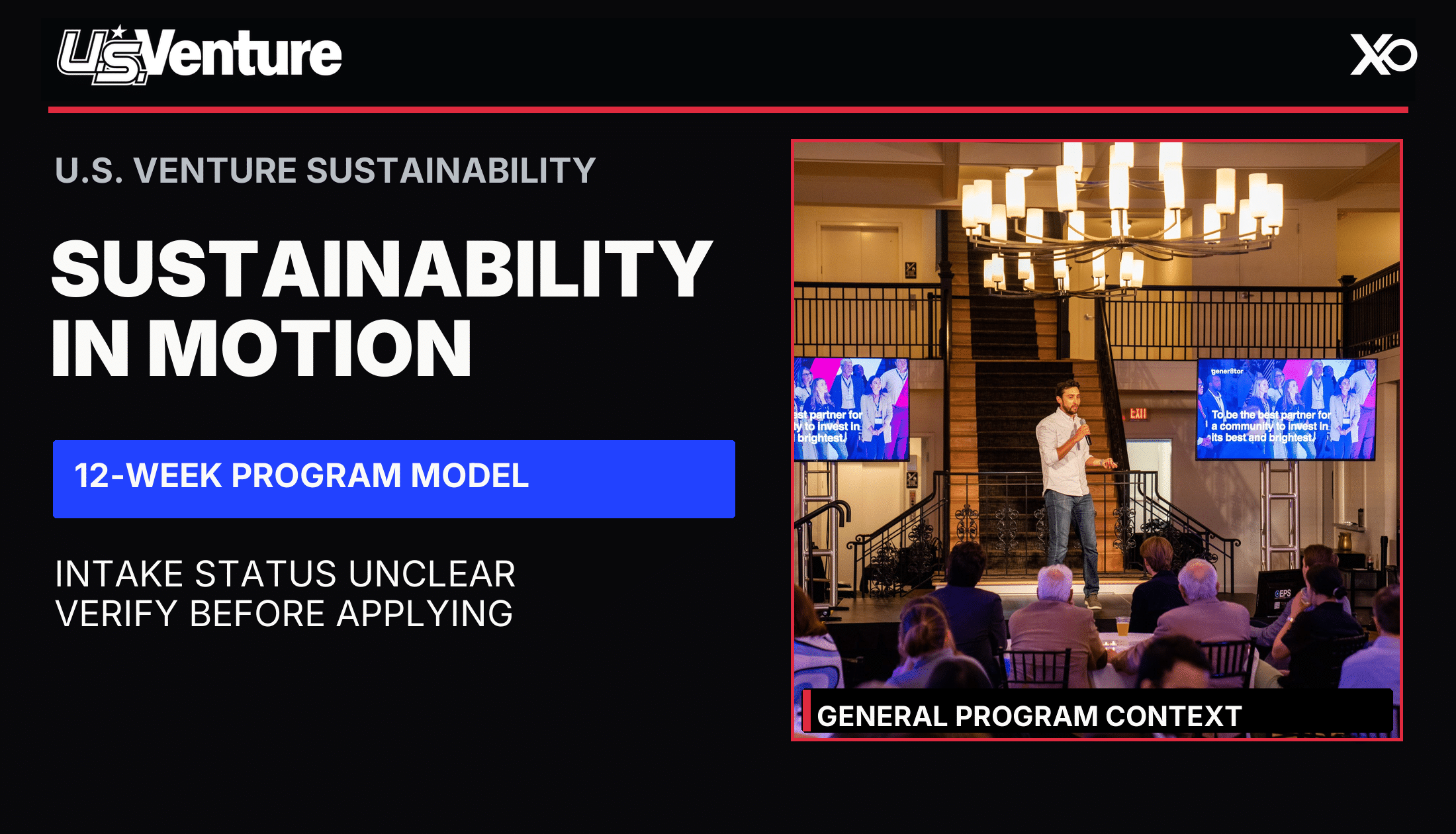
The U.S. Venture Sustainability Accelerator, powered by gener8tor, is a real program with a confirmed 2026 cohort. Its next application window is unclear as of October 10, 2026. The published model offers selected sustainability and mobility startups investment and intensive support in Appleton, Wisconsin, with an in-person commitment.
Treat this as a preparation opportunity, not an open deadline. Founders should first confirm the next intake, geographic eligibility and written investment terms. A live application form alone does not establish that a new cohort is recruiting.
XRAISE ACCELERATORS
Related Posts

Explore Accelerator Opportunities on XRaise
Browse accelerator programs and continue through your XRaise account.
Explore AcceleratorsProgram snapshot
| Decision | Published information | What to check |
|---|---|---|
| Applications | Current intake unclear | Deadline and next cohort |
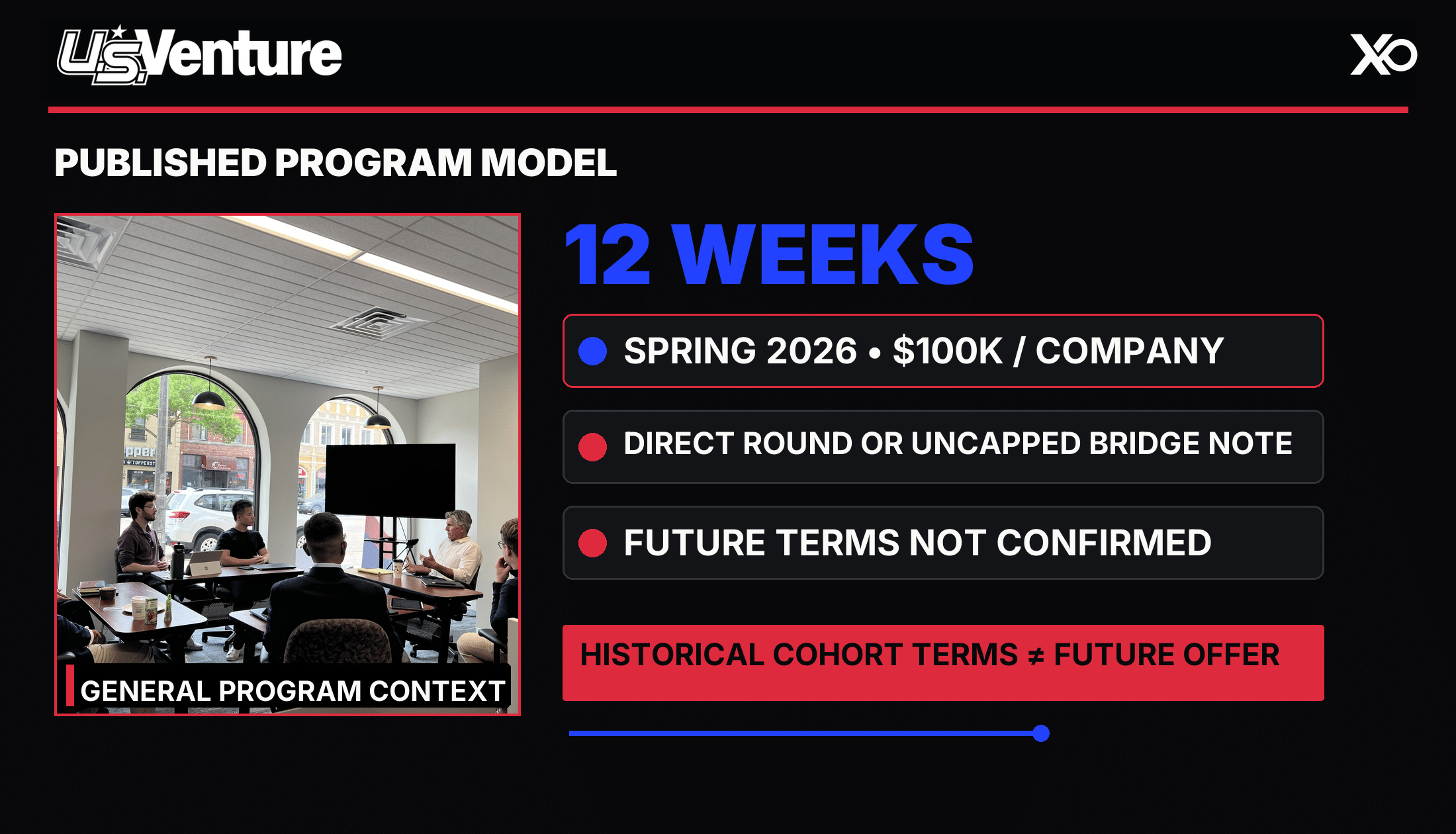
| Investment | $100,000 per selected company | Your financing documents |
| Commitment | 12 weeks in Appleton, Wisconsin | Attendance and relocation logistics |
| Cohort | Five companies in the announced 2026 cohort | Next cohort size |
| Fit | Sustainability or mobility focus | Geographic eligibility |
Is the U.S. Venture Sustainability Accelerator currently open?
Status: UNCLEAR. The official site links to a program-specific form, but its required Programs selector returned no choices during verification. No current application deadline, opening date, next start date or end date could be confirmed. Do not interpret an accessible form as rolling admission.
The official June 2026 cohort announcement identifies five selected companies and calls that cohort Spring 2026. That supports the program’s identity, not a future Spring intake. There is no verified basis here for a Spring 2027 deadline.
Ask the team which cohort is accepting applications before spending time on submission. Use that answer to decide whether preparation belongs in this week’s priorities or a later review; XRaise’s accelerator timing guide provides a broader decision framework.
Who is eligible—and what remains uncertain?
The official program page and FAQs target sustainability or mobility businesses. They emphasize scalability, revenue or a credible adoption path, and founders ready to use growth support.
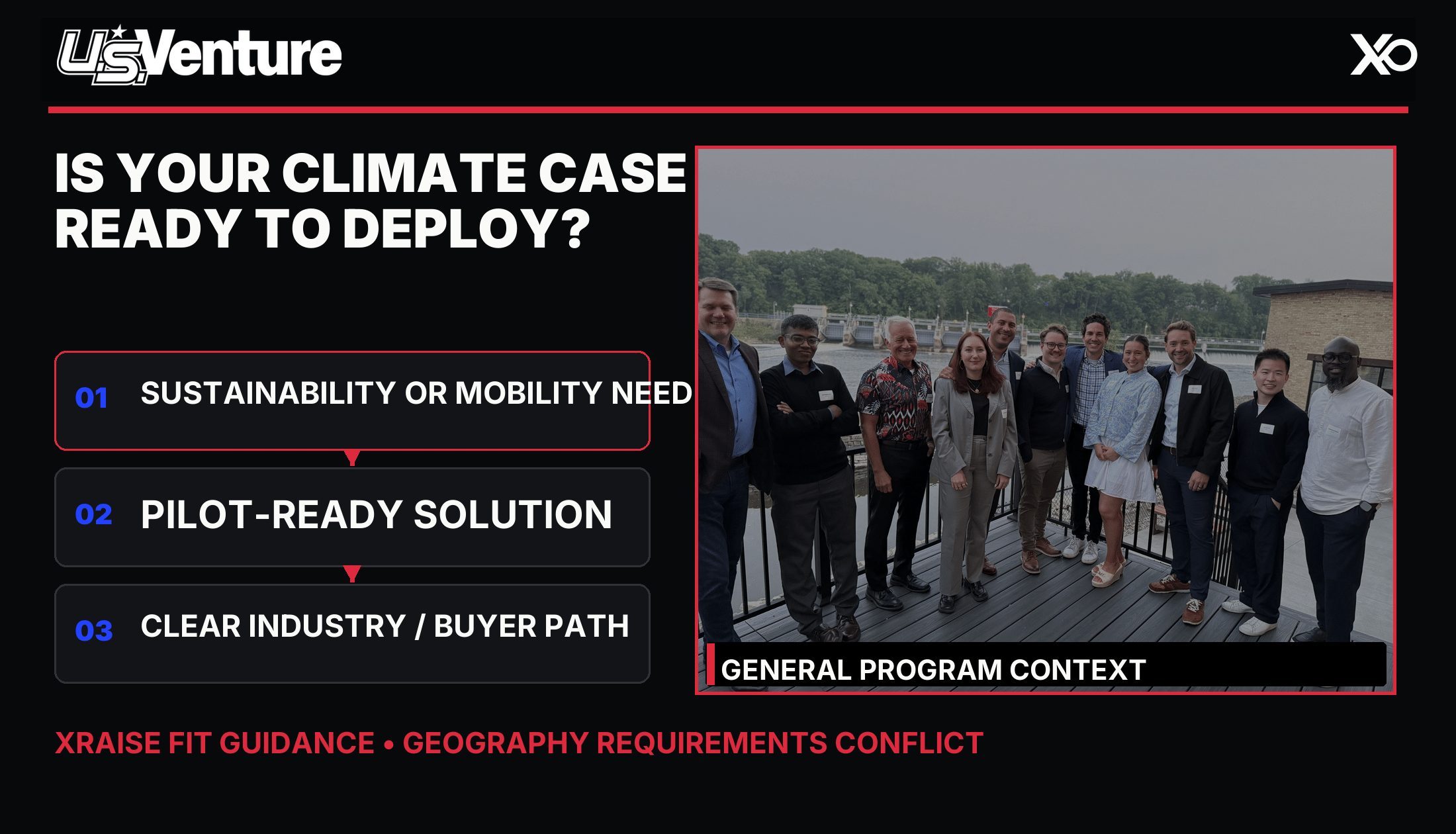
Geographic wording conflicts: the introduction and FAQ specify the United States and Canada, while another section welcomes companies worldwide. International founders should request confirmation rather than assume either automatic eligibility or exclusion. No precise funding-stage cutoff or minimum revenue threshold was verified.
For founder fit, separate a relevant sector from a relevant growth problem. A company selling fleet-efficiency software might benefit from industry introductions; a team still deciding which customer to serve may need customer discovery first. That comparison is XRaise guidance, not an official admissions rule.
What funding and investment terms are published?
The page describes $100,000 invested into a company’s current round when it is fundraising, or an uncapped convertible bridge note when it is not. It does not establish a fixed ownership percentage, a complete note term sheet or a publicly confirmed program fee.
Ask for the instrument, conversion terms and any participation costs in writing before accepting. Do not model this investment as a grant or guaranteed cash available to every applicant.
Keep the program distinct from gener8tor Madison: shared operator branding does not make the two programs’ financing terms interchangeable.
What does participation require?
The published format is twelve weeks in person, with relocation to Appleton required for the program. Additional travel expectations, accommodation support and expense reimbursement were not publicly confirmed.
The practical trade-off is founder capacity. Decide who would attend, who would maintain customer delivery and what progress would justify the disruption. Budget housing and operational coverage provisionally, then replace estimates with confirmed logistics before committing.
Mentorship and industry connections are central benefits. The 2026 announcement describes collaboration opportunities across U.S. Venture’s businesses; it does not promise a pilot contract, procurement deal or follow-on investment.
What should founders prepare before applying?
The official application form asks about the business model, competitors, team, traction, funding, challenges and program goals. It also requests a pitch deck and executive summary as PDFs. Prepare those materials offline while confirming the application route.
Use a small evidence pack:
- Customer problem: identify the buyer, purchasing trigger and cost of the current approach.
- Traction: distinguish paid revenue, signed pilots, unpaid tests and conversations. Show the period behind each number.
- Impact: explain how the product changes resource use, emissions or mobility outcomes, with a baseline and honest limits.
- Program goals: name three concrete outcomes that would help the company progress.
- Team capacity: explain relevant experience and how you would cover the Appleton commitment.
For example, “validate a fleet pilot with two qualified operators” is more actionable than “meet investors.” Avoid presenting hypothetical partnerships as traction. These preparation suggestions are editorial guidance, not a gener8tor scoring rubric.

Startup Perks AI Assistant
Have questions about credits? Let's chat instantly.
What appears to strengthen an application?
The form’s emphasis on traction, challenges and objectives suggests that specific evidence will communicate fit more clearly than broad climate ambition. That is an inference from the questions, not a published selection formula.
Connect your strongest proof to a bottleneck the program might help address. Explain why this industry network matters now, what you have already tested and what you would do with access to relevant operators. Do not merely repeat the program’s marketing language.
A program-specific interview sequence, selection timetable and acceptance rate were not verified. Prepare to discuss assumptions and evidence, but do not build your schedule around an invented interview process.
FAQ
Does the program exist today?
Yes. The official program page and 2026 cohort announcement establish its identity. The next intake remains unconfirmed.
Is it equity-free?
Do not assume that. The published financing involves investment into a round or a convertible note; a fixed equity percentage is not confirmed.
Can founders participate remotely?
The program FAQ specifies in-person participation and relocation. Request direct clarification if your team cannot meet that commitment.
Should I submit an application today?
Confirm the current intake and functioning program selection first. No verified deadline supports an urgency claim.
The founder decision
Prepare if the sector fit, industry access and Appleton commitment align with a concrete business goal. Resolve timing, geography and financing before committing resources. If another program may fit better, compare the BEAM Circular Accelerator guide on its own terms.
Choose the program for the progress it can support—not the existence of an application button.