
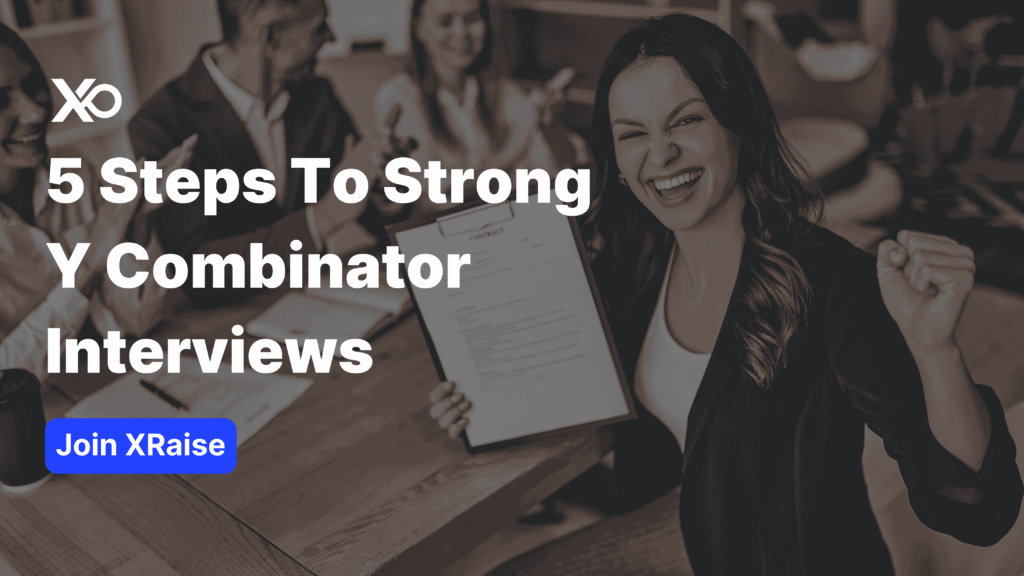
This guide covers the Y Combinator Accelerator Interview, what to expect, what YC partners care about, and how to stand out.
Now the real test is brutally simple: can you explain what you’re building, why it matters, what you’ve proven so far, and why your team will win, fast.
This guide walks you through what the Y Combinator Accelerator interview feels like, what YC partners pressure-test, and how to prepare without over-rehearsing. If you’re still in “application mode,” start by reading applying to YC through XRaise so your materials, story, and follow-ups stay consistent across programs.
Related Posts




Y Combinator Accelerator Interview: What It’s Really Like
The Y Combinator Accelerator interview isn’t a casual chat. It’s a short, intense, high-pressure test of your company’s clarity.
Here’s the format founders consistently experience:
- Format: A rapid-fire virtual video call with 2–3 YC partners.
- Timing: Around 10 minutes (sometimes 12–15, but don’t plan on it).
- Style: Direct, fast, and interruption-heavy. If you get cut off mid-sentence, treat it as normal, not personal.
- Decision process: The people you meet are decision-makers. You’ll typically hear back the same day by email or phone. Offers are standard, not negotiated.
Bottom line: your job is to be clear under pressure. Not charismatic. Not perfect. Clear.
Y Combinator Accelerator Interview Checklist: What They Look For
In a short interview, partners don’t have time for vibes. They’re scanning for fundamentals, especially where weak answers reveal weak execution.
Based on what founders report and what YC pressures in these interviews, the biggest evaluation areas are:
1) Team and execution ability
- Are the founders aligned?
- Do you move fast?
- Do you understand the user pain deeply?
- Does the team dynamic look stable (no weird tension or contradictions)?
2) The problem and why it matters
- Is the problem real and specific?
- Who feels it most?
- What happens if it stays unsolved?
3) The solution and “why now”
- What did you build?
- Why is it compelling?
- Why is now the moment this can work?
4) Market and path to growth
- Is the market meaningfully large (or high-value even if niche)?
- Do you have a credible plan to reach users?
5) Traction and learning (even early)
- What have you shipped?
- What did you learn?
- What changed in your approach because of real-world feedback?
6) Honesty and clarity
- Can you explain your metrics plainly?
- Do you acknowledge risks without spinning?
- Can you answer directly without rambling?
If anything in your story is vague, inconsistent, or overly “pitchy,” partners will push on it.

Startup Perks AI Assistant
Have questions about credits? Let's chat instantly.
YC Interview Questions: Rapid-Fire Drill Sheet
YC Interview Question: Why will you win?
You don’t need more slides. You need tighter answers.
Use this drill sheet to practice what YC tends to ask, and the level of specificity they expect:
Intro / Problem
Typical questions:
- What are you working on?
- Who are your users?
- What problem are you solving?
How to answer:
Give a 20-second one-liner, jargon-free. Make it obvious who hurts if you stop existing tomorrow.
Traction
Typical questions:
- What’s your traction / progress?
- How many users, revenue, growth?
- What have you learned?
How to answer:
Use precise numbers (the way you already wrote them in your application). Avoid “traction is strong.” Say what changed and what you learned.
Market & business model
Typical questions:
- How big is your market?
- Who are competitors?
- How will you make money?
How to answer:
Be ready to describe your market sizing clearly, and name competitors without getting defensive.
Team & alignment
Typical questions:
- Who are the founders?
- How did you meet?
- Who does what? Equity split?
How to answer:
Be transparent and aligned. Don’t tell long stories. Show the partnership works.
Defensibility
Typical questions:
- Why will you win vs. competitor X?
- What if Google builds this?
How to answer:
Don’t pretend you’re invincible. Explain why you’re positioned to move faster and learn faster, and what makes your approach hard to copy.
Surprises / curveballs
Typical questions:
- Biggest learning so far?
- Hardest challenge?
- A failed experiment?
How to answer:
Show self-awareness. YC tends to respect founders who learn quickly and adapt without ego.
Pro tip: time your answers with a stopwatch. If you can’t answer most questions in 2–3 sentences, you’re not interview-ready yet.
Train Like You Play: Prepping Like a YC Insider
YC Interview Prep: Do mock interviews with interruptions
Treat the YC interview like a speed test for clarity: short answers, real numbers, zero fluff. Teams that do well don’t “memorize answers.” They build a system that keeps answers consistent, short, and real.
1) Know your application cold
Partners will reference your written application. Be ready for follow-ups on anything you wrote, especially metrics and claims.
2) Do real mock interviews (not friendly practice)
Don’t practice with someone who lets you ramble. Practice with interruptions. Practice being challenged. Record sessions and review for clarity.
3) Assign roles and handoffs
Decide who answers what: tech, product, market, traction. Practice seamless handoffs so you don’t interrupt each other.
4) Align on metrics and story
Conflicting answers on user, market, progress, or challenges kills trust immediately. Align on:
- what your product does
- what users get
- what you’ve proven
- what you’re doing next
5) “I don’t know” is okay, if followed by a plan
If you don’t know something, say so calmly and explain how you’ll find out. Bluffing is usually obvious.
6) Tech-check your setup
It’s a virtual interview. Don’t lose because your audio glitches, lighting is bad, or Wi-Fi drops.
If you want broader context on how programs evaluate readiness (not just YC), browse the Startup Programs & Accelerators hub, it helps you benchmark expectations across top accelerators.
YC Interview Do’s & Don’ts: Founder Checklist
YC interview evaluation: honesty and clarity
Great answers can still fail if your delivery creates doubt. Use this checklist to keep your interview clean.
Do
- Be concise (2–3 sentences per answer)
- Answer the actual question asked
- Know your numbers clearly
- Share insights honestly (including mistakes)
- Let the right person answer (pre-assigned)
- If interrupted, stop and listen
- Stay calm under intensity
- Show real founder energy without sounding scripted
Don’t
- Ramble or monologue
- “Spin” weaknesses into nonsense
- Guess metrics you should know
- Argue with partners or get defensive
- Talk over your co-founder
Also: avoid “over-rehearsed” delivery. Prepared is good. Robotic is not. In the Y Combinator Accelerator Interview, delivery matters as much as content, concise, calm, and aligned.
After the YC Interview: Decisions and Next Steps
After the YC interview: acceptance and next steps
YC usually notifies you the same day by phone or email.
If accepted, onboarding moves fast. If rejected, treat it as information, not a verdict. Many strong companies weren’t accepted on their first try.
If you get feedback, it’s valuable, but don’t rely on it. Your best response is progress:
- build
- ship
- learn
- improve metrics
- re-apply after meaningful change
If fundraising is part of your post-interview plan, it also helps to run a tighter investor process. Tools like DocSend for startups can help you understand how investors engage with your deck, so you can iterate faster.
FAQ: Y Combinator Accelerator Interview
YC interview: biggest mistakes founders make
How long is the YC interview?
Founders commonly report about 10 minutes, sometimes slightly longer.
Who’s in the interview?
Typically 2–3 YC partners on a video call.
What’s the most common reason teams underperform?
Not knowing their numbers, rambling answers, or cofounders giving inconsistent stories.
Is it bad if partners interrupt me?
No, interruptions are common in this format. Treat it as normal pacing, not hostility.
If I get rejected, should I re-apply?
If you’ve made meaningful progress (product, traction, learning, clarity), yes, re-applying can make sense.
Final Thoughts: Clarity, Honesty, and Relentless Focus Win
The Y Combinator Accelerator interview rewards founders who can think clearly under pressure. If you can explain your startup clearly in the Y Combinator Accelerator Interview, you’re already ahead of most teams.
You don’t need hype. You need:
- a simple explanation of what you’re building
- precise numbers you can defend
- evidence you’re learning fast
- a team that looks aligned and resilient
When you can answer “What are you working on?” in one breath, and back it up with real progress, you’ll be in the best possible position.
Claim your Y Combinator application pathway on XRaise today: Apply through XRaise
If you need the vendor’s official details, you can always check the official Y Combinator page.
If you’re still deciding timing and readiness, skim when you should apply to an accelerator to pressure-test whether this batch is the right moment.