
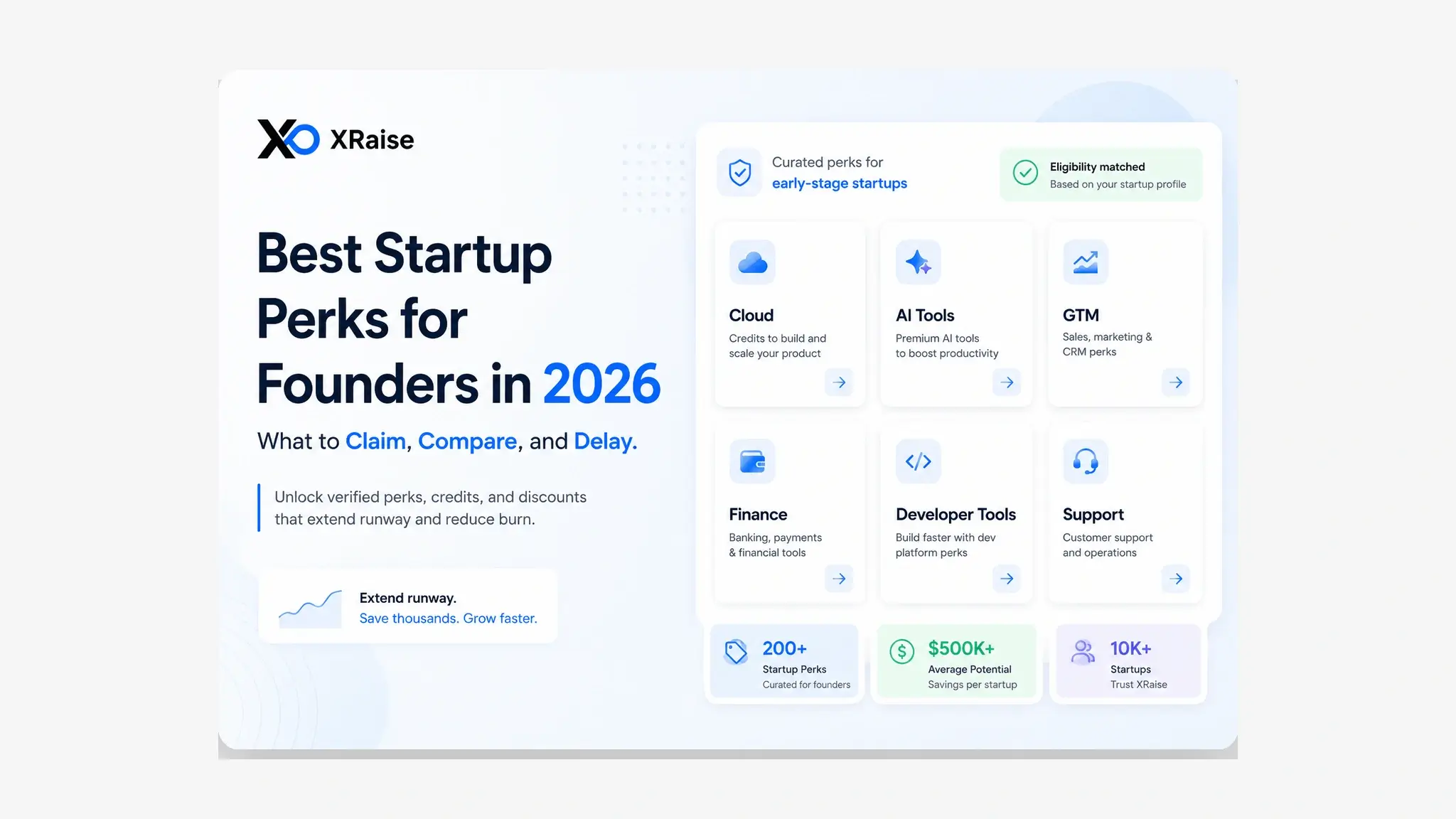
Startup perks should reduce the cost of tools, credits, and programs founders already need. They should not become an excuse to add another dashboard, another renewal date, another admin owner, or another half-used SaaS product that quietly drains attention. The best startup perks for founders make an existing operating decision cheaper; the wrong ones make premature complexity feel responsible.
For founders comparing options now, startup perks for founders gives the team a clearer place to review relevant offers before paying full price or building around a vendor too early. For broader founder operating-system thinking, the XRaise blog is the natural next reading path.
The useful question is not “Which offer is biggest?” It is “Which perk reduces a real bottleneck without creating stack complexity we are not ready to own?” That is the whole decision.
Related Posts




TL;DR
Startup perks are useful when they lower the cost of tools or programs the company already needs. Cloud credits, AI tool offers, collaboration discounts, developer credits, finance programs, GTM discounts, and support tools can all help, but only when they match the stage of the company.
The best startup perks are not always the largest offers. They are the offers with a clear owner, a near-term use case, a sane renewal path, and low switching risk.

Startup Perks AI Assistant
Have questions about credits? Let's chat instantly.
Founders should claim perks that protect runway and delay perks that mainly create setup work, permission sprawl, data cleanup, or a tool nobody will maintain after the first week.
Why startup perks matter more than founders think
Startup perks look tactical at first. A founder claims a cloud credit. A teammate starts a discounted Notion workspace. Sales gets a CRM trial. Marketing grabs an ad credit. Someone adds an AI note-taker because the first month is cheap.
None of that feels like company architecture in the moment. It feels like being resourceful. Then the stack hardens.
The cloud provider becomes harder to leave. The CRM becomes the source of truth even though nobody fully trusts the stages. The workspace fills with stale docs. The AI tool speeds up drafts but creates founder review debt. The finance tool is helpful until renewal dates and card ownership start spreading across the company.
This is why startup discounts are not just savings. They shape how a team builds, sells, supports, reports, and remembers work.
A founder usually notices the cost later, when the invoice is lower but the company has more places to check. The CRM says one thing, the support queue says another, the docs are outdated, the dashboard is almost right, and the founder still has to carry the real context in their head.
That is not leverage. That is discounted operating drag.
The founder rule: choose perks by bottleneck, not offer size
The right startup perk starts with a bottleneck.
If hosting cost is about to rise, cloud credits may matter. If founder-led sales follow-up is slipping, a CRM or sales tool discount may help. If customer feedback is getting lost across calls, a support or feedback tool might be worth reviewing. If documentation is scattered, a workspace or collaboration offer can reduce operational drag.
If there is no bottleneck, the offer is probably noise.
This rule protects founders from a common trap: using discount size as a proxy for importance. A large credit can still be wrong if it pulls the team into infrastructure too early. A small collaboration discount can be valuable if it keeps decisions findable during launch week. A CRM offer can be useful after sales activity becomes real, but distracting if the founder has not defined ICP, stages, or follow-up rhythm.
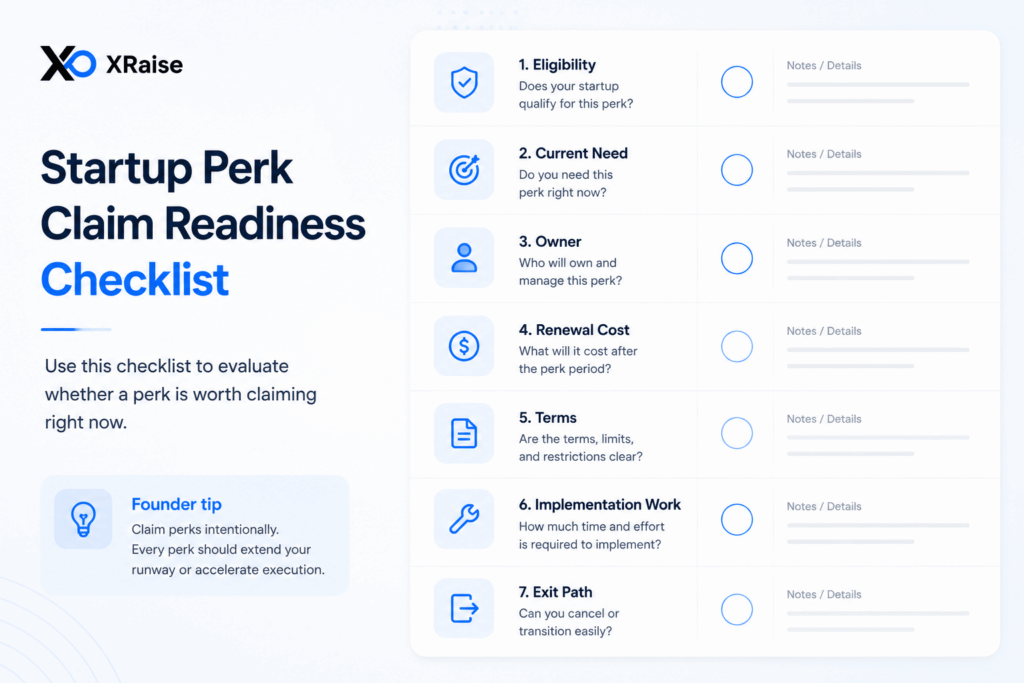
The practical questions are simple:
- Would we use this tool without the discount?
- Does it remove a current operating bottleneck?
- Who owns setup, hygiene, renewal, permissions, and exit?
- What happens when the free period or discount ends?
- Does this perk reduce founder attention cost or create more of it?
Good startup perks make an existing workflow cheaper or clearer. Bad timing turns a discount into another system.
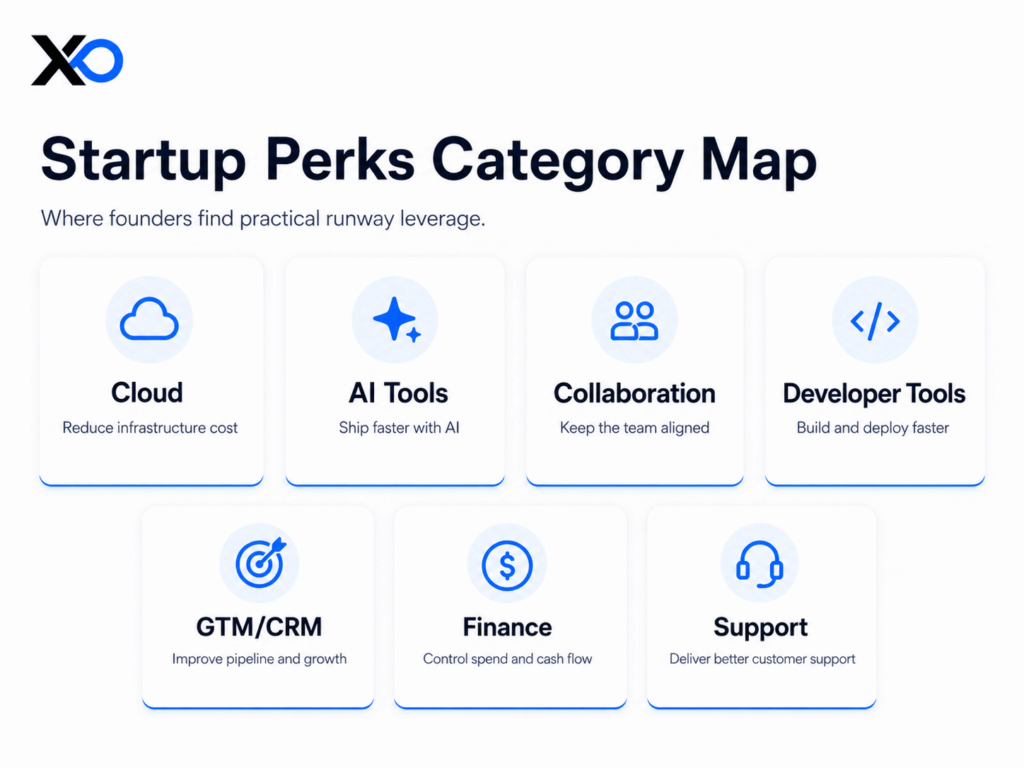
Startup perks founders should review early
Founders do not need every category at once. They need the categories that protect shipping, learning, cash visibility, customer trust, and follow-up.
| Perk Category | Review Early When | Delay When | Founder Guidance |
|---|---|---|---|
| Cloud and infrastructure credits | Product usage or hosting spend is becoming real | The prototype still changes weekly | Use credits to reduce cost, not to pick architecture too early |
| AI tools | Drafting, coding, research, support, or sales notes repeat weekly | Nobody can review output before it affects customers | Keep human approval visible |
| Documentation and collaboration | Decisions disappear across chat, calls, and docs | The team is documenting to avoid deciding | Assign hygiene ownership |
| Developer tools | Shipping, errors, reviews, or deployment habits need support | Alerts and workflows have no owner | Prefer simple habits the team will use |
| GTM and CRM | Leads are real and follow-up is slipping | ICP, stages, and qualification are still guesses | Match tooling to the sales motion |
| Finance and operations | Recurring spend, invoices, contractors, or cards appear | There is not enough activity to review | Make renewals and owners visible |
| Support and feedback | Customer issues repeat and need memory | Volume is still tiny and direct founder contact works | Automate routing before judgment |
This is where founders save real time: not by claiming every offer, but by matching the perk to the next operating constraint.
Cloud and infrastructure credits
Cloud credits can be one of the highest-value startup perks, especially when product usage is real or infrastructure spend is about to climb. They can help with compute, storage, databases, deployment, logging, and experimentation.
The risk is architecture pressure. A founder may activate a credit because the offer is generous, then discover the team is now building around provider-specific services before it understands future switching cost. For a broader category view, the XRaise guide to cloud credits for startups is the natural next read.
Before building around provider credits, verify current program terms directly with AWS Activate Credits, Google for Startups Cloud Program, and Microsoft for Startups. Those pages should be treated as the source of truth for eligibility, redemption, and credit terms.
AI tools
AI credits and startup discounts can help with writing, coding, research, support summaries, sales notes, and internal automation. They are useful when the workflow already repeats and a human review point is obvious.
They become expensive when output volume rises faster than review quality. A founder may save time drafting content, then spend the same time fixing voice, facts, customer promises, or code assumptions. The cost is not just subscription price. It is trust in the workflow.
A good AI perk has a narrow job: draft the support summary, suggest the CRM note, prepare the research brief, or speed up coding review. A weak AI perk becomes a second brain nobody audits.
Documentation and collaboration
Workspace perks can help early teams keep decisions out of memory. Notion, Google Workspace, Slack, Loom, and related tools can reduce confusion when product specs, meeting notes, sales context, and onboarding docs start spreading.
The moment to use them is when information is genuinely being lost. The moment to delay is when documentation becomes theater. A messy workspace with nobody responsible for hygiene becomes another place to search. Founders evaluating this category can use the XRaise guide to Notion for Startups as a specific example.
Developer tools
Developer perks can support code review, deployment, observability, testing, security, and error monitoring. These are useful when shipping is real enough that the team needs repeatable habits.
The hidden cost is alert ownership. A tool that creates warnings nobody reviews is not operational leverage. It is background noise with a login screen.
This is where founders should be honest about operating maturity. A lightweight developer workflow the team checks daily can beat a sophisticated tool that only one person understands.
GTM and CRM
GTM and CRM discounts can help when founder-led sales starts producing real leads. CRM, forms, outbound tools, ad credits, landing page tools, and enrichment products can protect follow-up discipline.
But sales tooling is unforgiving when the process is immature. A founder can spend Friday cleaning duplicate CRM fields before an investor update because “qualified” meant three different things to three people. Marketing credits have a similar risk: the budget may be discounted, but weak positioning still creates weak learning.
The XRaise article on Google Ads promo code startups is useful when founders are deciding whether paid acquisition is ready for budget at all.
Finance and operations
Finance perks can help with banking, cards, bookkeeping, payroll, spend management, and accounting. These matter once recurring spend, invoices, subscriptions, contractors, or payroll enter the business.
The first version does not need to be elaborate. It needs to make cash, renewals, owners, and recurring charges visible before SaaS spend spreads.
A founder does not need a heavy finance stack before there is real movement. But once renewals, contractors, cards, invoices, and tax obligations appear, finance tooling becomes memory infrastructure.
Support and feedback
Support and feedback perks become useful when customers need consistent response and the team needs memory. Help desks, feedback boards, event tools, and routing systems can help founders see patterns instead of relying on scattered conversations.
Use them when support issues repeat. Delay them when volume is still small enough for direct founder contact. A specific example is the XRaise guide to Ticket Tailor discount for startups, which is relevant when events, community, or customer sessions become part of the GTM motion.
Startup perks founders should skip or delay
Skip perks that mainly make the company look mature.
Enterprise CRM can wait until sales complexity is real. Advanced analytics can wait until events are named consistently. Heavy lifecycle marketing can wait until acquisition channels are repeatable. Complex automation can wait until the process is stable enough to inspect. Multi-cloud architecture can wait until the team has a real reason to carry that complexity.
The hidden cost usually appears after setup. Someone has to own seats, permissions, naming conventions, renewal reminders, templates, data quality, integration rules, billing contacts, and offboarding. If nobody owns those details, the startup discount is not free.
The first week feels productive. The second month is where the truth shows up.
That is when a dashboard goes stale, a renewal hits the wrong card, an automation sends the wrong follow-up, or nobody remembers who approved a tool in the first place.
The hardest perks to delay are the ones that sound strategic: the larger cloud credit, the mature CRM, the advanced AI workflow, the analytics suite with beautiful dashboards. They promise the future version of the company. The founder still has to operate the current one.
Best startup perks by founder stage
Stage matters because a perk can be right later and wrong now. Founders rarely regret starting with a lighter tool. They regret letting discounted tools become the operating system before the workflow is ready.
| Founder Stage | Perks To Review Early | Perks To Delay | Founder Guidance |
|---|---|---|---|
| Idea or pre-product | Workspace, prototype tools, simple hosting, founder learning resources | Enterprise CRM, complex analytics, heavy automation | Keep the stack easy to change weekly |
| MVP build | Cloud credits, developer tools, collaboration, basic AI assistance | Multi-cloud setups, advanced observability, complex GTM tooling | Reduce build cost without locking architecture too early |
| First customers | CRM, support, feedback, analytics, bookkeeping | Broad BI, heavy RevOps, mature lifecycle marketing | Protect customer learning and follow-up discipline |
| Founder-led sales | CRM, outbound support, call notes, forms, enrichment, content workflows | Fully automated sales sequences without review | Keep customer promises visible and owned |
| Early revenue | Finance, support, observability, documentation, renewal tracking | Tools that need dedicated operators before the team has them | Watch renewal sprawl, permission creep, and duplicate workflows |
The category matters less than the burden it creates. A useful perk reduces cost and preserves flexibility. A premature perk gives the team something else to maintain.
Startup perks vs startup grants vs cloud credits
Founders often group perks, grants, and credits together. They can all support runway, but they are different tools.
| Option | What It Usually Means | Best Fit | What To Watch |
|---|---|---|---|
| Startup perks | Discounts, credits, trials, or partner offers for tools and services | Reducing cost on software or programs the team already needs | Renewal cost, eligibility, and SaaS sprawl |
| Startup grants | Non-dilutive funding or program support, often with an application process | Research, impact, sector-specific, or ecosystem-backed companies | Eligibility rules, reporting requirements, timing |
| Cloud credits | Provider-specific infrastructure credits | Teams with real cloud usage or upcoming product scale | Migration risk, usage limits, expiration, architecture lock-in |
Use startup perks for near-term operating cost. Use grants for funding opportunities that fit the company. Use cloud credits when infrastructure spend is real enough to justify the provider decision.
For infrastructure-heavy teams, provider choice deserves extra care. A credit can make a platform cheaper this quarter, but the architecture may last much longer than the discount. Founders comparing provider tradeoffs can read the XRaise guide to AWS vs Azure for startups before treating credit value as the whole decision..
How startup credits and perks change the runway decision
Startup credits and perks change the runway decision by lowering the upfront cost of a tool, platform, or service. They do not remove the operating cost around it.
That distinction matters.
A discounted CRM still needs clean stages. A cloud credit still needs billing alerts and architecture review. An AI credit still needs human approval before customer-facing use. A collaboration perk still needs documentation hygiene. A finance offer still needs reconciliation and ownership.
The better way to think about runway is not “How much does this save?” but “Which decision does this make cheaper, and would we still make that decision without the discount?”
A startup perk can extend runway when it reduces spend the company already planned to take on. It can shorten practical runway when it creates a tool migration, another source of truth, a renewal surprise, or a workflow the founder has to babysit.
The best way to use startup discounts is to ask:
- Would we use this without the discount?
- Does it remove a current bottleneck or protect a near-term workflow?
- Who owns the tool after setup?
- What happens when the credit, trial, or discount ends?
- How hard is it to leave later?
- What cleanup work will this create if the team stops using it?
What to claim now vs what to delay
Use-now decisions should feel boringly obvious. Delay decisions should feel like protecting attention, not missing out.
| Claim Now | Delay |
|---|---|
| Cloud credits when product usage or infrastructure spend is real | Provider credits that force architecture choices too early |
| Collaboration tools when decisions are getting lost | Complex workspaces nobody will keep clean |
| CRM or sales tools when leads are slipping | Enterprise CRM before ICP, stages, and follow-up rhythm exist |
| Finance tools when recurring spend or invoices appear | Heavy finance workflows before there is real activity |
| Support tools when customer issues repeat | Support systems that hide urgent issues behind routing rules |
| AI credits for repeatable internal workflows with review | AI agents that touch customers without approval checkpoints |
This is where the article stops being about discounts and becomes about operating taste. A founder who delays the wrong perk may pay a little more later. A founder who claims the wrong perk too early may spend months cleaning up workflows the company never needed.
How to build a lean startup perks strategy
Build the strategy in layers.
First, list current bottlenecks: shipping, sales follow-up, support memory, cash visibility, customer learning, content production, infrastructure cost, or team coordination.
Second, map each bottleneck to one category of perk. Do not start with vendor logos. Start with the workflow.
Third, check ownership. If nobody can own the fields, renewal, permissions, review path, or exit plan, the perk should wait.
Fourth, review official terms before publishing, budgeting, or building around the offer. Startup programs change. Credit amounts, eligibility rules, expiration windows, and partner requirements may shift.
Fifth, compare the perk to the broader tool decision. Founders building the wider stack can pair this article with the XRaise startup tools guide to separate tool decisions from perk decisions.
Finally, remove what is not used. A lean startup perks strategy is not a collection. It is a set of cost reductions attached to real work.
The review cadence can be simple: once a month, check active perks, renewal dates, owners, seats, duplicate tools, and whether each offer still maps to a current bottleneck.
Common mistakes founders make with startup discounts
The first mistake is claiming perks because they feel scarce. Scarcity can be useful, but only after fit is clear.
The second mistake is building around a perk before reading the terms. Founders should verify eligibility, activation steps, credit expiration, support level, usage limits, country availability, and renewal pricing before committing the workflow.
The third mistake is letting every function claim its own tools. That feels fast until marketing, sales, support, and product all create separate systems for the same customer context.
The fourth mistake is ignoring the cost of almost working systems. A CRM that almost reflects reality, a dashboard nobody fully trusts, a workspace nobody cleans, or an automation that needs constant exceptions can exhaust a team more than an obviously broken tool.
The fifth mistake is sounding like a coupon hunter. A founder does not need to chase every offer. The company needs a smaller number of startup discounts that reduce real spend and support the operating system it is already building.
A quieter mistake is never closing the loop. Teams claim a perk, onboard the tool, use it for a month, and then never review whether it still deserves a place in the stack. That is how a discount turns into SaaS sprawl.
Practical startup perks stack: a simple starting point
For many early teams, a practical starting point looks like this:
- Cloud or hosting credits only when product usage is real enough to plan around.
- Documentation and collaboration discounts when decisions start disappearing across chat, calls, and docs.
- Developer tool offers when shipping cadence, errors, reviews, or deployment habits need support.
- CRM or GTM perks when founder-led sales has real leads and follow-up risk.
- Finance and spend tools when recurring subscriptions, invoices, contractors, or cards appear.
- Support and feedback tools when customer issues repeat and need memory.
- AI credits where drafting, research, support, coding, or internal automation already repeats and can be reviewed.
This is not a universal prescription. It is a starting shape.
The stronger habit is a monthly perk review: what is active, what is unused, what renews soon, who owns it, what changed since setup, and what should be removed before it becomes operational clutter.
What to read next
Pillar pages should help founders choose the next useful page, not trap them in another long article.
If you are comparing marketplaces, start with the XRaise guide to startup perks platforms. If infrastructure spend is the issue, use the cloud credits and provider-comparison guides linked above. If your team is building the broader operating stack, pair this with the startup tools guide linked earlier.
Specific perk examples can also help founders see the difference between a useful offer and a distracting one. Notion, Google Ads, Ticket Tailor, cloud programs, AI tools, and GTM offers all have different operating costs after the claim.
How XRaise helps founders review and claim startup perks
XRaise should be treated as a startup runway advisor, opportunity discovery layer, and review layer. The point is not to browse discounts for entertainment. The point is to review relevant opportunities, compare fit, and avoid paying full price for tools the company already plans to use.
That distinction matters.
A coupon marketplace asks, “What can you claim?” A founder review layer asks, “What should you claim, why now, and what will it cost to operate?”
Before you claim another startup perk.
The practical rule is simple: use it now when the owner, review path, and next action are obvious. Delay when the hidden cost, migration work, human approval, or approval checkpoint is still fuzzy. A 90-day framework keeps the team honest without turning the decision into another planning ritual.
The same discipline applies across startup operations: founder-led sales, GTM systems, RevOps, onboarding workflow, automation workflows, startup infrastructure, and the broader SaaS stack. The point is not to collect more software. It is to protect startup runway, reduce SaaS spend that does not map to real work, and create operational leverage the team can actually maintain.
Key Takeaways
- Startup perks are most valuable when they reduce the cost of tools or programs founders already plan to use.
- The best startup perks usually map to cloud, AI, collaboration, finance, developer, GTM, and support needs.
- Founders should verify eligibility, terms, renewal cost, implementation work, owner, and exit path before claiming an offer.
- XRaise helps founders review relevant startup opportunities without turning the decision into a generic coupon hunt.
FAQ
What are startup perks?
Startup perks are founder-focused offers, credits, discounts, tools, and programs that help early companies reduce costs on software, cloud infrastructure, AI tools, finance products, GTM systems, and other operating needs.
What are the best startup perks for founders?
The best startup perks for founders usually include cloud credits, AI tool credits, collaboration software discounts, developer tool offers, finance and spend-management programs, CRM or GTM discounts, support or feedback tools, and founder operations offers that reduce costs the startup already planned to take on.
How should founders choose startup discounts?
Founders should choose startup discounts by checking whether the offer solves a current bottleneck, whether the team qualifies, who owns the tool after setup, and whether the cost still makes sense after the perk ends.
Should founders claim every startup perk they qualify for?
No. Claiming every available perk can create SaaS sprawl, renewal surprises, onboarding confusion, and workflows nobody owns. Founders should prioritize perks tied to current operating needs.
How does XRaise help founders find startup perks?
XRaise helps founders review relevant startup opportunities, compare fit, and find startup perks they can actually claim without turning the decision into a generic coupon search.