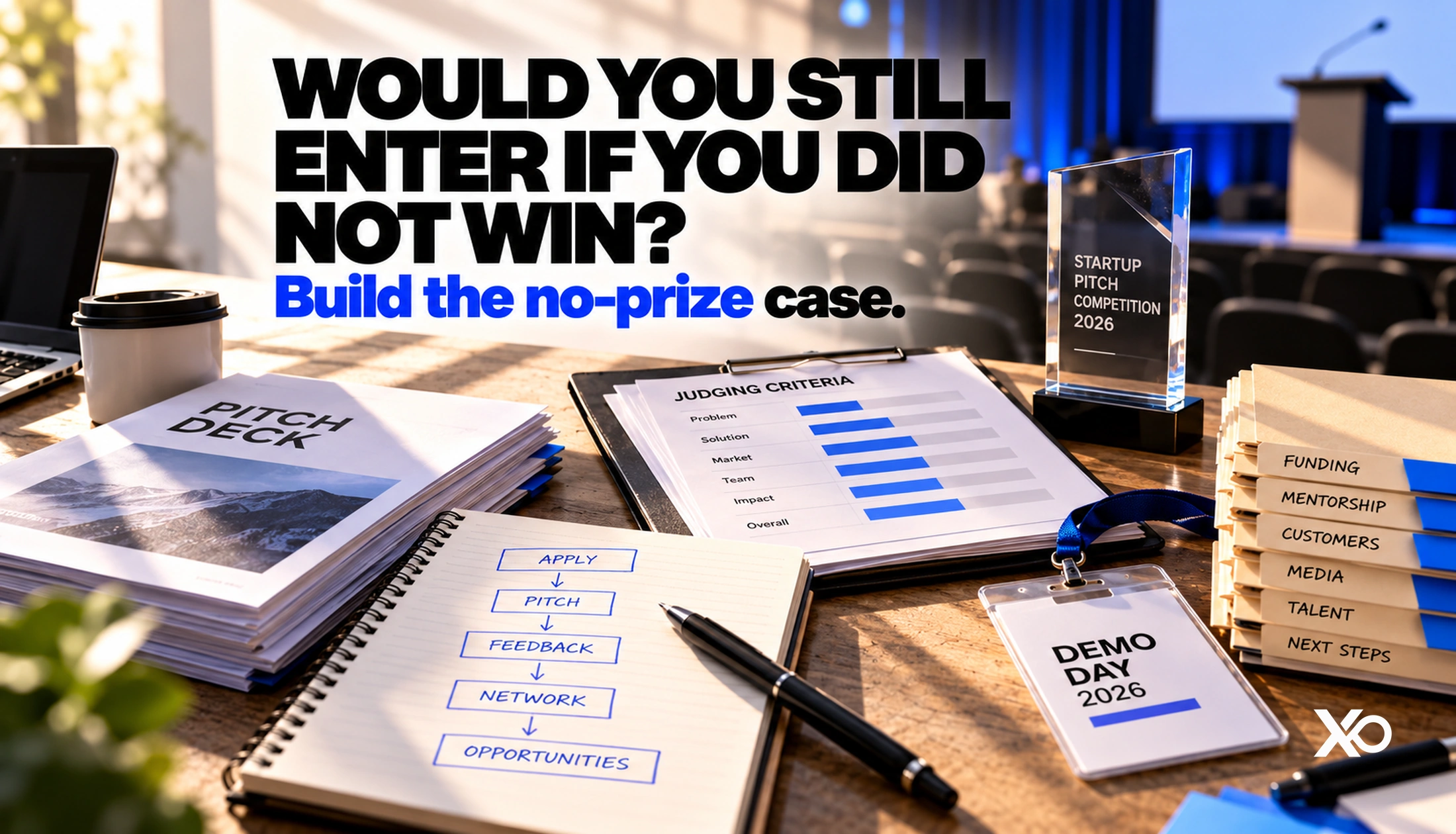
Choose startup pitch competitions in 2026 by checking eligibility, the value you can obtain without winning, the evidence your team can present, and the work required afterward. Enter when those four conditions support a current company milestone. Prepare when a specific evidence gap is fixable. Pass when the event consumes resources without a credible route to customers, useful feedback, or appropriate capital.
A stage invitation can look like progress while a product milestone slips. The opposite can also be true: one carefully chosen competition can put a working product in front of exactly the people a founder needs. The decision is about the opportunity you can use, not the size of the winner’s photograph.
Status checked October 17, 2026. This guide distinguishes completed 2026 competitions, remaining regional routes, and applications submitted in 2026 for a 2027 event. An upcoming conference is not proof that its pitch competition is still accepting entries. Program facts below are linked to organizers; the Competition Commitment Test and operating recommendations are XRaise editorial guidance.

TL;DR
- Check the exact competition edition, entry route, eligibility rules, and deadline before preparing an application.
- Separate cash awards, conditional investment, services, and visibility; they are not interchangeable benefits.
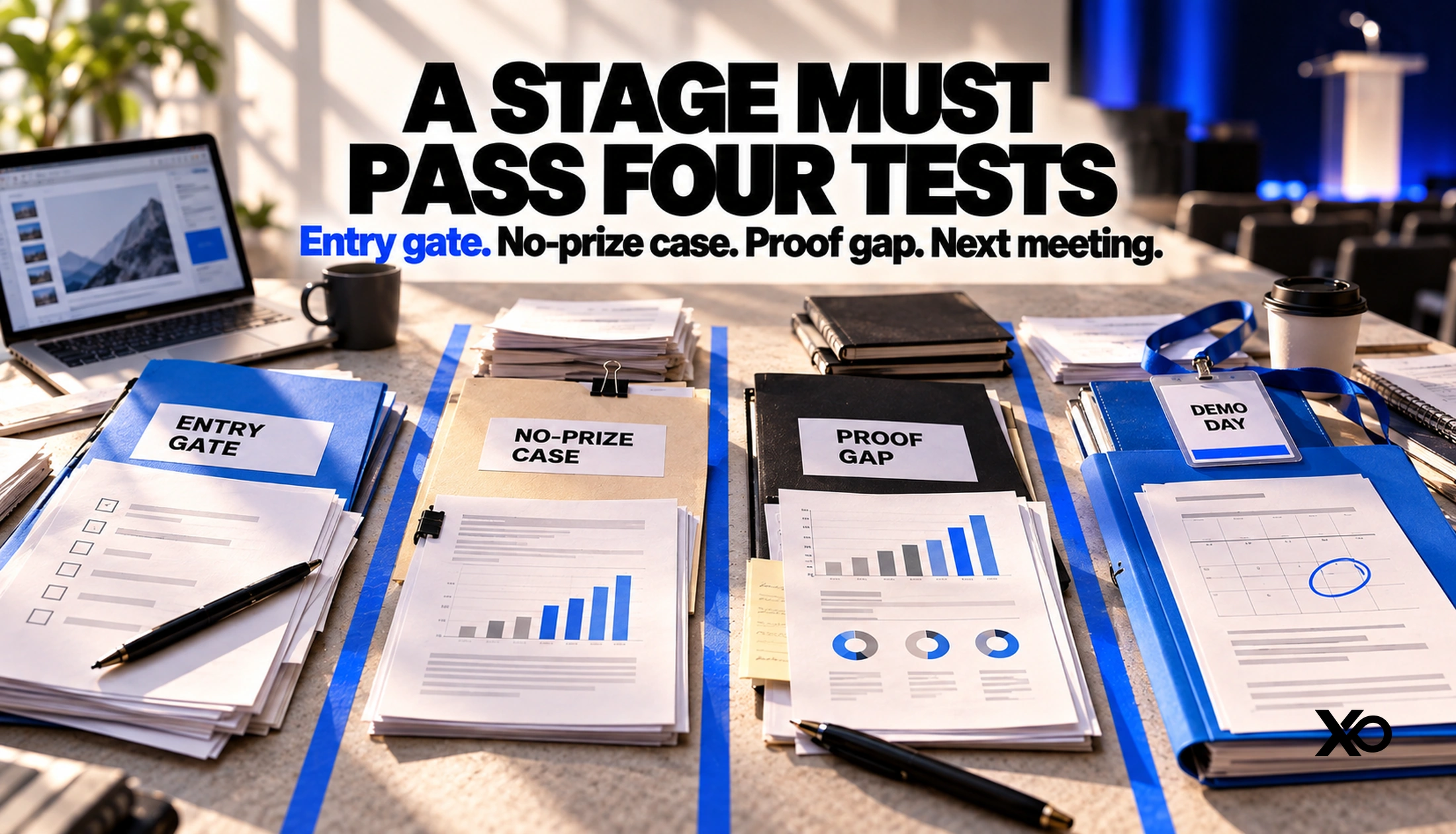
- Use the Competition Commitment Test: entry gate, no-prize case, proof gap, and next meeting.
- Include preparation, travel, delivery disruption, and follow-up in the participation budget.
- Enter for a specific company milestone, prepare for a defined readiness gap, or pass when the fit is weak.
- Keep closed editions in a monitoring list, not an “open now” application list.
Why a competition needs its own decision process
Pitch competitions combine selection, performance, and opportunity access. A startup can be suitable for the audience but ineligible for the competition. It can qualify for the competition but lack a useful reason to attend. It can present brilliantly and still have no realistic process for converting attention into a customer conversation.
Those are separate problems. A better deck cannot fix an ownership restriction. More rehearsal cannot make an investment prize suitable for a team that does not want that financing structure. A prestigious venue cannot compensate for a founder who has no time to follow up.
For startup pitch competitions 2026, the timing problem is especially visible late in the year. Search results may mix completed editions with next-year calls and pages whose application buttons outlast their deadlines. Build an evidence-backed shortlist rather than treating a directory as a live application system.
This is a competition-selection hub, not a substitute for program-specific application rules. XRaise’s accelerator application checklist supports the broader preparation work; this guide focuses on a bounded pitch event and the decision to spend scarce founder attention on it.
Use the Competition Commitment Test
The Competition Commitment Test is an XRaise editorial method with four questions. It does not predict selection or assign a probability of winning. It creates a reasoned Enter, Prepare, or Pass decision before the team commits.
Entry gate: can we compete under the actual rules? Verify the edition, geography, incorporation status, sector, student requirements, funding history, product stage, and attendance obligations. A hard exclusion ends the current application decision. An unclear condition needs organizer confirmation; it is not an automatic yes.
No-prize case: would participation still support our milestone if we lost? Name the useful audience, feedback, introductions, or learning that could remain. Explain how you would access it. A generic promise of exposure is not a plan, and a meeting request is not a guaranteed meeting.
Proof gap: can we demonstrate the claims that this event will evaluate? Match each central claim to a demo, customer observation, operating metric, or other appropriate evidence. Identify what is missing and whether the gap can be closed before submission without distorting the company’s priorities.
Next meeting: who will turn interest into a concrete next action? Decide what you will ask an investor, customer, or partner to do after the event. Assign an owner, prepare the relevant material, and leave capacity for follow-up. Without that capacity, the no-prize case may disappear.
Enter when all four questions have credible answers. Prepare when eligibility is plausible and a bounded gap can be resolved. Pass when a hard restriction, unacceptable term, or weak milestone connection remains. Do not average a failed eligibility gate into a flattering overall score.
Compare the opportunity types before the prize sizes
A cash-prize competition can support a prototype or operating milestone, but an award may still have conditions. Read payment timing, permitted uses, reporting, and attendance requirements rather than interpreting “cash” as unrestricted money arriving immediately.
An investment competition is also a financing decision. The headline amount does not describe ownership, valuation mechanics, diligence, or the final agreement. Assess whether the potential investor and process fit the company before treating the event as a funding shortcut.
A showcase competition may primarily offer a stage, introductions, or recognition. It can be useful when the right audience is reachable and the company has a clear next step. Do not create an assumed cash prize because another competition offers one.
Student startup competitions can provide a structured setting for developing a company, but eligibility may attach to particular team members and dates. Adding a student name to a slide is not evidence that the organization meets the rules.
A regional or sector competition may offer a narrower but more relevant audience. Check local participation, industry scope, customer relevance, and any obligations that continue after the event. Smaller audience size is not inherently a disadvantage if the people in the room can help with the next milestone.
| Opportunity type | Useful when | Question before committing |
|---|---|---|
| Cash award | The funded milestone is clear | What conditions and payment steps apply? |
| Investment award | The financing relationship fits | What instrument and diligence are involved? |
| Showcase | Relevant people are reachable | How will attention become a next action? |
| Student competition | The team meets current rules | Which people and dates determine eligibility? |
| Regional or sector event | Local or specialist access matters | Can we meet the participation obligations? |
What current official competition pages show
The following examples illustrate different decisions. They are not an exhaustive ranking or a promise of current admission. Keep the edition and application status beside each name in your own shortlist.
Startup Battlefield: 2026 applications are closed; the winner prize is $100,000 equity-free. XRaise also has a program-specific pitch guide; use current organizer rules for any future application. Next deadline not publicly confirmed.
Startup World Cup: the organizer lists November 4–6, 2026 in San Francisco. Its FAQ describes a regional-winner route, so a finale ticket should not be confused with a competition entry. It also says the central organizer does not cover flights or hotels; local arrangements can differ. Under the official competition terms, the headline award is up to $1 million in investment, potentially involving equity or a convertible note and subject to diligence. Those terms require a registered entity rather than an idea alone. Regional availability must be checked separately; this guide does not label every regional route open. Next deadline not publicly confirmed; deadlines vary by regional competition.
Rice Business Plan Competition: the 2026 results confirm that the April 9–11 event is complete and that announced awards included investment, cash, and in-kind support. The current eligibility page points to a 2027 application window opening November 9, 2026 and closing January 29, 2027. It lists student-team and historical funding/revenue tests. It also retains some older-year labels, so use the linked edition-specific rules and confirm inconsistent dates before submitting. As of this review, the announced next application window has not started.
SXSW Pitch: applications are open for the 2027 event, not a remaining 2026 stage. The current program page lists March 16–17, 2027 and a $225 regular application fee that is non-refundable. The official support article confirms a November 13, 2026 deadline at 11:59 p.m. Pacific. One FAQ passage on the program page gives a conflicting November 11 date; confirm the deadline in the application portal before relying on the later date. Review the launch, funding, ownership, and category requirements rather than assuming every early-stage startup qualifies.
Web Summit PITCH: the official PITCH page presents an application route alongside prior-year participants and judges. Next deadline not publicly confirmed. That mixed page also does not establish a verified 2026 PITCH cash award for this guide. Confirm competition selection, startup-program participation, and any attendance costs directly. An event date or an “Apply now” button alone is insufficient evidence of a currently available competition place.
Startup pitch competitions 2026: verify the shortlist
Start with an organizer-owned page, then inspect the actual application destination. Record the edition, submission deadline with timezone, current entry status, eligibility document, and date checked. Treat third-party lists as discovery aids; they should not be the final authority for an application decision.
Use four status labels: open and verified, announced but not open, closed or completed, and unclear—confirm. The last category is useful. It prevents an attractive but unresolved opportunity from silently becoming a commitment.
A page that displays last year’s winners is not necessarily inactive, but those winners do not establish this year’s application terms. Similarly, a page showing a future event can describe a competition whose selection is already finished. Check submission access separately from tickets and general startup exhibition registration.
When information conflicts, save both statements and ask the organizer a precise question. Include the edition and relevant condition rather than asking whether “applications are open” in the abstract. Do not book non-refundable travel while a material entry condition remains unresolved.
For future publication or use, refresh this status record close to the decision date. The practical output is a small verified shortlist with next actions, not a large spreadsheet full of optimistic assumptions.
Treat pitch competition deadlines as a work schedule
A deadline is the end of a submission process, not the start of preparation. Work backward through eligibility confirmation, evidence collection, writing, rehearsal, review, and upload. Reserve time for dependencies such as a customer approving a quote or a teammate validating a metric.
Separate the application deadline from finalist confirmation, rehearsal, attendance, and award-related steps. A founder might be able to submit but unable to travel if selected. Decide that before applying, including who keeps serving customers during the event.
Record the organizer’s timezone and the actual submission receipt. A calendar reminder should not be your only evidence that an application was accepted. Save the submitted version and confirmation so the team can reconcile later questions with what reviewers received.
If readiness slips, reduce scope honestly or move the opportunity to Prepare. Do not manufacture traction, promise a demo that does not work, or turn a customer’s exploratory conversation into a signed commercial relationship to meet a date.
Budget founder time and cash separately
Startup competition costs include more than an entry fee. Build a cash view for fees, travel, accommodation, required tickets, demo equipment, and incremental support. Build a separate capacity view for founder hours, engineering help, rehearsal, and follow-up. Do not mix them into one cash figure without explaining the assumptions.
Illustrative planning example, not a program quote: suppose an event requires $300 in entry and attendance charges, $900 in travel, and $600 in accommodation. That is $1,800 of planned cash before other expenses. If preparation and participation consume 24 founder hours, record those hours separately rather than treating them as free.
Now identify what those hours displace: customer interviews, a delivery milestone, onboarding, or a fundraising meeting already in progress. A competition that appears affordable can still be badly timed if it interrupts the most important learning cycle.
Use a no-prize budget. Can the company absorb the cost if it receives no award and no immediate deal? Do not book an unawarded prize as available runway. If the only acceptable outcome is winning, the commitment may be too fragile for the current stage.
Services and credits deserve their own line. Value them by relevant planned use and applicable terms, not just the stated retail total. A service you would never buy does not automatically offset travel spending.
Make the no-prize case concrete
Write one sentence before applying: “Even if we do not win, we intend to use this event to achieve through .” The second blank matters. It names the mechanism, such as a scheduled customer demo, relevant judge feedback, or a conversation with an investor whose mandate fits.
Then look for evidence that the mechanism is available. Does the format permit meetings? Is the relevant audience identified? Can you contact people through an approved event channel? What can you arrange before traveling? Do not substitute the organizer’s total audience size for the people your company can realistically reach.
Set a small number of outcomes the team can act on. Examples include validating one procurement objection, earning permission for a technical follow-up, or finding a suitable pilot contact. These are operating goals, not guaranteed returns or universal benchmarks.
If the main objective is technical research funding rather than a stage opportunity, compare the different decision in XRaise’s AI startup grants guide. An application-intensive funding path and a short pitch event should not compete in your calendar under the same vague label of “fundraising.”
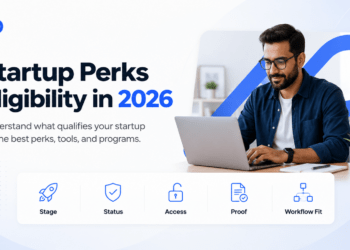
Match pitch competition eligibility to your stage
Idea stage: favor formats that explicitly accept ideas and offer useful feedback. The first proof may be a clear problem and disciplined discovery work. Do not spend heavily on a global stage merely to avoid testing the idea with likely customers.
Working MVP: prioritize the ability to demonstrate one useful workflow reliably. A relevant audience can challenge assumptions about the buyer and adoption. Avoid building a special event-only feature that distracts from the product’s actual value.
Early revenue: bring evidence of repeatable customer value and clarity about what remains uncertain. An event may support distribution or partner discovery. Protect onboarding and delivery capacity; a publicity spike is not useful if the team cannot support resulting interest.
Active fundraising: evaluate investor relevance, financing terms, diligence readiness, and timing against the existing raise. A competition can supplement investor conversations, but it should not become an assumed replacement for a financing process that needs predictable work.
Established growth: ask whether the specific market, customer, or partner access is still distinctive. Some early-stage rules may exclude the company. Even when eligible, delegate preparation only if the business case survives the full organizational cost.
Across stages, do not equate company age with readiness. A young team with a tested product may have stronger evidence for one contest than an older company with a vague market claim. The competition’s rubric determines the relevant comparison.
Build evidence before polishing the pitch
Founder pitch preparation begins with a claim-to-evidence map. For each essential statement, write what supports it, when it was measured, who owns the record, and what limitation should accompany it. A pitch deck for competitions should make the strongest defensible story easy to understand, not hide uncertainty under design.
Distinguish paid customers from pilots, signed agreements from conversations, active use from registrations, and measured performance from a target. When a number is a projection, label the assumptions. Consistency between the form, deck, demo, and spoken pitch matters more than adding another impressive statistic.
Review the organizer’s evaluation criteria before choosing what to emphasize. A technical competition, a commercial showcase, and a student venture contest may reward different evidence. XRaise’s application criteria guide provides related preparation context; use the competition’s own rubric for the actual entry.
Prepare a public-safe version of the demo and supporting materials. Remove credentials, personal data, and confidential customer information. Decide which questions can be answered publicly and which require a later appropriate conversation. Where rights or disclosure terms are material to the business, have the relevant adviser review them before submission.
Choose Enter, Prepare, or Pass in realistic situations
Consider a pre-revenue team with a working prototype and a narrow specialist event nearby. If the team qualifies, can afford the trip, and has a credible route to feedback from potential buyers, Enter may be sensible even without a large award. The milestone is learning whether the workflow fits a real purchasing need.
Now consider a student team interested in an announced next-year competition. If the student and historical funding conditions appear relevant but the application window has not opened, Prepare is the accurate state. Gather evidence and verify the rules; do not describe the team as accepted or the competition as currently entered.
Finally, consider a company facing a major customer deployment that wants to attend a distant showcase with no clear access plan. Pass can protect the more valuable commitment. Keep a monitoring note if future evidence might change the answer; passing today need not mean rejecting the program permanently.
These examples are editorial scenarios, not descriptions of actual applicants. Their purpose is to show how the same framework produces different decisions without a universal ranking of competitions.
Practical playbook for a competition application
Step 1 — Define the company milestone
Choose the result that matters: customer learning, distribution, investor readiness, or another specific outcome. Name the decision owner and the work that must continue during preparation. Make the opportunity compete honestly with the team’s current priorities.
Step 2 — Build a verified shortlist
Use official pages to record the edition, rules, status, deadline, and terms. Remove hard exclusions immediately. Keep uncertainty visible and assign the next verification action rather than repeatedly rediscovering the same unresolved question.
Step 3 — Write the no-prize case and budget
Describe the useful outcome and access mechanism. Approve cash and time separately. Confirm who can attend if selected and which commitments would be displaced. If the case depends entirely on winning, reconsider the scope of the commitment.
Step 4 — Assemble and rehearse the evidence
Adapt a reusable evidence pack to the actual rubric. Test the demo, verify metrics, review sensitive information, and rehearse within the organizer’s format. Ask a reviewer to identify unsupported claims and confusing transitions, not merely compliment the presentation.
Step 5 — Submit, follow through, and review
Save the submitted version and confirmation. If selected, prepare the next-meeting request before the event. Afterward, record concrete follow-ups, feedback, and costs. Compare the result with the original milestone so the next competition decision becomes more informed.
Failure modes that waste the opportunity
Applying because the prize is large: the team ignores eligibility, financing terms, or audience fit. Correct this by completing the entry gate and no-prize case before producing a custom deck.
Treating a shortlist as an open call: a founder acts on an old article or a surviving application button. Correct this with an edition-specific status record and a check of the actual submission process.
Overproducing the presentation: the team spends days refining visuals while central claims remain weak. Correct this by resolving the proof gap first and limiting design work to clarity and reliable delivery.

Startup Perks AI Assistant
Have questions about credits? Let's chat instantly.
Counting attention as commercial progress: photos, impressions, and applause become the result. Correct this by tracking agreed next steps, qualified conversations, and learning that changes a decision, while avoiding claims that every contact will convert.
Failing to reserve follow-up capacity: promising conversations disappear into inboxes after travel. Correct this by assigning one owner and preparing the appropriate next material before leaving for the event.
A final competition decision checklist
Before choosing Enter, confirm that the edition and application route are current; eligibility is supported; the prize structure is understood; cash and time are affordable without winning; the evidence matches the rubric; attendance is practical; and a follow-up owner exists.
Choose Prepare when the missing item is explicit and fixable. Attach a next action and review date. Choose Pass when the obstacle is structural or the opportunity does not justify the work. A recorded pass is useful operating discipline, not a failure of ambition.
Related XRaise resources
Use program profiles for context after choosing the kind of opportunity you need. The IdeaFest profile illustrates a local competition format, while the 43North guide describes a different program relationship. These are supporting reading, not evidence that their application windows are open today. Recheck current organizer terms before acting.
FAQ
Which startup pitch competitions 2026 should we enter?
Start with eligibility and a current company milestone. Then assess value without winning, evidence readiness, and follow-up capacity. There is no universal best competition; a narrower event can be more useful when its audience and obligations fit the company.
How do we find startup competitions open now?
Check the official edition page and application portal, recording the deadline and timezone. Separate open, announced, closed, and unclear states. A directory entry, future conference date, or active ticket sale does not establish an open pitch application.
How should we manage pitch competition deadlines?
Work backward from submission through evidence collection, review, rehearsal, and upload. Track finalist confirmation and attendance separately. Save the receipt and submitted version, and resolve conflicting dates with the organizer before relying on the later deadline.
What determines pitch competition eligibility?
Rules can depend on geography, incorporation, sector, funding history, product timing, student participation, and attendance. Read the specific edition’s requirements. If a material condition is ambiguous, confirm it rather than assuming “early stage” is sufficient.
Are all competition prizes non-dilutive startup funding?
No. Distinguish cash, investment, services, and recognition. Investment awards can involve ownership or other financing terms. Even a cash award can have conditions. Review the actual agreement and payment process instead of relying on the prize headline.
What should a pitch deck for competitions contain?
Answer the event’s rubric with a clear customer problem, useful product explanation, credible evidence, team relevance, and a concrete next step. Keep the deck consistent with the application and demo. Do not present projections or exploratory interest as achieved traction.
Is paying an application fee worthwhile?
Only if eligibility, audience relevance, readiness, and the no-prize case justify the total commitment. Include travel and founder time, not just the fee. Check refund conditions before paying; an application payment does not guarantee selection or a useful result.
What should we do if we do not win?
Complete promised follow-ups, evaluate feedback, and compare actual outcomes with the original goal. Record useful learning without pretending every event succeeded. Decide whether to enter again only after identifying what would improve the business case or evidence.
Make the next stage earn your time
The best use of startup pitch competitions 2026 is a deliberate commitment to a useful outcome. Run the Competition Commitment Test before polishing the deck: verify the entry gate, justify participation without a prize, close the proof gap, and plan the next meeting.
Your next action is to take one opportunity through that test and label it Enter, Prepare, or Pass. Keep pitch competition deadlines and evidence in the same decision record. The objective is a stronger company and a clearer next step, whether or not the team leaves with a trophy.