

Leading startup incubator blogs are the fastest way to get accelerator-ready without paying tuition or giving up equity. This guide shows which ones matter, and how to turn reading into execution.
TL;DR
This guide shows you how one weekly loop can turn high-signal incubator writing into shipped product and sharper fundraising materials.
- Leading startup incubator blogs publish real accelerator playbooks, if you treat them like a curriculum, not entertainment.
- Your edge comes from a weekly loop: read → extract a framework → run a 7-day test → log results.
- Use the blogs to reverse-engineer what programs and investors reward: clarity, speed, proof, and default-alive runway thinking.
- Watch the traps: stage mismatch, survivorship bias, and “productive procrastination”, implementation is the filter.
Leading startup incubator blogs: why most founders waste them
If you can quote Paul Graham but you can’t show what shipped this week, the blogs aren’t helping, you’re just getting smarter at avoiding discomfort.




If you want a broader “when should I even join a program” sanity check, start with XRaise.ai’s breakdown of startup incubators in 2026 and the tradeoffs founders actually pay (time, focus, and sometimes equity).
Leading startup incubator blogs: what “leading” means
Updated for today’s market
“Leading startup incubator blogs” are not defined by brand. They’re defined by output.
Here’s the filter that works:
- Track record you can verify. Strong portfolios don’t guarantee good advice, but weak portfolios are a red flag.
- Operational depth. Frameworks, templates, post-mortems, and “here’s how we did it,” not vibe content.
- Market-cycle awareness. Good content shifts when the market shifts (AI-native building, capital efficiency, tighter sales motions).
- Implementation bias. It turns into next actions, not quotes.
Leading startup incubator blogs: the 8 you need
These are the leading startup incubator blogs I’d hand a founder who wants executable frameworks.

What each blog is best for
1) Y Combinator Library (the canonical founder curriculum)
In the universe of leading startup incubator blogs, this is the canonical founder curriculum.
The YC Startup Library is explicitly designed as startup education, not company marketing.
Start here:
- Paul Graham’s “Alive or Default Dead?” for runway math and reality checks.
- “Do Things that Don’t Scale” for early distribution tactics that actually work.
- “Startup = Growth” to keep you honest about what game you’re playing.
When you’re stuck on ideation, loop back to “How to Get Startup Ideas.”
YC’s Requests for Startups is a public map of what they think is underbuilt right now.
2) Techstars Blog (execution frameworks + mentor network signal)
As leading startup incubator blogs go, Techstars is the “operating system” option: structure, mentors, and execution.
Techstars’ content is less philosophical and more “how programs run” and “how founders win inside them.” Their blog is broad, but the best posts are mentor-driven and execution-heavy.
Use it for:
- B2B sales and partnership motion
- Mentor management (how to not get advice-whiplash)
- Program expectations (what “good” looks like in a 3-month sprint).
If you’re applying, use XRaise’s Techstars acceptance guide to build the right assets, not the prettiest story.
3) 500 Global content hub (distribution discipline, not “growth hacks”)
For leading startup incubator blogs focused on distribution, 500 Global is still the reference point.
500 Global’s brand has always been distribution: acquisition, retention, monetization, and measurement. Their content hub is where you’ll find ecosystem updates, founder lessons, and growth thinking across regions.
4) Seedcamp News & Views (Europe-specific clarity + investor pattern recognition)
Among leading startup incubator blogs for European builders, Seedcamp is one of the cleanest reality checks.
Most “startup advice” assumes you’re in the US. Seedcamp’s writing is one of the better correctives for Europe: ecosystem context, fundraising realities, and what strong teams look like.
Why it’s credible: Seedcamp publishes portfolio-level stats and outcomes.
5) Entrepreneur First Insights (cofounder selection + deep-tech founder edge)
If your problem is “team before idea,” EF is one of the few leading startup incubator blogs that actually talks about the ugly parts.
EF’s model is talent-first, so their insights are strongest where most founders are weakest: cofounder choice, personal “edge,” and building from -1 to 1. Their Insights page is the entry point.
6) Antler Insights (day-zero building across non-obvious markets)
For leading startup incubator blogs that start before you have a company, Antler is the day-zero play.
Antler’s “day zero” posture shows up clearly in their Insights and founder stories: team formation, early conviction, and market selection when you’re not sitting in SF with instant VC proximity.
7) Plug and Play Tech Center Insights (corporate innovation + “pilot → contract” mechanics)
For leading startup incubator blogs in the corporate innovation lane, Plug and Play is hard to beat.
Plug and Play’s Insights section is useful when you’re selling into enterprise and need to understand how corporate innovation teams think.
8) Founder Institute Insights (earliest-stage fundamentals + global operator reality)
Founder Institute is one of the leading startup incubator blogs that’s built for the earliest stage and for founders outside the usual hubs.
Founder Institute publishes broad early-stage guidance that respects “non-SV” realities. Their Insights hub is the best starting point.
How to use leading startup incubator blogs
You don’t need more reading. You need a loop.
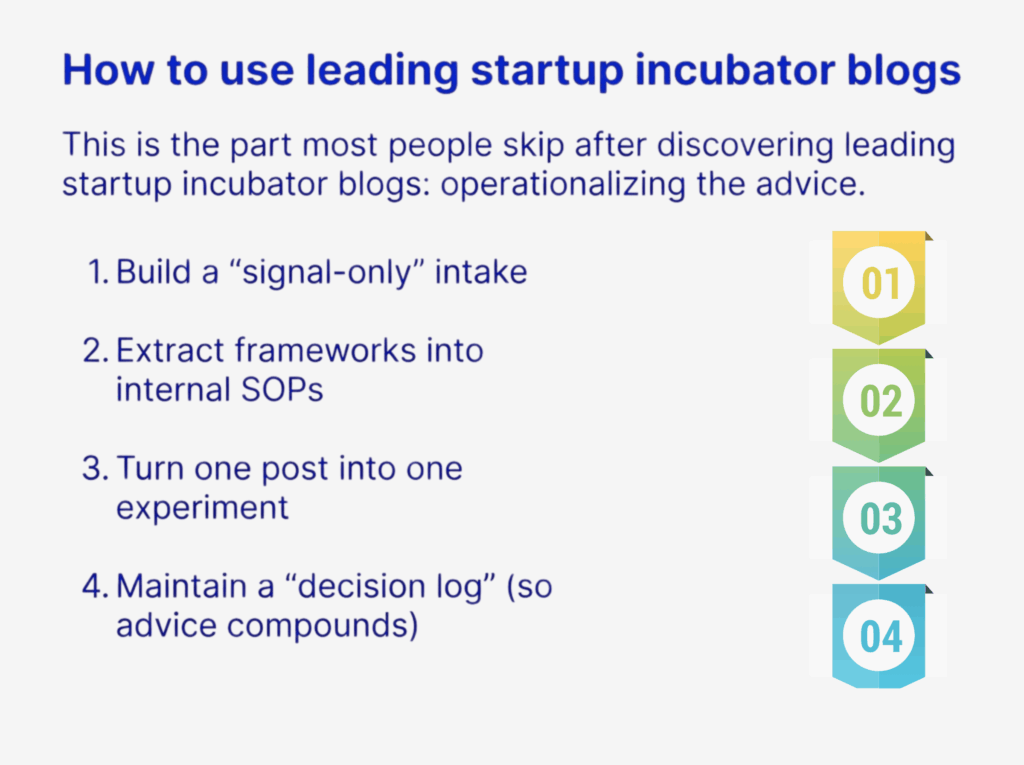
This is the part most people skip after discovering leading startup incubator blogs: operationalizing the advice.
Run 7-day tests and track outcomes
Step 1: Build a “signal-only” intake
Pick 3–5 sources.
- Subscribe (RSS/newsletter)
- Save posts into one place
- Schedule one weekly review window (30 minutes)
Step 2: Extract frameworks into internal SOPs
Use this extraction template:
- Core claim (1 sentence)
- Where it applies (your stage + market)
- Smallest 7-day test
- Success metric + owner
If you’re already running Notion, it’s worth grabbing credits before you build a sprawling knowledge base: see XRaise’s Notion promo code for startups.
Step 3: Turn one post into one experiment
For example, “Do Things That Don’t Scale” becomes:
- Personally onboard 10 users this week
- Write down the 3 objections you hear repeatedly
- Ship the one change that removes the biggest objection
Step 4: Maintain a “decision log” (so advice compounds)
Keep a decision log: what you tried, what happened, what you’d repeat, what you’d avoid.
Accelerator-ready signals from incubator playbooks
Accelerator writing is a public leak of their private rubric.
Leading startup incubator blogs are open-source selection criteria, if you read them like a partner would.
Read it correctly and you stop asking “How do I sound impressive?” You start asking “What proof would make this unignorable?”
Practical moves:
- Collect the repeated themes (speed, clarity, coachability, default-alive runway thinking).
- Rewrite your deck narrative around proofs, not adjectives.
- Align your application answers to experiments you actually ran.
If you’re targeting YC specifically, XRaise’s guide on how to apply to Y Combinator (2025–2026) is a solid checklist for building the “fast interview” package.
When you’re closer to interview stage, the companion guide on what to expect in a Y Combinator interview helps you tighten the 60–90 second story.
Mistakes with accelerator blogs
These blogs are high-signal, but leading startup incubator blogs can still mess you up if you misapply them.
- Stage mismatch. Series B advice will poison a pre-seed roadmap.
- Survivorship bias. You’re reading the winners. Extract principles, not cosplay.
- Framework hoarding. If your Notion database grows faster than your product, you have an awareness problem.
Operator callout: if you can’t explain why a framework fits your current constraints, cut it.
Tool stack costs and runway
Here’s the real gap: incubator blogs teach you what good looks like.
Leading startup incubator blogs don’t solve execution for you, your system does. Two leverage points close that gap:
1) Kill tool-stack burn (so you buy more runway)
Your sources will recommend the usual suspects (cloud, CRM, analytics, collaboration). Following that stack at list price can hit $50K+/year in the early days (and yes, that’s before you’ve earned the right to scale). That’s why perks matter.
Start with credits that move runway immediately:
- Cloud: Amazon Web Services credits on AWS Activate credits + cloud credit program selection.
- CRM: HubSpot savings on HubSpot startup promo.
- Workspace: Notion startup credits.
2) Convert frameworks into investor-ready artifacts, fast
Execution tools are force multipliers:
- Build your deck once, then tailor it per program with XRaise AI Pitch Deck Builder.
- Run programs like a pipeline using startup programs strategy in 2026.
- Avoid spray-and-pray with Startup accelerators in 2026: the smart way to apply.
Your Action Plan:
- Assess fit: Are you at the right stage? Is your network weak enough to justify the equity cost? Be honest.
- Build your application foundation: Create a pitch deck that meets top-tier standards, whether you apply or not. → Use XRaise AI Pitch Deck Builder
- Hedge your bets: Lock in accelerator-level perks NOW, regardless of whether you apply. → Claim $500K+ in XRaise Perks
- Apply strategically: 5 targeted applications to programs with genuine thesis fit beat 20 spray-and-pray submissions every time.
Whether you’re accelerator-bound or building independently, XRaise gives you the unfair advantage, the tools, the perks, and the investor access without the equity cost.
Leading startup incubator blogs in 2026
Incubator content is getting more open, more tactical, and more AI-aware, because the cost to build has dropped, but the cost to get attention hasn’t. Founders who treat leading startup incubator blogs as a curriculum (not a feed) will keep compounding while everyone else scrolls.
The winners won’t be the founders with the biggest reading list, they’ll be the founders with the tightest feedback loop.

Startup Perks AI Assistant
Have questions about credits? Let's chat instantly.
In the next 60 days, pick your three sources, run eight small experiments, and rewrite your deck around what you’ve proven, not what you hope is true.
Learn more and start building with XRaise’s Web App, then explore programs that can help you scale faster through XRaise’s Accelerators.