
Last verified: June 27, 2026.
TL;DR
- Product analytics for startups is not about tracking every click; it is about proving activation, retention, feature adoption, cohort behavior, and revenue readiness before scaling.
- The main value is focus: founders can see whether the product is creating repeatable customer value or just generating activity.
- This is best for early-stage SaaS, AI, marketplace, developer tool, and product-led growth teams preparing to increase acquisition, hiring, sales, or onboarding investment.
- Before scaling, define the few product analytics metrics that prove users reach value, return, and support a stronger growth decision.
Quick Answer
- What it is: A focused way to measure activation rate, user retention, feature adoption, cohort analysis, and revenue-linked product behavior.
- Who it is for: Early-stage founders preparing to scale acquisition, hiring, sales, onboarding, or product-led growth.
- When to use it: Use it before increasing growth spend, adding sales capacity, expanding the roadmap, or pushing PLG.
- When to avoid it: Avoid overbuilding analytics when the product is still undefined, the value moment is unclear, or the team cannot act on the data yet.
- Key decision insight: Scale only when product behavior shows that the right users reach value, return, deepen usage, and support a stronger revenue path.
Why Product Analytics Matters Before You Scale
Scaling makes weak signals expensive.
Acquisition should not scale before activation is clear, because the startup may end up paying to bring more users into a product that does not convert. Sales hiring also needs retention context, otherwise the team can close customers who never build a habit. Product-led growth works best when feature adoption is already measured; without that, signups may rise while value stays shallow.



Product analytics gives founders a proof system. It helps the team see what users actually do after they sign up, which segments reach value, where onboarding breaks, which features create durable usage, and whether product behavior connects to revenue.
That does not mean every early startup needs a large data stack. Many teams only need a clean event plan, a product analytics tool, a few cohort views, and a weekly review habit. Founders can review Mixpanel through XRaise if they need a product analytics tool that supports activation, retention, feature usage, and cohort analysis. The tool matters less than the discipline: measure the behaviors that determine whether growth deserves more fuel.

Mixpanel for Startups
Get $50,000 in credits for product analytics built to help startups understand growth.
Product Analytics for Startups: The Proof Metrics That Matter
The strongest startup product metrics answer five founder questions:
- Do users reach the first meaningful value moment?
- Do the right users come back?
- Which features create habit, depth, or expansion?
- Which cohorts improve or decay over time?
- Which product behaviors predict revenue, renewal, or upgrade intent?
These are not vanity metrics. They are operating signals. They tell founders whether to improve onboarding, narrow the ideal customer profile, change pricing, increase acquisition, hire sales, build more product, or pause scaling until the value path is clearer.
Use this simple map before adding more dashboards.
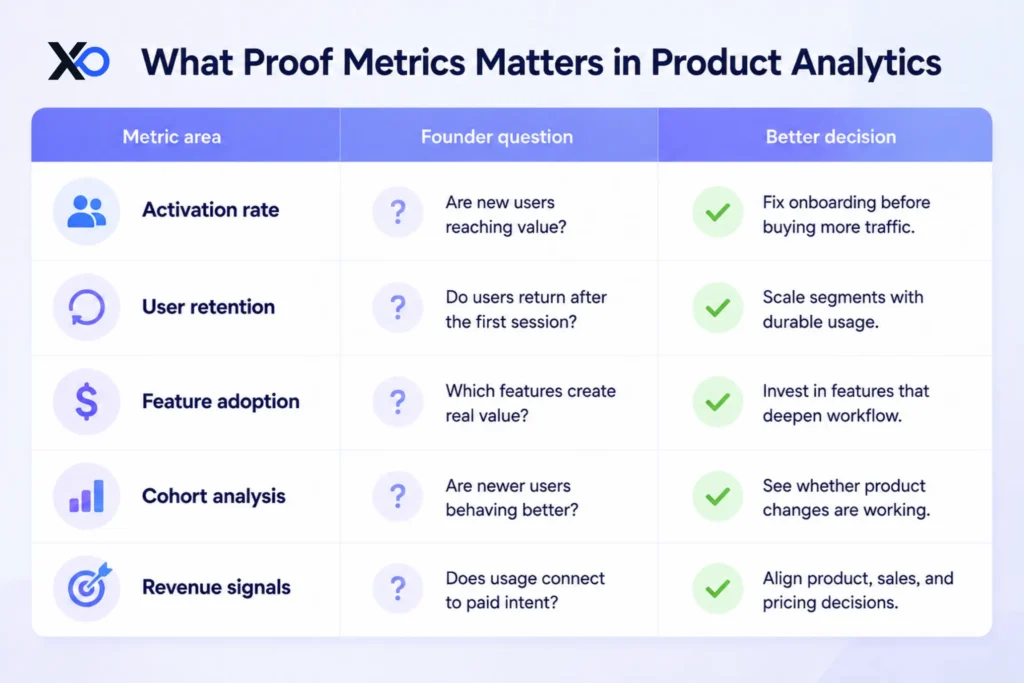
This is the core idea: a metric is useful only if it changes what the founder does next.
Start With Activation Rate
Activation rate measures the percentage of new users who reach a meaningful first value moment.
The key phrase is meaningful. Activation is not always “created an account” or “opened the dashboard.” For most startups, activation should represent the first moment when the user experiences the product’s promise.
Examples:
- A project tool: created a workspace and invited a teammate.
- An AI writing tool: created a usable first draft.
- A developer tool: completed first API call or deployed first integration.
- A marketplace: completed a first qualified match, booking, or transaction.
- A B2B SaaS product: imported data, configured a workflow, and saw first insight.
Activation rate matters because it reveals whether acquisition is sending users into a clear path to value. A startup with low activation should be careful about scaling paid acquisition, adding sales development, or pushing product-led growth. More leads will usually expose the same onboarding problem faster.
How to Measure Activation
Define one primary activation event and two or three supporting events.
The primary event should be tied to the value promise. Supporting events can help diagnose where users drop off.
For example, an analytics product might track:
- Account created.
- First data source connected.
- First dashboard viewed.
- First saved insight shared with a teammate.
The activation event might be “first saved insight shared” because it shows the user reached value and involved the workflow owner. If the startup only tracks account creation, the metric is too shallow.
Measure User Retention by Segment
User retention shows whether people come back after the first value moment.
For early-stage startups, retention is often more important than total signups because it shows whether the product is becoming useful enough to repeat. A founder can usually buy or hustle more top-of-funnel activity. It is harder to fake users returning because the product matters.
Retention should be measured by segment, not only as one blended average. A startup may have strong retention among startup founders but weak retention among agencies. Another may retain technical users but lose nontechnical buyers. Blended retention hides those truths.
Useful retention views include:
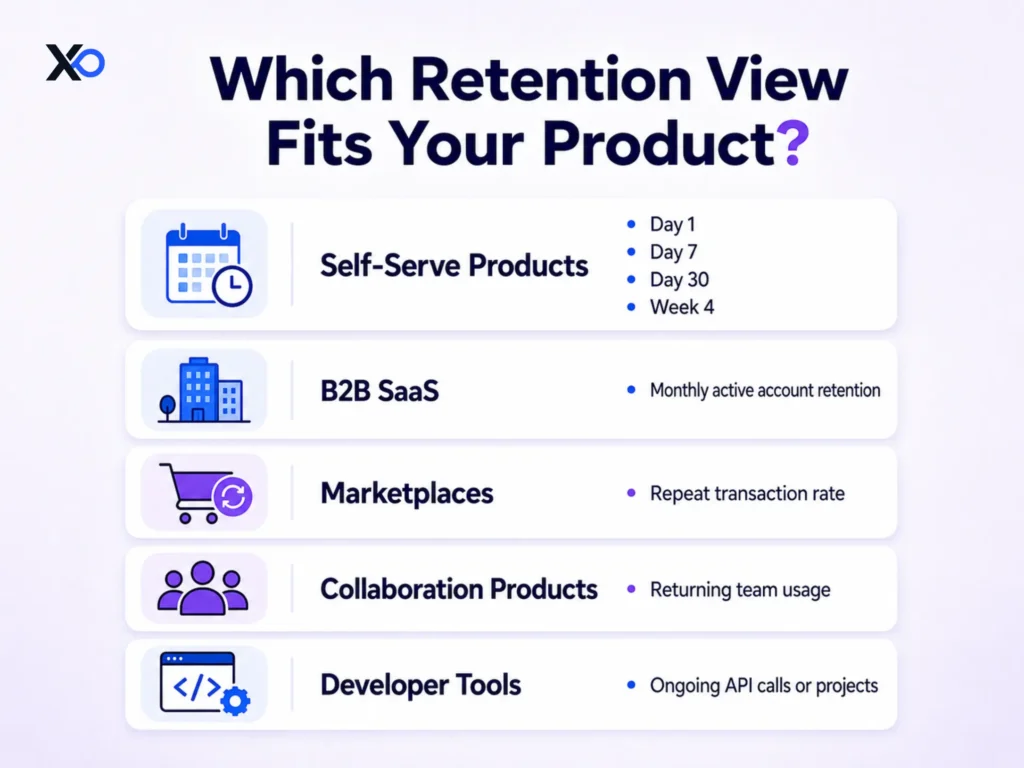
The right window depends on the product’s natural usage rhythm. A daily workflow should show frequent return behavior. A monthly finance workflow should not be judged by daily active use. Match the metric to the problem.
Track Feature Adoption Without Tracking Everything
Feature adoption shows whether users engage with the parts of the product that create value.
This is where many startups overmeasure. They track every button, menu, modal, tooltip, and page view, then still cannot answer which product behavior matters.
A better approach is to identify the few features that connect to value, habit, workflow depth, or revenue. Measure those deeply.
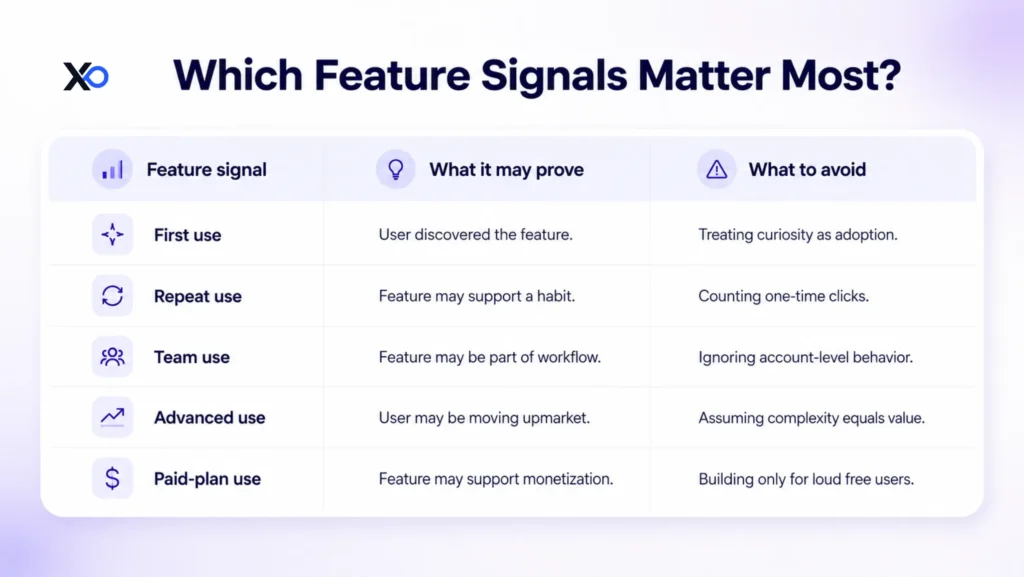
For product-led growth metrics, feature adoption should connect to the product’s growth loop. In a collaboration-led product, that means measuring invites, shared projects, and active teammates. When data depth drives retention, founders should track connected sources, saved reports, and recurring review behavior. For automation-led products, the useful signals are workflows created, workflows completed, and error rates.
The goal is to find the features that create proof, not the features that make the dashboard look busy.
Use Cohort Analysis to See Whether the Product Is Improving
Cohort analysis groups users by shared start date, segment, acquisition source, plan, use case, or onboarding path, then tracks how behavior changes over time.
This is one of the most useful product analytics metrics for founders because it shows whether newer users are behaving better than older users.
For example:
- Users who joined after the new onboarding flow activate faster.
- Teams from one acquisition channel retain better than another.
- Accounts that invite a teammate in week one have higher month-two retention.
- Users who adopt one core feature are more likely to upgrade.
- A new ICP segment has lower churn than the old broad audience.
Without cohort analysis, founders often rely on averages. Averages can be dangerous because they smooth over the learning. If one customer segment is working and another is not, the blended chart may look “fine” while the startup misses the path to scale.
Cohorts Founders Should Review Weekly
Founders do not need dozens of cohort reports. Start with a small set:
- Signup cohort by week or month.
- Activation cohort by onboarding path.
- Retention cohort by customer segment.
- Feature adoption cohort by core use case.
- Revenue cohort by plan, source, or account type.
The weekly question is simple: which cohort shows evidence that the product is getting easier to adopt, harder to leave, or more likely to convert?
Connect Product Behavior to Revenue Signals
Product analytics becomes more powerful when it connects usage to revenue signals.
For early teams, this does not always mean complex revenue operations. It can start with simple patterns:
- Activated users are more likely to start a trial.
- Accounts with three active teammates convert at a higher rate.
- Users who create two workflows are more likely to upgrade.
- High-retention cohorts come from one acquisition source.
- Churned accounts never reached the key value moment.
These patterns help founders make better tradeoffs. Sales can prioritize accounts with strong product intent. Product can improve the activation path that leads to conversion. Marketing can focus on channels that produce users who retain, not just users who sign up.
This is also where analytics protects runway. Scaling spend without revenue-linked product behavior can create false confidence. The startup may see traffic, signups, and demo requests, but still miss the question that matters: are the right users doing the things that predict durable revenue?
A Practical Product Analytics Framework for Founders
Use this framework before scaling acquisition, hiring, sales, or product-led growth.

Startup Perks AI Assistant
Have questions about credits? Let's chat instantly.
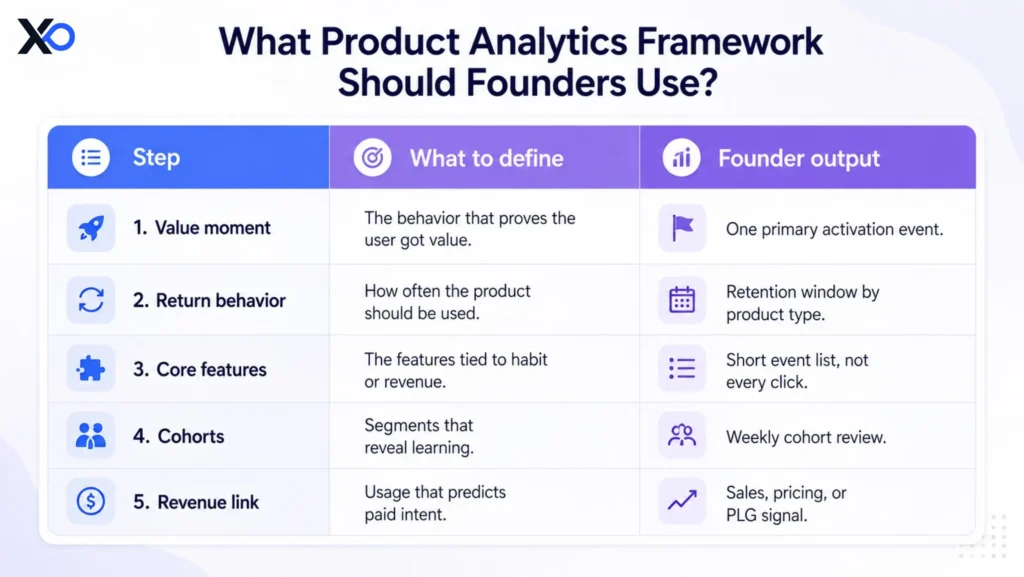
This framework works because it forces the team to define meaning before measurement. A dashboard cannot decide what value looks like. Founders and operators have to define it first.
Once the framework is clear, the product analytics tool becomes easier to evaluate. You need event tracking, funnels, retention, cohorts, segmentation, and enough reporting clarity that the team can use the data every week.
What to Measure Before Scaling Acquisition
Before increasing acquisition spend, measure:
- Activation rate by channel.
- Retention by channel.
- Cost per activated user, not only cost per signup.
- Feature adoption by source.
- Conversion or revenue signal by cohort.
This keeps the team from scaling low-quality traffic. A channel that produces cheap signups but weak activation can burn time and budget. A channel that produces fewer users with strong retention may be more valuable.
What to Measure Before Hiring Sales
Before hiring sales, measure:
- Which product behaviors predict a qualified account.
- Which segments activate and retain.
- Which accounts show team adoption.
- Which usage signals create expansion or upgrade conversations.
- Which onboarding gaps require human help.
Sales hiring works better when the team knows which accounts deserve attention. If every signup looks the same, sales will spend time chasing weak intent. If product analytics shows which accounts reached value, invited teammates, or hit usage thresholds, the sales motion can be more focused.
What to Measure Before Product-Led Growth
Product-led growth depends on a product experience that can create, expand, and reveal demand.
| PLG metric | What it helps founders understand |
|---|---|
| Self-serve activation rate | Whether users can reach value without sales or support |
| Time to value | How quickly new users experience the product’s core benefit |
| Invite, sharing, or collaboration behavior | Whether the product naturally spreads inside teams |
| Free-to-paid conversion signals | Whether free users show buying intent |
| Retention by use case | Which use cases keep users coming back |
| Expansion behavior inside accounts | Whether usage can grow across seats, teams, or departments |
PLG is not just adding a free plan. It is building a product path where the user can discover value, invite others, deepen usage, and show buying intent. Product analytics helps founders see whether that path exists yet.
Common Product Analytics Mistakes
The biggest mistake is tracking too much too early.
When every click becomes an event, teams drown in data but still cannot explain the customer journey. The second mistake is tracking metrics that flatter growth: page views, total signups, total events, total dashboards created, or total active users without cohort context.
| Common mistake | Why it creates a problem |
|---|---|
| Measuring activation before defining the value moment | The team may track activity that does not prove real user value |
| Looking at retention without segmenting by customer type | Strong and weak segments get mixed together |
| Treating feature discovery as feature adoption | Seeing a feature is not the same as using it meaningfully |
| Ignoring churned users | The team misses the reasons customers leave |
| Letting one person own all analytics knowledge | Data becomes hard for the wider team to use |
| Reviewing dashboards without deciding the next action | Metrics create discussion, but no clear decision |
The fix is not a more complicated stack. The fix is a sharper metric model.
How XRaise Fits Into Product Analytics Decisions
XRaise helps founders review startup tools, credits, perks, and resources through the lens of runway, readiness, and practical fit.
For product analytics, that means choosing tools after the startup knows what it needs to prove. A founder should not add analytics because the category sounds mature. They should add analytics because activation, retention, feature adoption, cohort behavior, or revenue signals are unclear and the next growth decision depends on them.
If your team is reviewing analytics, CRM, onboarding, or customer research tools, start with the proof question first. Then use XRaise as a discovery and review layer for startup resources that may support the workflow.
Find startup perks you can actually claim: explore startup perks through XRaise.
Key Takeaways
- Product analytics for startups should prove activation, retention, feature adoption, cohort behavior, and revenue readiness before the team scales growth.
- The most useful startup product metrics are tied to founder decisions, not dashboard volume or vanity activity.
- Activation rate and user retention should be reviewed by segment so the team can see which users are actually worth scaling.
- Cohort analysis and revenue-linked product analytics metrics help founders decide when to increase acquisition, hire sales, or push product-led growth.
FAQ
What is product analytics for startups?
Product analytics for startups is the practice of measuring how users activate, return, adopt features, move through cohorts, and create revenue signals so founders can make better growth decisions.
Which product analytics metrics should startups track first?
Startups should usually track activation rate, user retention, feature adoption, cohort analysis, and revenue-linked product behavior before adding more advanced product analytics metrics.
Why is activation rate important for startups?
Activation rate shows whether new users reach the first meaningful value moment. If activation is weak, scaling acquisition usually increases burn before fixing the product journey.
How does cohort analysis help early-stage founders?
Cohort analysis helps founders see whether newer users, specific segments, or certain acquisition sources retain and convert better over time instead of relying on blended averages.
What are product-led growth metrics?
Product-led growth metrics include self-serve activation, time to value, invite or sharing behavior, feature adoption, free-to-paid conversion signals, retention, and expansion inside accounts.
Final Thoughts
Product analytics for startups should give founders the confidence to scale because the product is creating repeatable value, not because the dashboard is full.
Before you increase acquisition, hire sales, push product-led growth, or expand the roadmap, define the value moment, measure activation, review retention by segment, study cohort behavior, and connect usage to revenue signals. Then use XRaise to review product analytics tools and startup resources that support the proof your company actually needs.
This article is written for XRaise.ai and is intended to help founders compare startup tools, analytics workflows, perks, and growth decisions more clearly. Tool details, pricing, eligibility, integrations, feature availability, and offer terms can change, so readers should verify official terms before applying, claiming, or committing budget.