Last verified: June 25, 2026
TL;DR
- Choosing startup tools that create proof means buying software only when it helps the team answer a real growth, customer, or runway question.
- The main risk is adding tools that increase activity without improving evidence, which makes the startup look busier while decisions stay unclear.
- This is best for founders building a lean go-to-market, product, analytics, or customer operating stack before raising, scaling, or increasing spend.
- Before adding another tool, define the proof you need, choose the lightest system that captures it, and review relevant startup tools through XRaise only when they support that evidence.
What It Means for a Startup Tool to Create Proof
A startup tool creates proof when it helps the team answer a decision-critical question with better evidence.
| Evidence area | What it shows |
|---|---|
| Customer acquisition | Whether the startup can acquire the right customers |
| Activation and retention | Whether users activate and return |
| CAC payback | Whether customer acquisition cost can pay back |
| Expansion potential | Whether accounts can expand |
| Customer proof | Whether customers can explain the value in their own words |
| Repeatability | Whether the workflow is repeatable enough to scale |
Noise is different. Noise is more dashboards, more automations, more tabs, more reports, more status updates, and more “visibility” that does not change what the founder should do next.


Early teams are especially vulnerable to noisy tools because software can feel like progress. A CRM makes the sales motion look organized. Analytics makes the product look measured. Automation makes operations look mature. A project tool makes work look controlled.
But a tool is only useful if it makes the company smarter about customers, growth, cost, or retention. If the tool cannot help you make a better decision, it is probably not proof. It is admin.
The Proof-First Tool Rule
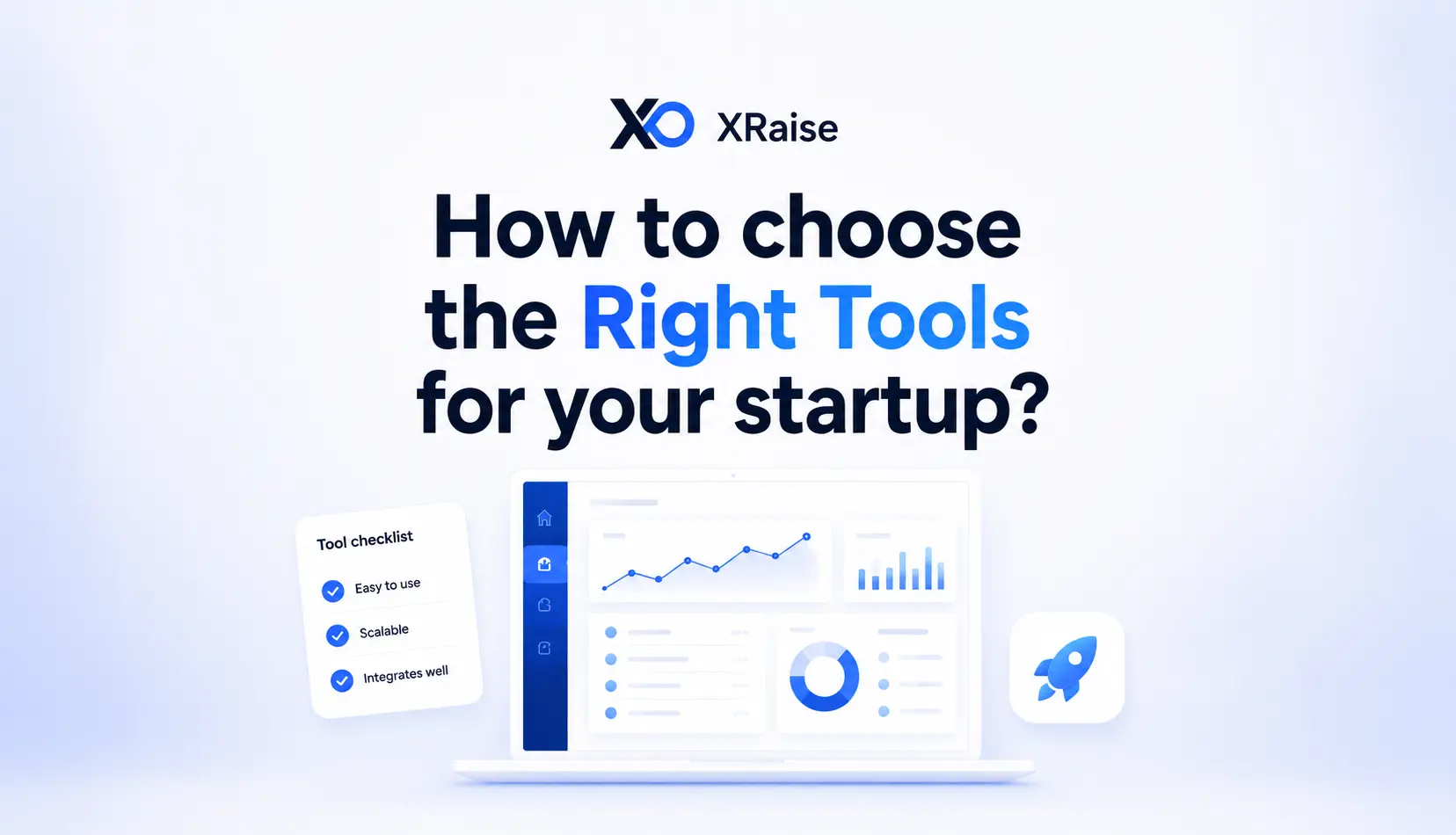
Before choosing any startup tool, write the proof question first.
- Do not start with “Which CRM should we use?” Start with “What do we need to prove about acquisition?”
- Do not start with “Which analytics tool is best?” Start with “Which activation, retention, or expansion behavior must we understand?”
- Do not start with “Can we automate this?” Start with “Is this workflow already repeatable enough to automate?”
Use this simple rule:
Tool decision = proof question + owner + workflow + next decision
If any part is missing, wait.
| Tool question | Proof-first version | Better founder decision |
|---|---|---|
| Which CRM should we buy? | What sales evidence do we need to capture? | Choose a CRM only when pipeline and follow-up need structure. |
| Which analytics tool should we use? | Which user behaviors prove retention or activation? | Track fewer events that map to real value. |
| Which automation platform should we add? | Which repeated workflow is slowing the team? | Automate only when the process is stable. |
| Which survey tool should we use? | What customer evidence is missing? | Ask sharper questions and store answers clearly. |
| Which project tool should we adopt? | What execution signal is currently invisible? | Track work only where it improves delivery. |
The goal is not to underbuild your stack. The goal is to avoid paying for complexity before the startup has enough signal to use it well.
Start With the Proof Your Stage Requires
Different stages require different proof.
An idea-stage founder does not need a full revenue operations stack. They need customer interviews, problem clarity, and early willingness to act.

Startup Perks AI Assistant
Have questions about credits? Let's chat instantly.
An MVP-stage team does not need a complex data warehouse. They need activation, usage, feedback, and churn signals.
A startup preparing to raise or scale needs stronger evidence: acquisition sources, retention cohorts, CAC payback, expansion paths, customer proof, and a clearer ideal customer profile.
Use this stage map to decide what tools should prove.
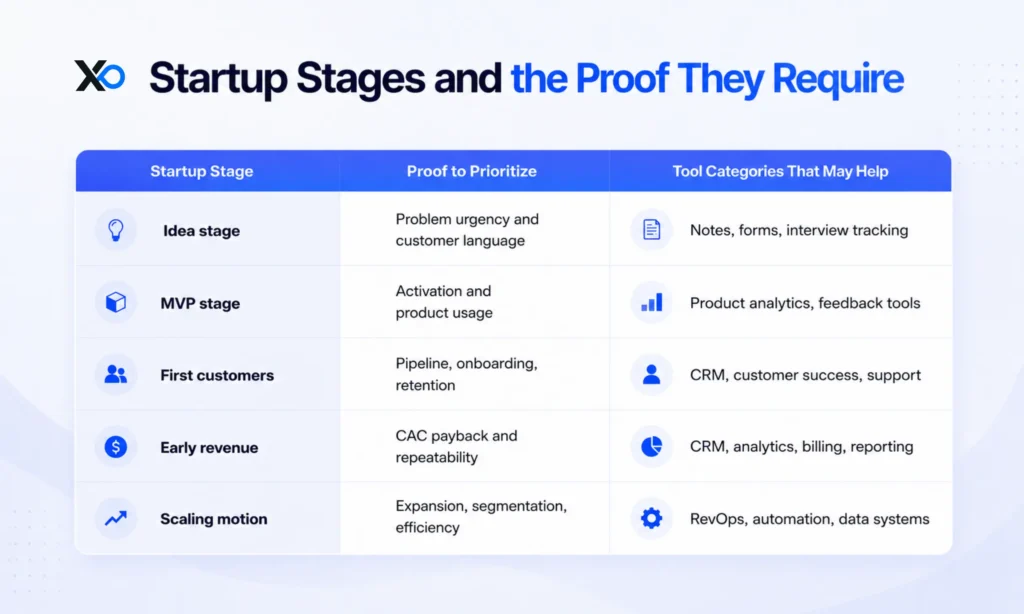
This helps founders avoid tool-stage mismatch.
Buying advanced tools too early can create a false sense of maturity. Waiting too long can make evidence messy. The right moment is when the proof question is real, repeated, and expensive to manage manually.
Choose Tools Around Five Proof Areas
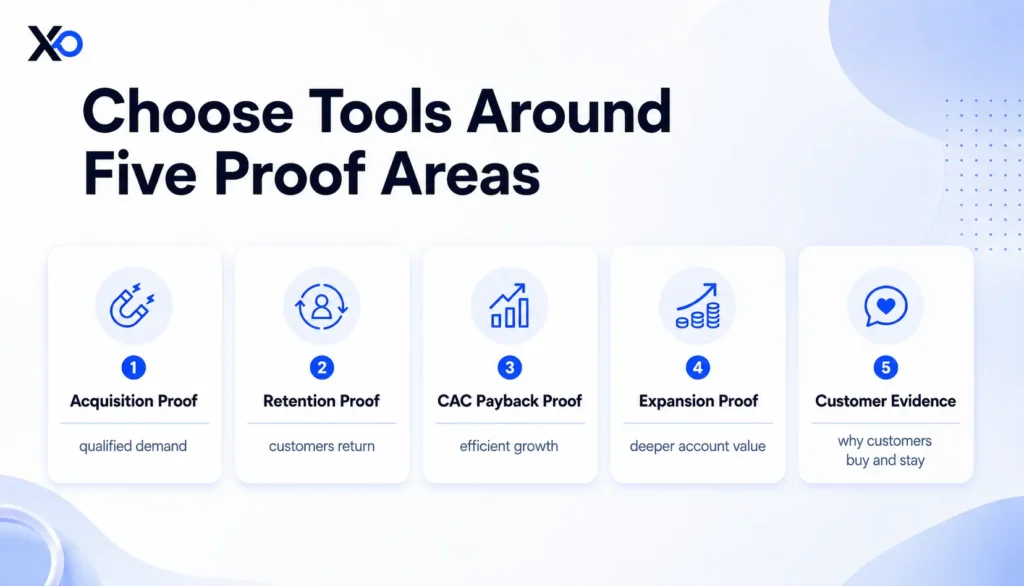
The best startup tool stack supports five evidence areas: acquisition, retention, CAC payback, expansion potential, and customer evidence.
These areas matter because they connect directly to founder decisions. A team can use them to decide whether to keep testing a channel, improve onboarding before adding more leads, hire sales, raise capital, push expansion, or narrow the ICP.
Acquisition Proof
Acquisition proof shows whether the startup can reach the right customer segment.
| Evidence area | What it shows |
|---|---|
| Customer acquisition | Whether the startup can acquire the right customers |
| Activation and retention | Whether users activate and return |
| CAC payback | Whether customer acquisition cost can pay back |
| Expansion potential | Whether accounts can expand |
| Customer proof | Whether customers can explain the value in their own words |
| Repeatability | Whether the workflow is repeatable enough to scale |
For founder-led sales, a simple CRM may be enough. If the team is ready to structure customer workflows, HubSpot through XRaise can be worth reviewing. The important part is not the tool name. It is whether the CRM helps you see which customers are real, which messages work, and which channels deserve more effort.

HubSpot for Startups
Up to 90% discount on AI-powered customer platform.
Avoid tools that only increase outbound volume before the team understands who responds and why.
Retention Proof
Retention proof shows whether customers continue receiving value after the first sale, signup, or onboarding moment.
| Signal area | What useful tools should help founders see |
|---|---|
| Activation | Activation events |
| Repeat usage | Whether users come back and use the product again |
| Cohort behavior | How different user groups behave over time |
| Drop-off points | Where users stop, churn, or fail to continue |
| Renewal signals | Early signs that customers may renew or not renew |
| Support and onboarding friction | Where users need help, get stuck, or slow down |
For product-led, SaaS, AI, marketplace, and developer-tool startups, product analytics can be useful when events are tied to real customer value. Founders can review Mixpanel through XRaise if they need clearer product usage and retention analysis.

Mixpanel for Startups
Get $50,000 in credits for product analytics built to help startups understand growth.
The mistake is tracking everything. A founder does not need 200 events if only five explain whether customers reach value and return.
CAC Payback Proof
CAC payback proof shows whether growth can become economically sane.
Early CAC data will not be perfect. Founder time, small samples, unpaid channels, and mixed motions can make the numbers rough. Still, a good tool stack should help the team estimate:
| CAC estimate area | What the tool stack should help the team estimate |
|---|---|
| Channel cost | How much each acquisition channel costs |
| Sales time | How much founder or sales time is needed to win customers |
| Conversion rate | How many leads turn into customers |
| First revenue | When and how much revenue appears from a customer |
| Gross margin | How much revenue remains after delivery costs |
| Payback by segment or channel | Which customer segments or channels recover CAC fastest |
This is where noisy dashboards become dangerous. A dashboard that shows leads, traffic, demos, and revenue without connecting spend to customer quality can make growth look better than it is.
The right tool setup should help founders ask: “If we spend more here, do we get customers who stay long enough to justify it?”
Expansion Proof
Expansion proof shows whether customer value can grow over time.
| Expansion signal | What useful tools should track |
|---|---|
| Seat growth | Whether more users are being added inside the account |
| Usage growth | Whether the customer is using the product more over time |
| Plan upgrades | Whether customers move to higher plans |
| Repeat purchases | Whether customers buy again |
| Additional teams or departments | Whether the product spreads inside the company |
| Cross-sell or add-on interest | Whether customers show interest in extra products, features, or services |
| Customer success notes | What the team learns from check-ins, support, and success conversations |
In practice, it is often hidden inside messy customer conversations. When one customer grows from a pilot to a team rollout, the tool should help preserve the evidence: what triggered the expansion, who sponsored it, and which outcome made the account deepen usage.
If the team cannot answer those questions, expansion is still mostly a story.
Customer Evidence
Customer evidence is the human proof layer. Metrics show what happened. Customer evidence explains why it happened.
| Customer evidence area | What useful tools should help founders capture |
|---|---|
| Customer quotes | The exact words customers use to describe the value |
| Interview notes | What customers say during discovery, onboarding, or feedback calls |
| Objections | What makes customers hesitate, delay, or say no |
| Churn reasons | Why customers leave or stop using the product |
| Renewal reasons | Why customers decide to stay or renew |
| Case study details | The customer problem, solution, result, and proof points |
| Support themes | Repeated questions, issues, or friction from support conversations |
| Before-and-after outcomes | What changed for the customer after using the product |
A lightweight workspace can work well here. Founders can review Notion for Startups through XRaise when they need one organized place for customer evidence, decision logs, and proof notes.

Notion for Startups
Workspace, docs, projects, and AI tools for startup teams.
The best customer evidence is not a folder of praise. It is a searchable record of why customers buy, stay, expand, object, or leave.
How to Spot Tool Noise Before It Spreads
Tool noise usually appears as extra work disguised as better operations.
The team adds a tool. Then someone has to configure it, maintain it, clean the data, invite users, manage permissions, update views, build dashboards, review alerts, and reconcile it with other tools. That can be worth it. But only when the evidence improves.
Use this table before adding a tool.
| Warning sign | What it usually means | Founder response |
|---|---|---|
| Nobody owns the tool | It will decay quickly. | Assign an owner or do not add it. |
| It duplicates another workflow | The team is buying confusion. | Pick one source of truth. |
| It tracks activity, not outcomes | The dashboard may flatter motion. | Tie metrics to customer proof. |
| It requires heavy setup before value | The team may be too early. | Start with a lighter workflow. |
| It has no decision attached | The output will not change behavior. | Define the next decision first. |
| It is bought because of a discount | The perk is driving the strategy. | Use savings only for real needs. |
The phrase “we will grow into it” deserves caution. Sometimes it is true. Often it means the startup is paying for a future operating model before the current one is proven.
Build a Proof-First Startup Tool Stack
A proof-first stack does not need to be fancy. It needs to be honest.
For many early teams, the stack can start with:
- One place for customer notes.
- One CRM or pipeline view.
- One product analytics source.
- One billing or revenue record.
- One support or feedback channel.
- One operating dashboard with the few metrics that matter.
The founder’s job is to connect the system, not collect tools.
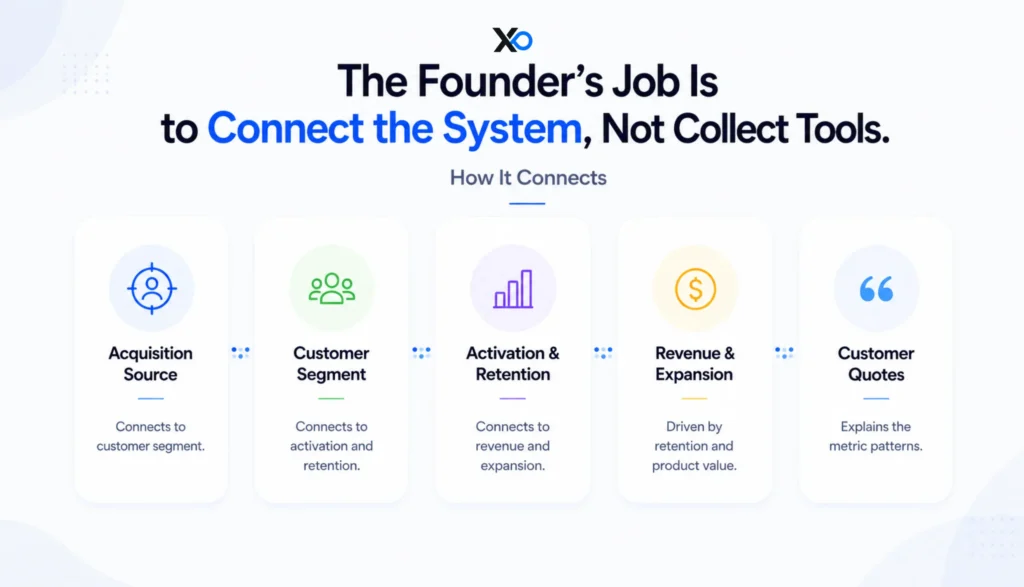
This is how tools create proof. They make the story more connected.
If the team has a CRM, analytics tool, customer notes, and revenue data, but nobody can explain which customer segment is strongest, the stack is not working yet.
The Minimum Useful Dashboard
Most startups do not need more dashboards. They need one operating view that helps the founder decide what to do next.
The minimum useful dashboard should answer:
- Where are qualified customers coming from?
- Which customers activate?
- Which customers retain?
- What does acquisition cost by channel or segment?
- Which customers expand?
- What do customers say about the value?
Keep the dashboard short enough that the team actually uses it.
| Metric area | Good proof signal | Noise version |
|---|---|---|
| Acquisition | Qualified leads by segment and source | Total traffic or raw lead count |
| Activation | Users reach a value moment | Signups without usage |
| Retention | Cohorts return, renew, or deepen use | Average activity with no cohort view |
| CAC payback | Payback by channel or segment | Blended spend with no customer quality |
| Expansion | Seats, usage, or revenue grows | “Could expand later” |
| Customer evidence | Quotes explain outcomes | Testimonials with no context |
If a dashboard cannot reveal a decision, remove it or simplify it.
When Automation Helps and When It Adds Noise
Automation is useful after a workflow is clear.
It can help route leads, send onboarding prompts, sync customer records, trigger renewal reminders, collect feedback, or reduce manual reporting.
But automation added too early can hide weak process design. A broken workflow that runs automatically is still broken.
Before using automation, ask:
- Does this workflow happen often enough?
- Is the process stable?
- Does the data have a clean source of truth?
- Who fixes the automation when it breaks?
- What decision or customer outcome improves?
Founders can review Make through XRaise when repeated workflows are already costing time. But the sequence matters: prove the workflow manually, then automate.

Make.com for Startups
Free Teams plan for AI-powered no-code automations.
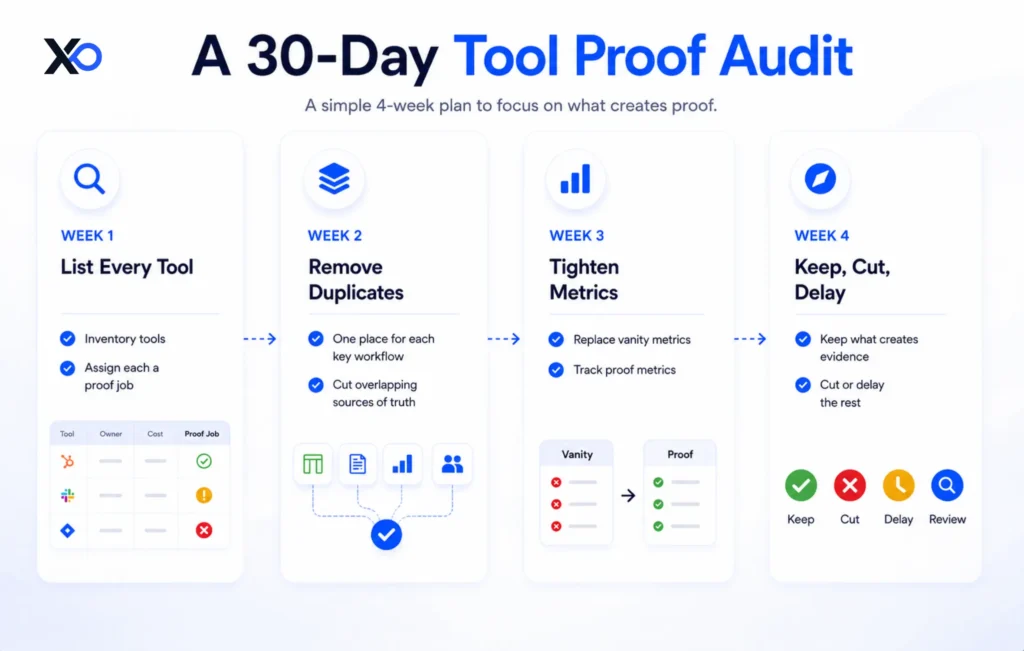
A 30-Day Tool Proof Audit
If your stack feels busy but unclear, run a 30-day proof audit.
Week 1: List Every Tool and Its Proof Job
Create a simple inventory with tool name, owner, monthly cost, renewal date, workflow, proof question, and next decision.
If a tool has no proof job, mark it for review.
Week 2: Remove Duplicate Sources of Truth
Pick one place for pipeline, one place for customer notes, one place for product usage, one place for revenue, and one place for team execution.
The goal is not to centralize everything. It is to stop the team from debating which system is real.
Week 3: Tighten the Metrics
Replace vanity metrics with proof metrics. Track qualified leads by segment, not total leads. Measure activation instead of signups. Review cohort behavior instead of usage averages. Check CAC payback before celebrating revenue spikes. Organize customer evidence by use case instead of collecting random happy quotes.
Week 4: Decide What to Keep, Cut, Delay, or Review Through XRaise
Keep tools that create useful evidence. Cut tools that create admin. Delay tools that are too early. Review relevant startup tools, credits, and founder resources through XRaise only when they support a real workflow.
How XRaise Fits Into Proof-First Tool Decisions
XRaise helps founders discover startup tools, credits, perks, and resources without treating software as the strategy.
That distinction matters.
A startup tool can reduce cost, improve measurement, and support a workflow, but it cannot create customer demand by itself. Tools also cannot fix weak retention or make CAC payback work when channel quality is poor. Scattered customer anecdotes only become proof when the team captures, organizes, and reviews them consistently.
Use XRaise when you already know the proof you need and want to reduce the cost or friction of building the right system around it.
Good XRaise use case:
- “We need product analytics because activation and retention are unclear.”
- “We need a CRM because founder-led sales follow-up is becoming hard to manage.”
- “We need a customer evidence workspace because interview notes are scattered.”
- “We need automation because a proven workflow is now repetitive.”
Weak XRaise use case:
- “This tool has a startup perk, so we should add it.”
The proof should choose the tool. The perk should only make the right tool easier to afford.
Explore startup tools and founder resources through XRaise
Key Takeaways
- Startup tools should be chosen around proof questions, not feature lists, discounts, or a desire to look more operationally mature.
- The strongest tools help founders prove acquisition, retention, CAC payback, expansion potential, and customer evidence with less confusion.
- Tool noise appears when software adds dashboards, duplicate workflows, and admin without improving the next founder decision.
- XRaise can help founders review relevant startup tools and resources, but the best stack still starts with the proof the company needs to create.
FAQ
How should founders choose startup tools?
Founders should choose startup tools by defining the proof they need first, then selecting the lightest tool that helps capture, organize, or act on that evidence.
What makes a startup tool useful?
A startup tool is useful when it improves a real workflow and helps the team make better decisions about acquisition, retention, CAC payback, expansion, customer evidence, or runway.
What is tool noise in a startup?
Tool noise is the extra work created by software that adds dashboards, alerts, workflows, reports, or duplicate systems without improving customer evidence or founder decisions.
Which startup tools create the most proof?
The most useful proof-building tools are usually CRM, product analytics, customer feedback, billing or revenue tracking, customer evidence workspaces, and automation tools used after a workflow is proven.
Should startups use tool discounts and perks?
Startups should use tool discounts and perks when the tool supports a real workflow, has an owner, and still makes sense after the discount or credit period ends.
Final Thoughts
Choosing startup tools that create proof is a discipline. It keeps founders focused on what the company needs to learn, not how many systems the team can adopt.
Start with the evidence that matters most: acquisition, retention, CAC payback, expansion potential, and customer truth. Then choose tools that make that evidence clearer, cheaper, easier to maintain, or easier to act on.
Before paying full price or adding another dashboard, review relevant startup tools through XRaise and ask the harder question first: will this help us prove something important, or will it just make the company noisier?
This article is written for XRaise.ai and is intended to help founders compare startup tools, credits, perks, and operating decisions more clearly. Program details, pricing, eligibility, billing rules, and offer terms can change, so readers should verify official terms before applying, claiming, or committing budget.