
TL;DR
- Startup runway extension means increasing the amount of time your company can operate before it needs more capital.
- The best approach is to reduce burn rate, use relevant startup credits, make cleaner tooling decisions, and improve cash habits without slowing product or customer learning.
- This is best for founders who need more time to reach revenue, traction, funding readiness, or a clearer strategic milestone.
- Start with a 30-day runway review, then use XRaise to find spend-reduction opportunities that match tools and infrastructure your startup already needs.
What Startup Runway Extension Really Means
Startup runway is the time your company has before cash runs out. If you have $300,000 in the bank and burn $50,000 per month, your simple runway is six months.
That number is useful, but it is incomplete. Real runway depends on committed spend, cash collection timing, renewal dates, cloud usage, payroll plans, contractor scope, debt obligations, founder compensation, tax payments, and the quality of your next milestone.
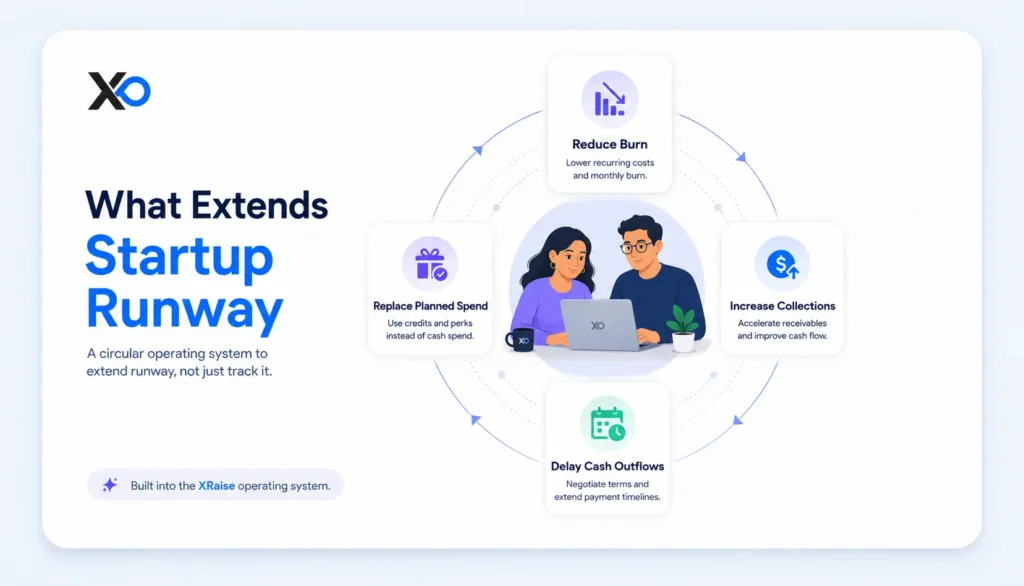
Startup runway extension means improving that timeline without raising more money. You can do that by lowering monthly burn, pulling cash forward, delaying cash outflows, replacing planned spend with credits, or making the company more focused.



The goal is not to make the company smaller for its own sake. The goal is to protect the work that helps you learn, sell, ship, and survive.
For a wider view of cost-saving opportunities, founders can use the XRaise startup perks directory to review relevant credits and discounts before paying full price for tools.
Calculate the Runway You Can Actually Manage
Before you cut anything, calculate the version of runway you can manage weekly.
Simple formula:
Runway = cash in bank / average monthly net burn
Better operating formula:
Runway = cash in bank / expected monthly cash outflow after reliable collections
Do not count hoped-for revenue, unsigned contracts, investor conversations, or “likely” grants in your base case. Track them as scenarios, but keep your default plan grounded in cash you can actually see.
Runway should be reviewed in three layers:
| Runway view | What it tells you | Founder action |
|---|---|---|
| Simple runway | Cash divided by monthly burn. | Understand the headline risk. |
| Committed runway | Cash after payroll, contracts, renewals, and fixed obligations. | Find costs that are already locked in. |
| Milestone runway | Time available to reach the next proof point. | Decide what to protect and what to cut. |
Milestone runway is the most important. A company with eight months of cash and no clear milestone can be in worse shape than a company with five months of cash and a focused path to revenue, retention proof, or a stronger raise.
Reduce Burn Rate Without Cutting the Company Too Deeply
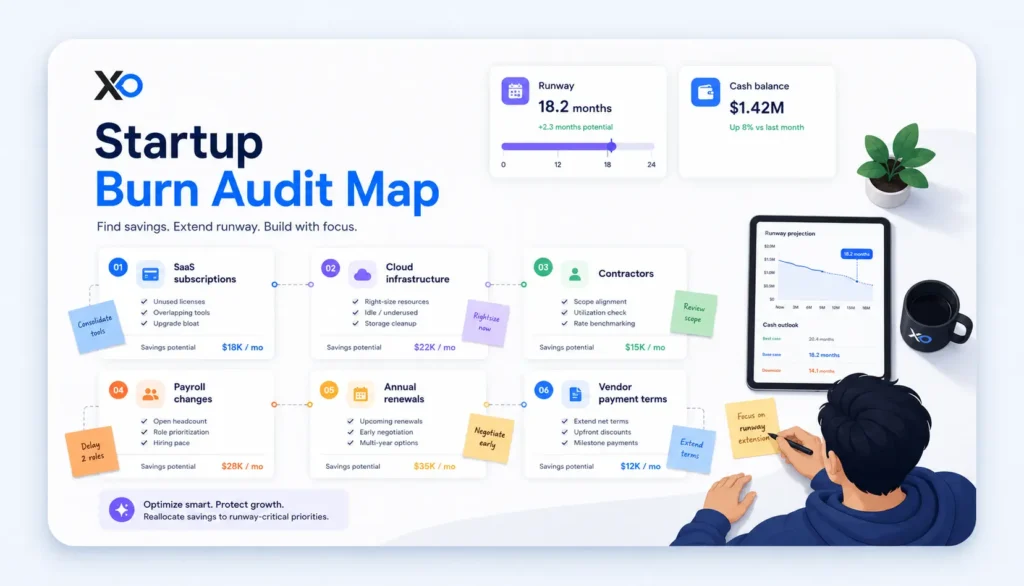
Reducing burn rate works best when founders separate waste from leverage.
Waste is spend that has no owner, no clear use, no renewal logic, no measurable outcome, or no connection to the next milestone. Leverage is spend that helps the company ship, learn, sell, support customers, or keep infrastructure reliable.
Start with recurring costs because they compound quietly.
Review:
- SaaS subscriptions.
- Cloud bills.
- Contractor retainers.
- Unused seats.
- Duplicate tools.
- Annual renewals.
- Paid experiments with no decision owner.
- Vendor contracts that were signed for an old plan.
Use this decision table:
| Cost type | Keep when | Cut, pause, or renegotiate when |
|---|---|---|
| Product infrastructure | It supports live users, reliability, or near-term shipping. | Usage is idle, oversized, duplicated, or unmonitored. |
| GTM software | It supports active leads, customers, or revenue workflows. | The team has no repeatable sales or marketing process yet. |
| Collaboration tools | They reduce coordination drag and preserve team memory. | They overlap with other tools or have no owner. |
| Contractors | They unblock a specific milestone. | The scope is vague or no longer urgent. |
| Experiments | They answer a real growth or product question. | Nobody will act on the result. |
This is the heart of founder-friendly cost control: do not cut the muscle just because it has a monthly bill.
Use Startup Credits Only When They Replace Real Spend
Startup credits can extend startup runway, especially when they reduce infrastructure, AI, cloud, developer, or software costs you already planned to carry.
They can also create false comfort. A large credit can make a tool feel cheap while the team builds around a system that becomes expensive, difficult to leave, or poorly matched to the product.
The rule is simple: use startup credits to reduce spend you already understand.
Good Use of Credits:
- You have a real cloud workload.
- You know who owns usage.
- You understand expiration and billing rules.
- You know what the bill looks like after the credit period.
- The provider fits your technical direction.
Weak Use of Credits:
- You claim the biggest headline amount without a workload.
- Nobody owns usage monitoring.
- The team changes architecture mainly because credits are available.
- You ignore migration cost after the credit window.
- You add tools because they are discounted, not because the workflow is real.
For infrastructure-heavy teams, XRaise’s guide to cloud credits for startups is useful context before choosing a cloud path.
Before choosing a provider, check eligibility, expiration, covered services, billing setup, support level, migration risk, and post-credit pricing.
Make Better Tooling Decisions Before Renewals Hit
Tooling decisions shape runway more than founders expect. A startup rarely overspends because of one bad tool. It overspends because the stack grows without a system.
One tool becomes the CRM. Another becomes the project tracker. A third stores docs. A fourth handles automation. A fifth produces dashboards nobody trusts. Each one looks reasonable in isolation, but together they create spend, admin work, permissions risk, renewal dates, and data cleanup.
The best startup runway extension plan treats tools as operating commitments.
Ask five questions before keeping or adding a tool:
- Does this support a current workflow?
- Who owns setup and ongoing quality?
- What cost does it replace or reduce?
- What happens after the discount or credit ends?
- What breaks if we cancel it in 90 days?
If the answers are fuzzy, wait.
XRaise’s guide to startup tools for founders can help founders think about the wider stack. For specific categories, review tools through XRaise only when they match a real operating need, such as HubSpot for customer workflows, Notion for team knowledge, Asana for project execution, or Make for workflow automation.
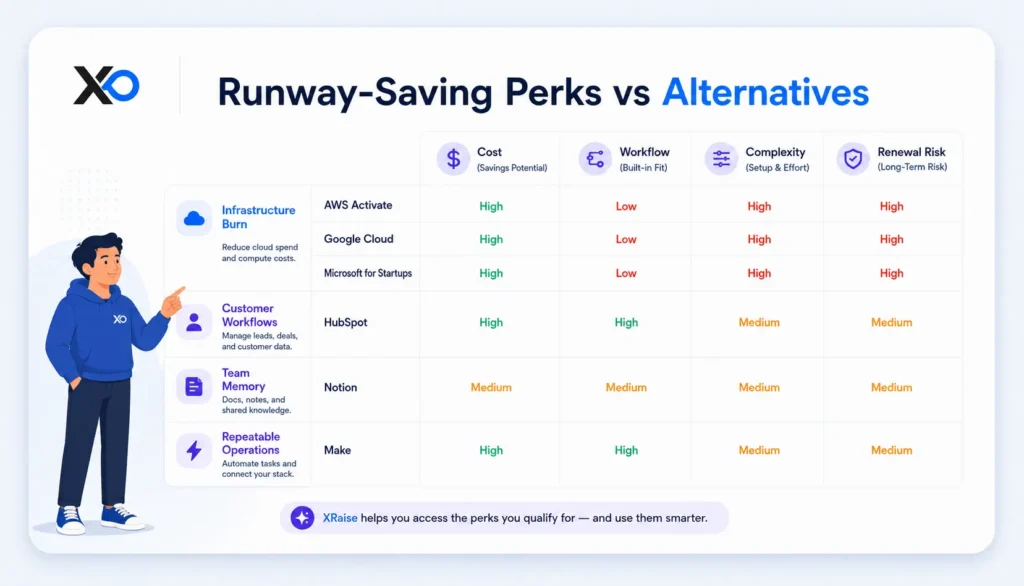
The point is not to build a bigger stack. The point is to reduce spend and operating drag at the same time.
Renegotiate Before You Cancel Useful Tools
Cancellation is not the only runway lever. If a vendor is useful but too expensive right now, ask for a lower-cash path before renewal.
You can ask for:
- Monthly billing instead of annual prepay.
- A temporary downgrade.
- Fewer seats.
- Usage caps.
- Startup pricing.
- Renewal relief.
- Deferred payment.
- A smaller plan that preserves the core workflow.
Copy-paste vendor note:
Hi [Name],

We are reviewing runway and reducing recurring spend this month. We still value [Product], but we need a lower-cash path for the next [60/90/180] days.

Could you review whether we can move to [monthly billing / fewer seats / a temporary downgrade / startup pricing / deferred renewal] while keeping the core workflow we rely on?

If there is an early-stage or startup option we qualify for, please send the best available path before our renewal decision.

Thanks,
[Your Name]
Keep the note calm and specific. Vendors can often help when they understand the decision date and the path that keeps you as a customer.
Improve Operating Habits That Protect Runway
Runway is not only a finance metric. It is a weekly operating habit.
The strongest founders make cash visibility boring. They know what is renewing, what is underused, what is about to increase, what is locked in, and what is tied to the next milestone.
Use this monthly operating checklist:
| Habit | Cadence | Why it helps runway |
|---|---|---|
| Cash and burn review | Weekly if runway is under nine months. | Keeps decisions tied to reality. |
| SaaS and seat audit | Monthly. | Stops small tools from becoming permanent burn. |
| Cloud usage review | Weekly or monthly. | Catches idle resources and surprise growth. |
| Renewal owner check | Monthly. | Prevents last-minute contract decisions. |
| Milestone review | Every two weeks. | Keeps cuts aligned with product and customers. |
| New spend rule | Every purchase. | Forces every cost to earn its place. |
A simple new spend rule works well:
“No new recurring spend unless it supports the next milestone, has an owner, and has a review date.”
That one sentence can save more money than a complicated policy.
If the team is considering automation to reduce manual work, read XRaise’s guide to AI agents for startups. Automation helps runway only when it removes repeatable work without creating new review debt.
Build a 30-Day Startup Runway Extension Plan
A good runway plan should be fast, practical, and visible to the team.
Week 1: Build the Cash Map
Pull bank balance, expected collections, payroll, contractor spend, cloud costs, subscription spend, annual renewals, debt, taxes, and large upcoming payments into one view.
Tag each cost as keep, reduce, renegotiate, replace with credits, pause, or cancel.
Week 2: Cut Obvious Waste
Cancel unused tools, remove inactive seats, pause vague contractor scopes, downgrade plans, and shut down idle infrastructure.

Startup Perks AI Assistant
Have questions about credits? Let's chat instantly.
Do not spend three weeks debating a tool nobody uses.
Week 3: Replace Planned Spend with Relevant Opportunities
Use XRaise to review credits, perks, and startup resources that reduce costs already in your plan. If a benefit creates a new workflow your team does not need, skip it.
The XRaise guide to startup perks for founders is a helpful companion here because the best perks reduce costs founders already planned to take on.
Week 4: Reset the Operating Rhythm
Assign owners for cash review, SaaS review, cloud review, renewal tracking, and new spend approval. Then set calendar reminders. A runway system that lives only in the founder’s head will decay.
What Not to Do When Runway Gets Tight
When cash feels tight, founders can move too fast or too emotionally. That is understandable, but it can hurt the company.
Avoid:
- Cutting customer learning before cutting tool waste.
- Keeping expensive infrastructure because migration feels annoying.
- Claiming every discount and creating tool sprawl.
- Paying annual contracts for small savings when flexibility matters more.
- Letting vendors surprise you at renewal.
- Counting uncollected revenue as cash.
- Cutting product quality work that protects retention.
- Automating messy workflows before the process is clear.
The goal is not austerity. The goal is focus.
Explore Runway-Saving Opportunities Through XRaise
XRaise helps founders find startup credits, software perks, and founder resources that can reduce spend without distracting the team from product and customers.
Use XRaise when you are already planning to spend in a category and want to check whether a relevant opportunity can reduce the cost. That might mean cloud credits, CRM discounts, collaboration tools, automation software, analytics tools, or founder resources.
Before you claim or apply for anything, review eligibility, billing, renewal pricing, plan rules, expiration, and the owner who will maintain the workflow.

Key Takeaways
- Startup runway extension works best when founders reduce burn rate without damaging product, customer learning, or revenue momentum.
- Startup credits and perks are useful when they replace real spend, not when they create a larger tool stack.
- The strongest runway habits are simple: weekly cash visibility, monthly SaaS reviews, cloud usage checks, renewal owners, and a strict new spend rule.
- XRaise helps founders review relevant opportunities before paying full price, while keeping the focus on the company milestone that matters next.
FAQ
What is startup runway extension?
Startup runway extension means increasing the time your company can operate before needing more capital. It usually involves reducing burn rate, improving cash timing, using startup credits, and cutting spend that does not support the next milestone.
How can founders extend startup runway without raising more money?
Founders can extend startup runway by auditing recurring spend, reducing cloud waste, renegotiating vendors, using relevant startup credits, improving collections, slowing new hires, and cutting projects that do not support product, customers, or revenue.
What is the fastest way to reduce burn rate?
The fastest way to reduce burn rate is usually a recurring spend audit. Review SaaS subscriptions, unused seats, cloud resources, contractors, annual renewals, and vendor plans before making deeper team or product cuts.
Do startup credits actually help runway?
Startup credits help runway when they reduce costs the startup already planned to carry. They are less useful when they push the team into a new tool, provider, or workflow that creates setup work and future renewal risk.
How often should founders review startup runway?
Founders should review runway monthly in normal conditions and weekly when runway is under nine months. The review should include cash, expected collections, monthly burn, renewal dates, cloud usage, and milestone progress.
Final Thoughts
Startup runway extension is a founder discipline. It is not only a finance cleanup and it is not a panic exercise.
The best plan protects the work that matters: product quality, customer learning, revenue, retention, and the next strategic proof point. Cut the costs that distract from that work. Keep the costs that make it possible.
Before you pay full price for tools, infrastructure, automation, or GTM software, review relevant opportunities through XRaise and make sure every claimed perk has a real use case, a clear owner, and a sane renewal path.
This article is written for XRaise.ai and is intended to help founders compare startup tools, credits, perks, and operating decisions more clearly. Program details, pricing, eligibility, credit limits, billing rules, and terms can change, so readers should verify official terms before applying, claiming, or committing budget.