
TL;DR
- Cloud credits reduce cash burn, but not architecture risk.
- Use the Credit Fit Filter: proof, cost, complexity, optionality.
- Avoid choosing the biggest credit before defining the workload.
- Model post-credit costs before committing core systems.
- Compare startup cloud perks through XRaise before you build around one provider.
The Problem: Cloud Credits Feel Free Until the Architecture Becomes Expensive
Most cloud credit mistakes start with a reasonable founder instinct: if a provider gives you infrastructure support, you should use it.
That instinct is not wrong. Startup cloud credits can be extremely useful. A SaaS team can run customer pilots without burning cash too early. An AI startup can test inference, storage, and data pipelines before revenue catches up. A developer-tool company can validate usage spikes without being punished by infrastructure bills in the first month.
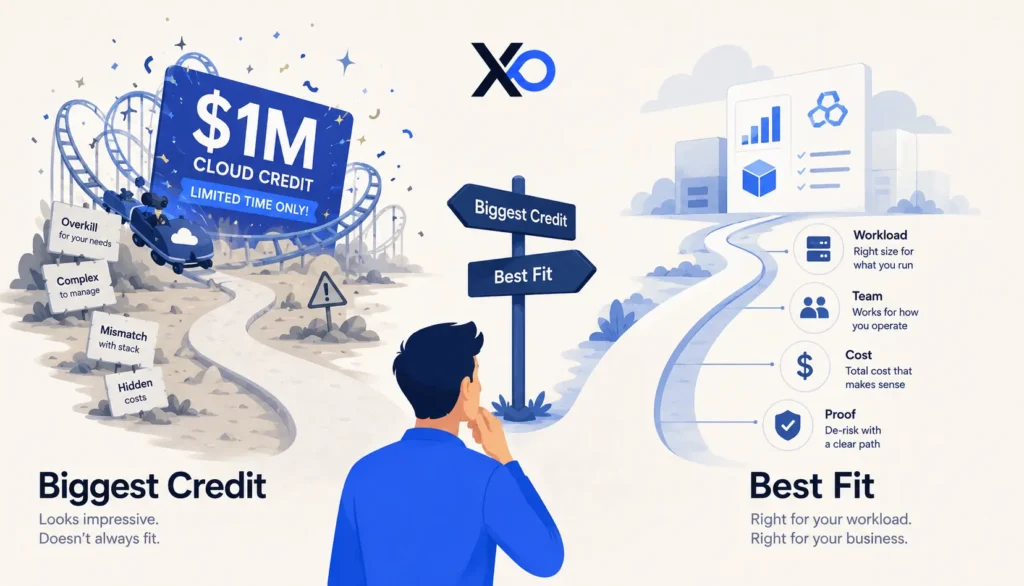
But credits change the psychology of technical decisions.




When cash is not leaving the bank today, founders often accept complexity they would have questioned otherwise. They overbuild deployment systems, choose managed services they do not fully understand, run more environments than they need, or commit to provider-specific services before the product’s real workload is clear.
The problem is not AWS, Google Cloud, Azure, DigitalOcean, or any other cloud provider. The problem is treating the credit as the decision instead of treating it as one input in broader startup infrastructure decisions.
The credit can disappear. The architecture remains.
Why Startup Cloud Credits Can Create Hidden Lock-In
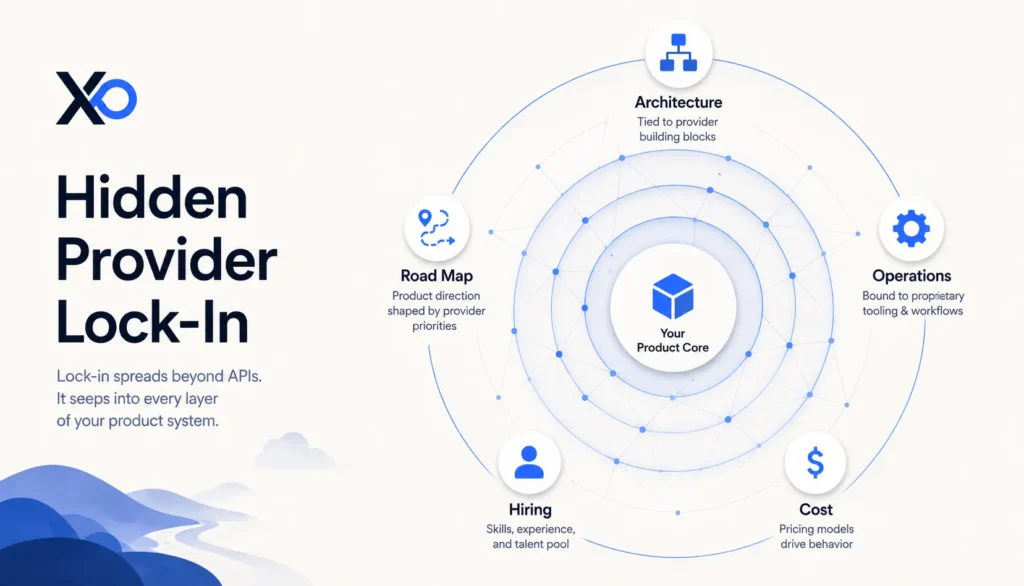
Cloud provider lock-in is often discussed like a purely technical issue. Founders imagine the danger is only about proprietary APIs, databases, or serverless functions.
That is part of it, but early-stage lock-in is broader.
There is architecture lock-in: your application becomes deeply shaped by one provider’s managed services, deployment patterns, identity system, logging stack, or data products.
There is operating lock-in: your small team learns one provider’s console, billing structure, permissions model, and debugging paths. Moving later becomes harder because nobody wants to relearn the operating surface while customers are waiting.
Cost lock-in appears when post-credit cloud spend becomes part of your gross margin, usually after the product has grown enough that replatforming is painful.
Hiring lock-in shows up when the stack starts requiring provider-specific expertise instead of general product engineering judgment.
Road map lock-in happens when features get built because credits make them feel cheap, not because customer proof says they matter.
None of this means lock-in is always bad. A deliberate provider bet can be smart. The mistake is drifting into lock-in because the first invoice was discounted.
The Credit Fit Filter: Proof, Cost, Complexity, Optionality
Before choosing a cloud startup program, run the decision through four questions:
- Proof: What product or customer assumption will this cloud setup help us prove?
- Cost: What will this workload cost when credits expire?
- Complexity: Can our current team operate this stack without slowing product learning?
- Optionality: Which parts of this architecture would be hard to move later?
This is the Credit Fit Filter.
It keeps cloud credits tied to startup learning instead of startup theater. A credit is useful when it lowers the cost of proving something important. It is risky when it encourages the team to build infrastructure maturity before the product has usage maturity.
For example, if you are building a B2B SaaS product with a conventional web app, database, background jobs, and moderate storage, the best choice may be the provider that lets you ship simply and understand costs quickly. If you are building an AI product with GPU-heavy inference, vector search, data processing, and strict latency needs, the best choice may depend much more on compute availability, model hosting options, data movement, and predictable scaling costs.
The same credit number can be strategic for one startup and distracting for another.
Mistake 1: Choosing the Biggest Credit Before Defining the Workload
The most common of all cloud credit mistakes is optimizing for the largest visible perk.
Founders compare cloud credits for startups like they are comparing cash in a bank account. Bigger feels safer. More credits feel like more runway. But cloud credits are only valuable if they map to the workload your company actually needs.
A marketplace startup with modest traffic, relational data, and simple file storage does not need the same infrastructure posture as an AI video company. A developer-tool startup with global build workloads has different needs from a vertical SaaS product serving small teams in one region.
Before choosing a provider, define the workload in plain language:
- What needs to run in the next 90 days?
- What customer behavior would increase infrastructure usage?
- What data must be stored, processed, moved, or secured?
- What latency, compliance, or availability requirements are real today?
- Which workloads are experimental and which are core?
If you cannot answer those questions, the credit amount is not yet the right comparison. The first comparison is fit.
Mistake 2: Treating Managed Services as Free Because Credits Cover Them
Managed services can be a gift to a small team. They can reduce maintenance, improve reliability, and let founders spend more time on product.
They can also quietly narrow your choices.
This is where cloud provider lock-in usually starts. A team adopts a managed database, message queue, authentication layer, ML service, search product, analytics service, or deployment pattern because the credits cover it. Six months later, the product depends on provider-specific behavior, permissions, pricing, and operational assumptions.
That may be fine if the service creates real leverage. It is not fine if the team adopted it because the bill was temporarily invisible.
Use this rule: the more provider-specific a service is, the more explicit the decision should be.
Ask whether the service is helping you prove something faster, or whether it is just making the stack feel advanced. A managed service that saves two engineers weeks of maintenance can be worth the lock-in. A managed service that adds complexity before usage exists is just a future migration with better branding.
Mistake 3: Ignoring Post-Credit Cloud Costs
Post-credit cloud costs should be modeled before the startup commits core workloads, not after credits run out.
This is one of the cloud credit mistakes that hurts later because it hides inside growth. The product starts working. Customers use it. Data accumulates. Logs expand. Background jobs multiply. AI inference becomes routine. Storage, egress, monitoring, support, managed databases, and regional redundancy all begin to matter.
Then the credits expire, and the team discovers that the product’s unit economics were never tested under real pricing.
Founders should model at least three cost views:
- Baseline: what does the product cost with current usage?
- Growth: what happens if usage grows 5x or 10x?
- Stress: which component becomes expensive fastest?
The goal is not perfect financial forecasting. It is knowing which usage pattern can break gross margin.
For AI and developer-tool startups, this matters even more. Compute-heavy workloads can make early traction look better than it is if the real cost is being hidden by credits. For SaaS and marketplace teams, storage, egress, background processing, logging, and managed database pricing can create the surprise.
Do not ask only, “Can we afford this while credits last?”
Ask, “Would this architecture still make sense if we paid the full bill today?”
Mistake 4: Using Credits to Scale Before Usage Is Proven
Credits can make premature scale feel responsible.

Startup Perks AI Assistant
Have questions about credits? Let's chat instantly.
A team sets up multi-region infrastructure before it has a repeatable acquisition channel. Then it builds a complex data platform before anyone knows which metrics matter. Expensive AI experiments follow without a retention signal. Production-grade systems get added for customers who have not yet shown willingness to pay.
This does not usually happen because founders are careless. It happens because the credit lowers the pain of saying yes.
The better pattern is proof before scale.
Use startup cloud credits to test the next real constraint. Customer pilots that require better reliability may justify infrastructure investment. AI latency that blocks activation should push the team to test the inference path. A developer-tool product with real burst-capacity needs can use credits to support that workload. A marketplace without proven liquidity should not use infrastructure credits to build scale assumptions around behavior that does not exist yet.
Credits should accelerate learning. They should not replace evidence.
Mistake 5: Applying Without a Usage Owner or Exit Plan
Many founders treat cloud startup programs as admin work: apply, get approved, add credits, start building.
That is too loose for infrastructure.
Someone needs to own the usage plan. That owner does not need to be a finance leader. In an early team, it may be the CTO, technical founder, or senior engineer. The job is to make sure the startup knows what the credits are funding, when they expire, which accounts and projects are attached, what budgets and alerts exist, and what the company will do when credits are gone.
This is especially important when comparing AWS startup credits, Google Cloud startup credits, Azure startup credits through Microsoft startup programs, and other cloud startup programs. Eligibility, expiration windows, startup stage requirements, support levels, and product fit can vary. The right question is not, “Which provider gives us the most?” It is, “Which provider helps us prove the next technical and commercial milestone with the least future regret?”
An exit plan does not mean you expect to migrate. It means you know which parts of the stack are portable, which parts are deliberate bets, and which parts should stay simple until usage proves they deserve more commitment.
What to Check Before Choosing a Cloud Provider
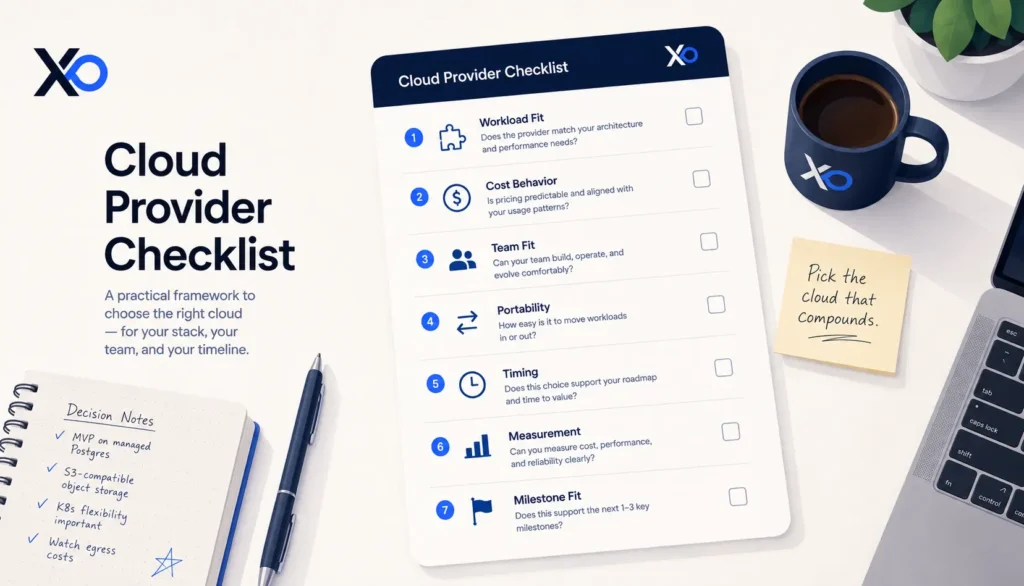
Before committing infrastructure around a provider, founders should review seven areas.
First, check workload fit. Match the provider to your real product needs: web app hosting, managed database, AI compute, data pipeline, storage, network, compliance, developer tooling, or global availability.
Second, check cost behavior. Understand which services become expensive as usage grows. Pay attention to egress, storage growth, database scaling, logs, support, GPUs, and managed AI services.
Third, check team fit. A powerful platform can slow you down if nobody on the team can operate it cleanly.
Fourth, check portability. Decide which layers should stay provider-neutral and which layers can be provider-specific.
Fifth, check timing. Some credits expire after a fixed period. If you apply before you can use them, you may waste the window.
Sixth, check measurement. Set budgets, alerts, tags, owners, and usage reviews before the bill matters.
Seventh, check milestone fit. The cloud decision should support the next proof point, not a vague future scale story.
This turns cloud evaluation from a perk comparison into an operating decision.
Decision rules
- If the credit is large but the workload fit is weak, wait.
- If the provider helps prove the next customer or technical milestone, consider it seriously.
- If a managed service saves meaningful engineering time on a proven workload, use it deliberately.
- If a managed service creates lock-in before usage is real, use a lighter option.
- If post-credit cloud costs would damage gross margin, redesign before scaling.
- If the team cannot explain the monthly bill drivers, slow down.
- If the startup is pre-product-market fit, optimize for learning speed and cost visibility.
- If the startup has repeatable usage, optimize for reliability, unit economics, and operational clarity.
- If a workload is experimental, keep it isolated from the core architecture.
- If switching later would be painful, write down why the lock-in is worth it.
Common Anti-Patterns That Make Credits Dangerous
The first anti-pattern is perk-first architecture. This happens when the startup builds around what is discounted instead of what the product needs.
The second anti-pattern is free-tier sprawl. Every free or credited service adds another account, permission layer, billing surface, and debugging path.
The third anti-pattern is maturity cosplay. The team copies the infrastructure shape of a later-stage company before it has later-stage usage.
The fourth anti-pattern is invisible unit economics. Credits hide the true cost of serving customers, especially for AI, data-heavy, and developer-tool products.
The fifth anti-pattern is no owner. Nobody reviews usage, expiration dates, service choices, or migration risk until the bill becomes painful.
These anti-patterns do not make cloud credits bad. They make cloud credits unmanaged.
How to Use This at Your Stage
Bootstrapped technical founders
Keep the stack boring until the product proves it deserves complexity. Use credits to reduce the cash cost of necessary experiments, not to adopt a provider-specific architecture too early. Cash discipline and architecture simplicity matter more than theoretical scale.
Pre-seed SaaS and marketplace teams
Your main job is proof. Use credits for customer pilots, reliable demos, basic production infrastructure, and experiments that test activation or liquidity. Do not overbuild for enterprise-grade scale before you have repeat usage.
AI and developer-tool startups
Your infrastructure decisions may affect product quality earlier than a conventional SaaS company. Model compute, inference, data movement, observability, and storage carefully. The cheapest credited path can become expensive if it trains the product around the wrong runtime assumptions.
Seed-stage teams
At seed, the question shifts from “Can we test this?” to “Can we operate this repeatedly?” Credits can support scale, but only after the workload is connected to customer growth, retention, revenue, or reliability. This is where post-credit cloud costs and ownership discipline become board-level operating issues.
Use XRaise to compare startup cloud perks before committing your infrastructure path:
- Explore startup cloud and software perks through XRaise: Startup perks and tools
- Compare AWS options: AWS Activate
- Compare Google Cloud options: Google Cloud
- Compare Microsoft startup options for Azure-oriented teams: Microsoft for Startups
- Compare a simpler infrastructure path for some early products: DigitalOcean Startup Program
- For AI teams evaluating GPU-related startup infrastructure, review: AWS credits through NVIDIA Inception
The best XRaise workflow is simple: compare the available perks, shortlist the providers that match your workload, then run the Credit Fit Filter before your team builds around one stack.
Final Takeaway
Cloud credits should buy learning, not accidental lock-in.
The right provider is not always the one with the biggest credit. It is the one that helps your startup prove the next technical and commercial milestone while keeping costs, complexity, and future choices visible.
Avoid the cloud credit mistakes that turn temporary discounts into permanent architecture. Choose the cloud stack your product is earning, not the one a perk made feel free.