TL;DR
- Choose workflow before tool.
- Use AI where review loops are clear.
- Avoid overlapping subscriptions.
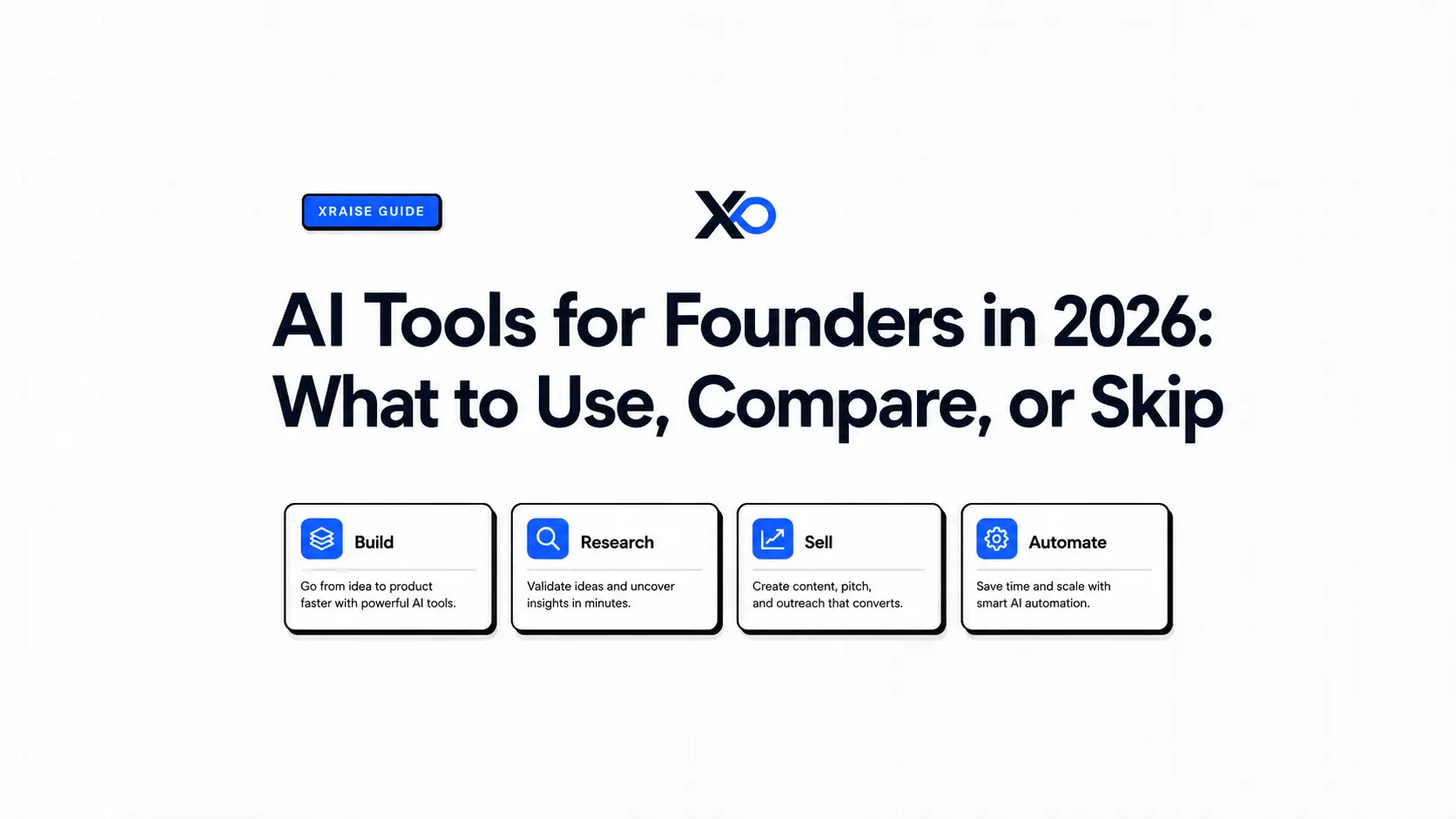
- Coding, research, sales, and automation tools create the fastest leverage.
- Early founders should prioritize proof, not polish.
- Use startup AI credits only when they replace real spend.
- Review relevant perks on XRaise before paying full price.
Why AI Tools for Founders Matter Now
AI tools for founders matter more in 2026 because they are no longer limited to writing drafts or answering questions. They now sit inside code editors, browsers, CRMs, support desks, meeting workflows, app builders, analytics tools, automation platforms, and cloud infrastructure.
That creates a real advantage for lean teams. A solo founder can test a landing page, build a prototype, research customer segments, summarize calls, draft outbound, clean data, and automate follow-up without hiring a full team.
It also creates a trap.




When every product claims to save time, founders can accidentally build an AI tool stack that takes more time to manage than the original workflow. One tool writes copy. Another rewrites it. A third schedules posts. A fourth summarizes sales calls. A fifth updates the CRM. A sixth generates dashboard insights. Soon the company has more output, but not more clarity.
The best AI tools for startups are not the loudest products. They are the tools that shorten a specific workflow, improve decision quality, and create proof the founder can act on.
The Founder Problem: AI Abundance Can Slow You Down
Early-stage teams usually have limited time, money, and attention. That makes AI attractive. It also makes tool sprawl dangerous.
Founders often make four mistakes:
- They test tools without naming the workflow.
- They buy overlapping tools because each one looks cheap alone.
- They automate weak processes before the process works manually.
- They trust AI output without building a review loop.
The result is startup theater: more assets, more dashboards, more messages, more summaries, and more “velocity,” but no better answers.
Do customers care? Are users activating? Is the product improving? Can the sales motion repeat? Is the team learning faster?
Those are the questions that matter.
This is why AI tools for founders should be chosen like operating leverage, not like toys.
The Core Framework: Workflow Before Tool
Use the Workflow Before Tool framework.
A startup should adopt an AI tool only when it passes four tests:
| Test | Founder question |
|---|---|
| Workflow | Which repeated workflow is slow, expensive, or blocked? |
| Leverage | Does the tool reduce time, cost, or headcount pressure? |
| Review | Can a human check quality before customers or code are affected? |
| Proof | Will this create evidence that changes the next decision? |
The rule is simple:

Startup Perks AI Assistant
Have questions about credits? Let's chat instantly.
AI tool decision = workflow bottleneck + review loop + measurable proof
If any part is missing, wait.
This framework keeps the founder from asking vague questions like “Should we use more AI?” and moves the decision toward practical questions:
- Should we use AI coding tools because engineering is the bottleneck?
- Should we use AI research tools because market learning is too slow?
- Should we use AI sales tools because founder-led selling is becoming hard to manage?
- Should we use AI automation tools because repeated operations are stealing build time?
- Should we use startup AI credits because usage-based costs are becoming material?
AI tools for founders work best when they help the team move from vague effort to visible proof.
Main Category Breakdown: Where AI Tools Actually Speed Founders Up
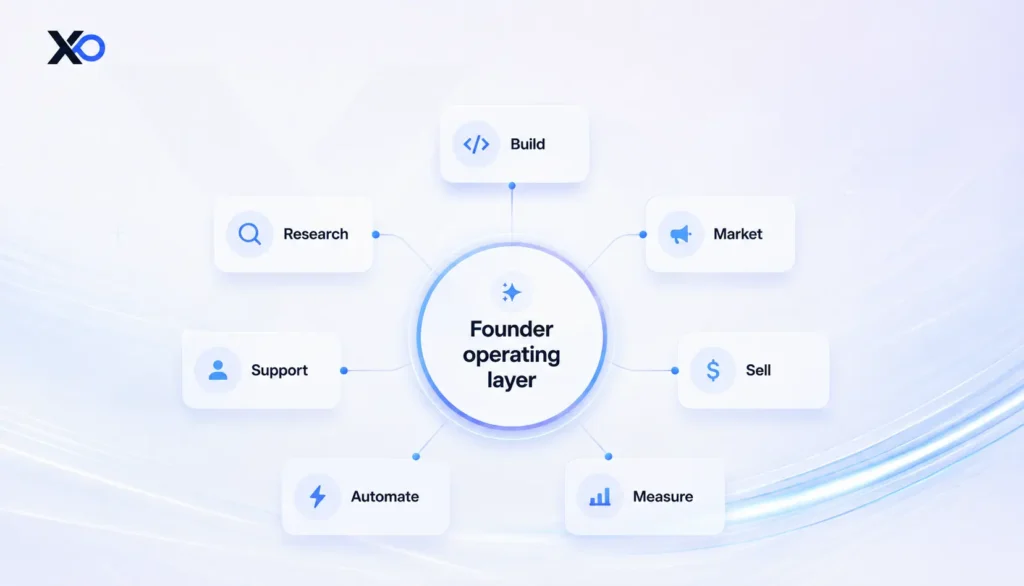
AI research tools
AI research tools help founders turn messy information into usable judgment. They can summarize customer interviews, compare competitors, analyze positioning, draft discovery questions, synthesize market reports, and prepare investor or customer research.
General assistants like Claude, research-first tools like Perplexity, and document tools like NotebookLM can be useful when a founder has too much context to process manually.
Use them when you need to understand a market, prepare customer interviews, analyze feedback, or compare strategic options.
Wait if you are using research tools to avoid talking to customers. Synthetic research should sharpen discovery, not replace it.
Compare:
- source visibility
- file and document handling
- accuracy on niche topics
- team collaboration
- privacy controls
- ability to turn research into decisions
The output should be a sharper decision, not a longer memo.
AI Coding Tools
AI coding tools are often the highest-leverage category for technical founders and SaaS teams. Tools like Cursor and GitHub Copilot can help with code completion, refactoring, tests, bug fixes, documentation, and agentic development workflows.
Use them when your team has a real repo, clear specs, tests, and someone capable of reviewing the result.
Wait if nobody can judge code quality, security risk, architecture fit, or maintainability. AI can accelerate engineering, but it can also accelerate bad decisions into production.
Compare:
- codebase understanding
- test-running workflow
- editor and GitHub integration
- security controls
- model choice
- pull request review support
- cost per active developer
For early founders, the goal is not to “vibe code” everything. The goal is to shorten the loop from idea to working, reviewed software.
AI App Builders and Prototype Tools
AI app builders help founders create working prototypes, internal tools, landing pages, and lightweight MVPs from prompts. Replit Agent, Lovable, and v0 are examples founders may compare.
Use them when speed to prototype matters more than perfect architecture. They are useful for demoing a workflow, testing demand, building a small admin tool, or creating a clickable product surface for customer feedback.
Wait if you are building regulated infrastructure, complex permissions, deep data models, or anything that requires careful long-term architecture from day one.
Compare:
- code ownership
- database and backend options
- deployment path
- ability to export or extend
- security posture
- design quality
- cost after usage grows
AI app builders are strongest when founders need learning velocity, not when the team is trying to skip engineering judgment forever.
AI Productivity Tools
This category includes meeting assistants, workspace search, document copilots, task assistants, inbox helpers, and team knowledge tools. Used well, they help founders preserve context and reduce admin drag.
Use them when the team has repeated meetings, customer notes, investor updates, product decisions, or internal knowledge that gets lost.
Wait if the team is still small enough that a simple doc, CRM note, or issue tracker is enough. Not every thought needs a workspace assistant watching from the rafters.
Compare:
- search quality
- permission handling
- meeting capture accuracy
- integrations with docs and tasks
- ease of cleaning stale information
- whether the team actually uses the output
Tools like Notion, Slack, and project management products increasingly include AI features. Founders can review relevant workspace and productivity perks through XRaise startup perks before adding another paid seat.
AI Marketing Tools
AI marketing tools help with positioning drafts, landing pages, SEO briefs, content outlines, ad variations, lifecycle emails, social posts, and creative testing.
Use them when you already know the ICP, pain point, and offer. AI can multiply a clear message. It cannot discover the truth of the market by itself.
Wait if your positioning is still mushy. In that case, AI will usually produce polished mush.
Compare:
- brand memory
- workflow with human editors
- SEO support
- multi-channel publishing
- ability to reuse customer language
- approval controls
- originality and factual review
The strongest use case is not “write all our content.” It is “turn verified customer insight into faster content experiments.”
AI Sales Tools
AI sales tools help with account research, enrichment, outbound personalization, meeting intelligence, objection tracking, call summaries, CRM updates, and follow-up.
Tools such as Clay, HubSpot Breeze, and sales-call intelligence products can be useful once founder-led sales starts creating repeated patterns.

HubSpot for Startups
Up to 90% discount on an AI-powered customer platform.
Use them when you have a clear ICP, enough conversations to learn from, and a CRM workflow worth maintaining.
Wait if you are still figuring out who buys. More automated outbound before the message works usually creates more rejection, not more learning.
Compare:
- data quality
- CRM sync
- call summary accuracy
- objection tracking
- workflow ownership
- deliverability risk
- compliance and consent requirements
For a practical XRaise example, founders can review Spiky.ai for AI sales call intelligence before adding another sales tool.
AI Support and Customer Success Tools
AI support tools can answer common questions, summarize tickets, suggest replies, route issues, detect themes, and reduce response time. Products like Fin show how support AI has moved from simple chatbot to customer agent.
Use them when support questions are repetitive, docs are accurate, and the team has a clear escalation path.
Wait if every support conversation is still product discovery. Early on, founder attention in support is not waste. It is learning.
Compare:
- answer accuracy
- knowledge base quality
- handoff to humans
- reporting on unresolved questions
- pricing by resolution or usage
- customer trust impact
The decision is not “Can AI answer tickets?” It is “Which support questions are now understood well enough to automate?”
AI Automation Tools
AI automation tools connect apps, transform data, trigger workflows, update records, generate summaries, route leads, and reduce repetitive operations. Zapier AI, Make, n8n, and similar tools can give small teams meaningful operating leverage.
Use them when a workflow happens often, has a reliable source of truth, and already works manually.
Wait if the process is unstable. Automating a broken process just makes the broken process faster and harder to see.
Compare:
- trigger reliability
- logs and debugging
- AI step quality
- permissions
- cost by task or operation
- owner responsibility
- failure alerts
XRaise has a practical guide to Make credits for startup workflow automation that fits this category.

Make.com for Startups
Free Teams plan for AI-powered no-code automations.
AI Analytics and Product Intelligence
AI analytics tools help founders understand product usage, retention, activation, funnel behavior, customer segments, and growth patterns. The AI layer can summarize trends, surface anomalies, suggest queries, or help non-technical teammates explore data.
Use this category when your product has real users and you know which behaviors matter.
Wait if you have not launched or if the event taxonomy is chaotic. AI cannot rescue bad tracking. It can only make bad tracking sound confident.
Compare:
- event quality
- funnel and retention analysis
- session replay
- warehouse or CRM integrations
- plain-language querying
- alerting
- startup pricing
Founders can compare Mixpanel startup analytics credits when product usage data is becoming important.
AI Infrastructure, APIs, and Startup AI Credits
AI startup tools can become expensive when the product itself depends on model calls, voice APIs, image processing, transcription, inference, vector search, or cloud workloads.
This is where startup AI credits and cloud credits matter. They can extend runway if they replace real infrastructure spend. They can also distort decisions if the founder chooses architecture around the biggest headline credit.
Use credits when you understand the workload, expected usage, expiration date, support level, and post-credit pricing.
Wait if you are claiming credits “just in case.”
Compare:
- eligible services
- credit amount and expiration
- usage caps
- compliance needs
- scaling cost
- migration risk
- customer workload fit
Voice AI founders, for example, can review Deepgram credits for voice AI startups. Infrastructure-heavy teams should also compare cloud credits for AI startups.
How to Choose AI Tools Without Chasing Hype
Use five decision rules.
First, start with the slow workflow. Do not start with the tool category. Write the sentence: “We are slow at ___ because ___.” If you cannot finish that sentence, do not buy anything yet.
Second, define the review loop. Code needs tests and reviewers. Research needs source checks. Sales copy needs deliverability and tone review. Support answers need escalation. Analytics summaries need clean data.
Third, compare replacement cost, not sticker price. A $30 monthly tool can be expensive if it adds admin. A larger subscription can be cheap if it replaces contractor hours or prevents engineering delay.
Fourth, choose one source of truth. AI tools become noisy when every system creates its own version of customer, product, or pipeline data.
Fifth, set a 30-day proof target. Keep the tool only if it improves a measurable workflow: faster prototype, more qualified interviews, fewer manual updates, shorter support response time, better activation insight, or lower API cost.
Examples and Use Cases
A solo SaaS founder might use an AI coding tool for product changes, an AI research tool for competitive mapping, an app builder for fast landing page tests, and a lightweight CRM assistant for customer notes. That is enough. The goal is not a big AI tool stack. The goal is shipping and learning faster.
A technical AI startup founder might prioritize coding agents, model evaluation tools, cloud credits, voice or data APIs, observability, and product analytics. Marketing automation can wait until the product workflow is clearer.
A product-led founder might use AI research tools for interview synthesis, AI product analytics for activation patterns, AI support tools for repeated questions, and AI marketing tools for onboarding emails.
A founder-led sales team might use Clay-style research, a CRM with AI summaries, call intelligence, and automation for follow-up. But only after the ICP and sales motion are specific enough to benefit from structure.
Mistakes and Anti-Patterns
Choosing tools before defining the workflow
Founders often buy the exciting tool first and invent the workflow later. That creates setup work without operating clarity. Instead, name the bottleneck before comparing vendors.
Using AI to create more output than the team can review
More drafts, more leads, more tickets, and more code do not help if nobody can check quality. Instead, match AI volume to human review capacity.
Automating customer discovery too early
Early customer conversations are not admin. They are signal. Instead, use AI to prepare, summarize, and organize discovery, while keeping the founder close to the conversation.
Comparing discounts instead of total cost
Startup credits can hide renewal risk, migration cost, and usage-based pricing. Instead, model what the tool costs after the discount ends.
Trusting AI analytics on messy data
If the events are wrong, the insight is wrong. Instead, clean the tracking plan before adding smart summaries.
Copying later-stage startup stacks
A seed-stage company does not need every tool used by a Series C team. Instead, choose tools that match the proof your stage requires.
Practical Comparison Table
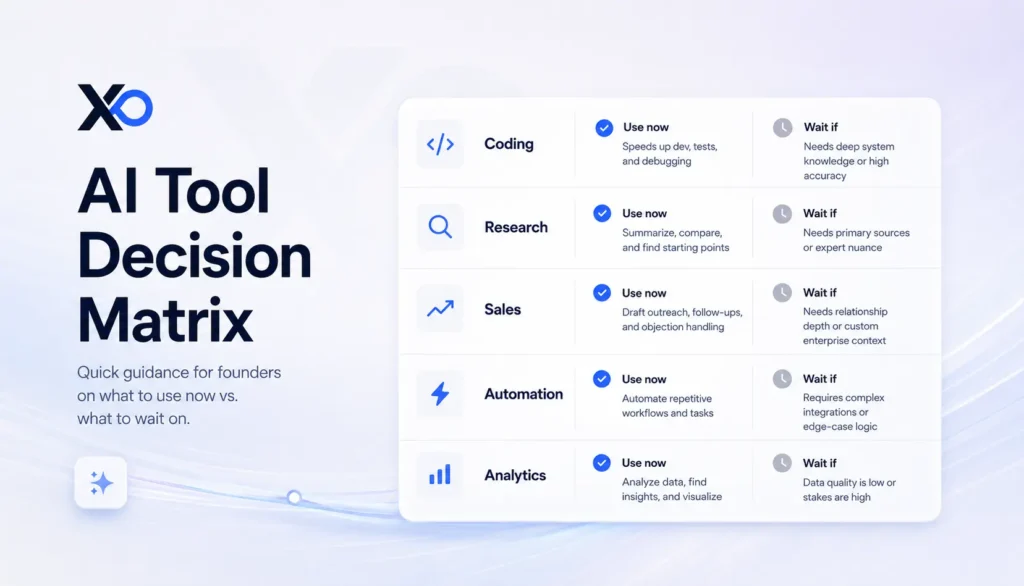
| AI tool category | Best for | Use when | Wait if | What to compare |
|---|---|---|---|---|
| AI research tools | Market, customer, and competitor synthesis | You need faster decisions from messy information | You are avoiding customer conversations | Source quality, file handling, privacy, collaboration |
| AI coding tools | Shipping, refactoring, tests, bug fixes | You have specs, repo context, and review capacity | Nobody can review code quality | Codebase understanding, test workflow, security, Git support |
| AI app builders | MVPs, demos, internal tools | Learning speed matters more than architecture | The product needs complex infrastructure | Export, backend, deployment, ownership |
| AI productivity tools | Notes, docs, meetings, internal knowledge | Context is getting lost | A simple doc still works | Permissions, search, integrations, cleanup |
| AI marketing tools | Content experiments and campaign variants | Positioning and ICP are clear | Message-market fit is unclear | Brand controls, SEO, workflow, originality |
| AI sales tools | Prospecting, enrichment, call intelligence | ICP and pipeline are active | You are still exploring who buys | Data quality, CRM sync, compliance, deliverability |
| AI support tools | Repeated customer questions | Docs are accurate and issues repeat | Support is still discovery | Accuracy, handoff, escalation, pricing |
| AI automation tools | Repetitive operations | Workflow is stable and owned | The process changes weekly | Reliability, logs, failure alerts, cost per task |
| AI analytics tools | Product usage and retention insight | You have users and clean events | Tracking is messy | Event model, funnels, retention, query layer |
| AI infrastructure and credits | AI product usage costs | Usage is real or near-term | You are claiming credits speculatively | Expiration, covered services, scaling cost |
What to Do at Each Startup Stage
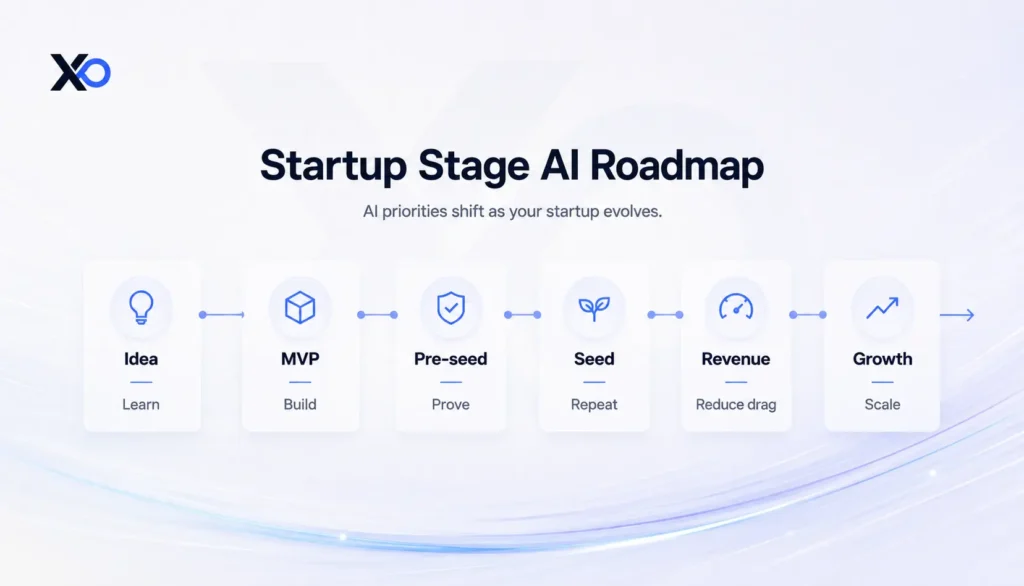
| Startup stage | Priority | Tools/resources to consider | What to avoid | What to measure |
|---|---|---|---|---|
| Idea stage | Learn faster | AI research tools, interview prep, lightweight notes | Paid stacks before customer proof | Interview volume, repeated pain, willingness to act |
| MVP stage | Build and test | AI coding tools, app builders, simple analytics | Complex automation and bloated CRMs | Prototype speed, activation, feedback quality |
| Pre-seed | Create proof | AI tool stack for product, sales notes, support themes, credits | Buying tools because investors expect maturity | Usage, retention, qualified pipeline, burn |
| Seed | Improve repeatability | AI sales tools, product analytics, automation, support AI | Automating weak processes | CAC signals, activation, support load, cycle time |
| Early revenue | Reduce drag | CRM AI, call intelligence, analytics, workflow automation | Too many disconnected sources of truth | Payback, conversion, expansion, churn reasons |
| Growth stage | Scale with control | AI automation tools, support agents, data workflows, governance | Uncontrolled agent access and tool sprawl | Cost per workflow, quality, security, team adoption |
Practical Playbook
Step 1 — Map your slowest workflows
List the workflows that slow the company down: shipping, research, customer calls, content, outbound, support, reporting, analytics, or internal ops. Rank them by founder time consumed.
Step 2 — Pick one AI tool category per bottleneck
Do not trial ten tools at once. Choose one category for one workflow. For example: AI coding tools for bug fixes, AI sales tools for call summaries, or AI automation tools for CRM updates.
Step 3 — Define the review loop
Decide who checks the output and what “good enough” means. Code needs tests. Research needs verification. Sales messages need tone and deliverability checks. Support answers need escalation.
Step 4 — Run a 30-day proof test
Set one measurable target. Examples: ship two product changes faster, reduce manual CRM updates by 50%, summarize every sales call within 10 minutes, or cut support first-response time.
Step 5 — Keep, cut, or find credits
Keep tools that create proof. Cut tools that create admin. Delay tools that are too early. Before paying full price, explore AI and productivity startup perks through XRaise.
FAQ
What are the best AI tools for startups in 2026?
The best AI tools for startups are the ones tied to real workflows: coding, research, prototyping, sales, support, analytics, automation, and infrastructure. Founders should avoid universal rankings and instead compare tools by speed gained, review quality, cost, and proof created.
What are the best AI tools for founders who want to build faster?
The best AI tools for founders are usually coding agents, AI app builders, research assistants, automation tools, and customer workflow tools. The right mix depends on whether the founder is slowed down by product development, market learning, sales, support, or operations.
Which AI coding tools should early founders compare?
Early founders should compare AI coding tools by codebase understanding, test support, Git workflow, security controls, and ease of review. Cursor, GitHub Copilot, Claude Code, and similar tools can help, but only when someone can inspect the output.
Are AI tools for solo founders worth paying for?
Yes, if they reduce real founder bottlenecks. AI tools for solo founders are most useful when they help ship product, summarize research, manage sales notes, create content tests, or automate repeat work. They are not worth it when they add maintenance without improving decisions.
Should non-technical founders use AI app builders?
Yes, for prototypes, demos, internal tools, and early validation. Non-technical founders should still understand ownership, export limits, security, data structure, and what happens when the prototype needs custom engineering.
Are AI sales tools useful before product-market fit?
AI sales tools can help summarize calls and organize learning before product-market fit. They are risky when used to scale outbound before the ICP, pain point, and message are clear. Early founders should use them to learn, not just send more messages.
How should founders use startup AI credits?
Use startup AI credits when they reduce costs for workflows you already need, such as voice APIs, cloud infrastructure, analytics, automation, or AI product workloads. Do not claim credits just because the headline amount is large.
What should founders avoid when building an AI tool stack?
Avoid overlapping tools, unclear owners, weak review loops, messy data, speculative credits, and automations that hide broken processes. A good AI tool stack should make the company faster and clearer, not just busier.
When should a startup upgrade from free AI tools to paid tools?
Upgrade when the free tool blocks a workflow that matters. Good reasons include better context limits, team collaboration, security controls, integrations, reliability, or usage capacity. Bad reasons include novelty, fear of missing out, or unused credits.
How can XRaise help founders choose AI startup tools?
XRaise helps founders compare startup perks, credits, discounts, and tool resources before paying full price. That helps teams connect AI startup tools to workflow needs, eligibility, and runway instead of buying software blindly.
Final Takeaway
AI will not make a startup faster by itself. It makes a startup faster when the founder connects each tool to a workflow, review loop, and proof target.
Start with the bottleneck. Choose the smallest useful tool. Measure whether it improves shipping, learning, selling, supporting, or operating. Then use XRaise to compare startup AI credits, software perks, and founder resources before adding another cost to the stack.