
TL;DR
- Tool sprawl usually starts with reactive buying.
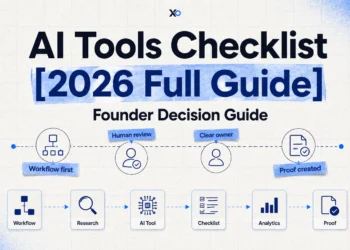
- Use the Job -> Owner -> Proof filter.
- Remove overlap before adding new software.
- Avoid automating workflows that are still unclear.
- Review your stack before paying full price.
Why Startup Tool Mistakes Start with Unclear Workflows
Early-stage founders buy tools under pressure.
Sales feels scattered, so the team adds a CRM. Support is noisy, so they add a help desk. Product decisions feel vague, so they add analytics. Team communication is messy, so they add project management. Reporting takes too long, so they add automation. AI feels urgent, so they add another tool.
Each decision can be reasonable in isolation. The problem is that the startup tool stack starts growing without a clear operating model underneath it.



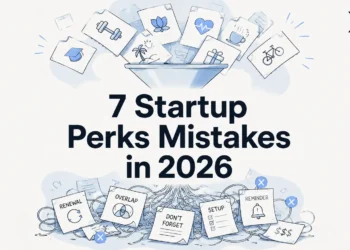
After a few months, the problem changes:
- The same customer data lives in three places.
- Nobody knows which dashboard is trusted.
- Two tools handle the same workflow.
- Automations break because the process keeps changing.
- Team members ignore tools they did not choose.
- Software renewals create surprise burn.
- Discounted tools become expensive after the startup stops using them well.
This is why startup tool mistakes are really workflow, ownership, and decision mistakes.
The real question is not, “Which tool should we add?”
Ask:

Startup Perks AI Assistant
Have questions about credits? Let's chat instantly.
“Which workflow deserves a tool, and what proof would show that the tool made it better?”
Why Tool Sprawl Increases Burn and Complexity
Tool sprawl is easy to underestimate because most software costs look small at first.
A $20 seat here, a $99 plan there, an annual subscription, a startup discount, an AI add-on, a data connector, a second automation tool. None looks dangerous alone.
But software cost is only one layer.
There is also context cost. Every new tool creates another place where decisions, customer notes, metrics, files, permissions, and notifications can live.
There is ownership cost. Someone needs to configure the tool, teach the team, review usage, cancel it if it stops helping, and protect the data inside it.
There is switching cost. The longer a tool stays in the stack, the more workflows grow around it, even if nobody would choose it again today.
There is decision cost. When multiple systems show different versions of reality, founders waste time reconciling tools instead of making decisions.
That is why a messy startup software stack does not only waste money. It slows the startup down.
The Job -> Owner -> Proof Filter
Before adding a new tool, run it through a simple three-part filter:
- Job
- Owner
- Proof
This is the fastest way to avoid the most common startup tool mistakes.
Job
What exact job should the tool do?
Do not answer with a category like “analytics,” “sales,” “support,” “AI,” or “automation.”
Use a workflow sentence instead:
- Track qualified sales conversations from first call to next step.
- Show where activated users drop before inviting teammates.
- Route inbound leads to the founder within five minutes.
- Turn customer support themes into product feedback.
- Keep product specs, launch notes, and decisions in one place.
If the job is vague, the tool will become vague too.
Owner
Who owns the tool?
Every tool needs one accountable person, even if multiple people use it. The owner decides how the tool fits the workflow, what data belongs there, whether the team is using it, and whether it should renew.
Without an owner, tools become shared clutter.
This is especially important for startup tools that touch revenue, customer data, analytics, automation, finance, or AI workflows.
Proof
How will you know the tool helped?
Useful proof might be:
- Faster response time
- Cleaner pipeline visibility
- Better activation insight
- Fewer manual handoffs
- More consistent follow-up
- Shorter support resolution time
- Less founder time spent on admin
- A decision the team can make with more confidence
If the tool cannot create proof in 30 to 60 days, it probably does not belong in the stack yet.
Mistake 1: Buying by Category Instead of Workflow

Founders often think, “We need a CRM,” or “We need product analytics,” or “We need an AI tool.”
That is category-first buying. It creates a stack that looks complete but does not match how the company actually works.
A CRM does not fix unclear sales stages. Product analytics does not fix undefined activation. Automation does not fix a process that changes every week. AI does not fix weak positioning or no owner for follow-up.
Buy by workflow instead.
For example, do not buy analytics because a startup “should have analytics.” Buy analytics when the team needs to answer a specific product question, such as which onboarding step blocks activation.
The right startup tool stack starts with decisions, not categories.
Mistake 2: Stacking Overlapping Tools
Overlap is one of the quietest forms of tool sprawl.
It happens when the team has two places for docs, two places for tasks, two places for customer notes, two places for dashboards, two places for automations, or three AI tools that all summarize, draft, and search.
Overlap creates argument, not leverage.
One person checks the project tool. Another checks the workspace. Customer notes live in the CRM, support tool, meeting transcripts, and a spreadsheet. Metrics appear in multiple dashboards, but the numbers do not match.
Before adding software, ask:
- What tool already partly does this job?
- Is the current problem tool quality or workflow discipline?
- Which system should be the source of truth?
- What will we remove if we add this?
If you cannot name what gets removed, you may be adding complexity instead of capability.
Mistake 3: Using Startup Perks as Permission to Overbuy
Startup perks, credits, and discounts can help founders test software, reduce early cash burn, and compare options before committing to full-price plans.
The mistake is treating a discount as a decision.
A free or discounted tool still has a cost. It can create onboarding work, data fragmentation, renewal risk, security questions, and switching cost. If the tool does not match a real job, the discount only makes it easier to keep clutter.
Use XRaise to find relevant startup perks, credits, and discounts before paying full price, but make the final choice with the Job -> Owner -> Proof filter.
The perk should reduce the cost of a decision you already understand. It should not create a new decision just because the offer exists.
Mistake 4: Automating Before the Process Is Stable
Automation is powerful when the process is repeatable.
It is expensive noise when the process is still unclear.
Founders often automate lead routing before they know which leads matter, customer emails before they know the real objection, or reporting before they know which metric drives decisions.
The result is brittle automation that breaks, routes the wrong work, or hides useful customer friction.
Use this rule: manual first, repeatable second, automated third.
If the founder cannot describe the manual workflow clearly, automation will usually scale confusion.
Mistake 5: Tracking Metrics Before Defining Decisions
Analytics tools are often added with good intent. Founders want better visibility, cleaner dashboards, and more confidence.
But product analytics for startups only helps when the team knows which decisions the data should support.
If the dashboard has no decision attached, it becomes decoration. The startup tracks signups, feature clicks, activation events, retention curves, and campaign performance, but nobody knows which number should change the roadmap.
Before adding analytics, define the decision:
- Are we trying to improve activation?
- Are we testing retention?
- Are we comparing acquisition channels?
- Are we prioritizing onboarding fixes?
- Are we deciding whether a feature deserves more investment?
Metrics should reduce uncertainty. If they only create more reporting work, the tool is not solving the right problem.
Mistake 6: Copying a Later-Stage Startup Stack Too Early
It is tempting to copy the tools used by companies that already look successful.
But later-stage companies have different problems. They need compliance, team permissions, formal reporting, sales operations, customer success systems, finance workflows, and cross-functional coordination.
An early-stage startup usually needs speed, learning, and proof.
Copying a mature SaaS stack too early can make a five-person team operate like a fifty-person company without the revenue, customers, or repeatability to justify it.
This is one of the startup tool mistakes that feels responsible from the inside. It looks like preparation, but creates premature operational weight.
Use tools that match your stage. Add maturity when the workflow earns it.
Mistake 7: Not Reviewing Renewals and Usage
The easiest tool to keep is the one nobody reviews.
Many teams only audit software when cash gets tight. By then, unused subscriptions, duplicate tools, forgotten trials, and inactive seats have already leaked runway.
A startup tool stack needs a renewal rhythm.
Every month, review:
- Which tools are used every week?
- Which tools have a clear owner?
- Which tools changed a decision?
- Which tools reduced manual work?
- Which tools overlap with another tool?
- Which tools are about to renew?
- Which tools would we not buy again today?
This does not need to be heavy. A simple monthly stack review can save more runway than random cost cutting.
Decision Rules for Avoiding Startup Tool Mistakes
- If the workflow is unclear, do the manual version first.
- If two tools solve the same job, choose one source of truth.
- If nobody owns the tool, do not renew it.
- If the tool creates proof within 30 to 60 days, keep testing it.
- If a discount lowers the cost of a necessary tool, use it deliberately.
- If the tool only makes the company feel more mature, wait.
- If an automation breaks often, simplify the process before rebuilding it.
- If analytics do not support a decision, reduce the dashboard.
- If the startup would not buy the tool again today, cancel or downgrade it.
How to Clean Up Your Startup Software Stack
Start with a one-page tool inventory.
For each tool, list the job, owner, cost, renewal date, primary users, data stored, overlap, and proof created in the last 60 days.
Then group the stack into four buckets:
Keep: tools with a clear job, owner, and proof.
Consolidate: tools that overlap with another system.
Downgrade: tools that are useful but overpowered for the current stage.
Remove: tools with no owner, no usage, no decision value, or no workflow fit.
This turns SaaS tools for startups from a pile of subscriptions into an operating system the team can manage.
What Should Founders Fix Before Adding New Tools?
Before buying more software, fix four things.
First, fix the workflow. Write down how the work should happen without the new tool.
Second, fix ownership. Assign one person to the workflow and one person to the tool.
Third, fix the source of truth. Decide where customer data, tasks, docs, metrics, or decisions should live.
Fourth, fix the review rhythm. Make sure the tool will be evaluated before it becomes a silent renewal.
This is the difference between a lean startup stack and a growing pile of apps.
Related XRaise resources
Use XRaise to compare startup tools, credits, and discounts:
- For a broader tool stack comparison, read: 25 Best Startup Tools for Founders in 2026
- For runway context, read: Startup Runway Extension
- For infrastructure decisions, read: 5 Cloud Credit Mistakes
- Explore startup software and perk options through XRaise: Startup perks and tools
- For early sales workflow discipline: HubSpot for Startups
- For product analytics decisions: Mixpanel
- For automation after the workflow is stable: Make Startup Program
- For team workspace and project workflows: Notion for Startups, ClickUp for Startups, Asana for Startups, Slack, and Miro
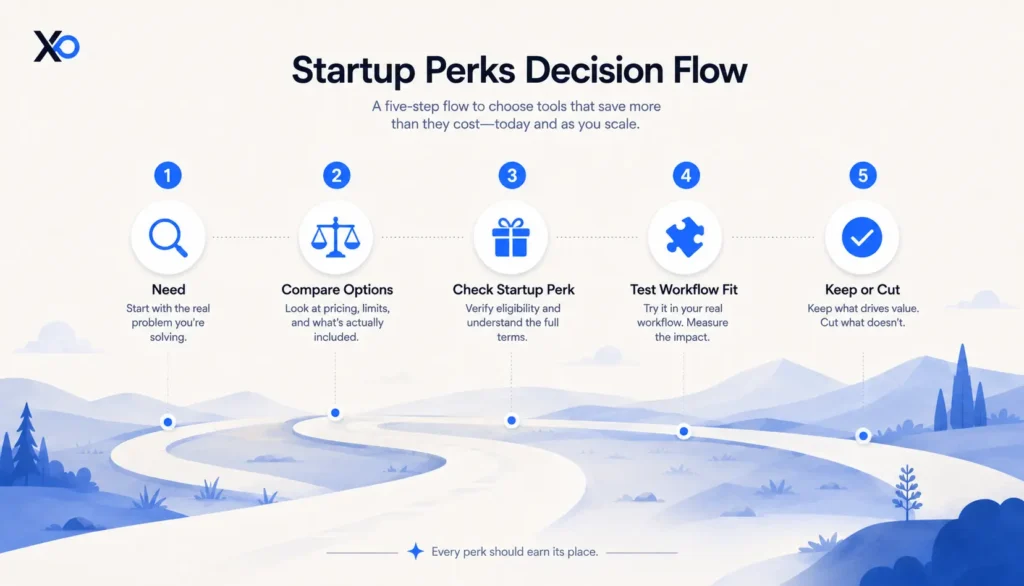
Workflow: identify the job, compare options through XRaise, reduce testing cost, and keep only tools that create proof.
Final Takeaway
The best startup tool stack is not the one with the most categories covered. It is the smallest set of tools that helps the team learn, build, sell, support, and operate with less drag.
Avoid startup tool mistakes by refusing to buy software until the workflow is clear, the owner is named, and the proof is defined.
Final rule:
Do not add a tool because the startup feels messy. Add a tool when you know exactly which workflow it will improve.