TL;DR
- Value: up to 12 months of Customer.io free for eligible startups.
- Best fit: SaaS, AI, mobile, and product-led teams building lifecycle messaging.
- Key benefit: behavioral email, SMS, push, in-app, and WhatsApp automation in one platform.
- Action: claim before scaling activation, retention, onboarding, or churn workflows.
What Is Customer.io for Startups?
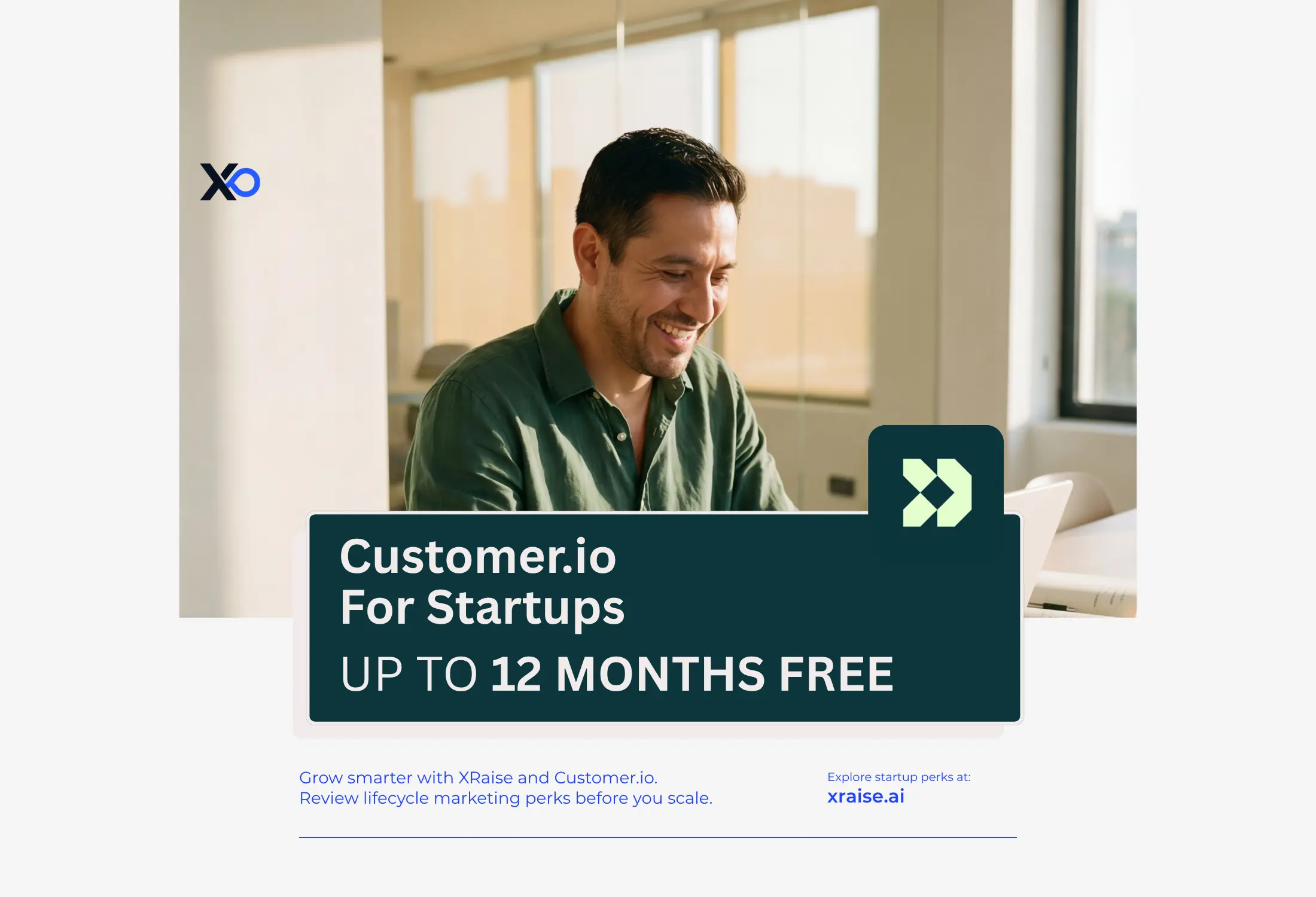
Customer.io for startups is a startup program for early-stage teams that need lifecycle marketing automation before customer engagement becomes expensive or fragmented. The official Customer.io startup page says eligible new customers can get up to 12 months free, including up to 30,000 customer profiles at no cost.

Customer.io for Startups
Up to 1 year free on a lifecycle marketing platform.
For founders, Customer.io for startups is not just an email tool. It is a customer engagement platform for behavior-based email, SMS, push, in-app, and WhatsApp messages.
Related Posts



Founders can review startup perks through XRaise and confirm the current offer on the official Customer.io startup program page before building lifecycle workflows around it.
What Does the Customer.io Startup Program Include?
The Customer.io startup program gives eligible startups access to Customer.io’s customer engagement platform for up to 12 months. The official page says the startup plan starts at $0 based on application eligibility and includes all Essentials features with additional user profiles.
| Item | Details |
|---|---|
| Offer value | Up to 12 months free |
| Included profile allowance | Up to 30,000 profiles, including people and objects |
| Core channels | Email, SMS, push notifications, in-app messages, and WhatsApp |
| Core platform areas | Journeys, Data Pipelines, Messaging, and AI Agent |
| Best fit | Lifecycle automation, activation, retention, onboarding, upsell, and customer engagement |
| Pricing caution | Confirm profile limits, channel costs, support level, and graduation pricing |
Use the free period to prove whether lifecycle messaging improves activation, trial conversion, retention, or expansion.
Who Should Use Customer.io Startup Credits?
Customer.io startup credits are best for startups that already have user behavior worth responding to: events, traits, product usage, and segments that can power better messages than a basic newsletter tool.
Strong fits include:
- SaaS startups improving onboarding, activation, and paid upgrades
- AI products guiding users through setup, prompt workflows, usage limits, and feature discovery
- Mobile apps sending push, in-app, and email journeys
- Product-led teams testing lifecycle experiments before hiring growth specialists
- Founder-led startups replacing manual follow-up with automated journeys
- Lifecycle marketers needing segmentation, data pipelines, and cross-channel orchestration
- Teams moving from scattered tools into a single customer engagement layer
Delay the perk if you have no product events, clear lifecycle moments, consented customer list, or messaging owner. Customer.io for startups can reduce cost, but it cannot fix unclear onboarding.
Who Is Eligible for Customer.io for Startups?
Customer.io eligibility matters because the program is application-based. The official requirements say businesses must have raised less than $10 million, use contact lists obtained through standard methods rather than purchased lists, and be new to Customer.io.
Prepare these details before applying:
- Company name, website, work email, and funding stage
- Confirmation that the company has raised under $10M
- Confirmation that the company is not currently and has never been a Customer.io customer
- Proof that contacts were collected through standard opt-in or customer methods
- Primary lifecycle use case, such as onboarding, retention, upsell, churn prevention, or transactional messaging
- Expected profile volume, message channels, and key integrations
Do not treat approval as automatic. Customer.io requirements should be checked before teams migrate production messaging into the platform.
How Do You Apply for the Customer.io Startup Perk?
Apply before you move production lifecycle campaigns into Customer.io, especially if you are replacing email, SMS, push, or in-app tools.
- Open the Customer.io startup program page.
- Review the current Customer.io startup offer and eligibility rules.
- Check the XRaise startup perks marketplace for the current claim path.
- Prepare funding, company, contact-list, and customer status details.
- Apply with accurate startup information.
- Confirm your free term, profile allowance, support level, and included features.
- Map your first three lifecycle journeys before importing large audiences.
- Track activation, retention, trial conversion, expansion, and churn metrics during the free period.
Start with one high-value lifecycle problem, such as signup -> first key action -> activation -> habit -> upgrade prompt.
Which Lifecycle Marketing Use Cases Make Sense?
Customer.io startup credits are most valuable when messaging is triggered by user behavior.
Activation is usually the first use case: guide users from signup to the action that predicts retention.
Retention is the second strong fit. Use segments and events to identify inactivity, failed setup, unused features, renewal risk, or usage drops.
Expansion can work once the product has enough usage signal, such as team invites, volume limits, feature depth, or repeated usage.
For mobile apps, push and in-app journeys can support habit loops. For B2B SaaS, email, in-app, and CRM handoffs often matter more than SMS.
What Customer.io Requirements and Constraints Should Founders Check?
The biggest Customer.io requirements are data readiness, consent, and post-perk cost exposure.
- Event tracking: signup, activation, billing, plan, usage, and churn-risk events must be reliable.
- Consent: contact lists must be obtained through standard methods.
- Message volume: Customer.io pricing depends on profiles, email volume, AI credits, and add-ons.
- Graduation pricing: model post-program costs before campaigns become hard to unwind.
- Ownership: assign one person to QA, suppression logic, naming conventions, and reporting.
The broader stack matters too. AWS Activate, Google Cloud for Startups, and Microsoft Azure for Startups support the product and data layer. HubSpot for Startup can own CRM context.
Pricing
Founders should check Customer.io’s official pricing page before applying or publishing. Customer.io pricing depends on plan, profiles, email volume, AI credits, channel usage, support, and custom terms.
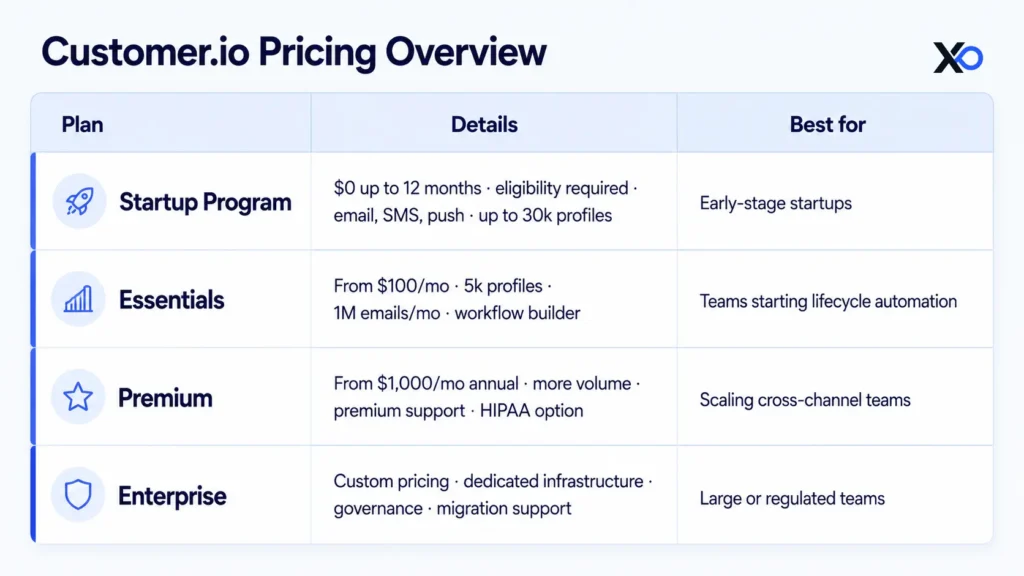
Check overage pricing for profiles, emails, AI credits, SMS, WhatsApp, and channel costs before relying on Customer.io pricing after the free period.
Related Startup Perks to Compare with Customer.io
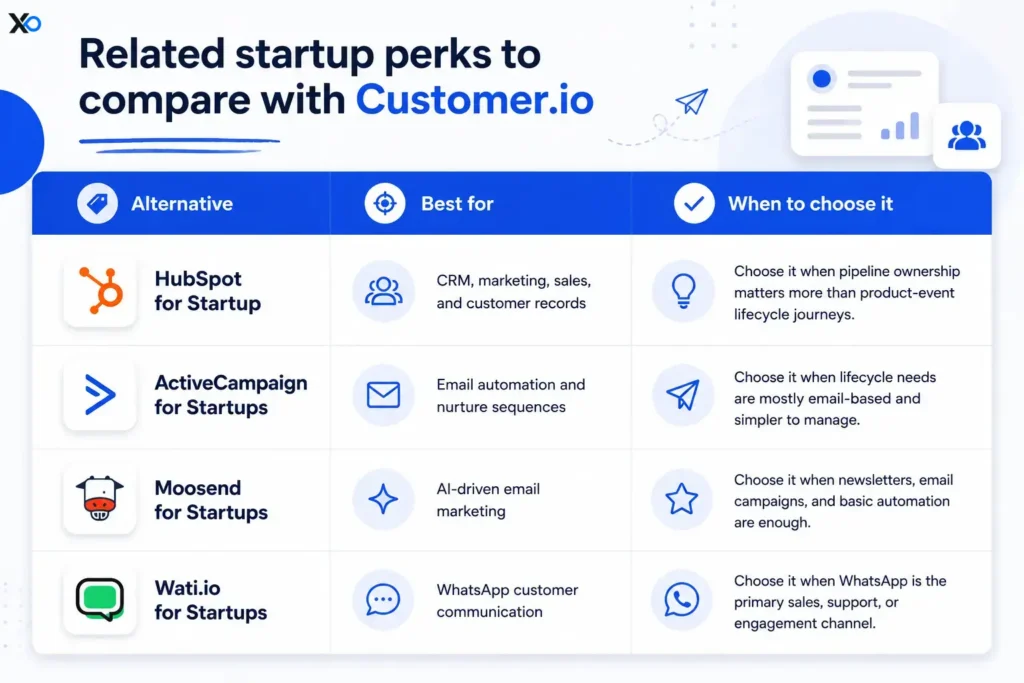
These are related XRaise perks, not all direct replacements. Compare them by workflow: CRM, email marketing, WhatsApp, or behavior-based lifecycle automation.
HubSpot for Startup
HubSpot for Startup is best when CRM, sales pipeline, marketing automation, and customer records need one platform. Choose it when sales context matters more than product-event messaging.
ActiveCampaign for Startups
ActiveCampaign for Startups is best for email automation, nurture sequences, and simpler customer journeys. Choose it when you do not yet need Customer.io’s deeper behavioral data layer.
Moosend for Startups
Moosend for Startups is best for AI-driven email marketing with a lighter setup. Choose it when newsletters and basic automation are enough.

Startup Perks AI Assistant
Have questions about credits? Let's chat instantly.
Wati.io for Startups
Wati.io for Startups is complementary when WhatsApp is the main customer communication channel. Choose it when WhatsApp sales or support is more important than broad lifecycle automation.
FAQ
How do startups get Customer.io credits in 2026?
Apply through the official Customer.io startup program and review the XRaise marketplace for the current perk path. Confirm eligibility, term length, profile allowance, and included features before migration.
Who is eligible for Customer.io startup credits?
Customer.io says eligible businesses must have raised less than $10M, use standard contact-list methods, and be new to Customer.io. Verify on the current application page.
How long do Customer.io credits last?
The official startup page says eligible startups can receive up to 12 months free. The exact term depends on application eligibility and should be confirmed during enrollment.
What can startups use Customer.io credits for?
Use Customer.io credits for lifecycle journeys, onboarding, retention, email, SMS, push, in-app, WhatsApp, segmentation, data pipelines, and AI-assisted campaign work.
What happens after Customer.io credits expire?
Customer.io says startups receive notice before graduation and an exclusive graduation offer. Still model post-perk pricing, profile volume, channel usage, and support needs.
Is Customer.io worth it for early-stage startups?
Customer.io is worth it when behavioral data can improve activation, retention, or expansion. It is less urgent before you have real events, consented contacts, and a messaging owner.
Should Your Startup Claim Customer.io for Startups?
Customer.io for Startups
Up to 1 year free on a lifecycle marketing platform.
Claim Customer.io for startups before scaling lifecycle marketing across email, SMS, push, in-app, and WhatsApp. Use the up to 12 months free startup program to validate activation, retention, onboarding, upsell, and churn-prevention workflows while messaging is still disciplined and measurable.