TL;DR
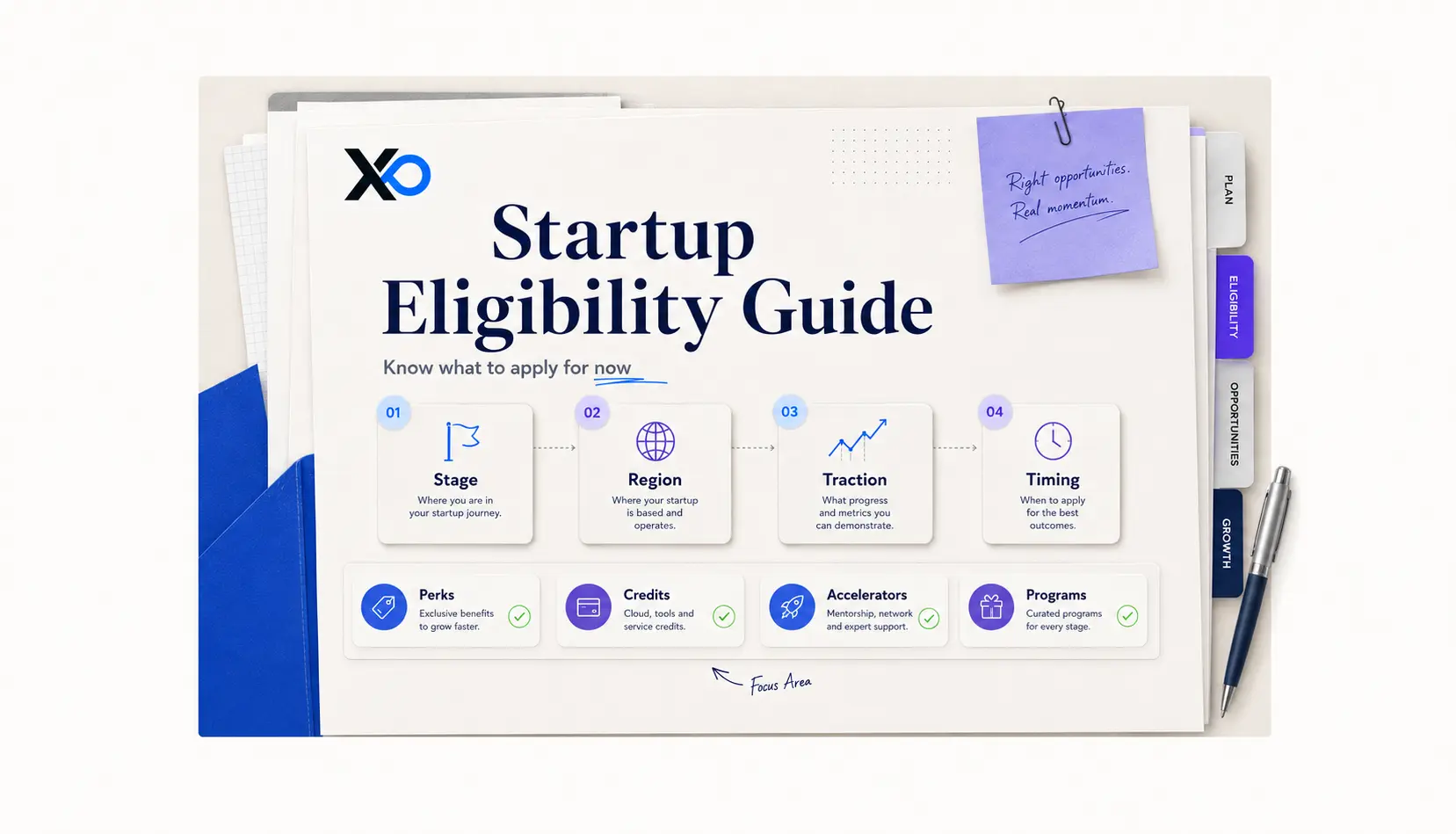
- A startup eligibility guide helps founders understand which perks, credits, accelerators, and startup programs are actually worth applying for now.
- The main goal is to match each opportunity to your company stage, legal setup, traction, region, funding path, team, product, and timing.
- This is best for founders who want to avoid wasted applications, missed deadlines, weak-fit programs, and benefits that create operational drag.
- Before applying, review startup opportunities through XRaise, confirm official terms, and build a simple eligibility system your team can reuse.
What Startup Eligibility Really Means
Startup eligibility is the set of conditions a company must meet before it can access a startup perk, cloud credit, software discount, accelerator, grant, fellowship, investor-backed program, or founder resource.
Most founders treat eligibility like a yes-or-no checklist. That is useful, but incomplete. The better way to think about startup eligibility is operational fit.
An opportunity can be technically available and still be wrong for your startup. A cloud credit may be generous but too early if you have not chosen a stack. A software perk may reduce cost but add a tool your team does not need. An accelerator may have a strong brand but require relocation, equity, or time your company cannot afford.

The question is not only “Can we apply?”
The stronger founder question is: “Does this opportunity fit where the company is, what we are trying to prove, and what we can realistically use?”
Eligibility should help founders protect runway, not create more operational noise.
The Main Eligibility Factors Founders Should Check
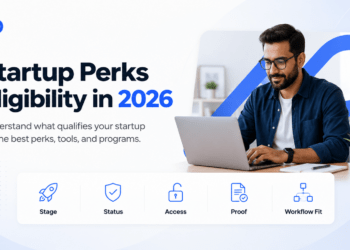
Most startup opportunities evaluate some combination of stage, traction, geography, incorporation, funding, team, product type, and timing. The exact rules change by program, but the pattern is consistent.
| Eligibility factor | What to check | Why it matters |
|---|---|---|
| Stage | Idea, MVP, launched, revenue, funded | Programs often target a specific maturity level. |
| Region | Country, state, market, relocation needs | Some offers are limited by geography or legal access. |
| Incorporation | Legal entity, age, registration status | Credits and accelerators may require a company entity. |
| Funding | Bootstrapped, pre-seed, seed, investor-backed | Some programs require or exclude certain funding paths. |
| Traction | Users, revenue, pilots, waitlist, usage | Accelerators and grants often need proof of momentum. |
| Team | Founder status, technical ability, full-time work | Some programs prefer committed teams over solo experiments. |
| Product type | SaaS, AI, marketplace, hardware, nonprofit | Eligibility can depend on what you are building. |
| Timing | Deadline, launch window, credit expiration | A good opportunity can be wasted if used too early. |
The most common mistake is applying only because the headline benefit looks attractive. Founders should first ask whether the requirement set matches the company they are actually running.
Eligibility by Startup Stage
Stage is usually the first eligibility filter. A pre-product founder, an MVP-stage team, and a seed-stage startup may all be “early-stage,” but they need different opportunities.
Idea Stage
At the idea stage, the strongest opportunities are usually learning resources, lightweight software perks, founder communities, no-code tools, free tiers, and startup education programs.
Many serious credits and accelerators will be too early unless the program is specifically designed for ideation or founder discovery. Applying too soon can waste time and sometimes reduce future eligibility if a program limits repeat applications.
MVP Stage
At the MVP stage, eligibility becomes more practical. Founders may qualify for startup software perks, cloud credits, analytics tools, workspace tools, and early startup programs that support product development.
This is where XRaise can be useful as a discovery layer. Founders can compare the Startup Perks Directory to find relevant tools and credits without treating every offer as equally urgent.
Launched but Pre-Revenue
Once a startup is live, eligibility often depends on usage, customers, public presence, product category, and proof that the team is active. Programs may ask for a website, company email, product demo, founder LinkedIn profiles, or active customer development.
This is a strong stage for applying to credits and startup tool programs because the team can actually use the benefits. It is also a good stage to prepare accelerator applications if the company has a clear problem, market, and early proof.
Revenue or Funded Stage
Revenue and funding can unlock stronger opportunities, but they can also close doors. Some programs are only for companies under a certain funding amount, company age, headcount, or annual revenue threshold.
At this stage, founders should track which programs reduce real spend, which create partnerships, which support hiring or sales, and which are distractions.
Perks, Credits, Accelerators, and Programs Are Not the Same
Founders often group startup opportunities together, but eligibility works differently across each type.
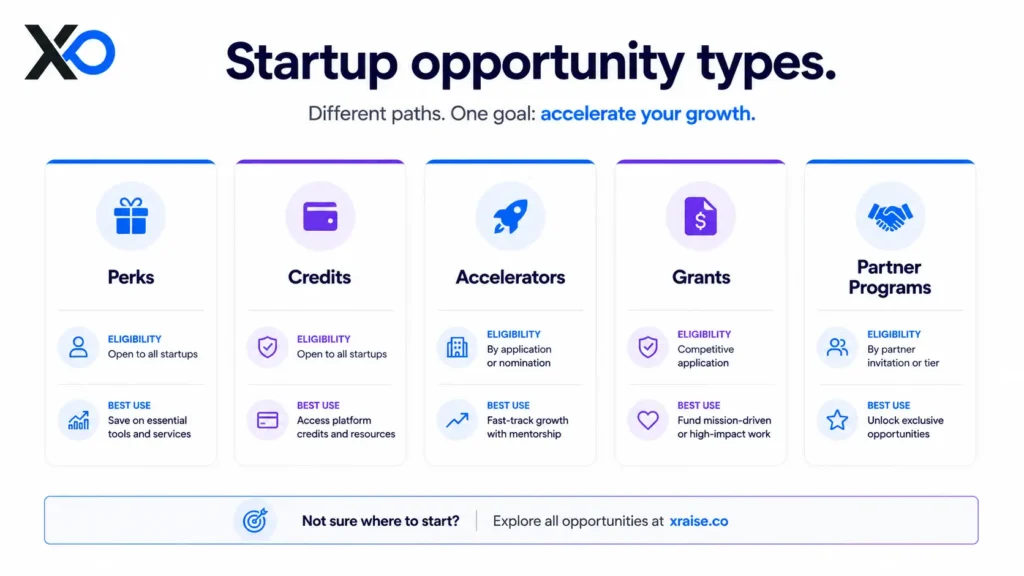
A founder should not use the same application logic for every opportunity. A software perk may require basic company information. A cloud credit may require technical usage planning. An accelerator may require a sharper story about traction, market, and why now.
How to Evaluate Perk Eligibility
Startup perks usually help founders reduce software, operations, marketing, analytics, support, finance, design, cloud, or productivity costs.
Perk eligibility is often lighter than accelerator eligibility, but founders should still evaluate fit. The best startup perks are not the ones with the biggest discount. They are the ones your team would likely use even without the discount.
Before claiming a perk, check:
| Question | Founder decision |
|---|---|
| Do we already need this tool? | If not, wait. A discount can still add distraction. |
| Who will own setup? | Perks fail when no one owns implementation. |
| What happens after the offer ends? | Avoid surprise cost cliffs. |
| Does it replace an existing tool? | Consolidation is often better than tool sprawl. |
| Does it improve a current workflow? | Good perks reduce friction, not just price. |
For example, a founder building early sales infrastructure may review HubSpot startup perks through XRaise.

HubSpot for Startups
Up to 90% off HubSpot’s AI-powered customer platform.
A product-led team organizing internal work may compare tools like Notion for Startups through XRaise.

Notion for Startups
Up to 6 months free on Notion Business with Notion AI included.
The operating rule is simple: claim perks that support an active workflow, not imagined future complexity.
How to Evaluate Credit Eligibility
Startup credits are often more valuable than ordinary discounts because they can offset infrastructure, cloud, AI, hosting, database, or platform costs. They also carry more operational risk.
Credits often depend on company stage, incorporation status, affiliation with a partner or investor, technical use case, previous credit usage, account history, region, and billing setup.
Cloud credits are a clear example.
A founder may qualify for AWS Activate startup credits, Google Cloud startup credits, Microsoft for Startups, or DigitalOcean startup credits listed on XRaise. But eligibility is only the first filter. The better question is whether the credit matches the infrastructure your team can actually build, maintain, and afford after the credit expires.
AWS Activate
AWS Activate is usually the first program to compare if your startup is building a broad infrastructure-heavy product, using AWS-native services, or planning to work with tools like Bedrock, S3, Lambda, EC2, or SageMaker. It can be useful for teams that already expect AWS to become part of their core stack. It is less useful if you would only move to AWS because the headline credit looks large.

Google Cloud
Google Cloud startup credits are especially relevant for AI-first startups, data-heavy products, Firebase teams, and founders building around Gemini, Vertex AI, BigQuery, or Google Cloud infrastructure. This path can make sense when AI, analytics, data pipelines, or scalable cloud services are central to the product. Founders should still check credit tier, eligibility, expiration timing, and whether the stack will remain affordable later.

Microsoft Azure
Microsoft for Startups may be a stronger fit for enterprise SaaS companies, Azure-native teams, or founders who care about Microsoft’s cloud, AI, and enterprise ecosystem. It can be useful when Azure is not just a credit option, but a strategic part of the product or go-to-market path. If your customers, integrations, or AI stack point toward Microsoft, this program deserves closer attention.

DigitalOcean
DigitalOcean startup credits can be more practical for small teams that want simpler infrastructure, easier setup, and less operational complexity. Not every startup needs a hyperscaler on day one. For lean teams shipping an MVP, hosting a SaaS app, or keeping cloud operations simple, DigitalOcean may offer a cleaner fit than a larger credit that creates extra setup work.
The point is not to claim every cloud credit you qualify for. The point is to choose the one that fits your stack, stage, team skill, and next 90 days of product work. A cloud credit should reduce real planned spend, not push the team into a platform it cannot manage.
Founders should check what services are covered, when credits expire, whether previous usage affects eligibility, who controls billing, and what the expected monthly bill becomes after the credit period.
Credits are most useful when they map to a real near-term build plan. If your team has no workload, no stack decision, and no cost owner, a large credit package can create false comfort.
How to Evaluate Accelerator Eligibility
Accelerator eligibility usually goes beyond basic company facts. Strong accelerators care about team quality, market insight, speed of learning, product clarity, traction, ambition, timing, and founder commitment.
Founders should evaluate accelerators on fit before prestige. A strong brand is not automatically right if the program takes too much time, requires relocation, conflicts with customer delivery, or pushes the company toward a funding path the founders do not want.
Ask these questions before applying:
| Accelerator factor | What founders should decide |
|---|---|
| Stage fit | Are we ready to benefit from mentorship, investor access, and intensity? |
| Time cost | Can founders commit without hurting customer delivery? |
| Equity or terms | Does the tradeoff match the value of the network and capital? |
| Market fit | Does the program understand our sector or customer type? |
| Timing | Would the program accelerate the next 3-6 months? |
Accelerators are strongest when a startup has enough clarity to move fast but still needs sharper feedback, capital access, customer introductions, or operating discipline.
They are weaker when founders only want validation. If the core problem, customer, and commitment are unclear, the better move may be customer discovery before applying.
Region, Incorporation, and Legal Readiness
Region and incorporation are easy to overlook until they block an application.
Some startup programs are limited by country, tax rules, sanctions compliance, billing availability, payment methods, company registration, or local partner relationships. Others require a company to be incorporated, below a certain age, using a business-domain email, or able to sign terms as a legal entity.
Founders should keep a basic eligibility folder ready. It can include company name, incorporation date, registration number, legal address, founder names, company domain, website, product summary, pitch deck, traction snapshot, and proof of funding or affiliation where relevant.
For global teams, region needs extra care. A founder may live in one country, incorporate in another, hire remotely, and serve customers elsewhere. Eligibility may depend on the legal entity, billing country, founder location, or target market. Read the terms before assuming remote or cross-border teams qualify.
Funding, Traction, and Team Signals
Funding and traction influence eligibility because programs need to decide whether a startup can use the opportunity well.
Bootstrapped startups may qualify for many perks and some credit programs, especially if they have a clear product and active build plan. Investor-backed startups may unlock partner-based credits, accelerator referrals, and higher-tier programs, but may also be excluded from opportunities reserved for unfunded or very early teams.
Traction does not always mean revenue. Depending on the program, traction can include pilots, waitlists, active users, letters of intent, usage growth, open-source adoption, customer interviews, demo requests, or early revenue.
Team signals matter too. A full-time founding team, technical founder, industry expert, or clear operator-owner can make an application stronger. Many programs want to see that someone can actually implement the benefit.
The founder move is to keep evidence current. Update your one-line pitch, stage, traction metrics, product demo, customer proof, team roles, and use-of-funds or use-of-credit explanation every month. Eligibility improves when your story is specific and recent.
Product Type and Use Case Fit
Product type can shape eligibility more than founders expect.

Startup Perks AI Assistant
Have questions about credits? Let's chat instantly.
AI startups may qualify for cloud, data, model, GPU, or infrastructure programs that do not apply to simple service businesses. SaaS startups may be a strong fit for cloud, analytics, CRM, support, and productivity tools. Hardware startups may need manufacturing, grant, lab, or accelerator programs. Impact startups may qualify for public-sector, climate, education, health, or nonprofit-related opportunities.
Use case matters because programs want credible alignment. A vague “we need credits for growth” is weaker than “we need database, storage, analytics, and inference credits to support our first 50 pilot customers.”
Write one reusable eligibility paragraph:
“We are a [stage] startup building [product] for [customer]. We are currently [traction signal]. We are applying because [specific benefit] will help us [next milestone] within [timeframe].“
That paragraph can be adapted for perks, credits, accelerators, and partner programs.
Product Type and Use Case Fit
Timing is one of the most important eligibility decisions. Applying too early can waste credits, weaken an accelerator application, or distract the team. Applying too late can mean missed deadlines, expired benefits, or paying full price for costs that could have been reduced.
Use this timing framework:
| Situation | Best move |
|---|---|
| You need the tool this month | Apply if eligibility is clear and setup is manageable. |
| You may need it later | Save the link, track requirements, wait. |
| Credits expire before usage ramps | Delay unless the program allows flexible timing. |
| Accelerator deadline matches a growth inflection | Apply with a sharp traction story. |
| Program terms create strategic drag | Pass, even if the brand is attractive. |
Timing should connect to milestones such as MVP build, first pilots, launch preparation, infrastructure scaling, team expansion, market entry, fundraising preparation, or accelerator-ready traction.
The worst time to apply is when the founder is avoiding a harder decision. Perks do not replace product clarity. Credits do not fix weak margins. Accelerators do not create founder commitment.
A Simple Startup Eligibility Operating System
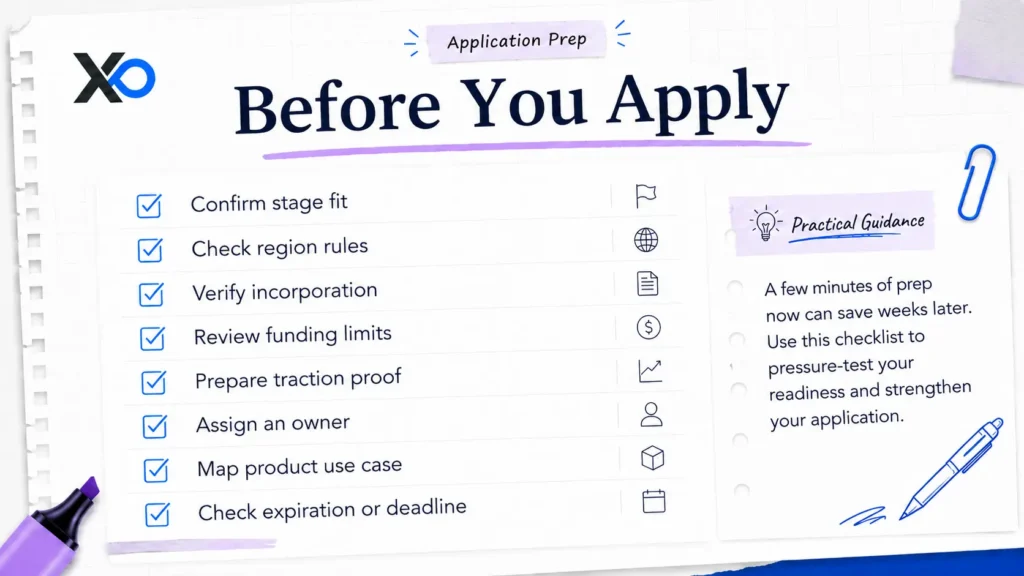
Founders do not need a complex process. They need a repeatable way to evaluate opportunities quickly.
Create a simple tracker with these columns: opportunity name, type, URL, owner, eligibility requirements, deadline, benefit, cost or tradeoff, documents needed, decision, next action, and review date.
Then score each opportunity:
- Fit: Does it match our stage, product, and next milestone?
- Value: Will it reduce real cost, unlock learning, or create access?
- Timing: Can we use it now or soon?
- Tradeoff: What attention, data, equity, setup, or lock-in does it require?
- Confidence: Are the official terms clear enough to act?
This keeps eligibility practical. It turns scattered opportunities into an operating rhythm.
Founders can also use the XRaise blog alongside the startup perks directory to build a clearer view of credits, tools, founder resources, and startup opportunity decisions.
Check Which Startup Opportunities Fit Your Eligibility
Before applying for a perk, credit, accelerator, or startup program, compare the opportunity against your stage, traction, region, incorporation status, funding path, team, product type, and timing.
Explore startup perks, credits, and founder resources through XRaise so your team can focus on opportunities that fit the company you are building now.

Key Takeaways
- Startup eligibility is an operating decision, not just an application checklist.
- The strongest opportunities match your stage, region, incorporation status, funding path, team, product type, traction, and timing.
- Perks, credits, accelerators, grants, and partner programs each require different eligibility logic.
- Founders should use XRaise to compare startup opportunities, then verify official terms before applying or committing budget.
FAQ
What does startup eligibility mean?
Startup eligibility means the requirements a company must meet to access a perk, credit, accelerator, grant, or startup program. It often depends on stage, location, incorporation, funding, traction, team, product type, and timing.
How do I know if my startup qualifies for perks or credits?
Start by checking the official eligibility rules, then compare them against your company stage, legal entity, region, billing setup, product use case, and whether your team can use the benefit before it expires.
Should early-stage founders apply for accelerators before launching?
Sometimes, but only if the accelerator supports idea or MVP-stage startups. Many accelerators are stronger fits once founders have a clear product direction, customer insight, traction signal, and ability to commit time.
Can bootstrapped startups qualify for startup programs?
Yes. Many startup perks, tool programs, founder communities, and some credit paths are available to bootstrapped startups. Other programs may require investor, accelerator, or partner affiliation.
What is the biggest mistake founders make with startup eligibility?
The biggest mistake is applying because the benefit looks valuable without checking whether the startup can use it now, meet the rules, absorb the tradeoffs, and benefit after the offer period ends.
Final Thoughts
Startup eligibility is not paperwork. It is how founders decide which opportunities deserve time, setup, and strategic attention.
The best perks, credits, accelerators, and startup programs should help your company reach the next milestone with less waste and more clarity. Before applying, compare fit through XRaise, then verify official terms, deadlines, and requirements before you commit.
This article is written for XRaise.ai and is intended to help founders compare startup perks, credits, accelerators, and opportunity eligibility more clearly. Program details, pricing, eligibility, deadlines, credit amounts, and offer terms can change, so readers should verify official terms before applying, claiming, or committing budget.