
TL;DR
- XRaise lists a random RunPod credit bonus between $5 and $500.
- Best for AI startups with a defined GPU experiment or inference workload.
- RunPod offers Pods, Serverless, Clusters, storage, and public model endpoints.
- The bonus amount, odds, expiration, and restrictions must be confirmed during the live claim.
- Claim before scaling, then measure compute, storage, latency, and cost per useful output.
What Is RunPod for Startups?
RunPod for startups is an XRaise-listed GPU infrastructure perk for teams that need compute for model training, fine-tuning, inference, image or video generation, voice AI, agents, and other machine learning workloads. The saved XRaise marketplace snapshot describes the benefit as a credit bonus between $5 and $500 for simplified GPU infrastructure.

RunPod for Startups
Credit bonus between $5 and $500 for simplified GPU infrastructure.
The important word is “between.” This is not a guaranteed $500 credit. The snapshot does not state the odds, reveal timing, expiration, existing-account rules, or covered products. Confirm those details during the live claim.
Related Posts




RunPod is a usage-based GPU cloud offering dedicated Pods, autoscaling Serverless workers, multi-node Clusters, persistent storage, and public model endpoints. Choose around whether the workload is interactive, batch-based, bursty, persistent, or distributed.
How Does the $5–$500 RunPod Credit Bonus Work?
The XRaise listing presents a random credit bonus within a $5–$500 range. Treat the awarded amount as a small experiment budget, not as committed infrastructure financing.
Before activating it, verify:
- the exact credit amount assigned to your account;
- whether the offer is limited to new RunPod users;
- whether a payment method or minimum deposit is required;
- which products and charges the credit covers;
- the activation and expiration dates;
- whether credits can be combined with another promotion;
- any country, company, or account restrictions.
A $5 bonus can fund a deployment check or inference benchmark. A larger award may support comparisons, load testing, fine-tuning, or a limited pilot. Neither replaces a cost model.
Who Should Use RunPod Startup Credits?
RunPod startup credits are most useful when a team already has a specific technical question to answer. Strong-fit users include:
- AI founders benchmarking GPU types for price, VRAM, throughput, and latency;
- teams deploying containerized model inference behind an API;
- image and video generation products testing cost per completed generation;
- voice AI teams measuring real-time factor, cold starts, and concurrent sessions;
- agent products running local or open-weight models and supporting services;
- machine learning teams fine-tuning or training models in bounded jobs;
- developer-tool startups giving customers temporary GPU-backed environments;
- analytics teams processing compute-heavy batches.
Wait if you lack a runnable workload, benchmark, or success metric. Unplanned GPU access becomes idle time or repeated setup.
Which RunPod GPU Infrastructure Option Fits Each Workload?
RunPod separates compute into several operating models. Choose the model around workload behavior rather than the largest available GPU.
| RunPod option | Best for | Use when | Watch closely |
|---|---|---|---|
| Pods | Development, training, fine-tuning, notebooks, persistent environments | You need dedicated control or a longer-running session | Idle GPU time, stopped-volume charges, and manual shutdown |
| Serverless | API inference and bursty workloads | Demand varies and scaling to zero can reduce idle compute | Cold starts, worker configuration, queue time, and cost per request |
| Clusters | Distributed training and multi-GPU jobs | One machine is insufficient and the workload can use multiple nodes efficiently | Communication overhead, utilization, and larger hourly exposure |
| Public endpoints | Fast tests with pre-deployed models | You want API access without operating the model stack | Per-request economics, model fit, and platform dependency |
| Network storage | Shared models and datasets | Data must persist across workers or Pods | Regional constraints, availability, ongoing storage cost, and backups |
For unpredictable inference, Serverless is usually the first comparison. For debugging, custom environments, training, or long jobs, a Pod may be simpler. Clusters belong later, after the team proves the code scales efficiently across GPUs.
What Should Founders Test Before Scaling GPU Spend?
The perk is valuable when it produces infrastructure evidence. Start with the smallest GPU class that fits the model and record:
- successful requests or jobs per GPU-hour;
- p50 and p95 latency;
- tokens, images, video seconds, or audio minutes per dollar;
- cold-start and model-load time;
- GPU memory headroom and utilization;
- queue time and failure rate;
- storage retained while compute is stopped;
- engineering time required to deploy, observe, and recover the workload.
Compare at least two configurations. A faster GPU can cost less per output despite a higher hourly rate; an underused accelerator can destroy unit economics. Optimize cost per reliable output, not sticker price.
What RunPod Requirements Should Founders Check?
The saved XRaise listing does not publish formal RunPod eligibility requirements beyond the offer description. Do not assume funding, incorporation, accelerator membership, team size, or startup age requirements.
Before claiming, have:

Startup Perks AI Assistant
Have questions about credits? Let's chat instantly.
- a RunPod-compatible workload or container;
- a bounded test with a shutdown condition;
- a maximum spend and alert threshold;
- a plan for secrets, access control, and logs;
- a backup strategy for critical models and data;
- someone responsible for deleting unused compute and storage.
RunPod’s current documentation says Pods need enough account credit for at least one hour of the selected on-demand configuration. It also warns that resources can stop when the remaining balance becomes too low. Confirm the live console requirements because billing rules can change.
How Do Startups Claim the RunPod Perk Through XRaise?
- Open the RunPod startup perk on XRaise.
- Review the live offer wording, account requirements, exclusions, and credit terms.
- Continue through the claim flow and create or connect the eligible RunPod account.
- Record the awarded amount and expiration date before deploying anything.
- Confirm where the balance appears and which RunPod charges it can offset.
- Deploy one bounded benchmark, set a hard stop, and monitor usage.
- Decide whether to continue only after calculating cost per useful output.
Save the live terms and awarded balance. If they differ from the snapshot, follow the live terms and clarify discrepancies before spending.
How Does RunPod Pricing Work After Credits End?
RunPod pricing is usage-based and changes by product, GPU, availability, and storage choice. Check RunPod’s current pricing immediately before budgeting.
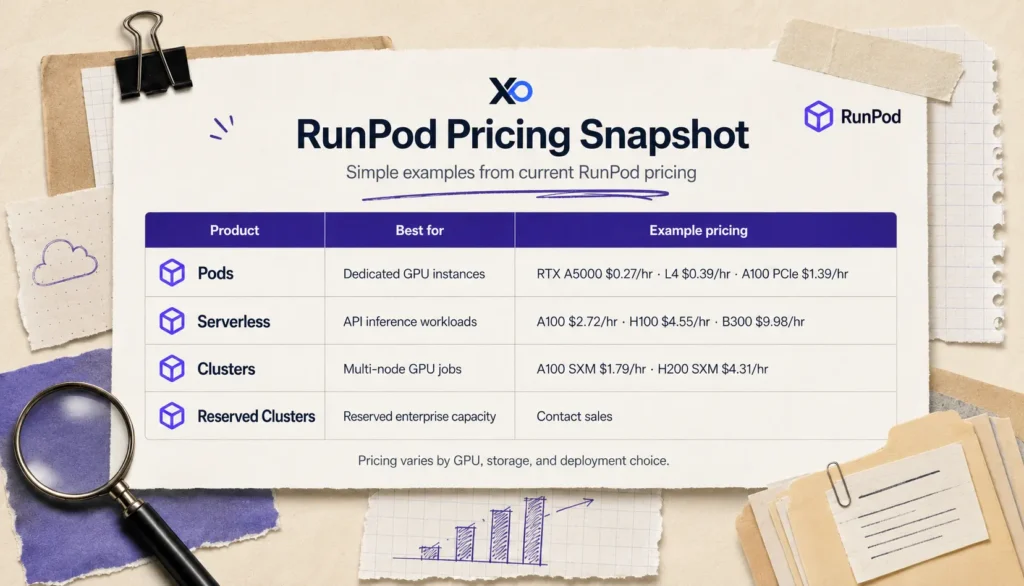
Official pricing viewed on July 11, 2026 showed Pod examples from $0.27/hour for an RTX A5000 to $7.39/hour for a B300, while Serverless examples ranged from $0.58/hour for a 16 GB class to $9.98/hour for a B300 worker. These are snapshots, not quotes. Availability, configuration, and live rates may differ.
Storage can outlive compute and keep billing. RunPod also offers non-refundable three- or six-month Pod savings plans. Do not prepay until duration and utilization are predictable.
Which RunPod Alternatives and Related GPU Credits Should Startups Compare?
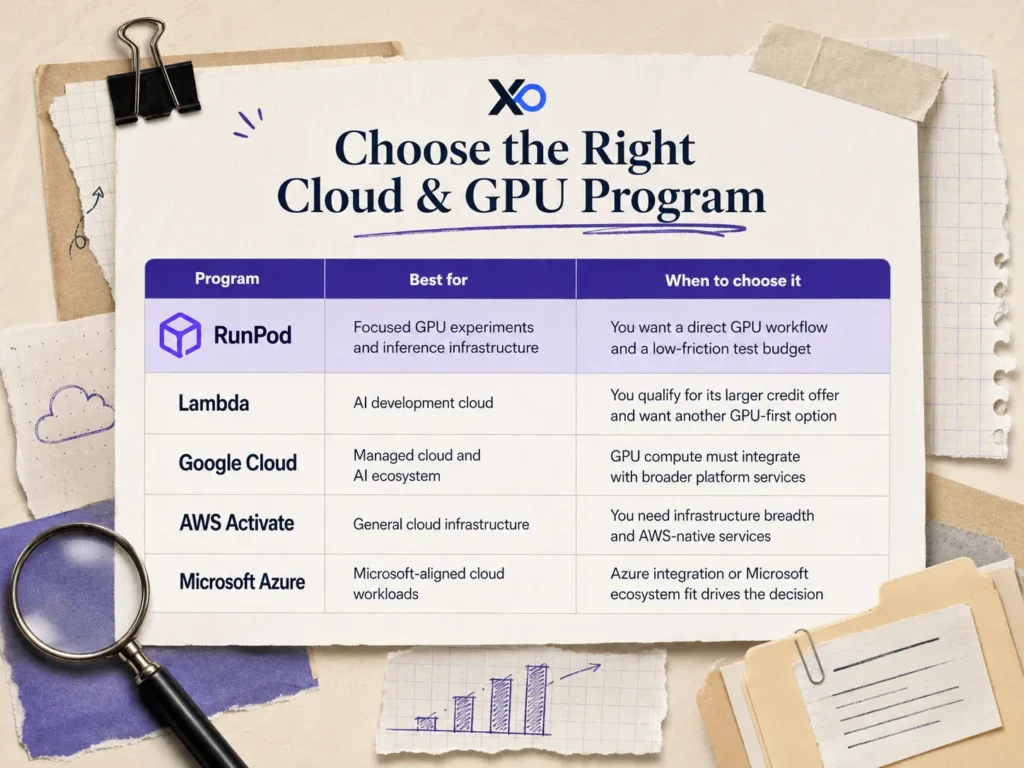
The XRaise marketplace includes one close GPU-cloud comparison and broader cloud-credit programs. Compare workload fit, GPU availability, managed services, eligibility, and post-credit cost.
Lambda for Startups
Lambda for Startups is the closest XRaise-listed GPU-cloud comparison, with a snapshot offer of up to $7,500 in credits. Compare it when dedicated AI development infrastructure and a larger, eligibility-dependent credit program matter.

Lambda for Startups
Up to $7,500 in credits for AI development cloud.
Google Cloud for Startups
Google Cloud for Startups is broader than RunPod. Consider it when GPU workloads must sit beside managed data, analytics, application, identity, and AI services.
AWS Activate for Startups
AWS Activate for Startups supports a large general-purpose cloud stack. Choose it when the infrastructure decision extends beyond GPUs into application hosting, storage, databases, networking, and managed services.
Microsoft Azure for Startups
Microsoft Azure for Startups is another broad cloud program. It can fit teams already using Microsoft tooling or needing Azure services alongside AI compute.
What Should Founders Know About RunPod Startup Credits in the FAQ?
How do startups get RunPod credits in 2026?
Open the XRaise-listed RunPod offer, review the live terms, complete the claim flow, and confirm the awarded balance in the eligible account. The saved listing states a random $5–$500 bonus but does not publish allocation odds.
Who is eligible for RunPod startup credits?
The saved marketplace snapshot does not state funding, company-age, team-size, or accelerator requirements. Check the live claim page for new-account rules, geography restrictions, identity checks, and payment requirements.
How long do RunPod credits last?
The XRaise snapshot does not state an expiration period. Record the live expiration date before deploying a workload and avoid relying on credits for production until the usable window is clear.
What can startups use RunPod credits for?
RunPod supports Pods, Serverless, Clusters, storage, and public endpoints, but the perk’s eligible charges are not disclosed in the saved listing. Confirm which products the awarded balance covers.
Is the $500 RunPod credit guaranteed?
No. XRaise describes a random credit bonus between $5 and $500. Budget as if you will receive the minimum, then treat any larger award as additional experiment capacity.
Is RunPod worth it for early-stage startups?
Yes, when the team has a runnable GPU workload and a measurable benchmark. It is a weaker fit when the startup lacks a deployment owner, spend controls, or a clear cost-per-output target.
Should startups use Pods or RunPod Serverless?
Use Pods for dedicated environments, debugging, training, and longer jobs. Test Serverless for bursty API inference where scaling with demand may reduce idle capacity. Benchmark both if the workload could fit either model.
What happens after RunPod credits expire?
Usage continues only if the account has sufficient funded balance and meets current billing requirements. Review compute and storage charges, set alerts, and delete unused resources before the promotional balance ends.
Should You Claim RunPod for Startups?
Claim RunPod for startups if you can name the workload, benchmark, maximum spend, and shutdown condition. The random bonus can reduce the cost of testing RunPod, but it should not determine your long-term infrastructure choice.
RunPod for Startups
Credit bonus between $5 and $500 for simplified GPU infrastructure.
Claim the RunPod startup perk through XRaise before scaling GPU usage. Confirm the awarded amount and live restrictions, run one controlled test, and keep paying only if the resulting RunPod pricing, reliability, and cost per useful output support the product’s unit economics.