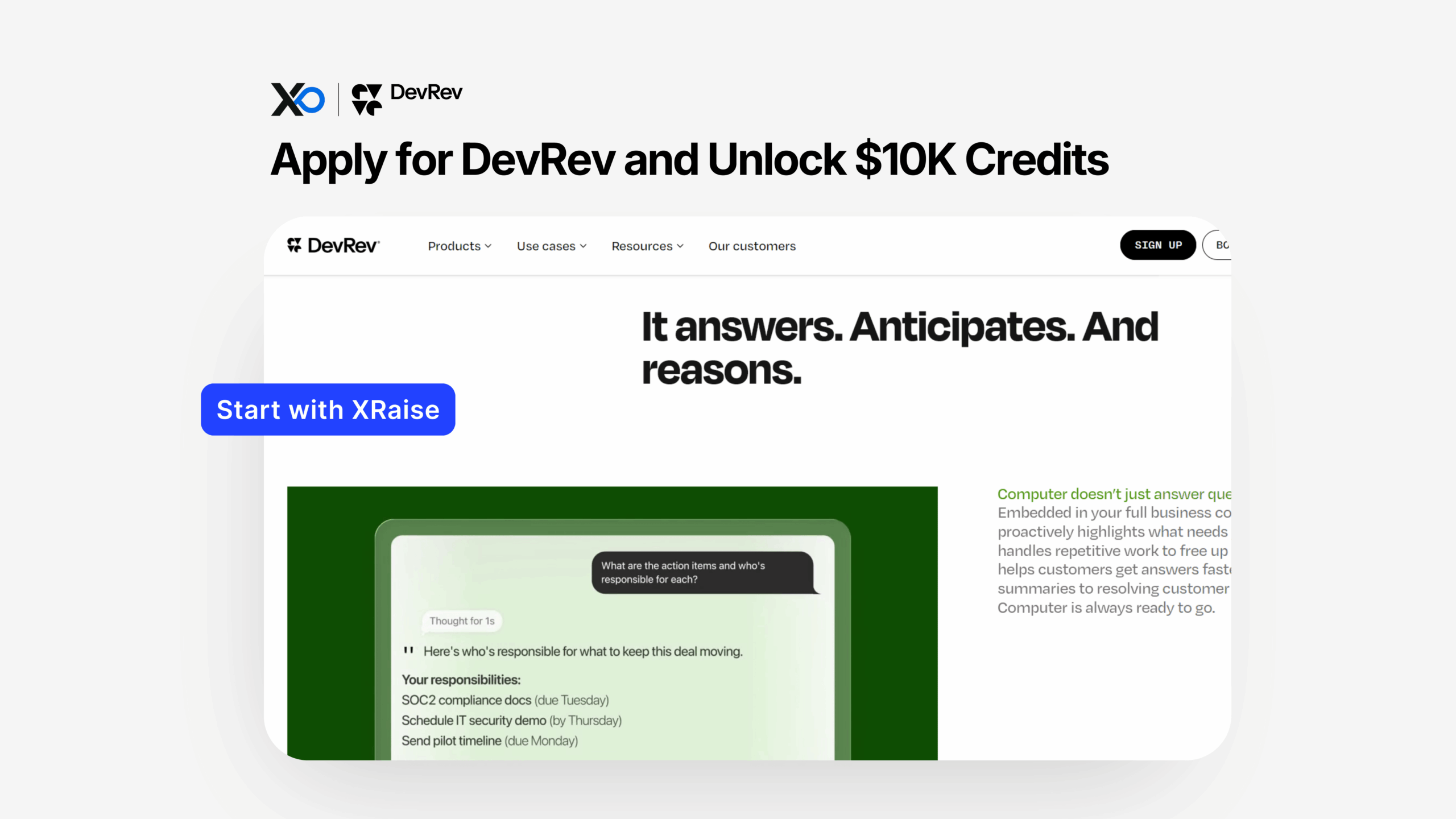
DevRev for Startups gives eligible teams a real way to centralize business context and run AI agents on top of it, without rebuilding your stack.
If you want the cleanest path, apply through XRaise first, then use DevRev’s official page only to confirm the exact terms. When you Apply for DevRev through XRaise, these credits are structured to support real implementation, not just testing.
TL;DR
This guide explains how the DevRev for Startups perk works, so you can Apply for DevRev through XRaise and use up to $10,000 in credits to operationalize AI agents across your business data.
Related Posts




- What you get: 12 months free (up to $10K credits) + onboarding-based unlocks and a follow-on discount.
- Who qualifies: early-stage (up to Seed/Series A), ecosystem/partner affiliated, and new to DevRev.
- How to apply: open the XRaise perk page, submit your startup details, then follow the onboarding steps.
- Next step: apply through XRaise, and use DevRev’s site only to confirm official terms.
DevRev for Startups: What It Is (Before You Apply for DevRev)
DevRev is a platform built to unify business data across tools (like Salesforce, Jira, and internal systems) and make that context usable through a knowledge graph and AI agents. Instead of hunting across tabs, you can ask questions, pull analytics, and trigger workflows from one place.
For founders and lean teams, the value is simple: fewer blind handoffs between support, product, engineering, and GTM, because you’re operating on shared context, not screenshots and Slack threads.
What do you get with this perk?
Through XRaise, eligible startups can access:
- 12 months free, up to $10,000 in credits
- $6,000 in credits at sign-up
- An additional $4,000 unlocked after onboarding milestones
- 50% off a one-year follow-on commitment if activated within six months
- Technical enablement, expert guidance, and training/learning resources
credits feel abstract until you map them to a real workflow. The practical interpretation is: you have a first-year budget buffer to implement DevRev properly (not “trial it lightly”), then a discounted path if you decide it becomes core.
For official terms and the vendor’s exact wording, confirm on the DevRev’s official website.

Startup Perks AI Assistant
Have questions about credits? Let's chat instantly.
Who is eligible (and who isn’t)?
DevRev’s startup offer is designed for:
Likely eligible
- Early-stage startups up to Seed or Series A
- Incubator/accelerator-backed startups or affiliated with a VC ecosystem partner
- Teams that are new to DevRev (not existing customers)
Common reasons you may be ineligible
- You’re beyond the stated stage (later than Series A)
- You’re an existing DevRev customer (not “new to DevRev”)
- You can’t confirm the ecosystem affiliation requirement
How to Apply for DevRev on XRaise (Step-by-Step)

Use this path when you want the fastest, most trackable workflow for claiming the perk.
- Go to the XRaise perk page: DevRev for Startups on XRaise
- Click the apply flow and submit your startup information (stage and “new customer” status matter).
- If asked, provide proof of eligibility (accelerator/incubator backing or ecosystem affiliation).
- After approval, activate your DevRev access so the initial credits are applied.
- Complete the required onboarding milestones to unlock the remaining credit tranche.
- Implement one “must-win” workflow first (examples below) before expanding scope.
- If DevRev becomes a core system, evaluate the follow-on discount window (within six months of activation).
- Keep the vendor link bookmarked only for terms verification.
What it’s worth in practice
Credits don’t create value by themselves. Value shows up when you stop paying the “coordination tax” across teams. This is typically where founders who Apply for DevRev see the fastest operational impact.
Here are realistic ways founders tend to feel the savings:
Scenario 1: Founder-led support that stops leaking product insights
If support lives in one place and engineering lives in another, you end up with two truth systems: tickets vs. what actually got fixed. DevRev’s “unify the data + answer layer” approach is most valuable when you can ask:
- “What are the top issues this week?”
- “Which accounts are most affected?”
- “What changed after the last release?”
That’s how you turn noise into a prioritized product loop.
Scenario 2: GTM + product alignment without weekly archaeology
When Salesforce notes and Jira tickets don’t connect, your team spends meetings reconstructing reality. A unified layer means faster answers to questions like:
- “Which pipeline deals are blocked by product gaps?”
- “What are the recurring objections by segment?”
- “What’s the real status of the top 10 customer asks?”
Scenario 3: Automation that removes “human routers”
Early-stage teams often rely on one operator to route everything: triage tickets, summarize customer asks, follow up internally, update docs. DevRev becomes valuable when AI agents can reduce repetitive routing and summarization across systems.
If you want the broader mindset behind “convert startup status into runway,” this XRaise piece is the right complement: How to Grow Your Company Startup Faster.
Tips to maximize approval + value
If you plan to Apply for DevRev, treat onboarding as a milestone sprint, not a passive setup.
Apply timing
- Apply when you can actually onboard soon. The extra credit unlock depends on onboarding milestones, so “apply now, implement later” usually delays value.
Implementation approach
- Start with one workflow that touches multiple teams (support → product → engineering, or GTM → product → support). Cross-functional workflows are where unified context pays off fastest.
Avoid these mistakes
- Trying to unify everything on day one: pick one system-of-record path first, then expand.
- Treating credits like free money: credits are best used to fund a real adoption sprint.
- Not planning for ownership: decide who owns the data mapping and the “answer quality” (usually ops, revops, or a technical PM).
If you also want ideas for automation patterns your team can reuse, this is a strong adjacent playbook: Choosing Make for Startup Automation.
Alternatives (optional, only if helpful)
DevRev is most compelling when you need a unified context layer across systems. If your need is narrower, consider:
- Intercom (better when your priority is customer messaging + support workflows first, and you don’t need a broad business graph yet): Intercom for Startups
- Make (better when you mainly need integrations and automation across tools, and you already know your sources of truth): Make automation deep dive
- A “lightweight CRM + helpdesk” combo (better when your team is very early and simply needs clean pipelines + basic ticketing before a unification layer)
Rule of thumb: if your problem is “we can’t get a straight answer without three people,” DevRev fits. If your problem is “we just need basic workflows,” start simpler.
FAQ
What do I need to qualify to Apply for DevRev?
How do I apply?
Apply through XRaise here.
What do I need to qualify?
You generally need to be early-stage (up to Seed/Series A), affiliated with an incubator/accelerator or VC ecosystem partner, and new to DevRev. Confirm edge cases on DevRev’s official page.
How do I unlock the full $10K?
You receive $6K at sign-up and unlock an additional $4K by completing onboarding milestones.
What is the follow-on discount?
A 50% discount on a one-year commitment if redeemed within six months of activating credits.
Final Thoughts
If you’re still running support, product, and GTM like separate planets, DevRev for Startups is a practical way to unify context and let AI agents work on your business data, without paying full price while you’re still early.
Your next step is simple: Apply for DevRev through XRaise.
Then use DevRev’s official page only to confirm the exact terms and timing.