
TL;DR
- Treat cloud credits as runway tools, not free money.
- Do not assume startup cloud credits can be stacked; combining credits depends on each provider’s terms, billing account, offer path, and eligible services.
- Use the Workload -> Owner -> Meter -> Exit -> Proof framework before activating credits.
- Model what happens when credits expire or run out, including the first full-price cloud bill.
- AI, SaaS, and data startups need cost models before usage spikes.
- Set budgets, alerts, labels, owners, expiration dates, and review dates before activation.
- Use XRaise to compare startup cloud credits before committing, then verify official provider terms.
Can You Stack Startup Cloud Credits?
Sometimes, but not as a universal rule. A startup can evaluate multiple cloud-credit programs, but stacking AWS, Google Cloud, Azure, or other startup credits depends on each provider’s current terms, account history, eligible services, billing account, partner or investor path, and whether the credits come from the same provider or different providers.
The safe founder rule is simple: never plan runway around combined credits until you have confirmed the exact offer, account, service coverage, expiration date, billing behavior, and post-credit cost for the workload you intend to run.
| Provider path | Stacking / expiry planning rule | What founders should verify |
|---|---|---|
| AWS Activate credits | AWS credits apply to eligible charges until they are exhausted or expire. When an AWS account has more than one credit, AWS billing applies credits using its own rules, including soonest-to-expire first. | Eligible services, account ownership, credit sharing rules, expiration date, remaining balance, and whether a higher-tier Activate offer only adds the difference up to the allowed cap. |
| Google Cloud startup credits | Google Cloud Start credits are valid for one year, while Scale benefits are structured across year-one and year-two credit periods. Program credits apply to Google Cloud Platform services and select offerings, with documented exclusions. | Program tier, billing account, prior credit history, covered services, third-party model or Marketplace exclusions, year-two discount terms, and unused-credit timing. |
| Microsoft for Startups / Azure credits | Microsoft’s standard Startup credits begin at $200 and can grow through milestones. Azure Sponsorship can convert to pay-as-you-go when credits are used or expired, whichever comes first. | Current milestone, required workloads, sustained usage requirements, credit balance, expiration behavior, payment method, and whether any Investor Network benefit is separate from the standard path. |
Why cloud credits matter now
Cloud credits are larger, more visible, and more strategically loaded in 2026. AWS publicly describes tiered Activate credit paths for startups from pre-seed to scale, Google for Startups Cloud highlights Google Cloud and Firebase coverage for eligible startups, Microsoft describes startup credits tied to Azure and go-to-market support, Cloudflare promotes a tiered credits program for developer platform usage, and DigitalOcean now distinguishes core credits from products that may be excluded or charged separately. Founders can review the current official pages for AWS Activate Credits, Google for Startups Cloud, Microsoft for Startups benefits, Cloudflare for Startups, and DigitalOcean Startups before planning around any advertised number.



That abundance creates a strange founder trap. A pre-seed company may be able to access meaningful startup cloud credits before it has revenue, stable workloads, mature billing practices, or a reliable model of infrastructure unit economics. An AI founder can spin up compute experiments before knowing whether inference, storage, data movement, or retrieval will become the real cost driver. A SaaS team can use credits to carry a production setup that would look too heavy if the same bill were paid in cash.
The right lesson is not “avoid credits.” Cloud credits for startups can be a real runway advantage. They can fund MVP hosting, customer pilots, model experiments, databases, storage, observability, edge infrastructure, and early production workloads. They can help founders reach proof before infrastructure spend becomes a board-level concern.
The wrong lesson is “spend because credits exist.” Credits should buy learning time. They should not hide waste, distort architecture, or train the team to ignore the bill.
Before a team starts collecting offers, it should compare startup perks and credits through a workload lens: does this resource fund something the startup is ready to prove, or does it simply make a bigger stack feel cheaper?
The founder problem
The founder problem is simple: cloud credits reduce immediate cash burn, but they do not remove infrastructure cost. They delay it, reshape it, and sometimes disguise it.
A founder sees a large credit offer and thinks, “Great, we have room to build.” That may be true, but cloud credits only help when the team has a workload plan.
Without one, services may get used because they are convenient rather than necessary. Test environments can stay live if no one owns shutdowns. Usage grows invisibly when metering is missing. Post-credit costs become a surprise when there is no exit plan. Most importantly, the startup cannot tell whether the credit created progress or simply funded activity.
This is especially dangerous for pre-seed and seed teams because early cloud habits compound. The MVP architecture becomes the beta architecture. The beta architecture becomes production. The production setup becomes the default operating model. By the time credits expire, the team may be facing migration risk, margin pressure, and technical debt at the same time.
Cloud credits should help a startup answer better questions:
- Which workload is worth funding right now?
- Who owns usage and cleanup?
- What metric tells us whether the spend is justified?
- What happens when credits expire?
- What product, customer, revenue, or technical proof did we create?
If the team cannot answer those questions, the credit is not yet a runway strategy. It is a permission slip to spend.
The core framework: Workload -> Owner -> Meter -> Exit -> Proof
Use one operating framework for every credit decision:
Workload -> Owner -> Meter -> Exit -> Proof
This framework keeps the startup from treating cloud credits as free capacity. It forces the team to connect credits to work, accountability, measurement, future cost, and evidence.
Workload
Name the exact workload before activating credits. “Infrastructure” is too vague. Good workload definitions sound like: production API for beta customers, Postgres database for the MVP, vector search experiment for support automation, GPU inference test for 500 daily requests, CI environment for deployment velocity, or analytics warehouse for onboarding drop-off analysis.
If the workload cannot be named, wait.
Owner
Assign one owner for billing, usage, cleanup, and weekly review. At a pre-seed company, this may be the technical founder. At seed stage, it may be the engineering lead, infrastructure lead, or operator responsible for burn. Ownership matters because cloud waste usually survives inside ambiguity. Everyone assumes someone else is watching.
Meter
Define the meter before usage starts. The meter might be monthly spend, spend per customer, compute hours per experiment, cost per inference, storage growth, bandwidth, database size, environment count, or cost per successful workflow. Cloud billing alerts are helpful only when the team knows which usage pattern should trigger concern.
Exit
Know what happens when the credit expires, runs out, or stops covering a service. The exit is not always migration. Sometimes the exit is reserved capacity, committed use discounts, a simpler architecture, a reduced retention policy, cheaper regions, a vendor negotiation, or a decision to keep only the workloads tied to revenue.
Proof
Every credit-funded workload should produce evidence. In a SaaS product, that evidence may show up as activation, retention, reliability, or revenue. For an AI startup, it may come from inference cost, latency, accuracy, customer willingness to pay, or production reliability. Data products should look for proof in query performance, customer insight, or operational efficiency.
This is the same discipline behind the XRaise guide to choose startup tools that create proof: do not adopt a tool or platform because it is available; adopt it because it makes a decision clearer.
The framework is intentionally strict. If a credit does not support Workload -> Owner -> Meter -> Exit -> Proof, it is not ready to use.
Cloud credits for startups are not one category
Founders often compare credits by provider name or headline value. That is the least useful comparison. The better question is: “Which workload category are we actually funding?”
MVP hosting and core app infrastructure
This is the most common use case for cloud credits. It includes app servers, container hosting, serverless functions, managed databases, object storage, queues, DNS, and basic networking.
Use credits here when the product is moving from prototype to a real user-facing system. Wait if customer discovery can still happen with mockups, manual delivery, no-code tools, or a tiny free-tier setup. Compare deployment speed, team familiarity, reliability requirements, regional support, service coverage, and the normal bill after credits.
For founders comparing provider fit, Compare cloud credits for AI startup workloads is useful even if the company is not purely AI, because it explains workload fit rather than ranking platforms by headline value. Teams leaning AWS can review AWS Activate through XRaise, while Google-native teams can compare Google Cloud credits on XRaise before hardening the first app environment.
Databases and storage
Databases and storage can quietly become startup infrastructure costs because growth looks cheap at first. A small managed database, object store, cache, search index, backup policy, or analytics dataset can feel minor during the credit window. Later, data retention, backups, replicas, query volume, and transfer costs start to matter.

Startup Perks AI Assistant
Have questions about credits? Let's chat instantly.
Use credits when the product needs reliable persistence for real users or when a data workflow is central to the business. Wait if the database choice is still speculative or if the data can be kept smaller, simpler, or manual during validation. Compare backup costs, storage growth, read/write patterns, export paths, retention policies, and managed-service lock-in.
The practical question is not “Can credits cover this database?” It is “Will this database still make sense when credits are gone?”
AI cloud credits and GPU workloads
AI cloud credits can fund model experimentation, inference, fine-tuning, embeddings, retrieval systems, GPUs, orchestration, data processing, and evaluation environments. They are valuable because AI workloads can become expensive before revenue catches up.
Use credits when the startup has a testable AI workflow: a model feature tied to users, a measurable inference path, a training or fine-tuning experiment with a success condition, or a production pilot where latency and cost matter. Wait if the team is exploring every model and every architecture at once.
Compare model cost, GPU availability, cold starts, batch versus real-time patterns, data transfer, storage, evaluation cost, reliability, and whether the provider’s credits cover the services you actually need. Founders building with GPUs should be especially careful with exclusions, because some startup cloud credits cover core cloud services but not separate GPU, marketplace, or third-party usage paths.
Data pipelines, analytics, and observability
Analytics and observability are easy to justify and easy to overbuild. Logs, traces, metrics, warehouses, dashboards, reverse ETL, and event pipelines can improve decisions, but they can also become expensive reporting systems before the startup knows which decisions matter.
Use credits when a dashboard will change product, reliability, revenue, or customer decisions. Wait if the team is collecting events “just in case.” Compare event volume, retention, query cost, sampling, ingestion, storage, alerting, and whether the team has a weekly operating rhythm for reviewing the data.
Cloud cost optimization for startups often starts here. Reduce logs before negotiating spend. Shorten retention before buying more storage. Track the few events that drive decisions before instrumenting the whole product.
Networking, edge, and security
Networking, CDN, edge functions, WAF, DDoS protection, identity, secrets, compliance logging, and security monitoring become more important when customers, traffic, or enterprise requirements appear.
Use credits when reliability, latency, or security is part of the sales or product promise. Wait if the startup is adding enterprise-grade complexity before users demand it. Compare included features, usage-based charges, traffic profiles, regional routing, security requirements, and support.
This is where provider fit matters more than credit size. A B2B SaaS company selling to Microsoft-heavy enterprise buyers may value Azure alignment and should review Microsoft for Startups on XRaise before assuming Azure credits fit the operating plan. A global developer platform may care about edge infrastructure. A data-heavy AI product may care about BigQuery, Vertex AI, or GPU paths. A general SaaS product may prefer the ecosystem its engineering team already knows.
Dev, test, staging, and experiments
Non-production environments are a classic credit leak. They feel harmless because they are not customer-facing, but idle dev instances, oversized staging databases, forgotten experiments, and abandoned proof-of-concept projects can drain credits faster than founders expect.
Use credits for dev and staging only when those environments accelerate shipping or reduce production risk. Wait if the environment has no owner, no shutdown schedule, and no success metric. Compare idle time, environment lifespan, instance size, test data volume, and whether the team can automate cleanup.
The simplest rule: every non-production resource needs an expiration date.
Founders who want simpler app hosting, managed databases, and startup-friendly cloud primitives can review DigitalOcean startup credits on XRaise, but the same cleanup rule still applies: simple infrastructure can still become waste if nobody owns it.
Migration and customer pilots
Credits can support migrations, enterprise pilots, customer-specific deployments, load tests, and temporary infrastructure needed to prove a deal. This can be a smart use of startup runway because the spend is tied to a commercial milestone.
Use credits when a customer, investor, or product milestone requires real infrastructure proof. Wait if the pilot is vague or unpaid and could be validated with a smaller setup. Compare pilot duration, customer success criteria, required uptime, data residency, support, and the cost to keep the customer live after the pilot.
Credit-funded pilots are strongest when they lead to a pricing, packaging, or infrastructure decision. They are weak when they merely make the product look bigger than the business.
Post-credit cloud costs are the real decision
The credit window is temporary. The architecture can last for years.
That is why post-credit cloud costs should be modeled before usage grows. A founder does not need a perfect forecast, but the team should know the likely paid bill at three points: current usage, expected usage at the next milestone, and usage if the best-case customer or traffic scenario happens.
Model the bill in units founders can reason about:
- monthly base infrastructure cost
- cost per active customer
- cost per workspace, project, or tenant
- cost per inference or automated workflow
- cost per GB stored
- cost per 1,000 events, jobs, or API calls
- cost per customer pilot
This turns cloud credits from a discount into a runway instrument. For broader startup credits planning across categories, see the XRaise founder guide. If a credit-funded workload proves that gross margin can work after the credit period, it created durable value. If it proves that the architecture only works while subsidized, that is still useful evidence, but the founder must act on it.
Founders thinking about broader spend should pair this with the XRaise guide to extend startup runway without raising more money, because infrastructure is only one part of burn discipline.
How to choose cloud credits without distorting the company
The right cloud credit path depends on stage, workload, team capability, and post-credit economics. It should not be chosen only by the biggest number.
Start with workload fit. Teams that already know AWS and need broad infrastructure services may find AWS Activate the logical first comparison. Products deeply tied to Firebase, BigQuery, Google Cloud data services, or Google-native AI workflows may fit better with Google Cloud credits for startups. Azure credits for startups are worth reviewing when customers, identity, compliance, or enterprise sales motion align with Microsoft. Cloudflare belongs in the comparison when edge compute, CDN, security, or developer platform primitives matter. DigitalOcean may be a practical fit for teams that value simpler cloud primitives and startup-friendly operations, as long as covered services and exclusions are reviewed carefully.
For a broader provider-level pass, founders can compare cloud credit programs for startups before letting a single headline number decide the stack.
Then check eligibility. Company age, funding stage, incorporation, prior credit use, domain email, public website, partner affiliation, billing account status, region, and provider-specific terms can all matter. The XRaise startup eligibility guide can help founders prepare before they apply.
Then model the exit. If the team would not keep the platform after credits expire, ask whether the workload should be built there in the first place. There are exceptions, such as temporary experiments or migration tests, but the team should name them clearly.
Finally, ask whether the credit produces proof. The best cloud credits create evidence that helps the founder make a better decision. The worst credits create the feeling of progress while hiding cost.
Practical comparison table
| Workload category | Best for | Use when | Wait if |
|---|---|---|---|
| MVP hosting | SaaS apps, APIs, web apps, early production | Real users will touch the product within 30-90 days | Validation can still happen manually |
| Databases and storage | Persistent product data, backups, search, data products | Data is tied to product value or customer workflows | Retention and growth are not understood |
| AI and GPU workloads | Inference, evaluation, fine-tuning, data processing | You can estimate usage and define success | You are testing every model with no owner |
| Analytics and observability | Product learning, reliability, activation, retention | Dashboards change weekly decisions | Events are being collected “just in case” |
| Edge, networking, security | Latency, security, global delivery, enterprise trust | Customer needs require it | It is added for appearance before usage |
| Dev and staging | Deployment speed, QA, safe releases | Environments have owners and cleanup rules | Idle resources are left running |
| Migration or pilots | Customer proof, sales support, architecture testing | A commercial or technical milestone is clear | The pilot has no success criteria |
What to do at each startup stage
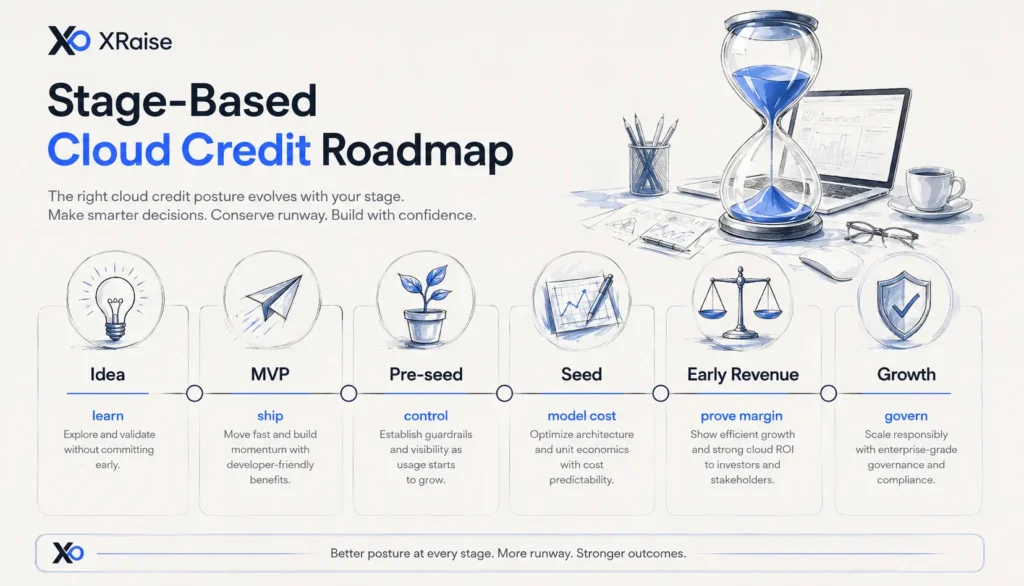
Idea stage
At idea stage, the highest-value move is usually not claiming cloud credits. It is narrowing the product question. What matters most is customer pain, workflow clarity, and technical feasibility. Use free tiers, local prototypes, mockups, manual workflows, or a very small hosted demo.
Avoid activating time-limited benefits before the product is ready to consume them. Measure customer signal, prototype learning, and whether a real workload is emerging.
MVP stage
At MVP stage, startup cloud credits can help if the team is ready to ship. The priority is a small, reliable architecture that supports learning. Use credits for hosting, a managed database, storage, basic monitoring, and a simple deployment path.
Avoid copying later-stage architectures. Measure monthly burn, uptime, deploy frequency, activation, retention, and cost per active user. This is also the right time to explore startup perks through XRaise if you already know which infrastructure path is likely.
Pre-seed
At pre-seed, the goal is to turn product usage into evidence without letting infrastructure drift. Assign billing ownership, add cloud billing alerts, tag resources, separate production from experiments, and create a monthly infrastructure review.
Use credits for customer-facing workloads, technical pilots, analytics tied to decisions, and carefully scoped AI experiments. Avoid unmanaged experiments, oversized defaults, and services chosen only because they are covered by credits.
Before applying, founders should check startup eligibility before applying for perks so activation timing, company stage, prior usage, partner requirements, and expiration windows do not create avoidable friction.
Seed
At seed stage, infrastructure starts to affect runway, margin, security, and hiring. The team should model post-credit cloud costs, review architecture decisions, and decide which services are worth standardizing.
Use credits to extend runway toward revenue proof, stronger retention, enterprise pilots, or production hardening. Avoid assuming subsidized gross margin is real. Measure cost per customer, cost per workflow, usage growth, reliability, and engineering time spent on cloud operations.
Early revenue
At early revenue, credits should support unit economics rather than hide them. The founder should know whether each customer, workspace, inference, or data workflow can be profitable after credits.
Use credits to test scaling, support customer growth, and buy time for optimization. Avoid discount-driven pricing that ignores the future bill. Measure gross margin, customer-level infrastructure cost, payback period, and support burden.
Growth stage
At growth stage, cloud credits become less about survival and more about procurement, commitments, governance, and leverage. The company may still use credits, but the bigger question is whether infrastructure spend is disciplined.
Use credits, discounts, and commitments only after workload patterns are stable. Avoid locking into long commitments before usage is predictable. Measure forecast accuracy, idle spend, reserved or committed utilization, platform concentration risk, and procurement outcomes.
Examples and use cases
The AI SaaS founder
An AI SaaS founder wants to test a support automation product. The expensive part is not the web app. It is the combination of embeddings, retrieval, inference, evaluation, logs, and customer data storage.
Under Workload -> Owner -> Meter -> Exit -> Proof, the founder defines one workload: run 10 customer pilots with measured inference cost and response quality. The technical founder owns usage. The meters are cost per conversation, latency, accuracy, and successful resolution. The exit is a paid architecture that works at expected pilot pricing. The proof is whether customers will pay at a margin that survives after credits.
That is a strong credit use case.
The B2B SaaS builder
A B2B SaaS team needs a stable production environment for its first design partners. Credits fund app hosting, managed Postgres, object storage, observability, and backups.
The team avoids Kubernetes, multi-region architecture, and enterprise security tooling until customers require it. The meter is cost per active workspace and reliability during pilots. The exit is a paid monthly baseline that fits seed-stage runway. The proof is whether design partners activate and return.
This is what disciplined cloud workload planning looks like.
The data product startup
A data product startup wants to process customer files, enrich records, and deliver reports. Credits can fund storage, batch jobs, queues, and analytics. The risk is that every customer creates persistent storage, expensive queries, and long retention obligations.
The team should set retention rules before accepting large files. Cost should be tracked per processed record and per report. Temporary data needs to be deleted on schedule. Most importantly, pricing should be built around paid infrastructure, not subsidized usage.
The credits help the startup learn. They do not become the business model.
Mistakes and anti-patterns
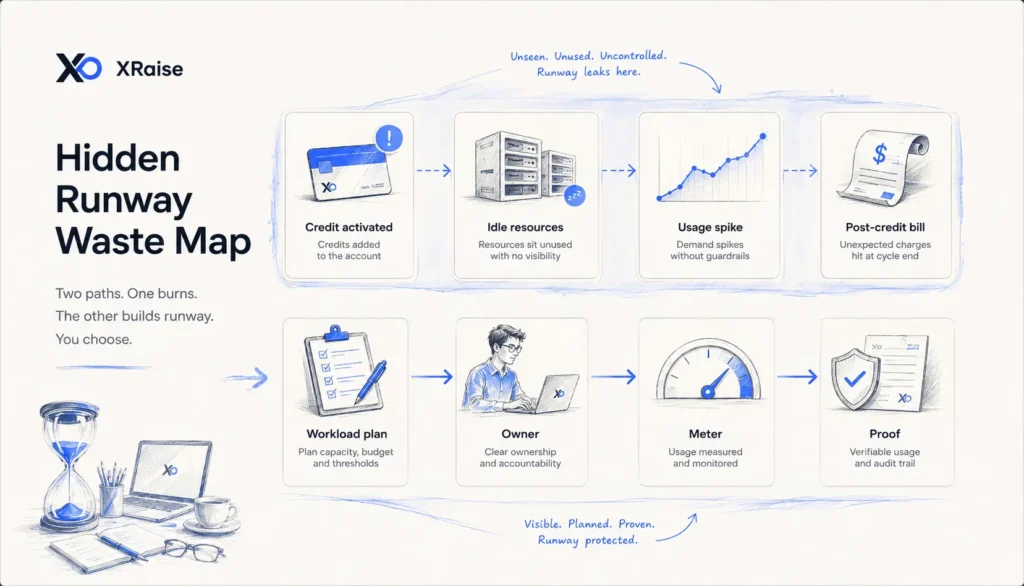
Choosing the provider before defining the workload
Founders often choose a provider because the credit offer looks generous. That hurts because provider choice shapes architecture, hiring, tooling, and migration cost.
Do this instead: define the workload first, then compare providers by team skill, covered services, reliability, integrations, customer requirements, and post-credit pricing.
Treating covered services as automatically useful
A service being covered does not make it necessary. Founders may add queues, warehouses, edge functions, AI services, or managed platforms before the product requires them.
Do this instead: require every service to support a named product, customer, revenue, reliability, or learning outcome.
Ignoring idle spend
Idle environments can drain credits because nobody feels the pain immediately. Forgotten notebooks, staging clusters, unused databases, and experiment resources are common offenders.
Do this instead: set expiration dates, shutdown rules, labels, owners, and weekly cleanup rituals.
Comparing credits without checking exclusions
A founder may assume all cloud spend is covered. In reality, startup programs can exclude certain services, third-party marketplace products, GPU products, support plans, data transfer paths, or overages.
Do this instead: verify current provider terms, covered services, caps, payment rules, and overage behavior before activating workloads.
For cloud-specific research, use the XRaise articles to review Google Cloud credits for startups and review Azure credits for startups, then confirm current coverage directly with the provider before launching the workload.
Building dashboards before defining decisions
Analytics and observability can create cost without improving execution. If no decision changes, the dashboard is not helping.
Do this instead: instrument the smallest set of events, logs, and metrics needed to guide product, reliability, customer, or revenue decisions.
Forgetting the post-credit renewal
Credits expire. The bill does not. If the team has not modeled the future bill, the startup may discover too late that its architecture or pricing is wrong.
Do this instead: review post-credit cloud costs monthly and model the paid bill at the next milestone.
Practical playbook
Step 1 – Map the next 90 days of workloads
List only the workloads that support the next real milestone: MVP launch, beta customers, AI experiment, data pilot, production hardening, or enterprise proof. Remove speculative infrastructure from the plan.
Step 2 – Assign one billing owner
Give one person responsibility for budgets, alerts, tags, invoices, cleanup, and provider terms. The owner does not need to approve every technical choice, but they must know what is running and why.
Step 3 – Set meters before spending
Choose the usage metrics that will tell you whether the credit is working. Common meters include monthly spend, cost per customer, cost per inference, environment count, storage growth, query cost, and idle resource count.
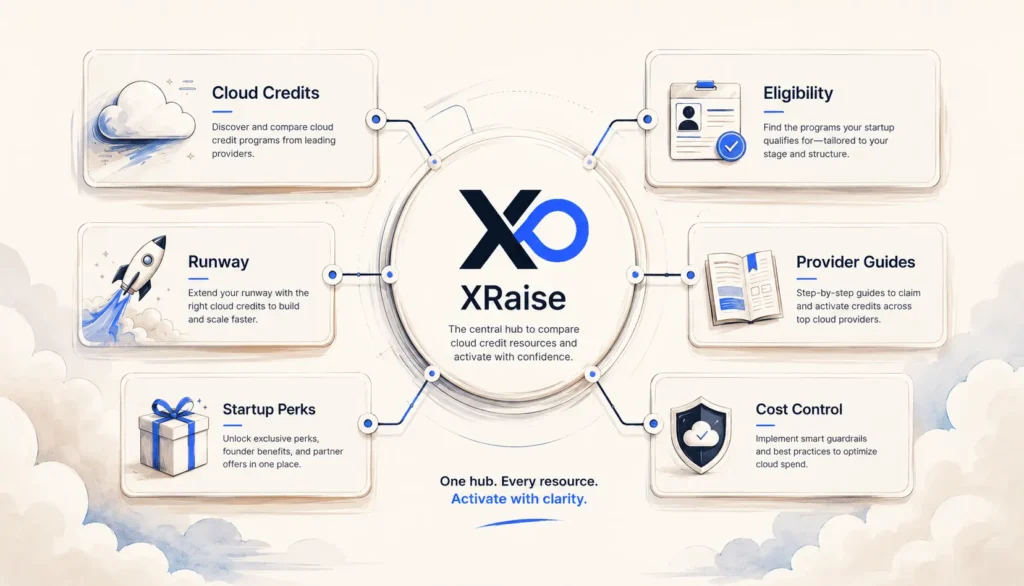
Step 4 – Compare credits through workload fit
Use XRaise to compare relevant startup perks, then verify official provider terms before activation. For infrastructure-specific research, founders can compare Google Cloud credits for startups, review Azure credits for startups, and compare broader cloud credit programs before committing.
Step 5 – Run a monthly post-credit review
Every month, ask: what did credits fund, what proof did they create, what waste did we remove, and what would this cost if credits ended today? That review turns credits into founder discipline rather than hidden spend.
FAQ
What are cloud credits?
Cloud credits are promotional credits that reduce eligible cloud infrastructure charges for a limited time or amount. They may apply to compute, storage, databases, networking, AI services, developer tools, or other covered services depending on the provider. They are useful only when founders understand eligibility, coverage, expiration, overages, and post-credit pricing.
Are cloud credits for startups actually free?
They can reduce cash spend, but they are not the same as free infrastructure. Credits are temporary, limited by terms, and may exclude important services. If usage exceeds the credit balance or uses uncovered products, the startup may still be charged. Founders should always set budgets, alerts, and billing ownership.
When should a startup apply for startup cloud credits?
Apply when you have a real workload coming in the next 30-90 days, such as an MVP launch, beta customer, AI experiment, database, production environment, or technical pilot. Waiting is often smarter at idea stage because many credits have time limits or usage windows.
How should founders compare AWS Activate credits, Google Cloud credits for startups, and Azure credits for startups?
Compare workload fit first. AWS may fit broad infrastructure needs, Google Cloud may fit AI, Firebase, and data-heavy workflows, and Azure may fit Microsoft-aligned B2B or enterprise startups. Then compare eligibility, covered services, team familiarity, billing controls, support, and post-credit cloud costs.
What are the biggest startup infrastructure costs credits can hide?
Common hidden costs include idle environments, oversized databases, storage growth, logs, data transfer, GPU usage, third-party services, support plans, and production architecture copied from larger companies. Credits can mask these costs until renewal or expiration, so teams should track usage from day one.
What cloud billing alerts should early-stage startups set?
Set alerts for monthly spend, forecasted spend, sudden spikes, budget thresholds, resource creation, high-cost services, storage growth, and non-production environments. The exact alerts depend on your provider, but the goal is the same: catch waste while the team can still change behavior.
How do AI cloud credits differ from normal cloud credits?
AI cloud credits may support model experimentation, inference, GPUs, embeddings, data processing, or AI platform usage, but coverage varies widely. Some programs separate core cloud credits from GPU or third-party model usage. AI founders should model cost per inference, latency, evaluation cost, and customer-level margin early.
Can cloud credits help extend startup runway?
Yes, if they replace infrastructure spend the startup would have incurred anyway and produce evidence. They do not extend runway when they fund unnecessary complexity, idle resources, or architecture that becomes unaffordable after credits expire. The best credits buy learning time and preserve cash for proof.
What happens when cloud credits expire?
The startup usually moves into normal paid billing unless it reduces usage, changes architecture, negotiates pricing, qualifies for another program, or shuts down workloads. AWS credits apply until they are exhausted or expire. Microsoft says Azure Sponsorship converts to pay-as-you-go once Azure credits are fully used or expired. Google Cloud startup credits are tied to the program tier and billing account, with Start credits valid for one year and Scale credits structured across year-one and year-two periods.
Founders should model post-credit cloud costs before expiration and decide which workloads are worth keeping at full price.
Can startups use or combine multiple cloud credit programs?
Sometimes, but founders should not assume credits can be freely combined. A startup may review AWS, Google Cloud, Azure, and other programs at the same time, but actual stacking depends on the provider, account, offer, eligible services, prior credits, and current terms. Treat every stacking claim as unverified until the provider confirms it for your exact account and workload.
What is the best framework for using cloud credits wisely?
Use Workload -> Owner -> Meter -> Exit -> Proof. Define the workload, assign ownership, measure usage, plan the post-credit exit, and connect the credit to real product or customer proof. This keeps credits tied to runway strategy instead of hidden spend.
Final takeaway
Cloud credits can be one of the most useful startup runway tools in 2026, but only when founders treat them as operating discipline. Start with the workload, assign an owner, measure usage, verify stacking and expiration terms, plan the post-credit bill, and demand proof from every credit-funded system.
Before you activate another infrastructure offer, use XRaise to compare startup perks, cloud credits for startups, and eligibility paths, then verify current provider terms and choose the path that supports the product you are actually ready to prove.