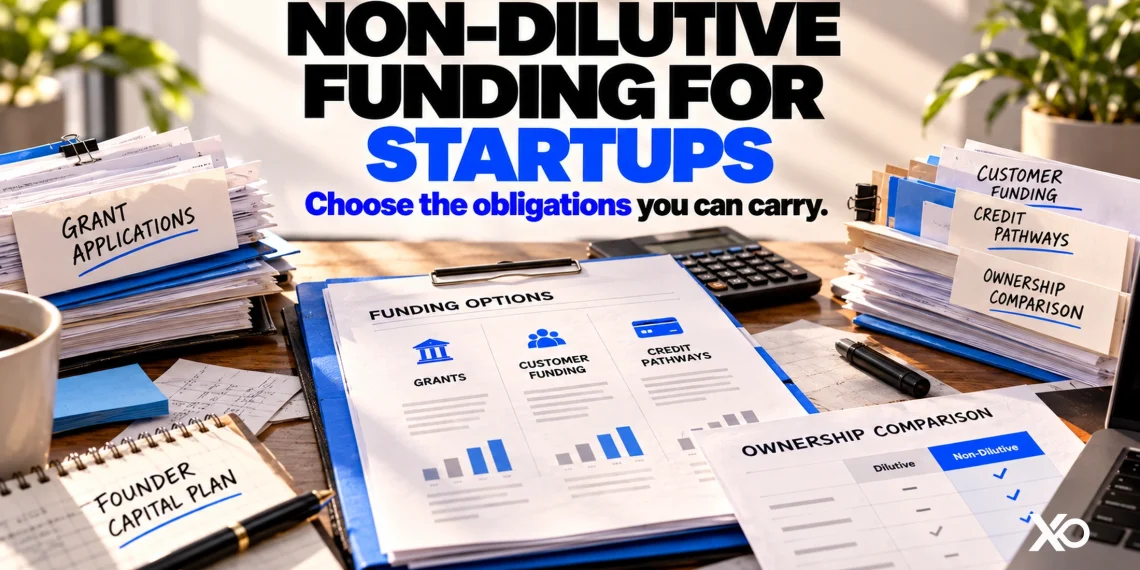
Choose non-dilutive funding for startups by matching the money to a specific business need and the obligation your company can carry. Grants fund qualifying work, customer payments finance delivery, borrowing creates repayment commitments, and credits reduce eligible expenses. Preserving ownership is useful only when the resulting cash flow, workload, and contractual restrictions remain manageable.
A clean cap table can hide a crowded operating calendar. One founder keeps every share but promises a custom product, pledges assets, and commits future receipts before the next hire starts. Another accepts some dilution and gains time to resolve technical uncertainty. The percentage retained does not, by itself, tell you which company has more freedom.
Evidence checked October 17, 2026. This guide compares financing structures, using selected U.S. and platform-specific examples. It is not a global eligibility directory or a list of currently open applications. Named-provider facts are attributed to official material. The Capital Obligation Ledger and founder scenarios are XRaise editorial guidance; actual agreements and local rules govern each transaction.



TL;DR
- Define the milestone and the date cash is needed before choosing a funding label.
- Separate spendable cash, future tax benefits, and restricted expense credits.
- Compare cash received, cash owed, work promised, and rights constrained.
- Test repayment and delivery in a slower-sales case, not just your growth forecast.
- Inspect warrants and conversion rights before calling an offer equity-free.
- Prefer one workable funding combination over several incompatible commitments.
What non-dilutive funding for startups actually means
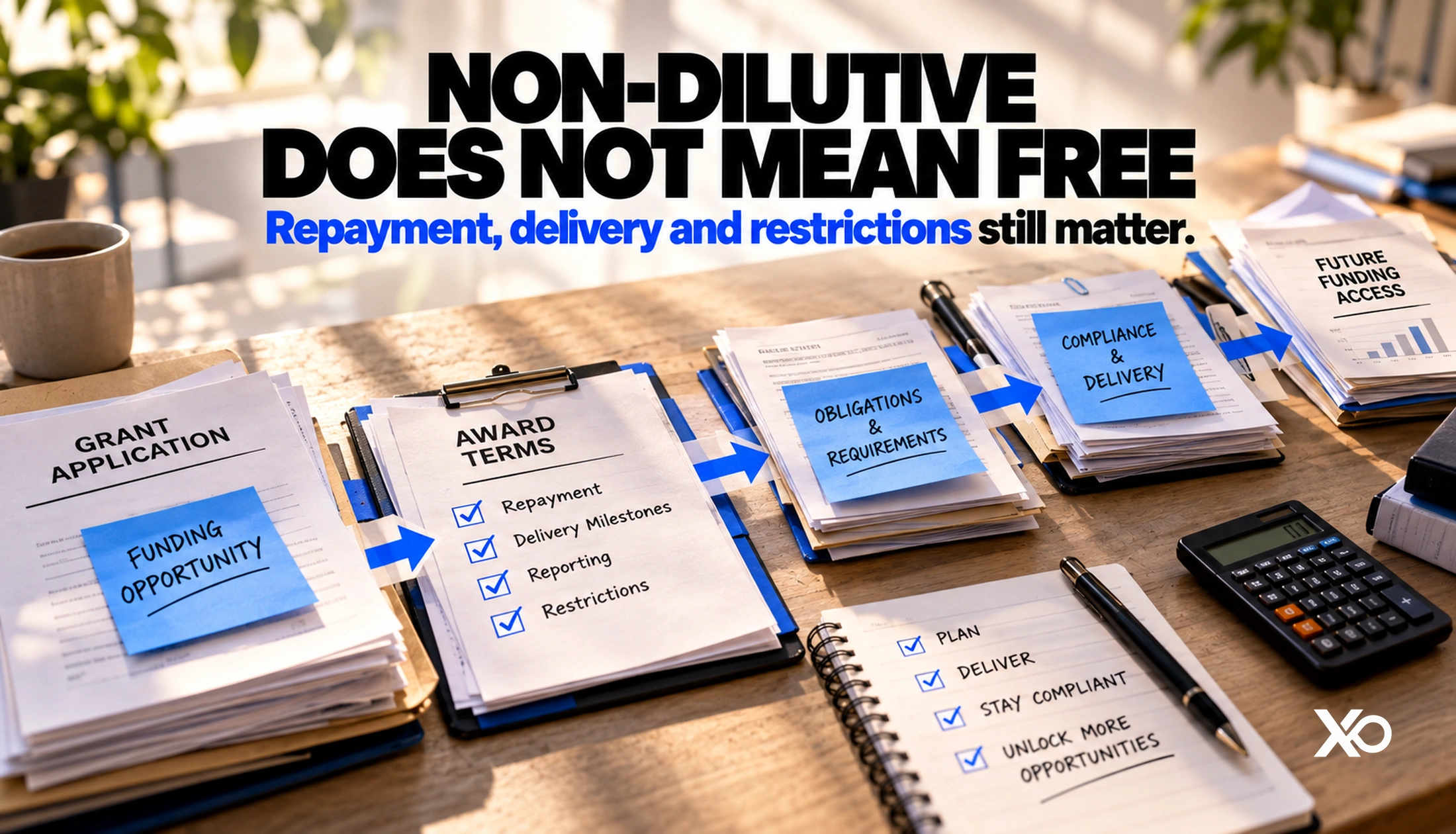
Non-dilutive funding for startups generally means obtaining resources without issuing additional ownership interests. The phrase describes an ownership effect, not a promise of free money, unrestricted spending, or complete operational control. Two offers can preserve the same percentage of founder equity and leave very different obligations.
A grant may restrict the project and require evidence of expenditure. A loan requires repayment under its terms. An advance against future receipts redirects money that would otherwise enter the operating account. A customer prepayment creates a delivery commitment. These startup financing options are different economic exchanges, even when none immediately changes the shareholder register.
Read the instrument behind the headline. A package can combine a grant with investment or a loan with equity rights. Y Combinator’s SAFE explanation describes funding now in exchange for rights to shares later. A SAFE is therefore not equity-free merely because shares have not yet been issued. Deferred dilution still belongs in the ownership analysis.
For this guide, tax relief and vendor credits sit alongside financing because they affect the resources a founder must secure. They are not interchangeable with cash raised. Keep that distinction visible throughout your plan; otherwise an impressive funding total can conceal an unpaid payroll bill.
Start with the job the capital must do
Write one sentence describing what the resources will accomplish. “Finance a customer-approved production run” is different from “discover whether anybody wants the product.” The first may have an identifiable collection event. The second contains uncertainty that may not support a fixed repayment promise.
Then name the cash deadline and the evidence available today. You might have a signed purchase order, repeat customers, a defined research project, an eligible expense base, or only a hypothesis. Those facts determine which conversations are useful. They matter more than a desire to avoid a particular fundraising category.
Separate three needs: funding uncertain discovery, financing delivery of already-supported demand, and reducing an expense you would otherwise incur. A single startup may have all three, but one instrument rarely handles them equally well. Split the uses before comparing offers.
XRaise’s runway extension guide helps organize the underlying operating plan. Build that plan first. A financing offer should improve the ability to reach a worthwhile milestone; it should not supply the reason to spend in the first place.
Use the Capital Obligation Ledger
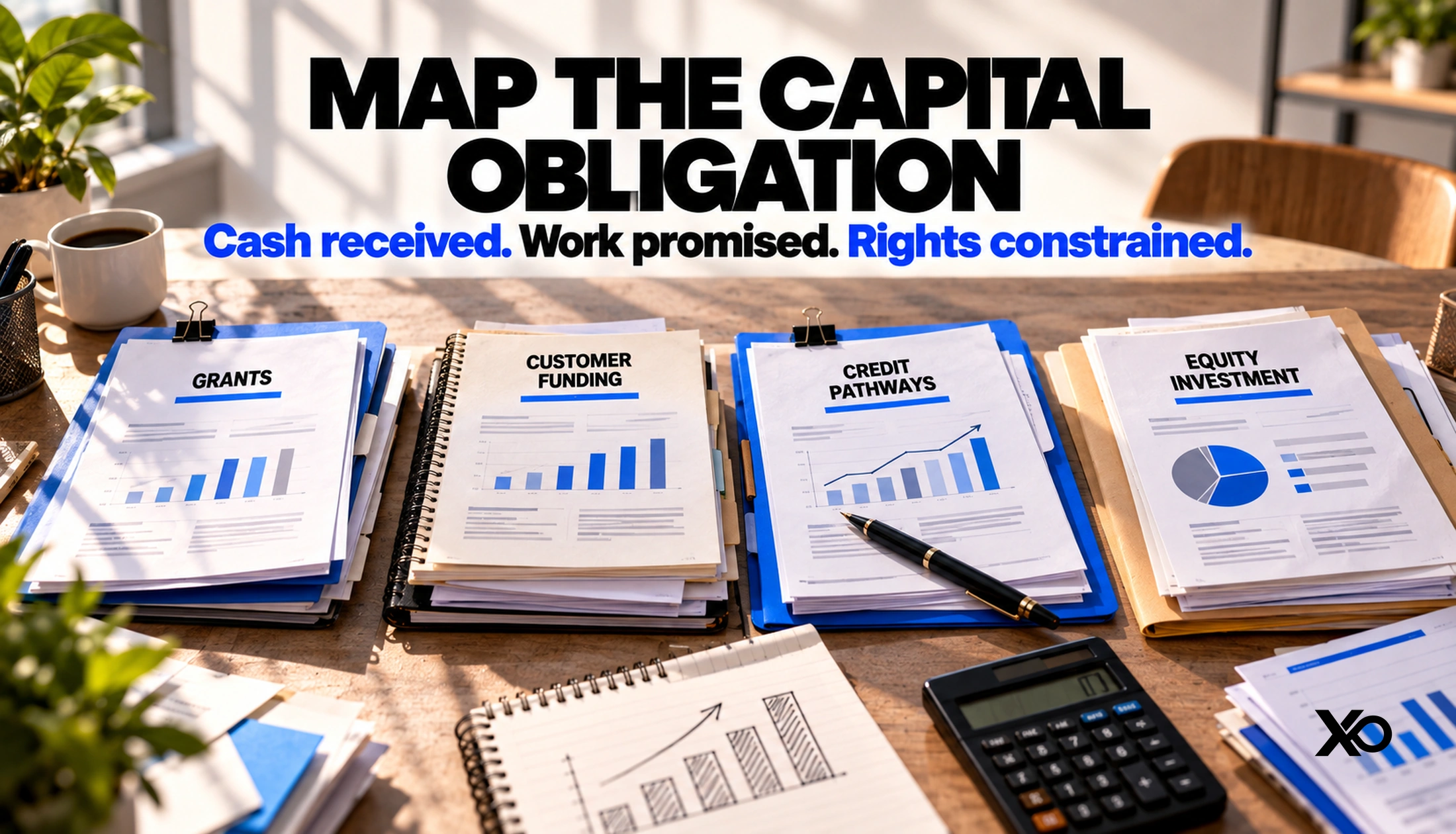
The Capital Obligation Ledger compares every route through four entries: cash received, cash owed, work promised, and rights constrained. It is an editorial evaluation method, not a lender score, legal classification, or prediction of approval. Fill it from the actual offer and flag anything not yet confirmed.
Cash received: What reaches the bank account, when, and with what conditions? Distinguish an approved amount from an available draw, a reimbursement, a possible tax benefit, or a credit against selected invoices. Record fees withheld before disbursement and any restrictions on use.
Cash owed: Which future payments follow? Include principal, fees, interest, revenue shares, minimum payments, and any repayment triggered by a breach. Where a route has no ordinary repayment, still record circumstances that could require money back. Do not infer an obligation from another provider’s contract.
Work promised: What must the team deliver to unlock or retain the benefit? That could mean research, a customer implementation, rewards, reporting, or a regional operating commitment. Estimate the people and calendar capacity required, including work that displaces the product roadmap.
Rights constrained: What choices become harder? Review ownership rights, collateral, guarantees, exclusivity, intellectual-property terms, restrictions on additional borrowing, and consent requirements where present. An unchanged cap table does not establish that all strategic options remain open.
The ledger has no universal winning score. One team can absorb reporting but cannot carry repayment. Another can service debt but cannot promise customer exclusivity. Reject the obligation that breaks the plan, even if the headline amount looks attractive.
Compare the main routes by their real exchange
Use this table to narrow the search. It describes common economic patterns, not eligibility promises or universal contract terms. Each actual offer needs its own ledger.
| Route | Resource gained | Obligation to examine |
|---|---|---|
| Grant or prize | Conditional award cash | Scope, selection and delivery |
| Customer funding | Earlier customer cash | Delivery, discount and rights |
| Loan or credit line | Borrowed cash | Repayment and security |
| Revenue-linked finance | Cash against future activity | Withholding and minimums |
| Research tax relief | Qualifying tax benefit | Eligibility, records and timing |
| Vendor credits | Eligible expense offset | Restrictions and expiry |
| Rewards crowdfunding | Backer-funded project resources | Fulfilment and communication |
Use the categories to identify two plausible routes, then compare terms. A long list without a funding purpose encourages application activity instead of a decision. The useful shortlist contains options your current evidence can support and your team can actually execute.
Non-dilutive grants: finance the right work
Non-dilutive grants can suit a defined project that matches a funder’s purpose. They are less useful when the founder needs unrestricted emergency cash or would have to invent a new project solely to fit the application. Award size should follow the useful work, not lead it.
The SBA’s grant guidance says it does not provide grants for starting and expanding a business and identifies particular support routes, including research and development. A general business-funding page is not evidence that ordinary operating costs qualify. Check the individual call before estimating its contribution.
For any award, distinguish application, selection, agreement, and payment. Do not put a pending application into committed liquidity. Confirm eligible work, the company’s contribution if required, payment conditions, and delivery ownership. The grant may improve project economics without resolving the cash needed to start it.

Startup Perks AI Assistant
Have questions about credits? Let's chat instantly.
Use the narrower AI startup grants guide when evaluating AI-specific program fit. Here, the decision is whether a grant belongs in the overall financing mix. Prize competitions also need their own assessment: uncertain selection and preparation time make them a poor substitute for cash already needed to meet a firm obligation.
Customer financing: earn cash without selling the roadmap
Customer financing for startups can include paid discovery, a funded pilot, deposits, milestone billing, or an annual prepayment. These are commercial arrangements, not automatically a financial product. Their usefulness depends on whether the company can deliver profitably while preserving a repeatable business.
Start with what the customer receives. A paid pilot should have a bounded objective, acceptance criteria, responsibilities, and a route to a subsequent commercial decision. A deposit should connect to a real delivery plan. Earlier cash is valuable, but it is not available for unrelated experiments if fulfilment consumes it.
Inspect the less visible price: discount, support intensity, custom features, refund exposure, exclusivity, and rights to the resulting work. A large customer payment can be expensive if it blocks sales to other buyers or turns a product company into a permanent custom-development team.
Make the delivery budget before negotiating the advance. Assign the owner and estimate the cash still needed after payment. Prefer a commercially useful commitment you can repeat. Renegotiate scope when the payment solves this month’s bank balance by creating next quarter’s unmanageable backlog.
Startup debt financing: match repayment to evidence
Startup debt financing is more credible when the business can explain how repayment will occur, even if growth disappoints. The relevant question is not only whether a lender approves the application. It is whether the company can carry the agreement without sacrificing the milestone the borrowing was supposed to support.
The SBA’s 7(a) loan overview requires creditworthiness and a reasonable ability to repay among its eligibility conditions. It explains that most term loans are repaid through monthly principal and interest payments from business cash flow. This is a U.S. example, not a universal startup entitlement or a grant.
Compare usable proceeds with the complete payment schedule. Review collateral, guarantees, covenants, fees, interest variability, early repayment treatment, and limits on further financing where relevant. Ask what happens after a missed milestone, a weaker month, or a planned sale of the company. Have qualified advisers review material commitments before signing.
Borrowing for a measurable working-capital cycle can be different from borrowing to search for product-market fit. If repayment depends entirely on a future equity round, make that dependence explicit. A hoped-for investor should not silently become the repayment plan.
Revenue-based financing: inspect the actual mechanism
Revenue-based financing for startups is often presented as payments that move with sales. That description is not enough to compare agreements. Establish whether the product is a loan, a purchase of receivables, or another structure, and whether minimum payments, maturity dates, reconciliation rights, or security apply.
Stripe Capital’s U.S. documentation distinguishes loans from merchant cash advances. It describes a flat fee and withholding from Stripe sales; loans can require minimum payments, with a shortfall debited from the linked account. The terms vary by financing type and country. Do not treat a sales-linked deduction as proof that every obligation disappears when revenue falls.
Model the effect on contribution cash, not just revenue. If a product has substantial fulfilment costs, the amount left after those costs may be much smaller than the reported sales. A modest-looking percentage of receipts can consume a significant part of the cash that pays the rest of the business.
Ask for the schedule under slower sales, faster sales, and a delayed customer payment. A flat fee is not the same as an annual percentage rate. Timing changes the economic comparison, so compare dated cash flows rather than placing an advance fee beside a loan interest rate as if they were identical measures.
Venture debt is a separate decision
Venture debt is designed around a different company context from ordinary customer-backed working capital. First Citizens’ venture-debt guide describes it as financing for high-growth, venture-backed companies that complements equity and can include defined repayment terms and covenants. It should not be assumed available to every bootstrapped startup.
Inspect the complete package before describing it as non-dilutive. Check whether the documents contain warrants, conversion provisions, or other ownership-linked rights, and include any such rights in the comparison. The product name alone cannot establish zero dilution.
A founder considering venture debt should connect draw timing, permitted uses, repayment, and the next operating milestone. Examine what happens if the next funding round is late or smaller than expected. Access to a facility is not the same as a reason to draw it immediately.
If the company needs patient capital for a highly uncertain project, compare equity directly rather than treating it as a failure. Preserving ownership matters, but an agreement that the business cannot service may undermine the value of the ownership preserved.
R&D tax credits and startup credits are different resources
R&D tax credits for startups require eligibility, qualifying activity, records, and the correct filing process. They should not be forecast as an unrestricted award simply because the company develops technology. The applicable jurisdiction and the company’s circumstances matter.
The IRS guidance on the qualified small business payroll tax credit describes an election using Form 6765 and claiming through Form 8974 with the employment tax return. This is a specific U.S. mechanism, not an automatic refund for every startup. Confirm eligibility and timing with the adviser responsible for the company’s filing.
Startup credits work differently again. AWS promotional-credit terms restrict credits to eligible service charges and state that they have no cash value. Their value to your operating plan depends on eligible usage and the applicable expiry and offer terms, not the maximum number printed on a program page.
Use XRaise’s startup perks guide to explore relevant expense offsets. Count only spending you would otherwise incur. A credit does not pay wages, and moving to an unsuitable tool to consume it can add migration and operating costs that exceed the saving.
Rewards crowdfunding: budget the promise
Rewards crowdfunding can provide resources for a defined project while testing audience interest. It also creates a public delivery commitment. Separate it from equity crowdfunding, where investors receive an ownership-related instrument; the shared word crowdfunding does not determine dilution.
Kickstarter’s current creator guidance emphasizes completing the promised work, delivering rewards, and communicating progress and delays. That makes fulfilment capacity part of the financing decision, not a later marketing detail.
Build the campaign budget around production, shipping, support, fees, and contingency as applicable. Stress-test a supplier delay and a higher-than-expected delivery cost. Demand that exceeds capacity can be a problem even when a campaign looks successful publicly.
Choose this route when the project, audience, and delivery plan fit together. Wait when the prototype or cost structure is too uncertain to make credible promises. Campaign receipts should fund the obligations that produced them before being treated as general expansion money.
Compare two offers using one cash forecast
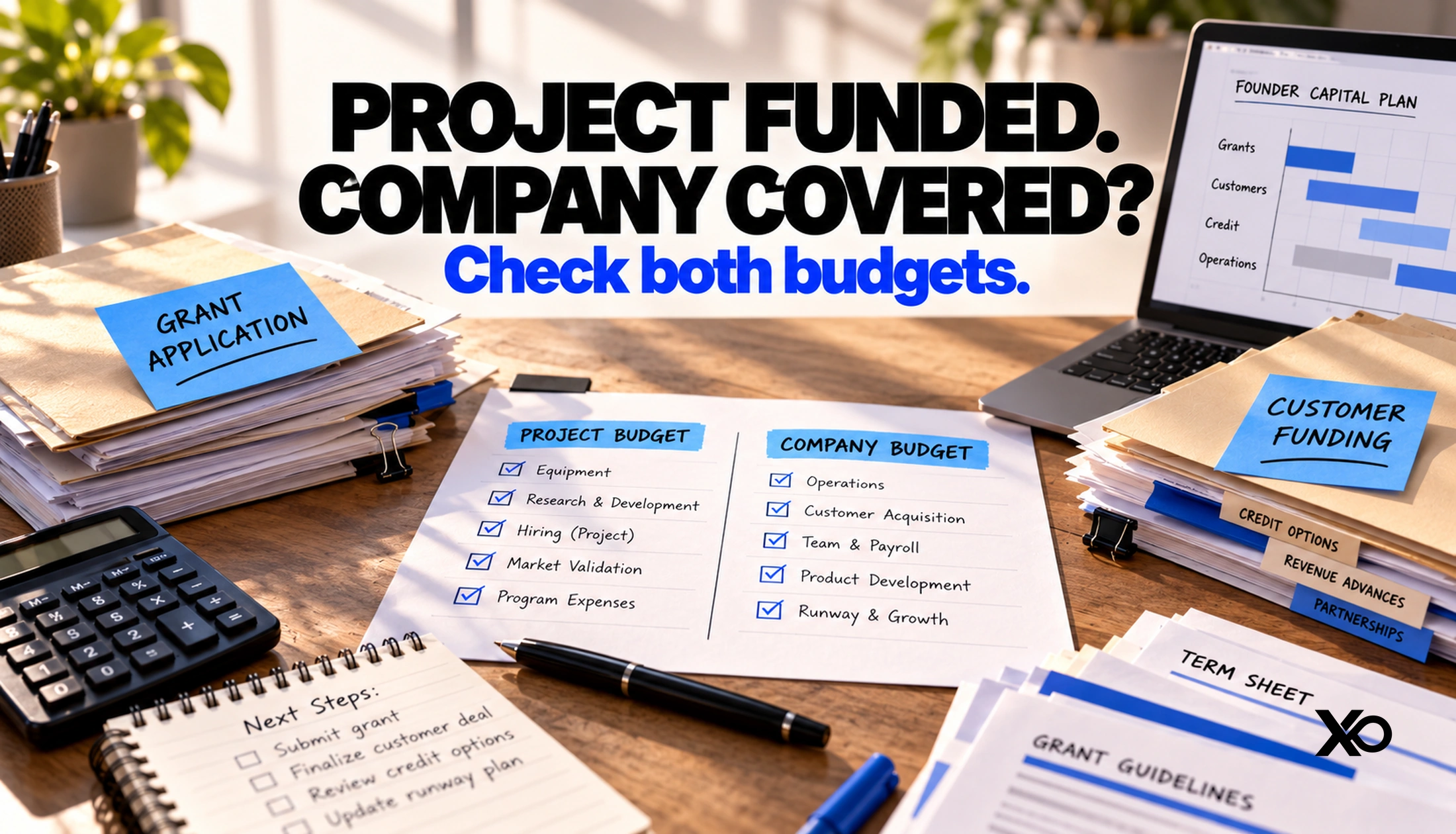
Illustrative scenario, not a provider quote: a startup needs $40,000 to deliver a contracted customer project. One option supplies a $40,000 loan with $44,000 total contractual payments over the agreed schedule. Another customer offers $40,000 upfront against $46,000 of otherwise expected contract receipts. The second choice brings a $6,000 revenue concession; the first brings $4,000 above principal, before considering any other terms.
Those figures do not prove the loan is better. The loan schedule may arrive before collections, while the customer arrangement may have different cancellation or delivery obligations. Neither difference is an annualized rate. Compare the dated cash flows and contractual risks on the same basis before choosing.
Now suppose fulfilling the project requires $28,000 of cash spending. The upfront receipt leaves $12,000 before other company costs, taxes, or reserves. It is not $40,000 of freely available runway. The same fulfilment spending belongs in the loan-funded scenario too; do not count it only against one option.
Run the forecast with delayed collection, higher delivery cost, and no subsequent financing. Record the lowest cash balance and the action needed if it approaches the company’s operating floor. Choose the combination that remains workable, not merely the one with the smallest isolated fee.
What to do at each startup stage
Discovery: prioritize evidence and a small reversible commitment. Customer-funded learning or a genuinely suitable research route may be worth exploring. Avoid repayment promises supported only by an untested revenue forecast. Measure whether the work resolves a decision, not how many applications were submitted.
MVP and first pilots: distinguish product learning from bespoke delivery. Use paid pilots only when scope and acceptance are clear. Consider credits against the infrastructure you actually need. Watch engineering time, cost to serve, and whether the next customer can use the same product.
Early recurring revenue: compare collection patterns with repayment or withholding. Reliable historical receipts can support a financing conversation, but concentration and churn still matter. Review gross margin and cash available after delivery before allocating a portion of sales to financing.
Repeatable growth: evaluate capital against a demonstrated use, such as an understood working-capital cycle or a measured expansion plan. Compare the downside of slower growth with the payment schedule. Increasing the facility size should not substitute for understanding incremental returns.
Venture-backed expansion: consider whether debt complements the existing capital strategy and its milestones. Review board approvals, current agreements, and financing interactions. Keep an explicit plan for a delayed equity round instead of assuming every lender obligation will be refinanced.
Build a financing mix without double counting
Non-dilutive funding for startups often works as a combination, but the pieces must be compatible. A grant, a customer payment, and a credit may all support the same period without supporting the same expense. Trace each resource to its permitted use and avoid counting the same cash benefit twice.
Record each commitment in one shared forecast. A customer advance might already be needed for delivery; a credit might already reduce a cloud-cost line; a tax benefit may arrive after the milestone. Adding their headline values together obscures these differences.
Review restrictions before assuming one source can fund another source’s required contribution. Check whether pledged assets, receivables, exclusivity, or spending rules limit the next agreement. Ask the relevant provider or adviser to resolve a specific conflict rather than relying on a general statement that funding is stackable.
Keep a contingency route. That may mean a smaller project, later hiring, a different customer scope, or an equity conversation. Optionality comes from having workable alternatives, not from describing every possible future application as part of the funding plan.
A practical funding decision playbook
Step 1 — Define the milestone. Specify the useful outcome, minimum scope, cash requirement, and latest workable start date. Separate essential expenditure from optional acceleration. Name what evidence will show the work succeeded.
Step 2 — Assemble the evidence. Gather current cash figures, customer contracts, expense records, project details, and existing financing commitments. Use XRaise’s startup eligibility guide to organize company information, then apply each provider’s own definitions.
Step 3 — Request comparable terms. Ask two credible routes for the information needed to complete the Capital Obligation Ledger. Record unresolved conditions as unknown. Do not fill missing repayment, ownership, or use restrictions with assumptions from a marketing summary.
Step 4 — Test the downside together. Have the finance and delivery owners examine the same forecast. Include slower sales, delayed receipts, and the work already promised. Review material legal and tax implications with the appropriate professionals before committing.
Step 5 — Assign owners and stop conditions. Identify who accepts the agreement, monitors payments, delivers the work, and handles required reporting. Set an internal point for revisiting the plan if assumptions fail. An approved facility or award is the start of execution, not the end of management.
Avoid ownership-first funding mistakes
The first mistake is treating equity-free startup funding as cost-free startup funding. Compare the entire exchange, including delivery and restrictions. A saved ownership percentage does not compensate for a commitment the company cannot fulfil.
The second is using uncertain future awards to justify fixed spending today. Keep applications outside committed liquidity until their conditions support inclusion. Separate the base operating plan from possible upside.
The third is choosing by headline amount. A smaller timely resource with a clear use can be more useful than a large restricted commitment. Match the resource to the milestone before expanding the milestone to consume the resource.
The fourth is hiding obligations in different teams. Sales negotiates a prepayment, finance accepts withholding, and engineering commits a delivery schedule; nobody notices they rely on the same cash and people. Review the combined ledger before signing another agreement.
Finally, avoid turning the search into a permanent founder job. Set a decision date and a shortlist. If no suitable route exists, reduce the scope or reconsider the capital strategy. More applications do not repair a mismatch between risk and repayment.
A founder decision checklist

- Is the milestone useful without the financing offer?
- Will usable cash arrive before the expense?
- Can the company meet payments in the downside case?
- Is delivery capacity assigned rather than assumed?
- Are ownership rights and other restrictions understood?
- Have overlapping claims on cash and work been resolved?
- Is there a smaller workable alternative if terms fail?
Use this checklist to expose the unresolved commitment. A missing answer is a reason to clarify or revise the offer, not a reason to award the option a reassuring score.
Related XRaise resources
For sector context, XRaise’s AI funding guide beyond VC explores an AI-specific landscape that also includes equity routes. Use it alongside this cross-sector obligation comparison rather than treating every alternative to VC as non-dilutive.
For program preparation, the accelerator application checklist helps organize the team and evidence. Verify the actual instrument and participation requirements before adding any program benefit to your financing forecast.
FAQ
Is non-dilutive funding for startups free money?
No. It generally avoids issuing ownership, but can require repayment, specific work, restricted spending, or contractual commitments. Compare cash received, cash owed, work promised, and rights constrained. The agreement determines the exchange; the funding label does not tell you whether the company can afford it.
What equity-free startup funding can a pre-revenue team consider?
Explore routes connected to real evidence: a qualifying research project, a bounded paid pilot, suitable awards, or credits against necessary expenses. Eligibility varies. Avoid assuming that a provider will finance an untested revenue forecast or that a future application can cover bills already committed.
Are non-dilutive grants better than loans?
They serve different purposes. A grant can fit eligible work and its delivery conditions; a loan can fit a credible repayment source. Compare timing, restrictions, preparation effort, and downside capacity. A grant that requires an unrelated project is not automatically better than borrowing for an understood commercial cycle.
Does revenue-based financing always slow payments when sales fall?
The sales-linked portion may fall, but the agreement may also include minimum payments, a term, or other requirements. Establish the financing type and inspect the actual schedule. Test lower revenue against all obligations rather than assuming that a percentage-based collection method makes every payment fully flexible.
Can startup debt financing still cause dilution?
Inspect the full documents for warrants, conversion rights, or other ownership-linked provisions. A package called debt does not establish zero dilution. Even when it has no equity component, repayment, security, or covenants can affect operating freedom. Keep ownership effects and other restrictions as separate ledger entries.
Should startup credits count as cash raised?
Keep them separate. Credits generally offset specified eligible expenses under their terms; they are not unrestricted bank cash. Forecast the spending they actually replace, consider expiry, and retain a plan for costs after the benefit ends. Avoid adding both the headline credit and the resulting savings to available cash.
Can we combine a grant, customer funding, and tax relief?
Possibly, but examine each source’s rules and the same underlying expenses. Verify eligible contributions, overlapping support, delivery commitments, and tax treatment. Track the timing in one forecast and have unresolved interactions reviewed. The fact that each source is individually attractive does not prove the combination is permitted or workable.
When should a founder choose equity instead?
Consider equity when the company needs capital for substantial uncertainty that available repayment or delivery promises cannot reasonably support. Compare the ownership tradeoff with the alternatives’ full obligations. A smaller project or delayed expansion may also be appropriate; preserving equity is one objective among several that determine the company’s survival and value.
Choose obligations the company can carry
The right non-dilutive funding for startups supports a useful milestone without creating an obligation the business cannot handle. Start with the work and cash deadline, then compare the actual agreements. Keep ownership, liquidity, delivery capacity, and strategic freedom visible together.
Take one opportunity through the Capital Obligation Ledger this week. Use XRaise to explore relevant startup resources after identifying the gap. Choose equity-free startup funding when the exchange works; change the scope or capital strategy when it does not.